Questões de Concurso
Comentadas sobre sinônimos | synonyms em inglês
Foram encontradas 1.061 questões


Text for the question.
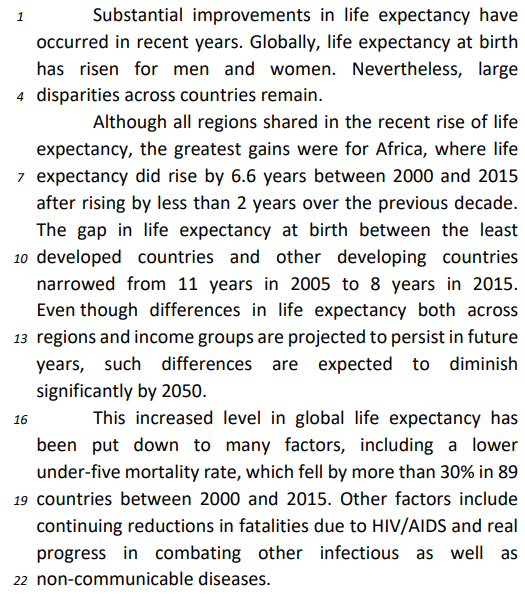
Higher life expectancy worldwide
Text for the question.
Higher life expectancy worldwide
Text for the question.
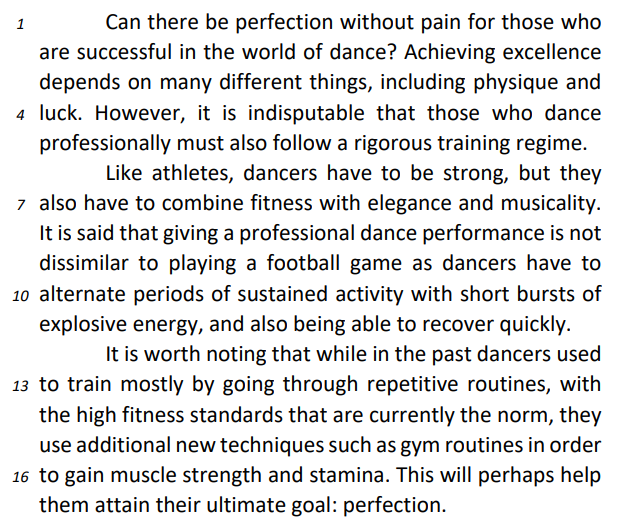
The route to perfection
Text for the question.
The route to perfection
According to the fourth paragraph, Kate quit studying chemistry.
The verb QUIT in this context means:

(Source:http://www.revasolutions.com/internet-of-things-newchallenges-and-practices-for-information-governance/. Retrieved on January 26th, 2018)
Governance Challenges for the Internet of Things
Virgilio A.F. Almeida -Federal University of Minas Gerais, Brazil
Danilo Doneda - Rio de Janeiro State University
Marília Monteiro - Public Law Institute of Brasília
Published by the IEEE Computer Society
© 2015
The future will be rich with sensors capable of collecting vast amounts of information. The Internet will be almost fused with the physical world as the Internet of Things (IoT) becomes a reality. Although it’s just beginning, experts estimate that by the end of 2015 there will be around 25 billion “things” connected to the global Internet. By 2025, the estimated number of connected devices should reach 100 billion. These estimates include smartphones, vehicles, appliances, and industrial equipment. Privacy, security, and safety fears grow as the IoT creates conditions for increasing surveillance by governments and corporations. So the question is: Will the IoT be good for the many, or the mighty few?
While technological aspects of the IoT have been extensively published in the technical literature, few studies have addressed the IoT’s social and political impacts. Two studies have shed light on challenges for the future with the IoT. In 2013, the European Commission (EC) published a study focusing on relevant aspects for possible IoT governance regimes. The EC report identified many challenges for IoT governance — namely privacy, security, ethics, and competition. In 2015, the US Federal Trade Commission (FTC) published the FTC Staff Report The Internet of Things: Privacy and Security in a Connected World. Although the report emphasizes the various benefits that the IoT will bring to consumers and citizens, it acknowledges that there are many risks associated with deploying IoT-based applications, especially in the realm of privacy and security.
[…]
The nature of privacy and security problems frequently
associated with the IoT indicates that further research, analysis,
and discussion are needed to identify possible solutions. First, the
introduction of security and privacy elements in the very design
of sensors, implementing Privacy by Design, must be taken into
account for outcomes such as the homologation process of
sensors by competent authorities. Even if the privacy governance
of IoT can oversee the control centers for collected data, we must
develop concrete means to set limits on the amount or nature of
the personal data collected.
Other critical issues regard notification and consent. If, from one side, it’s true that several sensors are already collecting as much personal data as possible, something must be done to increase citizens’ awareness of these data collection processes. Citizens must have means to take measures to protect their rights whenever necessary. If future scenarios indicate the inadequacy of a mere notice-and-consent approach, alternatives must be presented so that the individual’s autonomy isn’t eroded.
As with other technologies that aim to change human life, the IoT must be in all respects designed with people as its central focus. Privacy and ethics aren’t natural aspects to be considered in technology’s agenda. However, these features are essential to build the necessary trust in an IoT ecosystem, making it compatible with human rights and ensuring that it’s drafted at the measure, and not at the expense, of people.
(Source: https://cyber.harvard.edu/~valmeida/pdf/IoT-governance.pdf
Retrieved on January 23rd, 2018)

Based on the text, judge the following item.
A little is considered a correct alternative for “a few” in
“a few channels” (lines 7 and 8).
Based on the text, judge the following item.
“most of them” (lines 2 and 3) and the majority of them
are synonymous expressions.
Based on the text, judge the following item.
“Although” in “Although they differ” (line 2) can be
correctly replaced by though.

Based on the text, judge the following item.
“most” in “most of the stories” (line 15) and the word all
are not synonyms.
TEXT I
In Europe, Weber still rules
Statecrafting
Jul 13, 2016
Steven Van de Walle

True, many tools and management practices associated with the NPM such as staff performance talks or management by objectives have become very common. Across all countries, the almost 7000 top civil servants we surveyed list achieving results and ensuring an efficient use of resources among the most important roles they have. They are also in agreement that, compared to five years ago, the public sector has made major progress in terms of efficiency and service quality — two main objectives of the NPM.
There are ‘NPM champions’ — countries that have gone further than others in reforming the Weberian state. Think the UK or the Netherlands, where public employment is increasingly normalised, and delivery contracted out. But even there, the structures of traditional public administration remain firmly in place.
Some elements of the NPM are still mainly absent from current management practice in European countries. Internal steering by contract is not very common, and performance related pay is very rare despite the popularity in reform talk. The weak presence of flexible employment also shows that the Weberian model still dominates. Despite attempts to normalize public employment in some countries, civil servants still enjoy a unique statute. We also observed this during the fiscal crisis, where outright firing permanent civil servants or cutting salaries has been relatively rare.
For civil servants, referring issues upwards in the hierarchy is still the dominant response in situations when responsibilities or interests conflict with that of other organisations. European top civil servants consider the impartial implementation of laws and rules as one of their dominant roles, and largely prefer state provision of services over market provision, with the exception of the British, Danish, and Dutch.
There are clear country differences, with management ‘champions’ such as the UK, Estonia, Norway and the Netherlands, and more legalistic and traditional public administrations such as in Austria, France, Germany, Hungary and Spain. The adoption of newer reform ideas suggest that the Weberian state may now be in decline. Yet some of the other findings of the survey, reported above, show that Weberianism’s main ideas are still deeply embedded in European countries.
(Source: https://statecrafting.net/in-europe-weber-still-rulesa851866dbf02. Retrieved on January 21st, 2018)

Based on the text, judge the following item.
“More often than not” (line 7) means usually.
Text 5A7-I

Judge the following item, concerning the vocabulary used in text 5A7-I.
The word “undisputed” (l.30) may be replaced by
unquestioned, without altering the meaning of the sentence.
Text 5A7-I
Judge the following item, concerning the vocabulary used in text 5A7-I.
The phrase unprecedented suffering conveys the same idea
as “untold suffering” (l.6).

Considering the grammatical and semantic aspects of text VI, decide whether the following items are right (C) or wrong (E).
The word “simmering” (L.15) could be replaced by vocal without altering the general meaning of the passage.
Considering the grammatical and semantic aspects of text VI, decide whether the following items are right (C) or wrong (E).
The idiom “Across the pond” (L.19) could be replaced by
Overseas, without altering the meaning of the sentence.

 Conheça nossos planos