Questões de Concurso
Comentadas sobre sinônimos | synonyms em inglês
Foram encontradas 1.061 questões


TEXT I-
ENEM and the Language Policy forEnglish in the Brazilian Context
Andrea Barros Carvalho de Oliveira
1.INTRODUCTION
In the present article, I report the results of a doctoral research that focused on the language policy for English in Brazil, considering specifically the role of Exame Nacional do Ensino Médio (hereinafter ENEM) in this policy. Thus, taking into account the sociopolitical aspects of the teaching processes, learning, and use of English as a foreign language, we sought to identify the possible impact of ENEM on the status of English language as a school subject.
ENEM was initially conceived as a final exam to evaluate students at the end of basic education. However, it has been modified over the last few years to work as an entrance examination for public and private universities. In addition, the use of this exam in several governmental programs aimed at higher education access was preponderant to make it a high stakes exam in the educational scenario.
According to the literature on language examination exams, especially those considered to be high stakes, are seen as an intrinsically political activity (ALDERSON; BANERJEE, 2001). These exams can be used as educational policy tools as well as to promote a specific language related to local language policy objectives.
The theoretical conception of Language Policy (hereinafter LP) adopted in this investigation refers to Shohamy (2006). This author postulates that, although there is an official LP established in legislation and official documents, it is also necessary to consider the existence of a “real” LP, or “de facto” LP, which is put into practice through mechanisms, resources such as traffic signs, rules and laws related to official bodies, language exams, among others. Besides mechanisms, the beliefs or representations about the language that are shared in the community ought to be considered as well. The importance of mechanisms is that they reveal the true aims of LPas established by the government for a specific language, which are not always explicit in Brazilian law.
The research, the results of which are presented in this article, covered the three components of Shohamy’s theoretical model, namely: legislation, mechanisms (in this case, an exam, ENEM), and representations or beliefs about language. To obtain a sample of representations about English language, interviews were conducted with the students from an ENEM preparatory course for university entrance, with two teachers of English and two coordinators from public schools.
In the present article, I begin with a review of the expanded conception of LPelaborated by Shohamy, as it is the theoretical basis of this research. Second, I analyze some documents and laws regarding English teaching in Brazil. In addition to these documents, the English questions of ENEM (2016) were taken in consideration. Finally, I present an overview of the representations about English language that emerged from the interviews which constituted the empirical data of my doctoral thesis.
ALDERSON, J. C; BANERJEE, J. Language Testing and Assessment. Language Testing, [S.l.], n. 34, 2001, p. 213-236.
SHOHAMY, E. Language Policy: Hidden Agendas and New Approaches. London; New York: Routledge, 2006. (Adapted from: OLIVEIRA, A.B.C. ENEM and the Language Policy for English in the Brazilian Context. In.: Revista Brasileira de Linguística Aplicada. vol.19 no.2 th Belo Horizonte Apr./June 2019 Available at: http://www.scielo.br/scielo.php?script=sci_arttext&pid=S1984-63982019000200361 Accessed on October 20 , 2019)
CRIMINALS HAVE SMALLER BRAIN SIZE, SAYS STUDY
A new study has found that antisocial people are more likely to have smaller areas of their brain. Researchers said criminals' brains had a different structure to the brains of people who followed the law. The study is published in the journal "Lancet Psychiatry". Researchers used data from 672 people born in 1972-73. They looked at records of the people's antisocial behaviour between the ages of seven and 26. At the age of 45, the researchers scanned the people's brains. Eighty of the people had a history of criminal and antisocial behaviour from being early teenagers. Researchers found that the areas of the brain linked to emotions, motivation and behaviour control were smaller in the long-term criminals' brains.
Professor Terrie Moffitt, a co-author of the research, said the research could help doctors understand what is behind long-term antisocial behaviour. She said the antisocial people in the study may have behaved badly because of their brain structure. She said: "They are actually operating under some [disability] at the level of the brain." She added that because of this, we needed to care for these people in a kinder way. Lead author Dr Christina Carlisi said: "Differences in brain structure might make it difficult for people to develop social skills. This may prevent them from engaging in antisocial behaviour. These people could benefit from more support throughout their lives."
Available on: https://breakingnewsenglish.com/2002/200221-brain-size.html Accessed on: March, 20th 2020.
CRIMINALS HAVE SMALLER BRAIN SIZE, SAYS STUDY
A new study has found that antisocial people are more likely to have smaller areas of their brain. Researchers said criminals' brains had a different structure to the brains of people who followed the law. The study is published in the journal "Lancet Psychiatry". Researchers used data from 672 people born in 1972-73. They looked at records of the people's antisocial behaviour between the ages of seven and 26. At the age of 45, the researchers scanned the people's brains. Eighty of the people had a history of criminal and antisocial behaviour from being early teenagers. Researchers found that the areas of the brain linked to emotions, motivation and behaviour control were smaller in the long-term criminals' brains.
Professor Terrie Moffitt, a co-author of the research, said the research could help doctors understand what is behind long-term antisocial behaviour. She said the antisocial people in the study may have behaved badly because of their brain structure. She said: "They are actually operating under some [disability] at the level of the brain." She added that because of this, we needed to care for these people in a kinder way. Lead author Dr Christina Carlisi said: "Differences in brain structure might make it difficult for people to develop social skills. This may prevent them from engaging in antisocial behaviour. These people could benefit from more support throughout their lives."
Available on: https://breakingnewsenglish.com/2002/200221-brain-size.html Accessed on: March, 20th 2020.
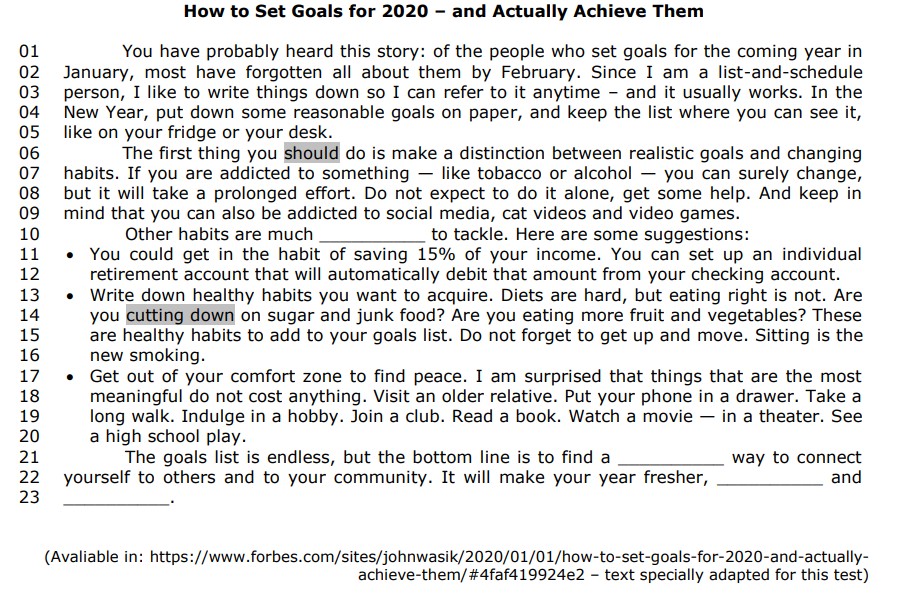
First Column: Vocabulary 1- but 2- excellent 3- compliment 4- assume 5- should
Second Column: Synonym ( ) terrific ( ) nevertheless ( ) suppose ( ) praise ( ) ought to
Choose the alternative that presents the correct match:
When you’re in a long line waiting for your turn with a bunch of other cranky people, a good wallet is essential. For everyone’s benefit, you want to be able to find the right card or bills, make your transaction, and get out of there as quickly as possible. Mobile payments, vendor apps, and the decline of cash have lessened the amount of space you need for library cards and twenties, and they’ve lessened the need for bulky, old-school leather cash carriers. There’s never been a better time to trim down your wallet and your carbon footprint in turn by choosing a wallet made from recycled or eco-friendly materials.
Answers the question according to the text below.
TEXT I
Em abril de 1912, o transatlântico Titanic colidiu com um iceberg e afundou em sua viagem inaugural. Como consequência de seu naufrágio, e também da falta de botes salva-vidas e de muitas outras medidas de segurança que foram negligenciadas, mais de 1.500 vidas foram perdidas.
Utilizamos, em inglês, a construção gramatical chamada Orações Condicionais (Conditional Clauses) para exemplificar algo imaginário que poderia ter acontecido se ações diferentes tivessem sido tomadas. Analise a seguinte oração:
If the safety measures had been taken, many lives could have been saved.
TEXT
REFERS TO QUESTION
The Literary Influences of Superstar Musician David Bowie
BY JOHN O'CONNELL ON 10/31/19 AT 5:00 AM EDT
David Bowie was a pop star for most of his career from the 1960s until his death in 2016. He was known for his flamboyant style, songwriting and the ability to artistically turn on a dime. But Bowie, who died of cancer at 69, was more than a multi-platinum rock and roller. He was also one of the more literate composers in the business.
So much so, in fact, that in conjunction with a career retrospective in 2013 at the Victoria & Albert Museum in London, Bowie issued a list of the one hundred books he considered the most important and influential. British music columnist John O'Connell linked this list to Bowie's prolific music. The result? A book called Bowie's Bookshelf out this month from Gallery Books.
William S. Burroughs first made the link between Bowie's lyrics and T. S. Eliot's poetry. In a Rolling Stone interview, Burroughs asked if Hunky Dory's "Eight Line Poem" had been influenced by Eliot's "The Hollow Men." Bowie's reply: "Never read him." But Bowie was definitely exposed to Eliot's influence. "Goodnight Ladies" on Transformer, the album Bowie produced for Lou Reed in 1972, is a riff on the end of the second section, "A Game of Chess," from Eliot's poem "The Waste Land." Eliot, for his part, is deliberately quoting Ophelia's "Good night, sweet ladies" speech from Hamlet. Eliot's method established a new protocol for artistic theft—the modern poet in dialogue with his or her predecessors. Bowie, too, was candid about how much he took from other artists. "You can't steal from a thief," he said when LCD Soundsystem's James Murphy admitted to stealing from Bowie's songs.
Avaiable in : https://www.newsweek.com/2019/11/15, accessed on
February 20th, 2020. Adapted.
The word closest in meaning to ABILITY as in
“the ability to artistically turn on a dime”
TEXT
REFERS TO QUESTION

Available in: https://www.gocomics.com, accessed on February 18th,
2020. Garfield by Jim Davis
REFERS TO QUESTION
Lessons for Americans, From a Chines Classroom
Observing how Chinese 2- and 3-year-olds navigated a second language, I wondered whether I could have done this for my children.
SHANGHAI — We sat in toddler-size wooden chairs around an orderly circle of Chinese 2-year-olds, busy with circle time. As a parent of three children who collectively spent 15 years in American day care, I am very familiar with circle time.
But I was in this Shanghai classroom as a professor, with college students from many different countries in a class I’m teaching here on children and childhood.
We were observing in a private kindergarten, designed to provide young children — starting at age 2 — with a carefully structured, fully bilingual curriculum, especially important because English language skills are vital for educational success in China.
Visits to Chinese educational institutions allow the college students in my course to get a look at real children and the ways that they learn, while also thinking about Chinese society today. They get windows onto certain slices of this complex country: a high-end private bilingual program that starts with toddlers; a city high school for academically gifted students; a middle school created for the children of the rural migrants who have come by the millions from China’s poorer provinces to work in Shanghai, but whose rights to social benefits are severely limited in the city.
These visits offer the college students insights into many of the social issues facing China, and we spend time in class discussing questions like the huge role that the annual gaokao college entrance exam plays in determining a child’s educational destiny (English is one of the required subjects), the pressures on families that create a culture of cram schools, and the controversies over reserving spots in colleges for kids from rural areas.
But all of those questions have powerful resonances when you think about the issues of childhood education and child development, which have to be addressed in every country. As my college students discuss the different facets of childhood around the world, visiting the Chinese schools also helps them in remembering and thinking about what children look like at different ages, and how they play and interact and learn.
Available in : https://www.nytimes.com/2020/01/20/, accessed on
February 26th, 2020. Adapted
REFERS TO QUESTION
Lessons for Americans, From a Chines Classroom
Observing how Chinese 2- and 3-year-olds navigated a second language, I wondered whether I could have done this for my children.
SHANGHAI — We sat in toddler-size wooden chairs around an orderly circle of Chinese 2-year-olds, busy with circle time. As a parent of three children who collectively spent 15 years in American day care, I am very familiar with circle time.
But I was in this Shanghai classroom as a professor, with college students from many different countries in a class I’m teaching here on children and childhood.
We were observing in a private kindergarten, designed to provide young children — starting at age 2 — with a carefully structured, fully bilingual curriculum, especially important because English language skills are vital for educational success in China.
Visits to Chinese educational institutions allow the college students in my course to get a look at real children and the ways that they learn, while also thinking about Chinese society today. They get windows onto certain slices of this complex country: a high-end private bilingual program that starts with toddlers; a city high school for academically gifted students; a middle school created for the children of the rural migrants who have come by the millions from China’s poorer provinces to work in Shanghai, but whose rights to social benefits are severely limited in the city.
These visits offer the college students insights into many of the social issues facing China, and we spend time in class discussing questions like the huge role that the annual gaokao college entrance exam plays in determining a child’s educational destiny (English is one of the required subjects), the pressures on families that create a culture of cram schools, and the controversies over reserving spots in colleges for kids from rural areas.
But all of those questions have powerful resonances when you think about the issues of childhood education and child development, which have to be addressed in every country. As my college students discuss the different facets of childhood around the world, visiting the Chinese schools also helps them in remembering and thinking about what children look like at different ages, and how they play and interact and learn.
Available in : https://www.nytimes.com/2020/01/20/, accessed on
February 26th, 2020. Adapted
“... Then the whining schoolboy, with his satchel And shining morning face, creeping like snail Unwillingly to school...”
“...His acts being seven ages. At first, the infant, Mewling and puking in the nurse's arms...”
What is the synonym for the word in bold?

 Conheça nossos planos