Questões de Concurso
Comentadas sobre sinônimos | synonyms em inglês
Foram encontradas 1.061 questões


Considering the information and the aspects of grammar in the
text above, judge the item below
In the second paragraph, the word “stakeholders” could be replaced by shareholders without any harm to the comprehension of the sentence.
Text for the item.


Internet: <https://hearinginfo.net>
According to the text, judge the item.
In the last paragraph of the text, the conjunctions
“Although” (line 27) and “So” (line 29) can be correctly
replaced by Even though and Therefore, in this order,
without changing the context of the sentences.
Text for the item.
Internet: <https://hearinginfo.net>
According to the text, judge the item.
In the sentences “There has been considerable interest
in the field of tele-health or e-health.” (lines 8 and 9) and
“Although teleaudiology is still considered primarily for
underserved populations, it is becoming more
common.” (lines 27 and 28) the words “considerable”
and “considered” can be used interchangeably within
the sentences.
Global Perspectives of Public Administration

From a global perspective, public administration still raises passionate debates. Many of us presume to know the virtues of a globalized world, where commerce flourishes without barriers, cultures intertwine with each other, communication and technologies connect distant places to local villages and even to one’s living room. We probably agree that globalization creates a sense of togetherness, a feeling that events on one side of the world concern people living on the other side and that democracy and good governance are globalized aspirations to which people of all nations are prime subscribers. We soon realize however that globalization carries within it an insatiable spirit of competition and greed. The idea that the fittest, the strongest ultimately destroys the weakest, is straight from the jungle. The notion that globalization facilitates the overhauling of established norms and values, for better or for worse, is very much practicable.
What are public administrators to do when globalization seems to threaten the very customs and values that glue their society together? […]
The notion that public administration is a global phenomenon, subject to universal principles of moralities and values is tantalizing but questionable. A particular form of governance seems to work well for societies with common cores principles and traditional heritage, while another form of practice seems to facilitate better the development and aspirations of citizens in other corners of the world. Public administrators are first and foremost responsible for the management of their constituent’s affairs. They should dedicate their time and energy to respond to the aspirations and desiderata of their people and within the established boundaries of their societies. Public administrators seem to be more effective when they are inspired by concrete societal goals and objectives rather than when they are driven by a subjective sense of universal morality and goodness toward mankind. Too often, we have witnessed senseless wars and targeted killings in the name of subjective greater goods and selfish interests. […]
Nevertheless, the world is interconnected and public administrators have to deal with internal as well as external issues outside of their national borders. International laws and regulations require that countries’ citizens behave in a certain manner toward fellow neighbors that certain principles of coexistence such as respect for diversity and basic understanding of human rights and dignity are undeniable. Public administrators in a globalized world have to focus on these ideas and create structures that essentially characterize these viewpoints.
(Adapted from https://patimes.org/global-perspectives-public-administration/
Retrieved June 28th, 2022.)
Read the text and choose the best alternative for the questions that follow
THE FLIPPED CLASSROOM FOR ENGLISH LANGUAGE TEACHING
What is it?
The flipped classroom concept Flipped learning is a form of blended instruction that mixes ''synchronous‘ learning with 'asynchronous‘ independent study. Synchronous learning usually takes place in real time in a physical classroom, though it can also take place in a virtual classroom online. Asynchronous learning is more independent. Content is usually accessed through some form of digital platform. Students can choose when they work, so whilst they can ask questions and share ideas with teachers and classmates, feedback may be delayed.
In a flipped learning model, independent study is used to input core ideas, concepts, or language prior to group study time. In group study time, students focus on practical tasks that enable them to develop a deeper understanding of their new knowledge and extend their skills. The traditional model of a classroom – where students receive input, then complete practice tasks for homework – is therefore 'flipped‘. Video, text, and audio input Video is commonly used as an input medium for self-study as it is accessible and allows students to stop and re-watch content as needed. Text and audio can also be used to develop content knowledge and ensure students are fully prepared for the synchronous class
What does it mean for the ELT classroom?
One of the key benefits of flipped learning is that it gives students more responsibility for their own learning. Outside the classroom, students are able to work at their own pace, whilst lessons become more student-centred. More importantly, it allows the teacher to dedicate more classroom time to practical, engaging, and interactive activities and projects.
Flipped learning means that appropriate amounts of time are given to introducing, clarifying, and practising new language. Language input is taught or revised during the pre-class learning stage, allowing more time for the students to practise interacting with the language in the classroom and to actively develop all of their language skills. Teachers are able to plan more effective lessons which meet the needs of their learners by focusing on additional language input, language revision, and language practice as required.
With more time spent producing language in class through speaking, writing, and project work, teachers have more opportunities to observe their students using the language and identify their strengths and weaknesses. This allows them to adapt the pace and content of their input accordingly, ensuring lessons are personalized and tasks are differentiated for each individual student.
In taking more responsibility for their own learning, students develop more effective independent study skills as they look for solutions and solve problems. This independence can lead to improved self-esteem and, in turn, higher levels of engagement.
What are the challenges?
Students may need support adjusting to flipped learning since it requires high levels of motivation and self-regulation. They might also need time management tips to help them allocate enough time to work through the pre-class materials. However, since the teacher can never assume that all students will arrive for lessons fully ready for the language practice stage, a certain amount of reviewing and revision should be built into every lesson, allowing for further clarification and peer teaching. In time, students should see the benefits of being prepared for lessons.
Some students may struggle to understand the input for the lesson without teacher or peer support. The teacher needs to be especially careful to ensure the materials they give are scaffolded well enough that all students gain the knowledge they need to complete the active tasks in the classroom.
Flipped learning requires teachers to take on more of an observational, supportive role and respond to individual students‘ needs, so further training and support may be needed as they experiment with this new approach.
There are currently relatively few professionally produced materials available which support the learning of English using a flipped model. Depending on what is available, teachers might need to acquire the skills and knowledge to source or produce high-quality, engaging materials for themselves. Rather than starting from scratch, teachers can look for videos that are appropriate for their learners and supplement them with engaging videos of their own as they build up a bank of resources over time.
Teachers need to be able to monitor students during the asynchronous preparation stage to gauge whether they can cope with the practice-orientated tasks in the classroom. To do this, teachers may need to allow extra time for accessing a learning management system (LMS) so they can stay up to date with student progress.
How can this be implemented?
Realistic expectations Whilst careful planning will go some way to ensuring success, be aware that establishing a successful flipped classroom may take time. For the first few classes, you may have students turning up unprepared. If you respond by reverting back to the way you taught previously, then it‘s unlikely that your classroom will flip. Keep persevering with the classes you planned until students adjust to the new way of learning and their new responsibilities. It takes time to create a new habit.
When preparing the asynchronous input, think about it in terms of bite-sized chunks of learning. The optimum length for a video clip is around two and a half minutes. If you can‘t cover what the students need to know in that time, then break down the input into shorter videos. Students are more likely to watch two short videos than one long video.
Passively watching or reading content doesn‘t provide an engaging learning experience, and it‘s easy for students to tune out. So, once you have created your content – whether it‘s text, audio, or video – be sure to design tasks to engage the students and guide them towards the learning outcomes. These could be comprehension-checking tasks or note-taking tasks, or you could establish forums to enable peer interaction around the content. Asking students to create something, like a role-play or short piece of writing, can be a great way for students to show what they have understood.
If you decide to create video content, make use of visuals to help convey meaning. It‘s easy to stand in front of the camera and talk, but that doesn‘t make for interesting or engaging viewing. It‘s far more effective to combine visuals with your words, as you would with your whiteboard in the classroom. An easy way to do this is to use presentation software to build the visuals and then record a voiceover. Most standard presentation applications offer this functionality.
Building your videos into an LMS will help you to monitor and understand how each student is using the content. You can also use it to build interactive materials that guide students‘ understanding of the content and which give them feedback on what they are learning.
If your classroom has desks in rows, think about how you can rearrange the furniture so that the room is more conducive to group work. For instance, put tables into blocks for students to work in small groups. Make sure that you leave enough space to move between the tables to monitor the work students are doing and to give support when they need it. Think about how and when you intervene in activities and provide correction and support. Be a good listener, make notes of any problems or new language your students need to do the activities more effectively, and set aside time to deal with these issues.
Adapted from: https://jcj.uj.edu.pl/documents/15103613/146115492/oup-focus-flipped-classroom.pdf/362253c0-07ca-4361-a1da-d740018255e6 (Accessed on
01.24.2022)
Text for the item.

According to the text, judge the item.
In the period “War devastates health systems, hampers access to medical supplies, and disrupts vaccination and other disease-prevention efforts, heightening the risk of outbreaks.” (lines from 8 to 11), the verb hamper can be correctly replaced by the verb impede.
The word Although highlighted in the excerpt could be best replaced by

Regarding the vocabulary of the text, decide whether the statements below are right (C) or wrong (E).
In line 12, the word “bound” could be replaced by
constrained without changing the meaning of the
sentence.

Considering the ideas and the vocabulary presented in the text, mark the following items as right (C) or wrong (E).
In line 43, the word “appreciated” could be replaced
with enjoyed without changing the meaning of the
sentence.
Considering the ideas and the vocabulary presented in the text, mark the following items as right (C) or wrong (E).
In line 41, the word “foes” could be replaced with
business counterparts without changing the meaning of
the sentence.

Considering the ideas and the vocabulary of the text above, decide whether the statements below are right (C) or wrong (E).
In lines 2, 11, and 12, the word “breach” could not be
replaced by severance in any of the situations without
changing the meaning of the sentences.
Considering the ideas and the vocabulary of the text above, decide whether the statements below are right (C) or wrong (E).
In lines 10 to 12, in the passage “this is more
straightforward when no formal breach of relations has
taken place”, “more straightforward” could be replaced
by less complex without changing the meaning of
the sentence.

Considering the ideas and the vocabulary presented in the text, mark the following items as right (C) or wrong (E).
The word “acute” (line 27) could be replaced with
mutual without changing the meaning of the sentence.

Considering the ideas and the vocabulary presented in the text, mark the following items as right (C) or wrong (E).
In line 34, the word “allegiance” could be replaced
with loyalty without changing the meaning of the
sentence.
Considering the ideas and the vocabulary presented in the text, mark the following items as right (C) or wrong (E).
In line 21, the word “fancy” could be replaced with
whim without changing the meaning of the sentence.
Text for the items from.
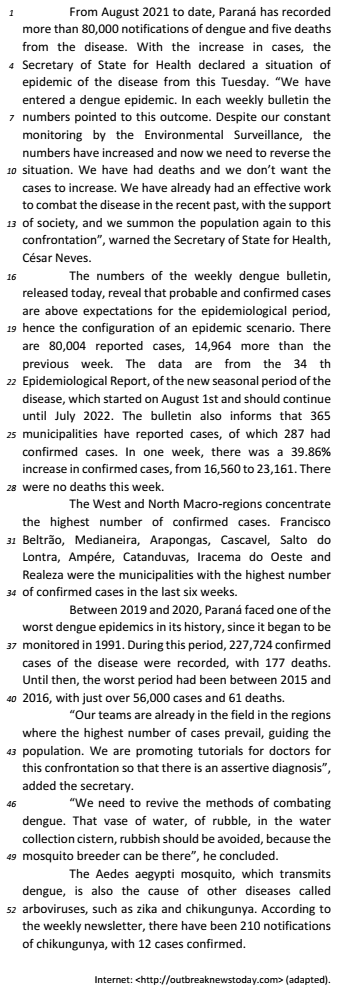
It would be grammatically correct and it would not change the meaning of the sentence if the preposition “above” was replaced by the preposition below in the sentence: The numbers of the weekly dengue bulletin, released today, reveal that probable and confirmed cases are below expectations for the epidemiological period.
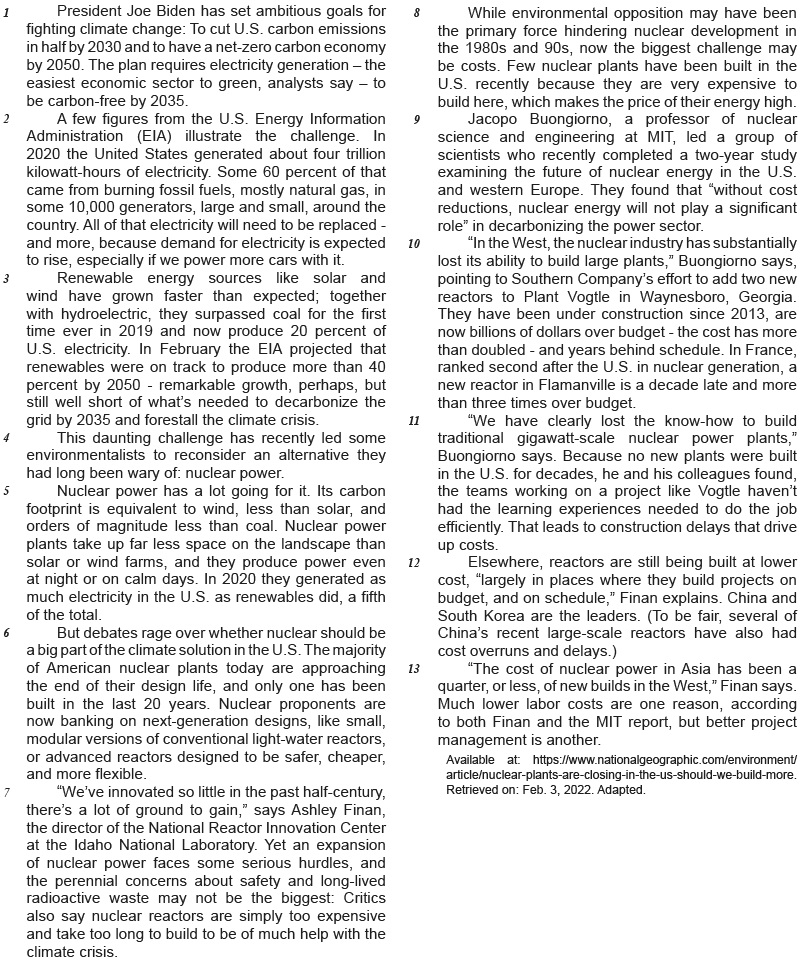
The controversial future of nuclear power in the U.S.
Lois Parshley


 Conheça nossos planos