Questões de Concurso Comentadas sobre sinônimos | synonyms em inglês

Questões Discursivas

Foram encontradas 1.059 questões

Q3025653 Inglês

After carrying out text reading, it is possible to infer the featured words highlight. 


    The announcement of pandemic-related lockdown measures in March 2020 in the UK led to a wide-ranging series of measures in education as a whole to deal with the sudden changes in the learning environment. These included top-down policy directives and centralised toolkits, but arguably in language education the most effective responses were often bottom-up community initiatives. Language education was well placed to deal with some of the challenges in responding to the rapid move to online teaching through historical work in areas such as computer-assisted language learning (CALL) (Levy) dating back to the 1960s and more recent variants such as mobile-assisted language learning (MALL). There has been undeniably community-driven work in the school sector in particular in recent years, with the use of the #MFLTwitterati hashtag in part driving debate around the use of technology in language education on Twitter long before COVID-19 struck, and the TiLT (Technology in Language Teaching) webinar series, which began soon afterwards in March 2020. During the COVID-19 crisis, in a drive to support language teachers in moving to online teaching, experts at the Open University developed a free toolkit that could be downloaded, used, adapted and modified by ML practitioners which indeed made a difference. Social media was often a useful platform to provide help with teaching online (Rosell-Aguilar). Other examples include interdisciplinary discussions, such as the AMLUK Symposium on Modern Languages, Area Studies and Linguistics in 2021, which provided examples of the relationship and possible interdisciplinary links between research and pedagogy in Modern Languages, Area Studies and Linguistics. This symposium assuredly opened up constructive discussions about which teaching methodologies and strategies could support the internationalisation and decolonisation of our discipline.

(Reflections on Post-Pandemic Pedagogical Trends in Language Education. In: Dec, 2023.) 

Alternativas
Q3024636 Inglês
Action for Global Health publishes Stocktake Review


Unlimit Health is a proud member of Action for Global Health (AfGH), an influential network of more than 50 organisations working towards a world where health equity is achieved and everyone has access to the quality healthcare they need without being forced into financial hardship.

Harnessing the expertise and strength of its members and partners, including people with lived experience of health inequity globally and civil society organisations based in low- and middle-income countries, AfGH works to secure political action and commitments in the UK to improve health equity globally.

Today, AfGH publishes the Stocktake Review. This report, created with the support of its membership and the Bill and Melinda Gates Foundation, provides an assessment and a series of recommendations for the UK’s role in global health.

Reflecting on the report, Wendy Harrison, Unlimit Health’s CEO said, “While the UK Government has long been committed to global health, this commitment should be supported through implementation plans and financial allocations, to achieve healthy outcomes for all. Recent cuts to UK overseas aid have impacted negatively on people affected by neglected tropical diseases and other health inequities, and set back efforts to strengthen health systems. As members of Action for Global Health, we call on the UK Government to maintain their world leading role in providing long-term, bold pledges to key global health goals and partnerships, stepping up efforts to build resilient, inclusive and strong health systems.”

The review provides a snapshot of the UK Government’s current political, financial and programmatic commitments to global health, as well as reviewing progress towards recommendations made in the previous Stocktake Review.


(Available at: https://www.wordreference.com/definition/Harnessing. Acesso em 25 ago. 2024.)
What is the synonym of globally?
Alternativas
Q3024619 Inglês
Do you see the cow you consume when you bite into a burger?


Philipp Ritter keeps his eyes fixed on the deer, pulls the trigger and hits the animal directly in the heart with one shot. It has not noticed anything and within a few moments the deer collapses and lies still. Ritter said that killing is never pleasant for him. He loves nature. The well-being of the forest and the animals are important to him. Hunters, like Ritter, make sure that nature is in balance. If there are too many deer, for example, the trees get damaged. For most of them, hunting is a passion. They treat the animals with respect and take just as many of them as necessary. Ritter has thought a lot about how he can eat meat with a clear conscience. He decided that if he wanted to eat it, he had to be ready to kill it. He started with fishing. It was difficult for him to kill his first fish. But he was also somehow proud. But should a person be able to eat meat without having to kill the animal they eat? Because that, of course, is not the way most people today get their meat. People have gradually moved away from hunting through the intermediate stages of farming and individual butchering to today’s industrial processing of meat, in order to give consumers the most convenience. Nowadays, it is possible to walk into a shop and buy a nicely packaged piece of meat at a cheap price. It is easy to forget that behind every piece of meat is a life that has come to an end.


(Available at: https://news-decoder.com/do-you-see-the-cow-you-consume-when-you-bite-into-a-burger/>. Access at: 25 aug. 2024.)
The word “noticed” can be replaced without losing the meaning by
Alternativas
Q3021648 Inglês
Text CB1A2-II

        Internet coverage in the European Union (EU) is impressive, standing at 100%; however, numbers on de facto usage (85%), broadband take-up (78%), users with at least basic digital skills (58%), next-generation access coverage providing at least 30 Mbps (86%) and 5G readiness (21%) cloud the picture.
       The significance of these circumstances does not only lie in the economic implications but also in the severe consequences for the individual and the society. People without adequate Internet access are missing out on means of participation and opportunities that have become part of everyday life. Countless contributions have been published on socioeconomic inequalities relating to access to, use of or impact of ICTs (information and communication technologies), known as the digital divide(s). These divides will only deepen, as disconnected citizens are likely to miss out on long-term benefits of innovation (information society) and modernization.
         The coronavirus pandemic exacerbated the social inequalities related to insufficient connectivity: privileged users experienced dropped calls and disrupted downloads, while disadvantaged users were left with no access at all or with makeshift solutions.

Internet:<www.europarl.europa.eu/thinktank>  (adapted). 

Based on the text CB1A2-II, judge the following item.


The adjective “makeshift”, in the last sentence of the text, is a synonym for obsolete.

Alternativas
Q3016036 Inglês

Choose the option that would correctly replace the highlighted word:


“He shouted from the other side of the lake.”

Alternativas
Q3012913 Inglês
A total solar eclipse passed over North America on Monday, putting on a dramatic show that was visible to millions of people.

A total solar eclipse occurs when the moon passes between Earth and the sun, completely blocking the sun's face. Those within the path of totality, including 32 million people in the United States, saw the eclipse in its full splendor. People outside the path were still able to see a partial solar eclipse, where the moon blocks only part of the sun's face.

Many people traveled to the path of totality to attend special viewing parties. Those along the very center line of the path saw an eclipse that lasted between 3 and half and 4 minutes, according to NASA.

For many Americans, this was the last chance to see a total solar eclipse for 20 years. The next one won't be visible across the contiguous United States until August 2044.

The Solar Eclipse. CNN. 08 April 2024. Adapted.
What term serves as a synonym for "contiguous" as employed in the provided text?
Alternativas
Q3009834 Inglês
Read the excerpt below to answer the question.

All the time in the world
By Shel Silverstein
Lay down
Let's explore this tenderness between us
There ain't no one around at all to see us
And baby would you mind
If maybe you and I
Took a little time to find each other? [...] 
“Mind” [line 04] is a multiple-meaning word. It plays different roles according to the context given. Mark the correct option according to the multiple uses of the term “mind”. 

I. “Never mind I’ll find someone like you.” - said Adele.
II. “Would you mind putting your seat upright?” - said the flight attendant.
III. “Mind your own business!” - said Kathleen.
IV. “You also need to bear in mind that not every student here can fully understand it.” - said the teacher.

V. “I don’t mind telling people my age.” - said Mrs. Howard. 
Alternativas
Q2847472 Inglês

Read the following text to answer the question.


By Leo Selivan


In this article, informed by the Lexical Approach, I reflect on grammar instruction in the classroom […]. I consider the problems with ‘traditional’ grammar teaching before arguing that what we actually need is more grammar input as well as showing how lexis can provide necessary ‘crutches’ for the learner.


Lexis = vocabulary + grammar


The shift in ELT from grammar to lexis mirrors a similar change in the attitude of linguists. In the past linguists were preoccupied with the grammar of language; however the advances in corpus linguistics have pushed lexis to the forefront. The term ‘lexis’, which was traditionally used by linguists, is a common word these days and frequently used even in textbooks.


Why use a technical term borrowed from the realm of linguistics instead of the word ‘vocabulary’? Quite simply because vocabulary is typically seen as individual words (often presented in lists) whereas lexis is a somewhat wider concept and consists of collocations, chunks and formulaic expressions. It also includes certain patterns that were traditionally associated with the grammar of a language, e.g. If I were you…, I haven’t seen you for ages etc.


Recognising certain grammar structures as lexical items means that they can be introduced much earlier, without structural analysis or elaboration. Indeed, since the concept of notions and functions made its way into language teaching, particularly as Communicative Language Teaching (CLT) gained prominence, some structures associated with grammar started to be taught lexically (or functionally). I’d like to is not taught as ‹the conditional› but as a chunk expressing desire. Similarly many other ‹traditional› grammar items can be introduced lexically relatively early on.


Less grammar or more grammar?


You are, no doubt, all familiar with students who on one hand seem to know the ‘rules’ of grammar but still fail to produce grammatically correct sentences when speaking or, on the other, sound unnatural and foreign-like even when their sentences are grammatically correct. Michael Lewis, who might be considered the founder of the Lexical Approach, once claimed that there was no direct relationship between the knowledge of grammar and speaking. In contrast, the knowledge of formulaic language has been shown by research to have a significant bearing on the natural language production.


Furthermore, certain grammar rules are practically impossible to learn. Dave Willis cites the grammar of orientation (which includes the notoriously difficult present perfect and the uses of certain modal verbs) as particularly resistant to teaching. The only way to grasp their meaning is through continuous exposure and use.


Finally, even the most authoritative English grammars never claim to provide a comprehensive description of all the grammar, hence the word ‘introduction’ often used in their titles (for instance, Huddleston & Pullum’s A Student’s Introduction to English Grammar or Halliday’s An Introduction to Functional Grammar).


If grammarians do not even attempt to address all areas of grammar, how can we, practitioners, cover all the aspects of grammar in our teaching, especially if all we seem to focus on is a limited selection of discrete items, comprised mostly of tenses and a handful of modal verbs? It would seem that we need to expose our students to a lot of naturally occurring language and frequently draw their attention to various grammar points as they arise.


For example, while teaching the expression fall asleep / be asleep you can ask your students:


• Don’t make any noise – she’s fallen asleep.

• Don’t make any noise – she’s asleep.


What does’s stand for in each of these cases (is or has)?


One of the fathers of the Communicative Language Teaching Henry Widdowson advocated using lexical items as a starting point and then ‘showing how they need to be grammatically modified to be communicatively effective’ (1990:95). For example, when exploring a text with your students, you may come across a sentence like this:


They’ve been married for seven years.


You can ask your students: When did they get married? How should you change the sentence if the couple you are talking about is no longer married?


The above demonstrates how the teacher should be constantly on the ball and take every opportunity to draw students’ attention to grammar. Such short but frequent ‘grammar spots’ will help to slowly raise students’ awareness and build their understanding of the English grammar system.

[…]


Conclusion


So is there room for grammar instruction in the classroom? Certainly yes. But the grammar practice should always start with the exploitation of lexical items. Exposing students to a lot of natural and contextualised examples will offer a lexical way into the grammar of the language.


To sum up, grammar should play some role in language teaching but should not occupy a big part of class time. Instead grammar should be delivered in small but frequent portions. Students should be encouraged to collect a lot of examples of a particular structure before being invited to analyse it. Hence, analysis should be preceded by synthesis.


Lastly, language practitioners should bear in mind that grammar acquisition is an incremental process which requires frequent focus and refocus on the items already studied.


Available at: https://www.teachingenglish.org.uk/professionaldevelopment/teachers/knowing-subject/articles/grammar-vs-lexisor-grammar-through. Accessed on: April 29, 2024.

The conjunction whereas in “Quite simply because vocabulary is typically seen as individual words (often presented in lists) whereas lexis is a somewhat wider concept and consists of collocations, chunks and formulaic expressions.” is closest in meaning to
Alternativas
Q2847469 Inglês

Empowering language learning through assessment 

By Liying Cheng & Janna Fox


 Introduction

Like you, we are teachers. We both began our careers teaching English to students ______ first languages were not English. We taught many of these students in Asia, the Middle East, Africa, and North America, navigating our way through the teaching, learning, and assessment of our students with little guidance from theory or resources. Over the years, we became increasingly sensitive to the negative influence and consequences of ill-considered assessment and testing practices. Although we could increasingly find resources on language teaching methods, strategies, and techniques, very few of these resources provided systematic and coherent support for our day-to-day assessment practices. There were no ready answers to our questions in the research literature either – researchers tended to write for other researchers, and their findings, although interesting, were not readily applicable in our classrooms. Years later, our long-term interest in assessment led us to teaching courses to pre-service and in-service teachers: helping them to support their students’ learning through sound assessment practices. This thread has centrally run through our work. Again, we searched for resources that could answer the questions and address the issues arising in the classroom; we realised that the narrow scope of resources on classroom assessment rarely moved beyond test design and test analysis, and was more appropriate for large-scale testing than for on-going classroom assessment.

In the present educational climate, we are continually faced with complex assessment issues. For example, there is a great deal of discussion now about alignment as a guiding principle for high quality assessment: that is, the degree of agreement amongst standards, curriculum, learning outcomes, assessment tasks (including tests), and instruction. Alignment, validity, reliability, fairness, consequences, and practicality are viewed as central aspects of assessment practice that supports learning.

The alignment of learning goals, assessment, and classroom activity 


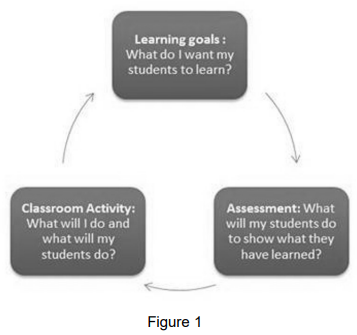
Figure 1 depicts assessment practices three-dimensionally and asks us as teachers to revisit our own classroom practices. Think about what it means to us in achieving instructional goals through teaching and assessment. In the center of this triangle is our students’ learning. The first question we need to ask relates to the learning goals we have for our students: What do I want my students to learn? What do I want them to know, value, and / or be able to do as an outcome of my teaching? Moving to the next question in Figure 1, on assessment, we need to ask how we will monitor and evaluate learning – or what information is essential in order to determine whether our students have met or exceeded the required expectations: What will my students do to show what they have learned? Given the evidence that we plan to collect during a course, we then need to identify the actual classroom activities that will support our students’ learning and development: What will I do as a teacher, and what will my students do as learners?

Assessment serves as the key to check on learning, providing essential information to teachers. This is an on-going, iterative, and cyclical way of supporting learners through assessment and teaching. In this sense, teaching and assessment are one integral and interconnected process. Teachers need to constantly ask themselves: Have my students learned? And how well have they progressed as a result of my assessment practices?


Assessment ofas, and for learning 

For teachers to support student learning through assessment, teachers need to engage themselves as well as their students in the discussion of assessment of learning, assessment for learning, and assessment as learning. We argue that it is inaccurate to view assessment only as judgments on learner progress at the conclusion of a unit of teaching and learning. Rather, it should also be viewed as a way of obtaining evidence for where students are in reaching their learning goals and what they need in order to progress towards these goals. Assessment as learning puts the focus on the students themselves taking responsibility for their own learning through self and peer-assessment, monitoring their own progress toward their goals and employing strategies for achieving them. We know that alignment and assessment of, for, and as learning ultimately empower our students’ language development.


Available at: https://www.onestopenglish.com/methodology-theworld-of-elt/applied-linguistics-empowering-language-learningthrough-assessment/555928.article. Accessed on: April 29, 2024.  
The conjunction although in “Although we could increasingly find resources on language teaching methods, strategies, and techniques, very few of these resources provided systematic and coherent support for our day-to-day assessment practices.” is closest in meaning to
Alternativas
Ano: 2024 Banca: FGV Órgão: EPE Prova: FGV - 2024 - EPE - Advogado |
Q2758984 Inglês
Text I


Energy Transition in a Transnational World


       Within the sphere of environmental law, the climate crisis is increasingly understood to be an intersectional challenge that implicates and exacerbates existing systemic challenges and prevailing pathways of inequality. From this vantage point climate change also creates opportunities for rethinking the role of law in limiting the destructive impacts of climate change and moving towards a more sustainable and equitable world in the process. This view is advanced by the climate justice movement, which is swelling in influence worldwide. Drawing from the environmental justice movement, the climate justice movement exposes not only how social and economic inequality has led to and perpetuates patterns of climate change, but also how climate change deepens inequality by disproportionately affecting the most vulnerable members of society. Climate justice seeks greater emphasis on this issue and advocates on the part of those most affected by climate change. The movement envisions a world which simultaneously curtails the negative effects of climate change and reshapes existing social, political, and economic relationships along the way.


      Amidst the overlapping crises of modern times, the modern climate justice movement is reviving dialogue at the intersection of feminism, environmentalism, social and economic justice, and other progressive law reform movements, as well as creating the space and momentum for intersectional ideas to flourish. For lawyers and legal scholars, the opportunity is to see climate change and environmental degradation within its broader social context and to seize upon the rule of law as a powerful tool for change. 


      Nowhere are these intersecting challenges as acute as in the context of energy. One of the principal aims of the climate justice movement is to achieve a just and equitable transition from an extractive economy to a regenerative economy. This requires transitioning from fossil fuel-dependent to low and zero-carbon economies. However, the pathways for overhauling energy systems worldwide remain indeterminate. Energy systems are evolving in response to a combination of law and policy changes, developments in energy technologies, and market forces. Moreover, given both the entrenched nature of fossil fuel economies and the varied social, political, economic, and environmental factors that shape energy transition, pathways to decarbonization are bound to be beset with complex trade-offs, such as those between energy security and environmental objectives, or between energy choice and economies of scale. The precise contours of these systemic changes vary from country to country, and remain under-explored both within their national contexts and from a broader transnational perspective. This knowledge gap is critical. Understanding how, why, and to what end states are restructuring their energy economies is essential for transitioning to more environmentally sustainable and just societies worldwide. In short, this is an area in need of experimentation and iterative learning. It is a subject ripe for greater scholarly focus, particularly at the transnational level, where improved learning and sharing is indispensable for achieving the global-level shifts needed to address climate change. Adapted from: Etty, Thijs et al. “Energy Transition in a Transnational World.” Transnational Environmental Law 10.2 (2021): 197–204. Available at https://www.cambridge.org/core/journals/transnational-environmentallaw/article/energy-transition-in-a-transnationalworld/9F9D4229588B39C0E5916DFBE82EA046 
The verb in “curtails the negative effects” (1st paragraph) means to 
Alternativas
Q2606974 Inglês

The item preserving the same message/idea as the one emphasized in the text below is:


Rahul: Hi, Raj. You 've participated the drawing competition.

Raj: Sure, you know drawing is my bailiwick.

Rahul: What is the topic you chose?

Raj: “Environmental Issues”

Rahul: How many days did it take you to complete it?

Raj: It took me 2.

Rahul: Have the results already? To whom did the prize go?

Raj: A dude in Texas, at least my personal experience has grown...


(Available in: https://brainly.in/question/6727599.)


Alternativas
Q2592871 Inglês

Read Text | and answer questions 05 to 13.


Netflix is trying to prove to the world that it's all grown up


Netflix is trying to persuade Wall Street that it is now all grown up. After squeezing out millions of additional subscribers via its password sharing crackdown and through the introduction of cheaper advertiser-supported plans, the streamer knows that its growth spurts are coming to an end — and now it wants investors to stop obsessing over those pesky membership numbers and instead focus on other metrics.

"In our early days, when we had little revenue or profit, membership growth was a strong indicator of our future potential. But now we're generating very substantial profit and free cash flow. We are also developing new revenue streams like advertising and our extra member feature, so memberships are just one component of our growth", Netflix told shareholders as it reported quarterly earnings.

To that end, Netflix said that it will no longer report quarterly subscriber numbers, starting in 2025. Alas, the metric that Wall Street has forever judged Netflix on — the metric that prompted legacy media companies to burn endless piles of cash in their bids to compete with the streamer — will be retired. The decision to shut off transparency on the metric represents a significant turning point in the streaming revolution. For years, Netflix has prided itself on being extraordinarily transparent. Now it is aiming to hold its cards closer to its chest. And given that streaming giant is the trendsetter in the space, one could expect that other media companies will be inspired by the company's move and also opt to cease reporting such data.

To be fair, what Netflix is saying isn't necessarily off base either. As the company shifts its business model away from subscriptions and toward advertising and other revenue streams, it makes sense to consider how much time users are spending on the service. The more content a user consumes on Netflix, the more likely they are to continue paying for the service, and the more money Netflix then makes from that single subscriber. "We're focused on revenue and operating margin as our primary financial metrics — and engagement (i.e. time spent) as our best proxy for customer satisfaction,” Netflix underscored in its letter to shareholders.

Regardless, less transparency in an already opaque industry is not ideal. The walled garden of streaming already lacks the same detailed viewership data that Nielsen collects on linear television broadcasters. Now, visibility into the streaming world will get even dimmer.

The announcement from Netflix managed to overshadow its otherwise stellar quarter. The company handily beat expectations and added a staggering 9.3 million subscribers, meaning it now boasts nearly 270 million in total. Netflix also beat analyst expectations on both earnings and revenue. However, it wasn't all good news. Netflix forecasted its subscriber growth to be lower in quarter two, chalking it up to “typical seasonality.” That led the stock to slide nearly 5% in after-hours trading.

Whether "typical seasonality” is solely to blame, or whether the streamer is simply starting to hit a ceiling, is hard to tell. Perhaps it is a mix of both. Whatever the cause, the stock sliding on the less-than-ideal outlook is a prime example of why Netflix wants Wall Street to stop focusing on its subscriber numbers. And, in one year's time, investors won't have a choice.


Adapted from: https://edition.cnn.com/2024/04/19/media/netflix-subscription-numbers/index.html

In "(..) what Netflix is saying isn't necessarily off base either”, "off base” can be replaced, without changing its meaning in the context of the text, by:

Alternativas
Q2572685 Inglês
Read the text and answer the question.  

    Bermuda Triangle in the last 500 years, over 1000 ships and aircraft have entered the Bermuda Triangle and mysteriously vanished. It is the deadliest place on Earth for planes and boats. The Bermuda Triangle is an area of water about 500,000 square miles in size. One tip of the triangle starts from Miami, Florida and extends northeast towards the island of Bermuda. The next side of the triangle then runs straight south towards the Puerto Rico and then turns back northeast up to Florida. 
    The story of Flight 19 is one of the most incredible cases of Bermuda Triangle disappearances. In the early afternoon of December 5, 1945, five American military aircraft with 14 men aboard departed from a naval base in Florida on a training flight. These aircraft were called Avengers, and they were among the sturdiest and most reliable aircraft in the world at the time. Commander Charles Taylor, an experienced pilot, was supposed to lead the flight east from the Florida coastline, which would take them into the Bermuda Triangle. The sky was clear, and it was a perfect day for flying but problems began about 90 minutes after takeoff.
    Taylor radioed back to his base at 3:40 p.m. that he was lost, and his plane’s compass was not working. This should not have been a problem as the normal procedure for going home was to simply fly west until they returned to the U.S. coast. the men of Flight 19, however, never returned home and the airplanes seemed to have simply vanished. The final radio messages from Flight 19 were very odd. One pilot stated, “Everything looks strange. Even the ocean.” Another one said, “It looks like we’re entering white water. We’re completely lost.” A rescue plane flew into the Bermuda Triangle to try and find the men, but it crashed and all 13 men on board were killed. Later on, a Navy official stated that Flight 19 “flew off to Mars.”
    Flight 19’s disappearance is just one of many in the long history of the Bermuda Triangle mystery. Is there a scientific explanation for these disappearances or are there supernatural forces at work in the area? The number of unanswered questions about the fate of the planes only adds to the mystery. Did Taylor, an experienced pilot, really make a simple navigational mistake? If so, why didn’t any of the other men in his flight see the error and correct it? Why has the wreckage of the planes and the men’s bodies never been found after all these years? The US Navy investigated the incident in 1946 and reported that the Flight 19 incident was a “disappearance” with the chilling words “cause unknown” added later on. 
Antonyms are words that have contrasting or opposite meanings. What is the antonym of the word “incredible”?
Alternativas
Q2572683 Inglês
Read the text and answer the question.  

    Bermuda Triangle in the last 500 years, over 1000 ships and aircraft have entered the Bermuda Triangle and mysteriously vanished. It is the deadliest place on Earth for planes and boats. The Bermuda Triangle is an area of water about 500,000 square miles in size. One tip of the triangle starts from Miami, Florida and extends northeast towards the island of Bermuda. The next side of the triangle then runs straight south towards the Puerto Rico and then turns back northeast up to Florida. 
    The story of Flight 19 is one of the most incredible cases of Bermuda Triangle disappearances. In the early afternoon of December 5, 1945, five American military aircraft with 14 men aboard departed from a naval base in Florida on a training flight. These aircraft were called Avengers, and they were among the sturdiest and most reliable aircraft in the world at the time. Commander Charles Taylor, an experienced pilot, was supposed to lead the flight east from the Florida coastline, which would take them into the Bermuda Triangle. The sky was clear, and it was a perfect day for flying but problems began about 90 minutes after takeoff.
    Taylor radioed back to his base at 3:40 p.m. that he was lost, and his plane’s compass was not working. This should not have been a problem as the normal procedure for going home was to simply fly west until they returned to the U.S. coast. the men of Flight 19, however, never returned home and the airplanes seemed to have simply vanished. The final radio messages from Flight 19 were very odd. One pilot stated, “Everything looks strange. Even the ocean.” Another one said, “It looks like we’re entering white water. We’re completely lost.” A rescue plane flew into the Bermuda Triangle to try and find the men, but it crashed and all 13 men on board were killed. Later on, a Navy official stated that Flight 19 “flew off to Mars.”
    Flight 19’s disappearance is just one of many in the long history of the Bermuda Triangle mystery. Is there a scientific explanation for these disappearances or are there supernatural forces at work in the area? The number of unanswered questions about the fate of the planes only adds to the mystery. Did Taylor, an experienced pilot, really make a simple navigational mistake? If so, why didn’t any of the other men in his flight see the error and correct it? Why has the wreckage of the planes and the men’s bodies never been found after all these years? The US Navy investigated the incident in 1946 and reported that the Flight 19 incident was a “disappearance” with the chilling words “cause unknown” added later on. 
The word “departed” in paragraph 2 is closest to meaning to:
Alternativas
Q2559187 Inglês
Which item correctly displays a synonym for the word “easy”?
Alternativas
Q2555349 Inglês
What is the synonym for "ubiquitous"?
Alternativas
Q2553912 Inglês
What is the opposite of "vivid"? 
Alternativas
Q2540474 Inglês

Read Text I to answer the question.

TEXT I


“One very active research tradition in the field of second language acquisition (SLA) attempts to establish causal relationships between environmental factors and learning. These include the type and quantity of input, instruction and feedback, and the interactional context of learning (Larsen-Freeman and Long 1991). A second very influential line of research and theory in SLA that came to fruition during the 1980s investigates the possible role of universal grammar (UG) in SLA (Eubank 1991b, White 1989). In the Chomskyan tradition, UG refers not to properties of language as the external object of learning but to innate properties of mind that direct the course of primary language acquisition. One question asked within this tradition has been whether or not second language this tradition learners still “have access” to UG, but it is assumed that UG principles are not accessible to learner awareness for any kind of conscious analysis of input. It is possible that SLA is the result of UG (a deep internal factor) acting upon input (an external factor), as proposed by White (1989), but what seems to be left out of such an account is the role of the learner's conscious mental processes.” […]


Available at: https://www.cambridge.org/core/journals/annual-review-of-applied-linguistics/ (adapted)

The word “fruition” in the text could be substituted without change in meaning is:
Alternativas
Q2540473 Inglês

Read Text I to answer the question.

TEXT I


“One very active research tradition in the field of second language acquisition (SLA) attempts to establish causal relationships between environmental factors and learning. These include the type and quantity of input, instruction and feedback, and the interactional context of learning (Larsen-Freeman and Long 1991). A second very influential line of research and theory in SLA that came to fruition during the 1980s investigates the possible role of universal grammar (UG) in SLA (Eubank 1991b, White 1989). In the Chomskyan tradition, UG refers not to properties of language as the external object of learning but to innate properties of mind that direct the course of primary language acquisition. One question asked within this tradition has been whether or not second language this tradition learners still “have access” to UG, but it is assumed that UG principles are not accessible to learner awareness for any kind of conscious analysis of input. It is possible that SLA is the result of UG (a deep internal factor) acting upon input (an external factor), as proposed by White (1989), but what seems to be left out of such an account is the role of the learner's conscious mental processes.” […]


Available at: https://www.cambridge.org/core/journals/annual-review-of-applied-linguistics/ (adapted)

The word “influential” in the text could be substituted without change in meaning is:
Alternativas
Q2538684 Inglês

Text 1


Youth and Adult Literacy in Brazil:

learning from practice


The Concept of functional ILLITERACY


[…] A person is considered functionally literate ..................... he or she is capable ................. using reading and writing skills ........................ meet the demands of his or her social context, using them to continue learning and developing over their lifetimes. With the expansion of the access to schooling beyond literacy, the focus was shifted to the quality of the educational process offered to all. The issue here is not simply whether people know how to read or write, but what they are capable of doing with those skills. This means that, besides the issue of illiteracy, a social problem that still persists in Brazil, there is also the issue of functional illiteracy; in other words, the inability to effectively use reading and writing skills in the various areas of social life after a certain number of years of schooling. According to census criteria, individuals with less than 4 years of schooling are considered functionally illiterate. […]


Source: https://unesdoc.unesco.org

Study these sentences below and decide if they are true ( T ) or false ( F ), according to structure and use of grammar and lexical aspects of language use.


( ) The words in bold, them and their in text 1, are respectively an object pronoun and a possessive adjective.


( ) In the sentence: The issue here is not simply whether people know how to read or write… the underlined word whether can be replaced by if without changing its meaning.


( ) The noun criteria in: According to census criteria, individuals with less than 4 years of schooling are considered functionally illiterate; is the singular form of criterium.


( ) In the following sentence from text 1: … the inability to effectively use reading and writing skills in the various areas of social life after a certain number of years of schooling; the underlined words reading, writing and schooling are examples of present participle.


Choose the alternative which presents the correct sequence, from top to bottom.

Alternativas
Respostas
221: C
222: B
223: B
224: E
225: A
226: B
227: C
228: B
229: B
230: A
231: B
232: D
233: C
234: A
235: B
236: C
237: B
238: D
239: A
240: A