Questões de Concurso Sobre inglês
Foram encontradas 25.431 questões


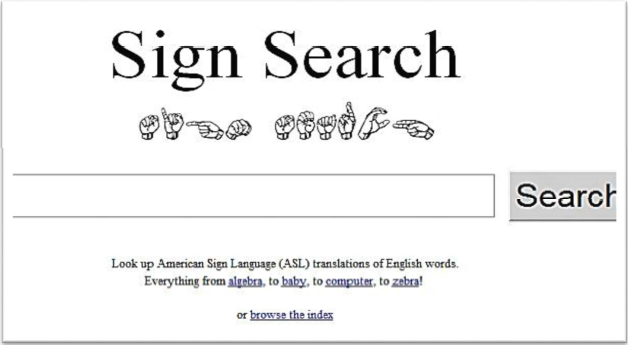
(Disponível em: http://idyeah.com/blog/wp-content/uploads/2012/06/asl.jpg. Acesso em: 15/11/2016.)
A figura acima é de um site
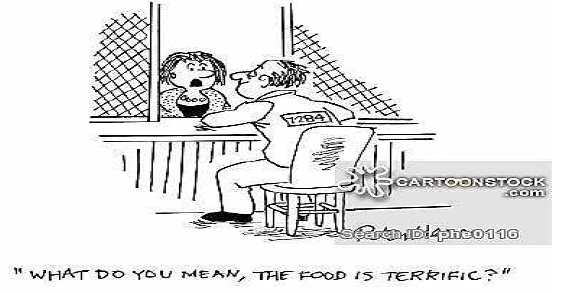
(Disponível em: https://www.cartoonstock.com/directory/v/visiting_prison.asp. Acesso em 15/11/2016.)
Segundo a linguagem verbal e não verbal do texto, pode-se inferir que
Hey, you
Out there in the cold
Getting lonely, getting old
Can you feel me? (…)
(Disponível em: https://www.letras.mus.br/pink-floyd/64540/. Acesso em: 02/11/2016.)
Na letra da canção Hey You , da banda Pink Floyd, o interlocutor (you) é
INSTRUÇÃO: Leia o texto e responda à questão.
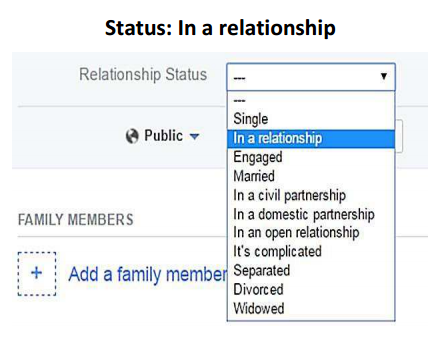
Sahar Zand (Iran): Increasing numbers of young Iranian couples are now living together before marriage, something which would have been unthinkable a generation ago and is still illegal. Dating apps like Tinder are starting to take off in Tehran and it's suddenly become fashionable for some middle-class girls in the capital to have lots of different boyfriends and to flag up their regularly changing relationship status on social media.
(Disponível em: http://www.bbc.com/news/magazine-36130971. Acesso em: 05/11/2016.)
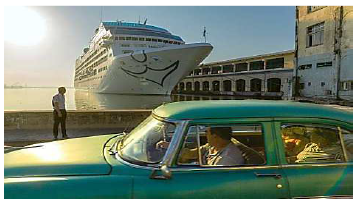
Here Comes a Wave of Change for Cuba
Warming relations with the U.S. has an upbeat but wary island bracing for a rush of visitors from its Cold War adversary.
(Disponível em: http://www.nationalgeographic.com/magazine/. Acesso em: 05/11/2016.)
Segundo o texto, as relações entre Estados Unidos e Cuba
INSTRUÇÃO: Leia o texto a seguir e responda à questão.

INSTRUÇÃO: Leia o texto a seguir e responda à questão.
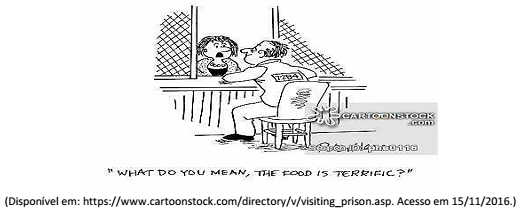
Segundo a linguagem verbal e não verbal do texto, pode-se inferir que
INSTRUÇÃO: Leia o texto e responda à questão.
Brazilian Gestures That Non-Brazilians Won't Be Able To Guess
[…] We Brazilians are famous for being expressive — not just vocally, but gesturally (after all, what’s music without some dancing to go with it?). So where does this talent for talking with our hands come from? Perhaps we inherited it from our Italian great-grandmothers (there have been several waves of Italian immigration to Brazil over the last century-and-a-half); or maybe it comes from our even older African and Portuguese roots. One thing is certain: We Brazilians have invented many gestures that are unique to our country. […]
(Disponível em: https://www.babbel.com/en/magazine/. Acesso em: 06/11/2016.)
O assunto principal do texto NÃO envolve questões relacionadas à
INSTRUÇÃO: Leia o texto e responda à questão

Sahar Zand (Iran): Increasing numbers of young Iranian couples are now living together before marriage, something which would have been unthinkable a generation ago and is still illegal. Dating apps like Tinder are starting to take off in Tehran and it's suddenly become fashionable for some middle-class girls in the capital to have lots of different boyfriends and to flag up their regularly changing relationship status on social media.
(Disponível em: http://www.bbc.com/news/magazine-36130971. Acesso em: 05/11/2016.)
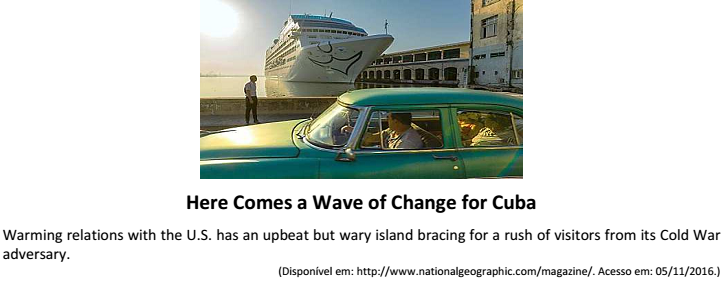
Segundo o texto, as relações entre Estados Unidos e Cuba
Read the text on climate change and answer question
According to all measurements, climate change is happening. But scientists appears to be split on what to do about it. Unfortunately, scientists do not all agree about the causes of global warming. In a recent book, two scientists – Fred Singer, a climate physicist, and Dennis Avery, a biologist – argue that the warming currently observed around the world is part of a 1,500-year cycle in solar energy. Singer, an outspoken critic of the idea that humans are warming the planet, and Avery, believe that a well established, 1,500 year cycle in the Earth’s climate can explain most of the global warming that has taken place in the last 100 years. We are currently in an upswing, getting back on the downswing, and getting colder again. They say that efforts to slow down the current warming by reducing emissions of greenhouse gases are at best pointless, or at worst economically damaging. This, of course, is not what the fourth assessment report of the UN Intergovernmental Panel on Climate Change (IPCC) said a few weeks ago. That report from UN climate science working group has concluded that it is likely that rising greenhouse gas concentrations have caused most recent warming and that, depending on our actions now to slow he growth of emissions, warming by 2100 will probably be between about 1.5ºC and 6º C. So, which scientists tell us the truth?
From: VINCE, Michael. Macmillan English Grammar in context. Oxford: Macmillan, 2008. p 30.
Read the text on climate change and answer question
According to all measurements, climate change is happening. But scientists appears to be split on what to do about it. Unfortunately, scientists do not all agree about the causes of global warming. In a recent book, two scientists – Fred Singer, a climate physicist, and Dennis Avery, a biologist – argue that the warming currently observed around the world is part of a 1,500-year cycle in solar energy. Singer, an outspoken critic of the idea that humans are warming the planet, and Avery, believe that a well established, 1,500 year cycle in the Earth’s climate can explain most of the global warming that has taken place in the last 100 years. We are currently in an upswing, getting back on the downswing, and getting colder again. They say that efforts to slow down the current warming by reducing emissions of greenhouse gases are at best pointless, or at worst economically damaging. This, of course, is not what the fourth assessment report of the UN Intergovernmental Panel on Climate Change (IPCC) said a few weeks ago. That report from UN climate science working group has concluded that it is likely that rising greenhouse gas concentrations have caused most recent warming and that, depending on our actions now to slow he growth of emissions, warming by 2100 will probably be between about 1.5ºC and 6º C. So, which scientists tell us the truth?
From: VINCE, Michael. Macmillan English Grammar in context. Oxford: Macmillan, 2008. p 30.
Read the text on climate change and answer question
According to all measurements, climate change is happening. But scientists appears to be split on what to do about it. Unfortunately, scientists do not all agree about the causes of global warming. In a recent book, two scientists – Fred Singer, a climate physicist, and Dennis Avery, a biologist – argue that the warming currently observed around the world is part of a 1,500-year cycle in solar energy. Singer, an outspoken critic of the idea that humans are warming the planet, and Avery, believe that a well established, 1,500 year cycle in the Earth’s climate can explain most of the global warming that has taken place in the last 100 years. We are currently in an upswing, getting back on the downswing, and getting colder again. They say that efforts to slow down the current warming by reducing emissions of greenhouse gases are at best pointless, or at worst economically damaging. This, of course, is not what the fourth assessment report of the UN Intergovernmental Panel on Climate Change (IPCC) said a few weeks ago. That report from UN climate science working group has concluded that it is likely that rising greenhouse gas concentrations have caused most recent warming and that, depending on our actions now to slow he growth of emissions, warming by 2100 will probably be between about 1.5ºC and 6º C. So, which scientists tell us the truth?
From: VINCE, Michael. Macmillan English Grammar in context. Oxford: Macmillan, 2008. p 30.
Read the text about a tribute to Franz Kafka for the question
Google Doodle celebrates Franz Kafka’s 130th birthday with ‘The Metamorphosis’ tribute Google has created a ‘doodle’ in tribute to Franz Kafka on the 130th anniversary of the Germanlanguage novelist’s birth.
The doodle is based on Kafka’s 1915 novella ‘The Metamorphosis’ – considered by many to be one of the most important works of fiction of the 20th Century – and shows the character Gregor Samsa walking into a room in the guise of a large insect.
In the much-celebrated work, Samsa is a travelling salesman who transforms into an insect overnight. The rest of novella focuses on his struggle to come to terms with his new existence and the burden it places on his family.
Kafka was born into an Ashkenazi Jewish family on 3 July 1883 in Prague, which was then part of the Austro-Hungarian Empire.
He originally trained as a lawyer but began writing short stories in his spare time - eventually coming to consider it his calling – despite only a handful of his works being published during his lifetime.
Regarded as one of the 20th Century’s most influential authors, Kafka’s works are dominated by unreliable narrators who often tell dark tales of existentialist difficulties.
Kafka’s notoriously difficult relationship with his father Hermann is believed to have strongly influenced his work – with The Metamorphosis itself thought to be based upon Kafka’s own fears of insignificance and repulsiveness to his own family.
From: HALL, John. Available at:<http://www.independent.co.uk/life-style/gadgets-and-tech/news/google-doodlecelebrates-franz-kafkas-130th-birthday-with-the-metamorphosis-tribute-8685557.html>.
Read the text about a tribute to Franz Kafka for the question
Google Doodle celebrates Franz Kafka’s 130th birthday with ‘The Metamorphosis’ tribute Google has created a ‘doodle’ in tribute to Franz Kafka on the 130th anniversary of the Germanlanguage novelist’s birth.
The doodle is based on Kafka’s 1915 novella ‘The Metamorphosis’ – considered by many to be one of the most important works of fiction of the 20th Century – and shows the character Gregor Samsa walking into a room in the guise of a large insect.
In the much-celebrated work, Samsa is a travelling salesman who transforms into an insect overnight. The rest of novella focuses on his struggle to come to terms with his new existence and the burden it places on his family.
Kafka was born into an Ashkenazi Jewish family on 3 July 1883 in Prague, which was then part of the Austro-Hungarian Empire.
He originally trained as a lawyer but began writing short stories in his spare time - eventually coming to consider it his calling – despite only a handful of his works being published during his lifetime.
Regarded as one of the 20th Century’s most influential authors, Kafka’s works are dominated by unreliable narrators who often tell dark tales of existentialist difficulties.
Kafka’s notoriously difficult relationship with his father Hermann is believed to have strongly influenced his work – with The Metamorphosis itself thought to be based upon Kafka’s own fears of insignificance and repulsiveness to his own family.
From: HALL, John. Available at:<http://www.independent.co.uk/life-style/gadgets-and-tech/news/google-doodlecelebrates-franz-kafkas-130th-birthday-with-the-metamorphosis-tribute-8685557.html>.
Read the text about a tribute to Franz Kafka for the question
Google Doodle celebrates Franz Kafka’s 130th birthday with ‘The Metamorphosis’ tribute Google has created a ‘doodle’ in tribute to Franz Kafka on the 130th anniversary of the Germanlanguage novelist’s birth.
The doodle is based on Kafka’s 1915 novella ‘The Metamorphosis’ – considered by many to be one of the most important works of fiction of the 20th Century – and shows the character Gregor Samsa walking into a room in the guise of a large insect.
In the much-celebrated work, Samsa is a travelling salesman who transforms into an insect overnight. The rest of novella focuses on his struggle to come to terms with his new existence and the burden it places on his family.
Kafka was born into an Ashkenazi Jewish family on 3 July 1883 in Prague, which was then part of the Austro-Hungarian Empire.
He originally trained as a lawyer but began writing short stories in his spare time - eventually coming to consider it his calling – despite only a handful of his works being published during his lifetime.
Regarded as one of the 20th Century’s most influential authors, Kafka’s works are dominated by unreliable narrators who often tell dark tales of existentialist difficulties.
Kafka’s notoriously difficult relationship with his father Hermann is believed to have strongly influenced his work – with The Metamorphosis itself thought to be based upon Kafka’s own fears of insignificance and repulsiveness to his own family.
From: HALL, John. Available at:<http://www.independent.co.uk/life-style/gadgets-and-tech/news/google-doodlecelebrates-franz-kafkas-130th-birthday-with-the-metamorphosis-tribute-8685557.html>.

 Conheça nossos planos