Questões de Concurso Sobre inglês
Foram encontradas 26.027 questões


Instruction: answer question based on the following text.
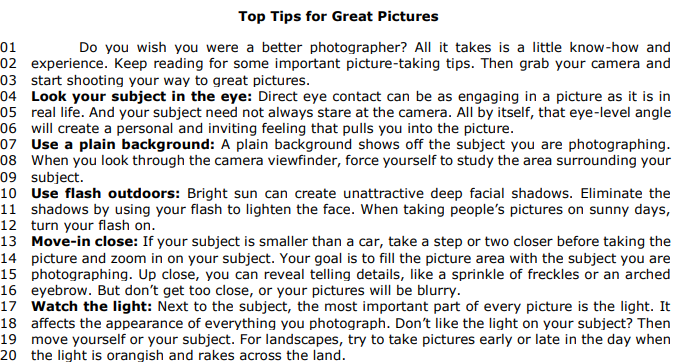
(Avalaible in: https://apps.kodakmoments.com/top-10-tips-for-great-pictures/ – text especially adapted for this
test)
Column 1
1. Keep reading for some important picture-taking tips. (l. 02).
2. Then grab your camera and start shooting your way to great pictures. (l. 02–03).
3. (...) will create a personal and inviting feeling that pulls you into the picture. (l. 06).
4. A plain background shows off the subject you are photographing. (l. 07).
Column 2
( ) The -ing form is part of a continuous/progressive verb tense structure.
( ) The gerund form is usually chosen to follow the first verb in this example in order to convey the continuity of action.
( ) The gerund form was chosen right after a verb that could also be followed by an infinitive form in this context, with no significative changes in meaning.
( ) The -ing form is transforming a verb into an adjective in this sentence.
The correct order of filling the parentheses, from top to bottom, is:
Instruction: answer question based on the following text.
(Avalaible in: https://apps.kodakmoments.com/top-10-tips-for-great-pictures/ – text especially adapted for this
test)
Instruction: answer question based on the following text.
(Avalaible in: https://apps.kodakmoments.com/top-10-tips-for-great-pictures/ – text especially adapted for this
test)
Instruction: answer question based on the following text.
(Avalaible in: https://apps.kodakmoments.com/top-10-tips-for-great-pictures/ – text especially adapted for this
test)
( ) The structure “wish you were” is usually used when the speaker believes it is hard or maybe impossible to achieve the goal.
( ) The verb BE is in the simple past, indicating a third conditional structure.
( ) If we changed the second “you” for “I,” the form “whish I was” would be accepted informally, while “whish I were” is desired in standard English.
The correct order of filling the parentheses, from top to bottom, is:
Instruction: answer question based on the following text.
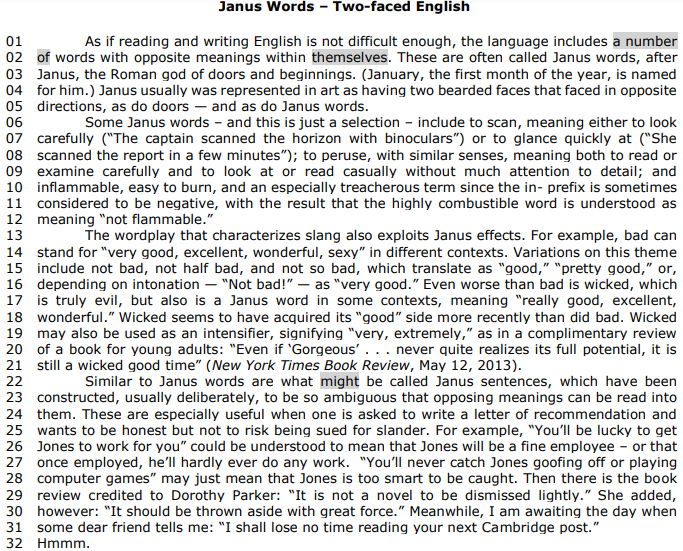
(Avalaible in: https://dictionaryblog.cambridge.org/2013/07/01/janus-words-two-faced-english/#more-2382 –
text especially adapted for this test).
I. “More recently than” is a superlative structure with an adverb.
II. If “more recently than” were substituted by “not as recently as,” without altering the order of any other word in the sentence, there would be no changes in meaning.
III. If “than did bad” were removed from the sentence, it would still be grammatically correct.
Which statements are correct?
Instruction: answer question based on the following text.
(Avalaible in: https://dictionaryblog.cambridge.org/2013/07/01/janus-words-two-faced-english/#more-2382 –
text especially adapted for this test).
Instruction: answer question based on the following text.
(Avalaible in: https://dictionaryblog.cambridge.org/2013/07/01/janus-words-two-faced-english/#more-2382 –
text especially adapted for this test).
Instruction: answer question based on the following text.
(Avalaible in: https://dictionaryblog.cambridge.org/2013/07/01/janus-words-two-faced-english/#more-2382 –
text especially adapted for this test).
Instruction: answer question based on the following text.
(Avalaible in: https://dictionaryblog.cambridge.org/2013/07/01/janus-words-two-faced-english/#more-2382 –
text especially adapted for this test).
Instruction: answer question based on the following text.
(Avalaible in: https://dictionaryblog.cambridge.org/2013/07/01/janus-words-two-faced-english/#more-2382 –
text especially adapted for this test).
Instruction: answer question based on the following text.
(Avalaible in: https://dictionaryblog.cambridge.org/2013/07/01/janus-words-two-faced-english/#more-2382 –
text especially adapted for this test).
“The church is very old. It’s the oldest Building in the town”
(Essential grammar in use: a self-study reference and practice book for elementar students of English. New York: Cambridge Press, 1990, p. 168.)
Choose the correct answer:
See the figure below:
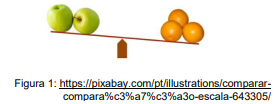
Choose the phrase that best represents the
image.
“Riding a horse is not as easy as Riding a motor cycle.”
THOMSON, A. J., MARTINET, A. V. A pratical english gramar. New York: Oxford. 1995, p. 39)
Choose the correct answer:
“Students review and extend important language for learning English, including how to say some letters of the alphabet, ask questions about language and identify parts of speech. The lesson includes an interactive game to test mastery of the content, which can be played in both online and face-to-face contexts. There is also a short optional extension activity about the NATO alphabet.” by Stephanie Hirschman.
(https://www.linguahouse.com/pt/esl-lesson-plans/general-english/language-for-learning)
Select the alternative that has only preposition.
I. Some people talk _________ their work all the time.
II. She goes to work _______ foot.
III. Do you like travelling ______ train? IV. Do you coffee _____ sugar?
“I’___________ to Mr. Pitt and tell him about Tom’s new house.”
(THOMSON, A. J., MARTINET, A. V. A pratical english gramar. New York: Oxford. 1995, p. 192)
I. Other man will climb these stairs and sit at my desk. – future simple
II. I’ll propably take – future perfect
III. By the end of next month he will have been here for ten Years – future perfect
IV. I will be helping Mary tomorrow. – future simple
Estão corretas as afirmativas:
“His father _______ five years before and since then Tom _________ alone”
(THOMSON, A. J., MARTINET, A. V. A pratical english gramar. New York: Oxford. 1995, p. 176.)
Assinale a alternativa que preencha correta e respectivamente as lacunas.
“At the start of the 20th century, a new city was beginning to grow on some flat land near the sea in southern California; its name was Los Angeles - the name of the old Spanish mission that had been there for many years. At the same time, a new industry was just being born; the cinema. In America, they talked of "motion pictures", but this soon became shortened to "movies".”
(https://linguapress.com/intermediate/hollywoodworld.htm)
Assinale a alternativa que apresenta o tempo verbal do termo em destaque.

 Conheça nossos planos