Questões de Concurso Sobre inglês
Foram encontradas 26.001 questões


INSTRUCTION: Read the following text to answer question.
Do Leveled Books Have Any Place in the Classroom?
“The little turtle can see the grass. The little turtle can see the trees. The little turtle can see the flowers”. These are the opening lines to one popular reading program’s leveled books: short, predictable texts designed for beginning readers. The patterned sentence structure – centered on the phrase “the little turtle can see" – invites students to rely on repetition and context clues to identify words they can’t sound out.
Leveled books have been a staple in early elementary reading instruction for more than two decades. But as the “science of reading” movement has spread, leveled books have come under fire. Initially, they encourage students to guess at words rather than use their phonics skills, researchers say, which can prevent children from mapping the letter-sound connections that allow them to become fluent readers.
A second problem is how they sort students into levels. Studies have shown that leveling systems are frequently inaccurate. These systems are usually created by the books’ publishers, which purport to match students with books that have a just-right alignment with their reading comprehension abilities.
In classrooms that are switching to a science of reading approach, educators are now wary of leveled books, because of the damage that they did, said Wiley Blevins, an educational consultant. In his opinion, when children are still learning the code of written language, it is required a “tight connection” between the letter-sound correspondences they’re learning and the text they’re reading, so that they have opportunities to practice. But leveled texts can’t do this job. Blevins said that the textdifficulty levels also don’t offer much practical use because they don’t tell educators what skills students still need to master – which doesn’t necessarily mean kids can’t ever pick up these books.
But what are leveled texts anyway? In many of the most popular reading programs of the last decade, leveled readers were some of the main texts that children worked with. Teachers used books for instruction, grouping students by their level and assigning them reading strategies to practice in the text. They have also been used for assessment since teachers listened to students read these books aloud, keeping a running record of their errors.
Publishers claimed that the text-leveling system could match students with books that were just right for their abilities – challenging enough to help them practice new skills, but not so challenging as to be frustrating or inaccessible. This idea is based on outdated theories about how children learn. Studies show that students can read books that are above their level with teacher and peer-provided support. They also indicate that restricting students to text at lower reading levels can actually widen achievement gaps.
However, other research has found that the leveling system isn’t even that accurate. A 2014 study showed that data from leveling assessments correctly predicted students’ reading ability only about 50 percent of the time.
The big problem with these books, though, is that they don’t help students develop their decoding skills, that is, their ability to sound out words by connecting letters to spoken sounds, said Kari Kurto, the National Science of Reading Project director at The Reading League – a group that advocates for evidence-based reading policy and classroom practice. Kurto complemented by saying that many of the words in these books aren’t written with constrained sound-spelling patterns, so “there’s no other strategy that a kid can use other than guessing,” Kurto said.
With all of this being said, one question pops up: how teachers can repurpose leveled readers?
As some districts have shifted their reading instructional practice, they have moved from leveled to decodable text – books written to give students practice with the letter-sound correspondences that they are learning in phonics lessons. However, decodable books shouldn’t be the only books that students ever see because at some point they will have to move on to more complex literature, said Blevins. In his point of view, teachers shouldn’t worry about matching students with a particular level, but rather see if they can find books that include some phonics patterns children know.
But can leveled texts build background knowledge? Some educators have repurposed leveled texts in a different way, using them to help students develop content knowledge about a subject. Research shows that students’ background knowledge is a key component of their reading comprehension ability.
According to Kurto, having more books available that might tap into kids’ different interests is valuable. Still, she draws the attention to the fact that many leveled books are written with simple themes and basic vocabulary and syntax. She said, “a lot of the leveled texts are just a little fluffy. If all [students are] getting beyond decodable text is leveled text, then it’s likely that they’re not being exposed to high-quality language and language structures.”
Although the debate about this matter is extensive and opinions are diverse, one thing is worth keeping in mind: what students read in class really matters.
Source: https://www.edweek.org/teaching-learning/doleveled-books-have-any-place-in-the-classroom/2024/10 Accessed on November 13, 2024. [Adapted]
INSTRUCTION: Read the following text to answer question.
Do Leveled Books Have Any Place in the Classroom?
“The little turtle can see the grass. The little turtle can see the trees. The little turtle can see the flowers”. These are the opening lines to one popular reading program’s leveled books: short, predictable texts designed for beginning readers. The patterned sentence structure – centered on the phrase “the little turtle can see" – invites students to rely on repetition and context clues to identify words they can’t sound out.
Leveled books have been a staple in early elementary reading instruction for more than two decades. But as the “science of reading” movement has spread, leveled books have come under fire. Initially, they encourage students to guess at words rather than use their phonics skills, researchers say, which can prevent children from mapping the letter-sound connections that allow them to become fluent readers.
A second problem is how they sort students into levels. Studies have shown that leveling systems are frequently inaccurate. These systems are usually created by the books’ publishers, which purport to match students with books that have a just-right alignment with their reading comprehension abilities.
In classrooms that are switching to a science of reading approach, educators are now wary of leveled books, because of the damage that they did, said Wiley Blevins, an educational consultant. In his opinion, when children are still learning the code of written language, it is required a “tight connection” between the letter-sound correspondences they’re learning and the text they’re reading, so that they have opportunities to practice. But leveled texts can’t do this job. Blevins said that the textdifficulty levels also don’t offer much practical use because they don’t tell educators what skills students still need to master – which doesn’t necessarily mean kids can’t ever pick up these books.
But what are leveled texts anyway? In many of the most popular reading programs of the last decade, leveled readers were some of the main texts that children worked with. Teachers used books for instruction, grouping students by their level and assigning them reading strategies to practice in the text. They have also been used for assessment since teachers listened to students read these books aloud, keeping a running record of their errors.
Publishers claimed that the text-leveling system could match students with books that were just right for their abilities – challenging enough to help them practice new skills, but not so challenging as to be frustrating or inaccessible. This idea is based on outdated theories about how children learn. Studies show that students can read books that are above their level with teacher and peer-provided support. They also indicate that restricting students to text at lower reading levels can actually widen achievement gaps.
However, other research has found that the leveling system isn’t even that accurate. A 2014 study showed that data from leveling assessments correctly predicted students’ reading ability only about 50 percent of the time.
The big problem with these books, though, is that they don’t help students develop their decoding skills, that is, their ability to sound out words by connecting letters to spoken sounds, said Kari Kurto, the National Science of Reading Project director at The Reading League – a group that advocates for evidence-based reading policy and classroom practice. Kurto complemented by saying that many of the words in these books aren’t written with constrained sound-spelling patterns, so “there’s no other strategy that a kid can use other than guessing,” Kurto said.
With all of this being said, one question pops up: how teachers can repurpose leveled readers?
As some districts have shifted their reading instructional practice, they have moved from leveled to decodable text – books written to give students practice with the letter-sound correspondences that they are learning in phonics lessons. However, decodable books shouldn’t be the only books that students ever see because at some point they will have to move on to more complex literature, said Blevins. In his point of view, teachers shouldn’t worry about matching students with a particular level, but rather see if they can find books that include some phonics patterns children know.
But can leveled texts build background knowledge? Some educators have repurposed leveled texts in a different way, using them to help students develop content knowledge about a subject. Research shows that students’ background knowledge is a key component of their reading comprehension ability.
According to Kurto, having more books available that might tap into kids’ different interests is valuable. Still, she draws the attention to the fact that many leveled books are written with simple themes and basic vocabulary and syntax. She said, “a lot of the leveled texts are just a little fluffy. If all [students are] getting beyond decodable text is leveled text, then it’s likely that they’re not being exposed to high-quality language and language structures.”
Although the debate about this matter is extensive and opinions are diverse, one thing is worth keeping in mind: what students read in class really matters.
Source: https://www.edweek.org/teaching-learning/doleveled-books-have-any-place-in-the-classroom/2024/10 Accessed on November 13, 2024. [Adapted]
INSTRUCTION: Read the following text to answer question.
Do Leveled Books Have Any Place in the Classroom?
“The little turtle can see the grass. The little turtle can see the trees. The little turtle can see the flowers”. These are the opening lines to one popular reading program’s leveled books: short, predictable texts designed for beginning readers. The patterned sentence structure – centered on the phrase “the little turtle can see" – invites students to rely on repetition and context clues to identify words they can’t sound out.
Leveled books have been a staple in early elementary reading instruction for more than two decades. But as the “science of reading” movement has spread, leveled books have come under fire. Initially, they encourage students to guess at words rather than use their phonics skills, researchers say, which can prevent children from mapping the letter-sound connections that allow them to become fluent readers.
A second problem is how they sort students into levels. Studies have shown that leveling systems are frequently inaccurate. These systems are usually created by the books’ publishers, which purport to match students with books that have a just-right alignment with their reading comprehension abilities.
In classrooms that are switching to a science of reading approach, educators are now wary of leveled books, because of the damage that they did, said Wiley Blevins, an educational consultant. In his opinion, when children are still learning the code of written language, it is required a “tight connection” between the letter-sound correspondences they’re learning and the text they’re reading, so that they have opportunities to practice. But leveled texts can’t do this job. Blevins said that the textdifficulty levels also don’t offer much practical use because they don’t tell educators what skills students still need to master – which doesn’t necessarily mean kids can’t ever pick up these books.
But what are leveled texts anyway? In many of the most popular reading programs of the last decade, leveled readers were some of the main texts that children worked with. Teachers used books for instruction, grouping students by their level and assigning them reading strategies to practice in the text. They have also been used for assessment since teachers listened to students read these books aloud, keeping a running record of their errors.
Publishers claimed that the text-leveling system could match students with books that were just right for their abilities – challenging enough to help them practice new skills, but not so challenging as to be frustrating or inaccessible. This idea is based on outdated theories about how children learn. Studies show that students can read books that are above their level with teacher and peer-provided support. They also indicate that restricting students to text at lower reading levels can actually widen achievement gaps.
However, other research has found that the leveling system isn’t even that accurate. A 2014 study showed that data from leveling assessments correctly predicted students’ reading ability only about 50 percent of the time.
The big problem with these books, though, is that they don’t help students develop their decoding skills, that is, their ability to sound out words by connecting letters to spoken sounds, said Kari Kurto, the National Science of Reading Project director at The Reading League – a group that advocates for evidence-based reading policy and classroom practice. Kurto complemented by saying that many of the words in these books aren’t written with constrained sound-spelling patterns, so “there’s no other strategy that a kid can use other than guessing,” Kurto said.
With all of this being said, one question pops up: how teachers can repurpose leveled readers?
As some districts have shifted their reading instructional practice, they have moved from leveled to decodable text – books written to give students practice with the letter-sound correspondences that they are learning in phonics lessons. However, decodable books shouldn’t be the only books that students ever see because at some point they will have to move on to more complex literature, said Blevins. In his point of view, teachers shouldn’t worry about matching students with a particular level, but rather see if they can find books that include some phonics patterns children know.
But can leveled texts build background knowledge? Some educators have repurposed leveled texts in a different way, using them to help students develop content knowledge about a subject. Research shows that students’ background knowledge is a key component of their reading comprehension ability.
According to Kurto, having more books available that might tap into kids’ different interests is valuable. Still, she draws the attention to the fact that many leveled books are written with simple themes and basic vocabulary and syntax. She said, “a lot of the leveled texts are just a little fluffy. If all [students are] getting beyond decodable text is leveled text, then it’s likely that they’re not being exposed to high-quality language and language structures.”
Although the debate about this matter is extensive and opinions are diverse, one thing is worth keeping in mind: what students read in class really matters.
Source: https://www.edweek.org/teaching-learning/doleveled-books-have-any-place-in-the-classroom/2024/10 Accessed on November 13, 2024. [Adapted]
“These systems are usually created by the books’ publishers, which purport to match students with books (…)”.
As regards it, mark the following statements as (C) if Correct, or (I) if Incorrect.
( ) “Purport” is a verb that means “to claim to be or do a particular thing when this claim may not be true”.
( ) If “oddly” replaces “usually”, the meaning of the sentence will remain the same.
( ) In the word “created”, -ed is a bound morpheme.
The statements are, from up to down, respectively:
INSTRUCTION: Read the following text to answer question.
Do Leveled Books Have Any Place in the Classroom?
“The little turtle can see the grass. The little turtle can see the trees. The little turtle can see the flowers”. These are the opening lines to one popular reading program’s leveled books: short, predictable texts designed for beginning readers. The patterned sentence structure – centered on the phrase “the little turtle can see" – invites students to rely on repetition and context clues to identify words they can’t sound out.
Leveled books have been a staple in early elementary reading instruction for more than two decades. But as the “science of reading” movement has spread, leveled books have come under fire. Initially, they encourage students to guess at words rather than use their phonics skills, researchers say, which can prevent children from mapping the letter-sound connections that allow them to become fluent readers.
A second problem is how they sort students into levels. Studies have shown that leveling systems are frequently inaccurate. These systems are usually created by the books’ publishers, which purport to match students with books that have a just-right alignment with their reading comprehension abilities.
In classrooms that are switching to a science of reading approach, educators are now wary of leveled books, because of the damage that they did, said Wiley Blevins, an educational consultant. In his opinion, when children are still learning the code of written language, it is required a “tight connection” between the letter-sound correspondences they’re learning and the text they’re reading, so that they have opportunities to practice. But leveled texts can’t do this job. Blevins said that the textdifficulty levels also don’t offer much practical use because they don’t tell educators what skills students still need to master – which doesn’t necessarily mean kids can’t ever pick up these books.
But what are leveled texts anyway? In many of the most popular reading programs of the last decade, leveled readers were some of the main texts that children worked with. Teachers used books for instruction, grouping students by their level and assigning them reading strategies to practice in the text. They have also been used for assessment since teachers listened to students read these books aloud, keeping a running record of their errors.
Publishers claimed that the text-leveling system could match students with books that were just right for their abilities – challenging enough to help them practice new skills, but not so challenging as to be frustrating or inaccessible. This idea is based on outdated theories about how children learn. Studies show that students can read books that are above their level with teacher and peer-provided support. They also indicate that restricting students to text at lower reading levels can actually widen achievement gaps.
However, other research has found that the leveling system isn’t even that accurate. A 2014 study showed that data from leveling assessments correctly predicted students’ reading ability only about 50 percent of the time.
The big problem with these books, though, is that they don’t help students develop their decoding skills, that is, their ability to sound out words by connecting letters to spoken sounds, said Kari Kurto, the National Science of Reading Project director at The Reading League – a group that advocates for evidence-based reading policy and classroom practice. Kurto complemented by saying that many of the words in these books aren’t written with constrained sound-spelling patterns, so “there’s no other strategy that a kid can use other than guessing,” Kurto said.
With all of this being said, one question pops up: how teachers can repurpose leveled readers?
As some districts have shifted their reading instructional practice, they have moved from leveled to decodable text – books written to give students practice with the letter-sound correspondences that they are learning in phonics lessons. However, decodable books shouldn’t be the only books that students ever see because at some point they will have to move on to more complex literature, said Blevins. In his point of view, teachers shouldn’t worry about matching students with a particular level, but rather see if they can find books that include some phonics patterns children know.
But can leveled texts build background knowledge? Some educators have repurposed leveled texts in a different way, using them to help students develop content knowledge about a subject. Research shows that students’ background knowledge is a key component of their reading comprehension ability.
According to Kurto, having more books available that might tap into kids’ different interests is valuable. Still, she draws the attention to the fact that many leveled books are written with simple themes and basic vocabulary and syntax. She said, “a lot of the leveled texts are just a little fluffy. If all [students are] getting beyond decodable text is leveled text, then it’s likely that they’re not being exposed to high-quality language and language structures.”
Although the debate about this matter is extensive and opinions are diverse, one thing is worth keeping in mind: what students read in class really matters.
Source: https://www.edweek.org/teaching-learning/doleveled-books-have-any-place-in-the-classroom/2024/10 Accessed on November 13, 2024. [Adapted]
INSTRUCTION: Read the following text to answer question.
Do Leveled Books Have Any Place in the Classroom?
“The little turtle can see the grass. The little turtle can see the trees. The little turtle can see the flowers”. These are the opening lines to one popular reading program’s leveled books: short, predictable texts designed for beginning readers. The patterned sentence structure – centered on the phrase “the little turtle can see" – invites students to rely on repetition and context clues to identify words they can’t sound out.
Leveled books have been a staple in early elementary reading instruction for more than two decades. But as the “science of reading” movement has spread, leveled books have come under fire. Initially, they encourage students to guess at words rather than use their phonics skills, researchers say, which can prevent children from mapping the letter-sound connections that allow them to become fluent readers.
A second problem is how they sort students into levels. Studies have shown that leveling systems are frequently inaccurate. These systems are usually created by the books’ publishers, which purport to match students with books that have a just-right alignment with their reading comprehension abilities.
In classrooms that are switching to a science of reading approach, educators are now wary of leveled books, because of the damage that they did, said Wiley Blevins, an educational consultant. In his opinion, when children are still learning the code of written language, it is required a “tight connection” between the letter-sound correspondences they’re learning and the text they’re reading, so that they have opportunities to practice. But leveled texts can’t do this job. Blevins said that the textdifficulty levels also don’t offer much practical use because they don’t tell educators what skills students still need to master – which doesn’t necessarily mean kids can’t ever pick up these books.
But what are leveled texts anyway? In many of the most popular reading programs of the last decade, leveled readers were some of the main texts that children worked with. Teachers used books for instruction, grouping students by their level and assigning them reading strategies to practice in the text. They have also been used for assessment since teachers listened to students read these books aloud, keeping a running record of their errors.
Publishers claimed that the text-leveling system could match students with books that were just right for their abilities – challenging enough to help them practice new skills, but not so challenging as to be frustrating or inaccessible. This idea is based on outdated theories about how children learn. Studies show that students can read books that are above their level with teacher and peer-provided support. They also indicate that restricting students to text at lower reading levels can actually widen achievement gaps.
However, other research has found that the leveling system isn’t even that accurate. A 2014 study showed that data from leveling assessments correctly predicted students’ reading ability only about 50 percent of the time.
The big problem with these books, though, is that they don’t help students develop their decoding skills, that is, their ability to sound out words by connecting letters to spoken sounds, said Kari Kurto, the National Science of Reading Project director at The Reading League – a group that advocates for evidence-based reading policy and classroom practice. Kurto complemented by saying that many of the words in these books aren’t written with constrained sound-spelling patterns, so “there’s no other strategy that a kid can use other than guessing,” Kurto said.
With all of this being said, one question pops up: how teachers can repurpose leveled readers?
As some districts have shifted their reading instructional practice, they have moved from leveled to decodable text – books written to give students practice with the letter-sound correspondences that they are learning in phonics lessons. However, decodable books shouldn’t be the only books that students ever see because at some point they will have to move on to more complex literature, said Blevins. In his point of view, teachers shouldn’t worry about matching students with a particular level, but rather see if they can find books that include some phonics patterns children know.
But can leveled texts build background knowledge? Some educators have repurposed leveled texts in a different way, using them to help students develop content knowledge about a subject. Research shows that students’ background knowledge is a key component of their reading comprehension ability.
According to Kurto, having more books available that might tap into kids’ different interests is valuable. Still, she draws the attention to the fact that many leveled books are written with simple themes and basic vocabulary and syntax. She said, “a lot of the leveled texts are just a little fluffy. If all [students are] getting beyond decodable text is leveled text, then it’s likely that they’re not being exposed to high-quality language and language structures.”
Although the debate about this matter is extensive and opinions are diverse, one thing is worth keeping in mind: what students read in class really matters.
Source: https://www.edweek.org/teaching-learning/doleveled-books-have-any-place-in-the-classroom/2024/10 Accessed on November 13, 2024. [Adapted]
INSTRUCTION: Read the following text to answer question.
Do Leveled Books Have Any Place in the Classroom?
“The little turtle can see the grass. The little turtle can see the trees. The little turtle can see the flowers”. These are the opening lines to one popular reading program’s leveled books: short, predictable texts designed for beginning readers. The patterned sentence structure – centered on the phrase “the little turtle can see" – invites students to rely on repetition and context clues to identify words they can’t sound out.
Leveled books have been a staple in early elementary reading instruction for more than two decades. But as the “science of reading” movement has spread, leveled books have come under fire. Initially, they encourage students to guess at words rather than use their phonics skills, researchers say, which can prevent children from mapping the letter-sound connections that allow them to become fluent readers.
A second problem is how they sort students into levels. Studies have shown that leveling systems are frequently inaccurate. These systems are usually created by the books’ publishers, which purport to match students with books that have a just-right alignment with their reading comprehension abilities.
In classrooms that are switching to a science of reading approach, educators are now wary of leveled books, because of the damage that they did, said Wiley Blevins, an educational consultant. In his opinion, when children are still learning the code of written language, it is required a “tight connection” between the letter-sound correspondences they’re learning and the text they’re reading, so that they have opportunities to practice. But leveled texts can’t do this job. Blevins said that the textdifficulty levels also don’t offer much practical use because they don’t tell educators what skills students still need to master – which doesn’t necessarily mean kids can’t ever pick up these books.
But what are leveled texts anyway? In many of the most popular reading programs of the last decade, leveled readers were some of the main texts that children worked with. Teachers used books for instruction, grouping students by their level and assigning them reading strategies to practice in the text. They have also been used for assessment since teachers listened to students read these books aloud, keeping a running record of their errors.
Publishers claimed that the text-leveling system could match students with books that were just right for their abilities – challenging enough to help them practice new skills, but not so challenging as to be frustrating or inaccessible. This idea is based on outdated theories about how children learn. Studies show that students can read books that are above their level with teacher and peer-provided support. They also indicate that restricting students to text at lower reading levels can actually widen achievement gaps.
However, other research has found that the leveling system isn’t even that accurate. A 2014 study showed that data from leveling assessments correctly predicted students’ reading ability only about 50 percent of the time.
The big problem with these books, though, is that they don’t help students develop their decoding skills, that is, their ability to sound out words by connecting letters to spoken sounds, said Kari Kurto, the National Science of Reading Project director at The Reading League – a group that advocates for evidence-based reading policy and classroom practice. Kurto complemented by saying that many of the words in these books aren’t written with constrained sound-spelling patterns, so “there’s no other strategy that a kid can use other than guessing,” Kurto said.
With all of this being said, one question pops up: how teachers can repurpose leveled readers?
As some districts have shifted their reading instructional practice, they have moved from leveled to decodable text – books written to give students practice with the letter-sound correspondences that they are learning in phonics lessons. However, decodable books shouldn’t be the only books that students ever see because at some point they will have to move on to more complex literature, said Blevins. In his point of view, teachers shouldn’t worry about matching students with a particular level, but rather see if they can find books that include some phonics patterns children know.
But can leveled texts build background knowledge? Some educators have repurposed leveled texts in a different way, using them to help students develop content knowledge about a subject. Research shows that students’ background knowledge is a key component of their reading comprehension ability.
According to Kurto, having more books available that might tap into kids’ different interests is valuable. Still, she draws the attention to the fact that many leveled books are written with simple themes and basic vocabulary and syntax. She said, “a lot of the leveled texts are just a little fluffy. If all [students are] getting beyond decodable text is leveled text, then it’s likely that they’re not being exposed to high-quality language and language structures.”
Although the debate about this matter is extensive and opinions are diverse, one thing is worth keeping in mind: what students read in class really matters.
Source: https://www.edweek.org/teaching-learning/doleveled-books-have-any-place-in-the-classroom/2024/10 Accessed on November 13, 2024. [Adapted]
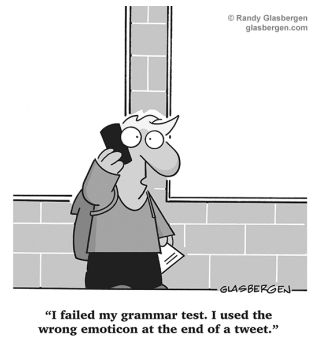
Available at: https://www.glasbergen.com/education-cartoons/ language-grammar/. Accessed on: Sept 3rd, 2024.
Available at: https://www.glasbergen.com/education-cartoons/ language-grammar/. Accessed on: Sept 3rd, 2024.
Part of the construction of humor in cartoons is what we infer from the text.
We can infer from the cartoon that the student is
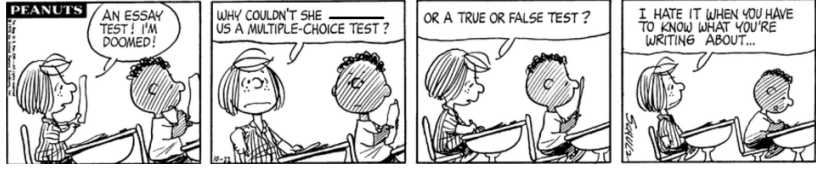
Available at: https://www.gocomics.com/peanuts/1970/10/22. Accessed on: Sept 3rd, 2024.
Choose the appropriate alternative to complete her sentence with the correct grammar.
Available at: https://www.gocomics.com/peanuts/1970/10/22. Accessed on: Sept 3rd, 2024.
[…]
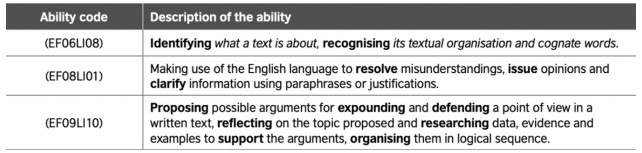
To develop the BNCC ability EF06LI08, which includes recognizing cognate words, an English teacher should provide students with targeted reading activities. These activities should, for instance, include opportunities for students to

 Conheça nossos planos