Questões de Concurso Sobre inglês
Foram encontradas 25.431 questões


Ano: 2012
Banca:
CESGRANRIO
Órgão:
DECEA
Prova:
CESGRANRIO - 2012 - DECEA - Controlador de Tráfego Aéreo Código |
Q277971
Inglês

President Obama’s warning to air traffic controllers “‘You better do your job.’” (lines 4-5, Text II) can be rephrased as
Ano: 2012
Banca:
CESGRANRIO
Órgão:
DECEA
Prova:
CESGRANRIO - 2012 - DECEA - Controlador de Tráfego Aéreo Código |
Q277970
Inglês

In Text I, the boldfaced item is synonymous with the expression in italics in
Ano: 2012
Banca:
CESGRANRIO
Órgão:
DECEA
Prova:
CESGRANRIO - 2012 - DECEA - Controlador de Tráfego Aéreo Código |
Q277969
Inglês
Based on Text I, lack of adequate amount of sleep is NOT responsible for
Ano: 2012
Banca:
CESGRANRIO
Órgão:
DECEA
Prova:
CESGRANRIO - 2012 - DECEA - Controlador de Tráfego Aéreo Código |
Q277968
Inglês
According to the author of Text I, it has been proven scientifically that workers who have jobs that demand they work in shifts
Ano: 2012
Banca:
CESGRANRIO
Órgão:
DECEA
Prova:
CESGRANRIO - 2012 - DECEA - Controlador de Tráfego Aéreo Código |
Q277967
Inglês
According to Text I, the Federal Aviation Administration, in response to serious public safety issues, has defined new norms that include all of the following, EXCEPT
Ano: 2012
Banca:
CESGRANRIO
Órgão:
DECEA
Prova:
CESGRANRIO - 2012 - DECEA - Controlador de Tráfego Aéreo Código |
Q277966
Inglês
In the fragment of Text I: “It is important, I believe, to separate the issue of air traffic controllers sleeping on the job from their choice to play with laptops and cell phones when they are supposed to be working” (lines 15-18), Dr. Michael Breus implies that
Ano: 2012
Banca:
CESGRANRIO
Órgão:
DECEA
Prova:
CESGRANRIO - 2012 - DECEA - Controlador de Tráfego Aéreo Código |
Q277965
Inglês
In Text I, the expression downright scary in “Here’s some news of workers sleeping on the job that’s downright scary.” (lines 1-2) can be replaced, without change in meaning, by
Ano: 2012
Banca:
CESGRANRIO
Órgão:
DECEA
Prova:
CESGRANRIO - 2012 - DECEA - Controlador de Tráfego Aéreo Código |
Q277964
Inglês
After reading Text I, it is possible to infer that the author’s intention is to
Ano: 2012
Banca:
CESPE / CEBRASPE
Órgão:
ANATEL
Prova:
CESPE - 2012 - ANATEL - Analista Administrativo |
Q277466
Inglês
Texto associado
This text refers to items from 23 to 28.

Based on the text, judge the following items.
Based on the text, judge the following items.
In the text,
the expression “At present” (L.24) is an adverb of place.
the expression “At present” (L.24) is an adverb of place.
Ano: 2012
Banca:
CESPE / CEBRASPE
Órgão:
ANATEL
Prova:
CESPE - 2012 - ANATEL - Analista Administrativo |
Q277465
Inglês
Texto associado
This text refers to items from 23 to 28.
Based on the text, judge the following items.
Based on the text, judge the following items.
Technological progress can, now and then, bring about problems, but it can also, more frequently, come up with their attainable solutions.
Ano: 2012
Banca:
CESPE / CEBRASPE
Órgão:
ANATEL
Prova:
CESPE - 2012 - ANATEL - Analista Administrativo |
Q277464
Inglês
Texto associado
This text refers to items from 23 to 28.
Based on the text, judge the following items.
Based on the text, judge the following items.
Nowadays, the crucial problems concerning society have to do with socioeconomic and political issues.
Ano: 2012
Banca:
CESPE / CEBRASPE
Órgão:
ANATEL
Prova:
CESPE - 2012 - ANATEL - Analista Administrativo |
Q277463
Inglês
Texto associado
This text refers to items from 23 to 28.
Based on the text, judge the following items.
Based on the text, judge the following items.
The majority of world’s leaders fail to notice the increasing pace of technological progress on one hand, and on the other the slowing down of social progress.
Ano: 2012
Banca:
CESPE / CEBRASPE
Órgão:
ANATEL
Prova:
CESPE - 2012 - ANATEL - Analista Administrativo |
Q277462
Inglês
Texto associado
This text refers to items from 23 to 28.
Based on the text, judge the following items.
Based on the text, judge the following items.
It is advisable to evaluate the likelihood of highly meaningful coming events.
Ano: 2012
Banca:
CESPE / CEBRASPE
Órgão:
ANATEL
Prova:
CESPE - 2012 - ANATEL - Analista Administrativo |
Q277461
Inglês
Texto associado
This text refers to items from 23 to 28.
Based on the text, judge the following items.
Based on the text, judge the following items.
Future forecast is entirely untenable.
Ano: 2012
Banca:
CESGRANRIO
Órgão:
Innova
Provas:
CESGRANRIO - 2012 - Innova - Advogado Júnior
|
CESGRANRIO - 2012 - Innova - Analista de Sistemas Júnior |
CESGRANRIO - 2012 - Innova - Administrador Júnior |
CESGRANRIO - 2012 - Innova - Contador Júnior |
CESGRANRIO - 2012 - Innova - Médico do Trabalho Júnior |
CESGRANRIO - 2012 - Innova - Engenheiro de Equipamento Júnior - Mecânica |
CESGRANRIO - 2012 - Innova - Engenheiro de Equipamento Júnior - Elétrica |
Q276497
Inglês
Texto associado
Text II
The Underwater Centre secures its biggest ever contract – worth $1.3million - to train Russian saturation divers
Your Oil and Gas News Magazine The world's leading commercial diver and Remotely Operated Vehicle (ROV) training facility, based in the Scottish Highlands and Australia, has secured its biggest ever contract – worth US$ 1.3 million – to train Russian saturation divers.
The award cements its reputation as a major service provider for the growing worldwide oil and gas industry. The men, already experienced air divers, were trained on saturation procedures and techniques and will receive the Australian Diver Accreditation Scheme (ADAS) and the Closed Bell certification. More advanced than the ADAS, the Closed Bell is the certification appropriate to deep water dives of 60 meters / 200 feet, using a trimix tank with 16 percent oxygen (O2). During the training, divers lived in a chamber for up to 28 days, which was pressurized to the same pressure of the sea, exactly at the depth that they will be working at. Living and working at pressure mean that they can be transported quickly and efficiently to the work site under the water without decompression stops, allowing divers to work in much greater depths and for much longer periods of time. MRTS Managing Director Alexander Kolikov said: “Oil and gas firms in Russia are currently facing a skills shortage due to the rapidly increasing amount of exploration work underway at the moment. By investing in the training of our divers in saturation diving, we are addressing this need for experts in maintenance and repair activities vital to maintaining Russia's subsea infrastructure." Steve Ham, General Manager at the Fort William Centre said: “We were delighted when MRTS chose The Underwater Centre to train its divers in saturation diving, and I think this is testament to the hard work we have been putting in to ensure our reputation as a world-class training facility. Available at: . Retrieved on: 28 June 2012. Adapted.
The Underwater Centre secures its biggest ever contract – worth $1.3million - to train Russian saturation divers
Your Oil and Gas News Magazine The world's leading commercial diver and Remotely Operated Vehicle (ROV) training facility, based in the Scottish Highlands and Australia, has secured its biggest ever contract – worth US$ 1.3 million – to train Russian saturation divers.
The award cements its reputation as a major service provider for the growing worldwide oil and gas industry. The men, already experienced air divers, were trained on saturation procedures and techniques and will receive the Australian Diver Accreditation Scheme (ADAS) and the Closed Bell certification. More advanced than the ADAS, the Closed Bell is the certification appropriate to deep water dives of 60 meters / 200 feet, using a trimix tank with 16 percent oxygen (O2). During the training, divers lived in a chamber for up to 28 days, which was pressurized to the same pressure of the sea, exactly at the depth that they will be working at. Living and working at pressure mean that they can be transported quickly and efficiently to the work site under the water without decompression stops, allowing divers to work in much greater depths and for much longer periods of time. MRTS Managing Director Alexander Kolikov said: “Oil and gas firms in Russia are currently facing a skills shortage due to the rapidly increasing amount of exploration work underway at the moment. By investing in the training of our divers in saturation diving, we are addressing this need for experts in maintenance and repair activities vital to maintaining Russia's subsea infrastructure." Steve Ham, General Manager at the Fort William Centre said: “We were delighted when MRTS chose The Underwater Centre to train its divers in saturation diving, and I think this is testament to the hard work we have been putting in to ensure our reputation as a world-class training facility. Available at: . Retrieved on: 28 June 2012. Adapted.
In Text II, Steve Ham, General Manager at the Fort William Centre, is
Ano: 2012
Banca:
CESGRANRIO
Órgão:
Innova
Provas:
CESGRANRIO - 2012 - Innova - Advogado Júnior
|
CESGRANRIO - 2012 - Innova - Analista de Sistemas Júnior |
CESGRANRIO - 2012 - Innova - Administrador Júnior |
CESGRANRIO - 2012 - Innova - Contador Júnior |
CESGRANRIO - 2012 - Innova - Médico do Trabalho Júnior |
CESGRANRIO - 2012 - Innova - Engenheiro de Equipamento Júnior - Mecânica |
CESGRANRIO - 2012 - Innova - Engenheiro de Equipamento Júnior - Elétrica |
Q276496
Inglês
Texto associado
Text II
The Underwater Centre secures its biggest ever contract – worth $1.3million - to train Russian saturation divers
Your Oil and Gas News Magazine The world's leading commercial diver and Remotely Operated Vehicle (ROV) training facility, based in the Scottish Highlands and Australia, has secured its biggest ever contract – worth US$ 1.3 million – to train Russian saturation divers.
The award cements its reputation as a major service provider for the growing worldwide oil and gas industry. The men, already experienced air divers, were trained on saturation procedures and techniques and will receive the Australian Diver Accreditation Scheme (ADAS) and the Closed Bell certification. More advanced than the ADAS, the Closed Bell is the certification appropriate to deep water dives of 60 meters / 200 feet, using a trimix tank with 16 percent oxygen (O2). During the training, divers lived in a chamber for up to 28 days, which was pressurized to the same pressure of the sea, exactly at the depth that they will be working at. Living and working at pressure mean that they can be transported quickly and efficiently to the work site under the water without decompression stops, allowing divers to work in much greater depths and for much longer periods of time. MRTS Managing Director Alexander Kolikov said: “Oil and gas firms in Russia are currently facing a skills shortage due to the rapidly increasing amount of exploration work underway at the moment. By investing in the training of our divers in saturation diving, we are addressing this need for experts in maintenance and repair activities vital to maintaining Russia's subsea infrastructure." Steve Ham, General Manager at the Fort William Centre said: “We were delighted when MRTS chose The Underwater Centre to train its divers in saturation diving, and I think this is testament to the hard work we have been putting in to ensure our reputation as a world-class training facility. Available at: . Retrieved on: 28 June 2012. Adapted.
The Underwater Centre secures its biggest ever contract – worth $1.3million - to train Russian saturation divers
Your Oil and Gas News Magazine The world's leading commercial diver and Remotely Operated Vehicle (ROV) training facility, based in the Scottish Highlands and Australia, has secured its biggest ever contract – worth US$ 1.3 million – to train Russian saturation divers.
The award cements its reputation as a major service provider for the growing worldwide oil and gas industry. The men, already experienced air divers, were trained on saturation procedures and techniques and will receive the Australian Diver Accreditation Scheme (ADAS) and the Closed Bell certification. More advanced than the ADAS, the Closed Bell is the certification appropriate to deep water dives of 60 meters / 200 feet, using a trimix tank with 16 percent oxygen (O2). During the training, divers lived in a chamber for up to 28 days, which was pressurized to the same pressure of the sea, exactly at the depth that they will be working at. Living and working at pressure mean that they can be transported quickly and efficiently to the work site under the water without decompression stops, allowing divers to work in much greater depths and for much longer periods of time. MRTS Managing Director Alexander Kolikov said: “Oil and gas firms in Russia are currently facing a skills shortage due to the rapidly increasing amount of exploration work underway at the moment. By investing in the training of our divers in saturation diving, we are addressing this need for experts in maintenance and repair activities vital to maintaining Russia's subsea infrastructure." Steve Ham, General Manager at the Fort William Centre said: “We were delighted when MRTS chose The Underwater Centre to train its divers in saturation diving, and I think this is testament to the hard work we have been putting in to ensure our reputation as a world-class training facility. Available at: . Retrieved on: 28 June 2012. Adapted.
In Text II, Director Kolikov explains that the
Ano: 2012
Banca:
CESGRANRIO
Órgão:
Innova
Provas:
CESGRANRIO - 2012 - Innova - Advogado Júnior
|
CESGRANRIO - 2012 - Innova - Analista de Sistemas Júnior |
CESGRANRIO - 2012 - Innova - Administrador Júnior |
CESGRANRIO - 2012 - Innova - Contador Júnior |
CESGRANRIO - 2012 - Innova - Médico do Trabalho Júnior |
CESGRANRIO - 2012 - Innova - Engenheiro de Equipamento Júnior - Mecânica |
CESGRANRIO - 2012 - Innova - Engenheiro de Equipamento Júnior - Elétrica |
Q276495
Inglês
Texto associado
Text II
The Underwater Centre secures its biggest ever contract – worth $1.3million - to train Russian saturation divers
Your Oil and Gas News Magazine The world's leading commercial diver and Remotely Operated Vehicle (ROV) training facility, based in the Scottish Highlands and Australia, has secured its biggest ever contract – worth US$ 1.3 million – to train Russian saturation divers.
The award cements its reputation as a major service provider for the growing worldwide oil and gas industry. The men, already experienced air divers, were trained on saturation procedures and techniques and will receive the Australian Diver Accreditation Scheme (ADAS) and the Closed Bell certification. More advanced than the ADAS, the Closed Bell is the certification appropriate to deep water dives of 60 meters / 200 feet, using a trimix tank with 16 percent oxygen (O2). During the training, divers lived in a chamber for up to 28 days, which was pressurized to the same pressure of the sea, exactly at the depth that they will be working at. Living and working at pressure mean that they can be transported quickly and efficiently to the work site under the water without decompression stops, allowing divers to work in much greater depths and for much longer periods of time. MRTS Managing Director Alexander Kolikov said: “Oil and gas firms in Russia are currently facing a skills shortage due to the rapidly increasing amount of exploration work underway at the moment. By investing in the training of our divers in saturation diving, we are addressing this need for experts in maintenance and repair activities vital to maintaining Russia's subsea infrastructure." Steve Ham, General Manager at the Fort William Centre said: “We were delighted when MRTS chose The Underwater Centre to train its divers in saturation diving, and I think this is testament to the hard work we have been putting in to ensure our reputation as a world-class training facility. Available at: . Retrieved on: 28 June 2012. Adapted.
The Underwater Centre secures its biggest ever contract – worth $1.3million - to train Russian saturation divers
Your Oil and Gas News Magazine The world's leading commercial diver and Remotely Operated Vehicle (ROV) training facility, based in the Scottish Highlands and Australia, has secured its biggest ever contract – worth US$ 1.3 million – to train Russian saturation divers.
The award cements its reputation as a major service provider for the growing worldwide oil and gas industry. The men, already experienced air divers, were trained on saturation procedures and techniques and will receive the Australian Diver Accreditation Scheme (ADAS) and the Closed Bell certification. More advanced than the ADAS, the Closed Bell is the certification appropriate to deep water dives of 60 meters / 200 feet, using a trimix tank with 16 percent oxygen (O2). During the training, divers lived in a chamber for up to 28 days, which was pressurized to the same pressure of the sea, exactly at the depth that they will be working at. Living and working at pressure mean that they can be transported quickly and efficiently to the work site under the water without decompression stops, allowing divers to work in much greater depths and for much longer periods of time. MRTS Managing Director Alexander Kolikov said: “Oil and gas firms in Russia are currently facing a skills shortage due to the rapidly increasing amount of exploration work underway at the moment. By investing in the training of our divers in saturation diving, we are addressing this need for experts in maintenance and repair activities vital to maintaining Russia's subsea infrastructure." Steve Ham, General Manager at the Fort William Centre said: “We were delighted when MRTS chose The Underwater Centre to train its divers in saturation diving, and I think this is testament to the hard work we have been putting in to ensure our reputation as a world-class training facility. Available at: . Retrieved on: 28 June 2012. Adapted.
About the training, it is stated in Text II that
Ano: 2012
Banca:
CESGRANRIO
Órgão:
Innova
Provas:
CESGRANRIO - 2012 - Innova - Advogado Júnior
|
CESGRANRIO - 2012 - Innova - Analista de Sistemas Júnior |
CESGRANRIO - 2012 - Innova - Administrador Júnior |
CESGRANRIO - 2012 - Innova - Contador Júnior |
CESGRANRIO - 2012 - Innova - Médico do Trabalho Júnior |
CESGRANRIO - 2012 - Innova - Engenheiro de Equipamento Júnior - Mecânica |
CESGRANRIO - 2012 - Innova - Engenheiro de Equipamento Júnior - Elétrica |
Q276494
Inglês
Texto associado
Text II
The Underwater Centre secures its biggest ever contract – worth $1.3million - to train Russian saturation divers
Your Oil and Gas News Magazine The world's leading commercial diver and Remotely Operated Vehicle (ROV) training facility, based in the Scottish Highlands and Australia, has secured its biggest ever contract – worth US$ 1.3 million – to train Russian saturation divers.
The award cements its reputation as a major service provider for the growing worldwide oil and gas industry. The men, already experienced air divers, were trained on saturation procedures and techniques and will receive the Australian Diver Accreditation Scheme (ADAS) and the Closed Bell certification. More advanced than the ADAS, the Closed Bell is the certification appropriate to deep water dives of 60 meters / 200 feet, using a trimix tank with 16 percent oxygen (O2). During the training, divers lived in a chamber for up to 28 days, which was pressurized to the same pressure of the sea, exactly at the depth that they will be working at. Living and working at pressure mean that they can be transported quickly and efficiently to the work site under the water without decompression stops, allowing divers to work in much greater depths and for much longer periods of time. MRTS Managing Director Alexander Kolikov said: “Oil and gas firms in Russia are currently facing a skills shortage due to the rapidly increasing amount of exploration work underway at the moment. By investing in the training of our divers in saturation diving, we are addressing this need for experts in maintenance and repair activities vital to maintaining Russia's subsea infrastructure." Steve Ham, General Manager at the Fort William Centre said: “We were delighted when MRTS chose The Underwater Centre to train its divers in saturation diving, and I think this is testament to the hard work we have been putting in to ensure our reputation as a world-class training facility. Available at: . Retrieved on: 28 June 2012. Adapted.
The Underwater Centre secures its biggest ever contract – worth $1.3million - to train Russian saturation divers
Your Oil and Gas News Magazine The world's leading commercial diver and Remotely Operated Vehicle (ROV) training facility, based in the Scottish Highlands and Australia, has secured its biggest ever contract – worth US$ 1.3 million – to train Russian saturation divers.
The award cements its reputation as a major service provider for the growing worldwide oil and gas industry. The men, already experienced air divers, were trained on saturation procedures and techniques and will receive the Australian Diver Accreditation Scheme (ADAS) and the Closed Bell certification. More advanced than the ADAS, the Closed Bell is the certification appropriate to deep water dives of 60 meters / 200 feet, using a trimix tank with 16 percent oxygen (O2). During the training, divers lived in a chamber for up to 28 days, which was pressurized to the same pressure of the sea, exactly at the depth that they will be working at. Living and working at pressure mean that they can be transported quickly and efficiently to the work site under the water without decompression stops, allowing divers to work in much greater depths and for much longer periods of time. MRTS Managing Director Alexander Kolikov said: “Oil and gas firms in Russia are currently facing a skills shortage due to the rapidly increasing amount of exploration work underway at the moment. By investing in the training of our divers in saturation diving, we are addressing this need for experts in maintenance and repair activities vital to maintaining Russia's subsea infrastructure." Steve Ham, General Manager at the Fort William Centre said: “We were delighted when MRTS chose The Underwater Centre to train its divers in saturation diving, and I think this is testament to the hard work we have been putting in to ensure our reputation as a world-class training facility. Available at: . Retrieved on: 28 June 2012. Adapted.
In Text II, when the author states that the divers completed an air course prior to the saturation diver training, he means that
Ano: 2012
Banca:
CESGRANRIO
Órgão:
Innova
Provas:
CESGRANRIO - 2012 - Innova - Advogado Júnior
|
CESGRANRIO - 2012 - Innova - Analista de Sistemas Júnior |
CESGRANRIO - 2012 - Innova - Administrador Júnior |
CESGRANRIO - 2012 - Innova - Contador Júnior |
CESGRANRIO - 2012 - Innova - Médico do Trabalho Júnior |
CESGRANRIO - 2012 - Innova - Engenheiro de Equipamento Júnior - Mecânica |
CESGRANRIO - 2012 - Innova - Engenheiro de Equipamento Júnior - Elétrica |
Q276493
Inglês
Texto associado
Text II
The Underwater Centre secures its biggest ever contract – worth $1.3million - to train Russian saturation divers
Your Oil and Gas News Magazine The world's leading commercial diver and Remotely Operated Vehicle (ROV) training facility, based in the Scottish Highlands and Australia, has secured its biggest ever contract – worth US$ 1.3 million – to train Russian saturation divers.
The award cements its reputation as a major service provider for the growing worldwide oil and gas industry. The men, already experienced air divers, were trained on saturation procedures and techniques and will receive the Australian Diver Accreditation Scheme (ADAS) and the Closed Bell certification. More advanced than the ADAS, the Closed Bell is the certification appropriate to deep water dives of 60 meters / 200 feet, using a trimix tank with 16 percent oxygen (O2). During the training, divers lived in a chamber for up to 28 days, which was pressurized to the same pressure of the sea, exactly at the depth that they will be working at. Living and working at pressure mean that they can be transported quickly and efficiently to the work site under the water without decompression stops, allowing divers to work in much greater depths and for much longer periods of time. MRTS Managing Director Alexander Kolikov said: “Oil and gas firms in Russia are currently facing a skills shortage due to the rapidly increasing amount of exploration work underway at the moment. By investing in the training of our divers in saturation diving, we are addressing this need for experts in maintenance and repair activities vital to maintaining Russia's subsea infrastructure." Steve Ham, General Manager at the Fort William Centre said: “We were delighted when MRTS chose The Underwater Centre to train its divers in saturation diving, and I think this is testament to the hard work we have been putting in to ensure our reputation as a world-class training facility. Available at: . Retrieved on: 28 June 2012. Adapted.
The Underwater Centre secures its biggest ever contract – worth $1.3million - to train Russian saturation divers
Your Oil and Gas News Magazine The world's leading commercial diver and Remotely Operated Vehicle (ROV) training facility, based in the Scottish Highlands and Australia, has secured its biggest ever contract – worth US$ 1.3 million – to train Russian saturation divers.
The award cements its reputation as a major service provider for the growing worldwide oil and gas industry. The men, already experienced air divers, were trained on saturation procedures and techniques and will receive the Australian Diver Accreditation Scheme (ADAS) and the Closed Bell certification. More advanced than the ADAS, the Closed Bell is the certification appropriate to deep water dives of 60 meters / 200 feet, using a trimix tank with 16 percent oxygen (O2). During the training, divers lived in a chamber for up to 28 days, which was pressurized to the same pressure of the sea, exactly at the depth that they will be working at. Living and working at pressure mean that they can be transported quickly and efficiently to the work site under the water without decompression stops, allowing divers to work in much greater depths and for much longer periods of time. MRTS Managing Director Alexander Kolikov said: “Oil and gas firms in Russia are currently facing a skills shortage due to the rapidly increasing amount of exploration work underway at the moment. By investing in the training of our divers in saturation diving, we are addressing this need for experts in maintenance and repair activities vital to maintaining Russia's subsea infrastructure." Steve Ham, General Manager at the Fort William Centre said: “We were delighted when MRTS chose The Underwater Centre to train its divers in saturation diving, and I think this is testament to the hard work we have been putting in to ensure our reputation as a world-class training facility. Available at: . Retrieved on: 28 June 2012. Adapted.
In Text II, the possessive pronoun its (line 6) refers to
Ano: 2012
Banca:
CESGRANRIO
Órgão:
Innova
Provas:
CESGRANRIO - 2012 - Innova - Advogado Júnior
|
CESGRANRIO - 2012 - Innova - Analista de Sistemas Júnior |
CESGRANRIO - 2012 - Innova - Administrador Júnior |
CESGRANRIO - 2012 - Innova - Médico do Trabalho Júnior |
CESGRANRIO - 2012 - Innova - Engenheiro de Equipamento Júnior - Mecânica |
CESGRANRIO - 2012 - Innova - Engenheiro de Equipamento Júnior - Elétrica |
Q276492
Inglês
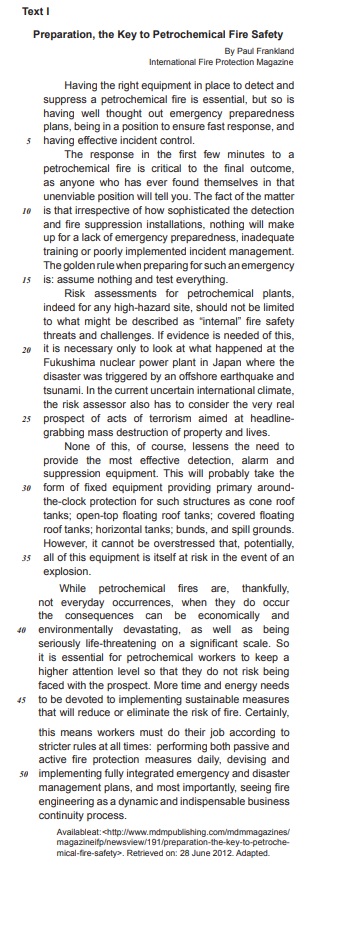
In Text I, the word do in the fragments: “when they do occur"(line 38); “they do not risk being faced"(lines 43-44) and “workers must do their job"(line 47) respectively, fulfill the role of

 Conheça nossos planos