Questões de Concurso Sobre inglês
Foram encontradas 25.349 questões


Ferdows Aghagolzadeh
Department of General Linguistics, Faculty of Humanities, Tarbiat Modares University, Tehran,
Iran Farzaneh Tajabadi (Corresponding Author)
Department of General linguistics, Faculty of Humanities,
Tarbiat Modares University, Tehran, Iran
Email: [email protected]
Abstract — Teaching materials play an important role in most foreign language teaching programs. The number of studies on this subject bears ample testimony to the significance given by scholars in this regard. This article is a review on some reasons that scholars propose for the use of literature as a language teaching material in foreign language (FL) classes and compares favors and disfavors ideas in this regard. Among a welter of reasons which have been proffered by a variety of authors and can be considered as the merits of literature in FLT, this study focuses on authenticity, cultural/incultural understanding, critical thinking and language skills and expand them further. This paper argues that teaching literature enhances students’ cultural understanding, facilitates critical thinking and improves language skills and all of these advantages caused by the authentic nature of literature. Index Terms — literature, FLT, authenticity, critical thinking, cultural awareness, language skills
Introduction
Teaching materials play an important role in FL teaching programs. For this reason, teachers rely on a different range of materials to support their teaching and their students’ learning. In this regard, Seniro (2005) says “we need to have a clear pedagogic goal in mind: what precisely we want our students to learn from these materials” (p. 71). It is one of the self-evident things that, as a teacher of a Foreign Language, our main concern is to help learners acquire communicative competence. Savvidou (2004) points that communicative competence is more than acquiring mastery of structure and form, it also involves acquiring the ability to interpret discourse in all its social and cultural contexts. In this direction and in order to reach this lofty goal, Howard & Major (2004) propose ten guidelines for preparing teaching materials. They argue that these materials should: 1 - Be contextualized. 2 - Stimulate interaction and be generative in terms of language. 3 -Encourage learners to develop learning skills and strategies. 4 - Allow for a focus on form as well as function. 5 - Offer opportunities for integrated language use. 6 - Be authentic. 7 - Link to each other to develop a progression of skills, understanding and language items. 8- Be attractive. 9- Have appropriate instruction. 10- Be flexible. According to these different criteria, the main question is that if literature can be used as an appropriate material and if it can satisfy these factors. In this paper we try to show that literature is in agreement with these yardsticks.
Statement of problem
From time to time the need or value of teaching literature in the language class as a teaching material has been questioned. Using literature to teach second/foreign languages can be traced back to over one century ago, but in recent times (the middle of the 1980s) a renewed interest has emerged in the teaching of literature in the language class. This can be confirmed by seeing so many publications heralding the coming back of literature in language classes. Maley (2001) (cited in Khatib et al., 2011) argues that this attitude toward literature is due to a paucity of empirical research confirming the significance of literary input for language class. Notwithstanding the few controversial points regarding whether literature can be used to enhance the efficiency of language learning programs, the relevant literature abounds with the reasons why literary exploration can be beneficial in the language classroom. Researchers who advocate the use of literature to teach SL/FL list several benefits of it. For example, Lazar (1993) proposes six purposes or reasons for using literature in the language classroom as motivating material: access to cultural background, encouraging language acquisition, expanding students’ language awareness, developing students’ interpretative abilities and educating the whole person. Van (2009) also counts some advantages of using literature in the FL classroom as below: 1- It provides meaningful contexts; 2- It involves a profound range of vocabulary, dialogues and prose; 3- It appeals to imagination and enhances creativity; 4- It develops cultural awareness; 5- It encourages critical thinking; 6- It is in line with CLT (Communicative Language Teaching) principles. In sum, motivation, authenticity, cultural/intercultural awareness and globalization, intensive/extensive reading practice, sociolinguistic/pragmatic knowledge, grammar and vocabulary knowledge, language skills, emotional intelligence and critical thinking are the payoffs’ list of using literature in FL/SL classes (Khatib et al., 2011). However, some of these justifications or benefits are the subject of debate among scholars, and some experts have posited the possible potholes literature might cause in language class. However, Savvidou (2004) believes that the reasons why few experts often consider literature inappropriate to the language classroom may be found in the common beliefs held about literature and literary language, and these views reflect the historic separation between the study of language and the study of literature, which has led to the limited role of literature in the language classroom. Since scholars are not unanimous about this subject, the purpose of this paper is to compare the different viewpoints (favors and disfavors), to reach a rational conclusion about using literature as an appropriate teaching material in FL class.
Ideas and discussion
Among a welter of reasons which have been proffered by a variety of authors, this study focuses on authenticity, cultural/incultural understanding, critical thinking and language skills and attempts to expand them further.
A. Authenticity
Authenticity is a criterion considered highly essential in the current literature in FLT (Khatib, et.al., 2011). A brief look at FL textbook topic contents reveals that they are fictions in a variety of ways. In other words, they are often unreal in the sense of relevance to the learners. The artificial nature of the language and structures used makes them very unlike anything that the learner will encounter in the real world and very often they don’t reflect how the language is really used. Berado (2006) states: “one of the main reasons for using authentic materials in the classroom is once outside the safe, controlled language learning environment, the learner will not encounter the artificial language of classroom, but the real world and language how it is really used”. According to Wallace (1992), authentic texts are “real life texts, not written for pedagogic purposes” (p.145). Peacock (1997) says the purpose of producing this material is to fulfill some social purpose in the language community. Berado (2006) writes the sources of authentic materials that can be used in the FL class are infinite and proposes four factors worth taking into consideration when choosing authentic material for the classroom. These factors are: suitability of content, exploitability, readability and presentation. He believes that the main advantages of using authentic materials in the classroom include: 1 - Having a positive effect on student motivation; 2 - Giving authentic cultural information; 3 - Exposing students to real language; 4 - Relating more closely to students’ needs; 5 - Supporting a more creative approach to teaching. Cruz (2010) believes that literature as aesthetic recreation can be considered a much more “authentic” source and can inspire more authority in the use and enrichment of language. He says “literature can be regarded as a rich source of authentic material, because it conveys two features in its written text: one is “language in use‟, that is, the employment of linguistics by those who have mastered it into a fashion intended for native speakers; the second is an aesthetic representation of the spoken language, which is meant to recover or represent language within a certain cultural context”. Literature as the authentic material imparts the diverse forms and functions of written language (Hadaway, 2002). These are what makes us excited and willing to use authentic materials in EFL class, but opponents believe that while using them, it is inevitable that we face some problems. Martinez (2002) (cited in Berardo, 2006) writes the negative aspects of authentic materials are that they can be too culturally biased, often a good knowledge of cultural background is required when reading, as well as that too many structures are mixed, causing lower level problems when decoding the texts. If we summarize the focal points of this discussion, we can say that arguably more important than the provision of authentic texts is authenticity in terms of the tasks which learners are required to perform with them. From what was said we can conclude that the use of literary text as an authentic material, from the language teaching point of view, will be useful because these texts show how language works in contexts. Furthermore, they show how language should be used in which condition and situation.
Available at: <https://s3.amazonaws.com/academia.edu. documents>. Accessed on: February 18th, 2019 (Edited).
According to one argument in the text, most foreign language textbooks contain
Ferdows Aghagolzadeh
Department of General Linguistics, Faculty of Humanities, Tarbiat Modares University, Tehran,
Iran Farzaneh Tajabadi (Corresponding Author)
Department of General linguistics, Faculty of Humanities,
Tarbiat Modares University, Tehran, Iran
Email: [email protected]
Abstract — Teaching materials play an important role in most foreign language teaching programs. The number of studies on this subject bears ample testimony to the significance given by scholars in this regard. This article is a review on some reasons that scholars propose for the use of literature as a language teaching material in foreign language (FL) classes and compares favors and disfavors ideas in this regard. Among a welter of reasons which have been proffered by a variety of authors and can be considered as the merits of literature in FLT, this study focuses on authenticity, cultural/incultural understanding, critical thinking and language skills and expand them further. This paper argues that teaching literature enhances students’ cultural understanding, facilitates critical thinking and improves language skills and all of these advantages caused by the authentic nature of literature. Index Terms — literature, FLT, authenticity, critical thinking, cultural awareness, language skills
Introduction
Teaching materials play an important role in FL teaching programs. For this reason, teachers rely on a different range of materials to support their teaching and their students’ learning. In this regard, Seniro (2005) says “we need to have a clear pedagogic goal in mind: what precisely we want our students to learn from these materials” (p. 71). It is one of the self-evident things that, as a teacher of a Foreign Language, our main concern is to help learners acquire communicative competence. Savvidou (2004) points that communicative competence is more than acquiring mastery of structure and form, it also involves acquiring the ability to interpret discourse in all its social and cultural contexts. In this direction and in order to reach this lofty goal, Howard & Major (2004) propose ten guidelines for preparing teaching materials. They argue that these materials should: 1 - Be contextualized. 2 - Stimulate interaction and be generative in terms of language. 3 -Encourage learners to develop learning skills and strategies. 4 - Allow for a focus on form as well as function. 5 - Offer opportunities for integrated language use. 6 - Be authentic. 7 - Link to each other to develop a progression of skills, understanding and language items. 8- Be attractive. 9- Have appropriate instruction. 10- Be flexible. According to these different criteria, the main question is that if literature can be used as an appropriate material and if it can satisfy these factors. In this paper we try to show that literature is in agreement with these yardsticks.
Statement of problem
From time to time the need or value of teaching literature in the language class as a teaching material has been questioned. Using literature to teach second/foreign languages can be traced back to over one century ago, but in recent times (the middle of the 1980s) a renewed interest has emerged in the teaching of literature in the language class. This can be confirmed by seeing so many publications heralding the coming back of literature in language classes. Maley (2001) (cited in Khatib et al., 2011) argues that this attitude toward literature is due to a paucity of empirical research confirming the significance of literary input for language class. Notwithstanding the few controversial points regarding whether literature can be used to enhance the efficiency of language learning programs, the relevant literature abounds with the reasons why literary exploration can be beneficial in the language classroom. Researchers who advocate the use of literature to teach SL/FL list several benefits of it. For example, Lazar (1993) proposes six purposes or reasons for using literature in the language classroom as motivating material: access to cultural background, encouraging language acquisition, expanding students’ language awareness, developing students’ interpretative abilities and educating the whole person. Van (2009) also counts some advantages of using literature in the FL classroom as below: 1- It provides meaningful contexts; 2- It involves a profound range of vocabulary, dialogues and prose; 3- It appeals to imagination and enhances creativity; 4- It develops cultural awareness; 5- It encourages critical thinking; 6- It is in line with CLT (Communicative Language Teaching) principles. In sum, motivation, authenticity, cultural/intercultural awareness and globalization, intensive/extensive reading practice, sociolinguistic/pragmatic knowledge, grammar and vocabulary knowledge, language skills, emotional intelligence and critical thinking are the payoffs’ list of using literature in FL/SL classes (Khatib et al., 2011). However, some of these justifications or benefits are the subject of debate among scholars, and some experts have posited the possible potholes literature might cause in language class. However, Savvidou (2004) believes that the reasons why few experts often consider literature inappropriate to the language classroom may be found in the common beliefs held about literature and literary language, and these views reflect the historic separation between the study of language and the study of literature, which has led to the limited role of literature in the language classroom. Since scholars are not unanimous about this subject, the purpose of this paper is to compare the different viewpoints (favors and disfavors), to reach a rational conclusion about using literature as an appropriate teaching material in FL class.
Ideas and discussion
Among a welter of reasons which have been proffered by a variety of authors, this study focuses on authenticity, cultural/incultural understanding, critical thinking and language skills and attempts to expand them further.
A. Authenticity
Authenticity is a criterion considered highly essential in the current literature in FLT (Khatib, et.al., 2011). A brief look at FL textbook topic contents reveals that they are fictions in a variety of ways. In other words, they are often unreal in the sense of relevance to the learners. The artificial nature of the language and structures used makes them very unlike anything that the learner will encounter in the real world and very often they don’t reflect how the language is really used. Berado (2006) states: “one of the main reasons for using authentic materials in the classroom is once outside the safe, controlled language learning environment, the learner will not encounter the artificial language of classroom, but the real world and language how it is really used”. According to Wallace (1992), authentic texts are “real life texts, not written for pedagogic purposes” (p.145). Peacock (1997) says the purpose of producing this material is to fulfill some social purpose in the language community. Berado (2006) writes the sources of authentic materials that can be used in the FL class are infinite and proposes four factors worth taking into consideration when choosing authentic material for the classroom. These factors are: suitability of content, exploitability, readability and presentation. He believes that the main advantages of using authentic materials in the classroom include: 1 - Having a positive effect on student motivation; 2 - Giving authentic cultural information; 3 - Exposing students to real language; 4 - Relating more closely to students’ needs; 5 - Supporting a more creative approach to teaching. Cruz (2010) believes that literature as aesthetic recreation can be considered a much more “authentic” source and can inspire more authority in the use and enrichment of language. He says “literature can be regarded as a rich source of authentic material, because it conveys two features in its written text: one is “language in use‟, that is, the employment of linguistics by those who have mastered it into a fashion intended for native speakers; the second is an aesthetic representation of the spoken language, which is meant to recover or represent language within a certain cultural context”. Literature as the authentic material imparts the diverse forms and functions of written language (Hadaway, 2002). These are what makes us excited and willing to use authentic materials in EFL class, but opponents believe that while using them, it is inevitable that we face some problems. Martinez (2002) (cited in Berardo, 2006) writes the negative aspects of authentic materials are that they can be too culturally biased, often a good knowledge of cultural background is required when reading, as well as that too many structures are mixed, causing lower level problems when decoding the texts. If we summarize the focal points of this discussion, we can say that arguably more important than the provision of authentic texts is authenticity in terms of the tasks which learners are required to perform with them. From what was said we can conclude that the use of literary text as an authentic material, from the language teaching point of view, will be useful because these texts show how language works in contexts. Furthermore, they show how language should be used in which condition and situation.
Available at: <https://s3.amazonaws.com/academia.edu. documents>. Accessed on: February 18th, 2019 (Edited).
The scarce use of literary texts in language classroom is due to the
I. The spaces in lines 04 and 12 should be filled in by many. BECAUSE II. They are followed by uncoutable plural nouns. Considering the sentences above:
I have suggested that many, if not most teachers, could usefully adjust the values they emphasise. Here, three of them:
1. From Short-Term to Long-Term Aims
Learning a foreign language can be a valuable, long-term personal asset for the student. lt can be inhibited by over-emphasising short-term objectives — tests, pressure to speak before you are ready etc.
2. From Knowledge to Skill
Knowledge involves answers and explanations and is necessary, but not sufficient. What matters is not what you know, but what you can do. ‘Knowing’ a foreign language may be interesting; the ability to use it is life-enhancing.
3. From Accuracy to Communication
Successful communication always involves at least limited accuracy. Accuracy need not involve communication at all. Communication is a wider, more useful concept; successful language is more valuable than language which is only accurate.
(Michael Lewis. The lexical approach. 2002. Adaptado)
I have suggested that many, if not most teachers, could usefully adjust the values they emphasise. Here, three of them:
1. From Short-Term to Long-Term Aims
Learning a foreign language can be a valuable, long-term personal asset for the student. lt can be inhibited by over-emphasising short-term objectives — tests, pressure to speak before you are ready etc.
2. From Knowledge to Skill
Knowledge involves answers and explanations and is necessary, but not sufficient. What matters is not what you know, but what you can do. ‘Knowing’ a foreign language may be interesting; the ability to use it is life-enhancing.
3. From Accuracy to Communication
Successful communication always involves at least limited accuracy. Accuracy need not involve communication at all. Communication is a wider, more useful concept; successful language is more valuable than language which is only accurate.
(Michael Lewis. The lexical approach. 2002. Adaptado)
I have suggested that many, if not most teachers, could usefully adjust the values they emphasise. Here, three of them:
1. From Short-Term to Long-Term Aims
Learning a foreign language can be a valuable, long-term personal asset for the student. lt can be inhibited by over-emphasising short-term objectives — tests, pressure to speak before you are ready etc.
2. From Knowledge to Skill
Knowledge involves answers and explanations and is necessary, but not sufficient. What matters is not what you know, but what you can do. ‘Knowing’ a foreign language may be interesting; the ability to use it is life-enhancing.
3. From Accuracy to Communication
Successful communication always involves at least limited accuracy. Accuracy need not involve communication at all. Communication is a wider, more useful concept; successful language is more valuable than language which is only accurate.
(Michael Lewis. The lexical approach. 2002. Adaptado)
Characteristics of a good test
In order to judge the effectiveness of any test, it is sensible to lay down criteria against which the test can be measured, as follows:
Validity: a test is valid if it tests what it is supposed to test. Thus it is not valid, for example, to test writing ability with an essay question that demands specialist knowledge of history or biology — unless it is known that all students share this knowledge before they do the test.
A particular kind of ‘validity’ that concerns most test designers is face validity. This means that the test should look, on the ‘face’ of it, as if it is valid. A test which consisted of only three multiple choice items would not convince students of its face validity however reliable or practical teachers thought it to be.
Reliability: a good test should give consistent results. For example, if the same group of students took the same test twice within two days — without reflecting on the first test before they sat it again — they should get the same results on each occasion. If two groups who were demonstrably alike took the test, the marking range would be the same.
In practice, ‘reliability’ is enhanced by making the test instructions absolutely clear, restricting the scope for variety in the answers. Reliability also depends on the people who mark the tests. Clearly a test is unreliable if the result depends to any large extent on who is marking it. Much thought has gone into making the scoring of tests as reliable as possible.
(Jeremy Harmer. The practice of English language teaching. 2007. Adaptado)
Characteristics of a good test
In order to judge the effectiveness of any test, it is sensible to lay down criteria against which the test can be measured, as follows:
Validity: a test is valid if it tests what it is supposed to test. Thus it is not valid, for example, to test writing ability with an essay question that demands specialist knowledge of history or biology — unless it is known that all students share this knowledge before they do the test.
A particular kind of ‘validity’ that concerns most test designers is face validity. This means that the test should look, on the ‘face’ of it, as if it is valid. A test which consisted of only three multiple choice items would not convince students of its face validity however reliable or practical teachers thought it to be.
Reliability: a good test should give consistent results. For example, if the same group of students took the same test twice within two days — without reflecting on the first test before they sat it again — they should get the same results on each occasion. If two groups who were demonstrably alike took the test, the marking range would be the same.
In practice, ‘reliability’ is enhanced by making the test instructions absolutely clear, restricting the scope for variety in the answers. Reliability also depends on the people who mark the tests. Clearly a test is unreliable if the result depends to any large extent on who is marking it. Much thought has gone into making the scoring of tests as reliable as possible.
(Jeremy Harmer. The practice of English language teaching. 2007. Adaptado)
Characteristics of a good test
In order to judge the effectiveness of any test, it is sensible to lay down criteria against which the test can be measured, as follows:
Validity: a test is valid if it tests what it is supposed to test. Thus it is not valid, for example, to test writing ability with an essay question that demands specialist knowledge of history or biology — unless it is known that all students share this knowledge before they do the test.
A particular kind of ‘validity’ that concerns most test designers is face validity. This means that the test should look, on the ‘face’ of it, as if it is valid. A test which consisted of only three multiple choice items would not convince students of its face validity however reliable or practical teachers thought it to be.
Reliability: a good test should give consistent results. For example, if the same group of students took the same test twice within two days — without reflecting on the first test before they sat it again — they should get the same results on each occasion. If two groups who were demonstrably alike took the test, the marking range would be the same.
In practice, ‘reliability’ is enhanced by making the test instructions absolutely clear, restricting the scope for variety in the answers. Reliability also depends on the people who mark the tests. Clearly a test is unreliable if the result depends to any large extent on who is marking it. Much thought has gone into making the scoring of tests as reliable as possible.
(Jeremy Harmer. The practice of English language teaching. 2007. Adaptado)
Characteristics of a good test
In order to judge the effectiveness of any test, it is sensible to lay down criteria against which the test can be measured, as follows:
Validity: a test is valid if it tests what it is supposed to test. Thus it is not valid, for example, to test writing ability with an essay question that demands specialist knowledge of history or biology — unless it is known that all students share this knowledge before they do the test.
A particular kind of ‘validity’ that concerns most test designers is face validity. This means that the test should look, on the ‘face’ of it, as if it is valid. A test which consisted of only three multiple choice items would not convince students of its face validity however reliable or practical teachers thought it to be.
Reliability: a good test should give consistent results. For example, if the same group of students took the same test twice within two days — without reflecting on the first test before they sat it again — they should get the same results on each occasion. If two groups who were demonstrably alike took the test, the marking range would be the same.
In practice, ‘reliability’ is enhanced by making the test instructions absolutely clear, restricting the scope for variety in the answers. Reliability also depends on the people who mark the tests. Clearly a test is unreliable if the result depends to any large extent on who is marking it. Much thought has gone into making the scoring of tests as reliable as possible.
(Jeremy Harmer. The practice of English language teaching. 2007. Adaptado)
Leia a charge.
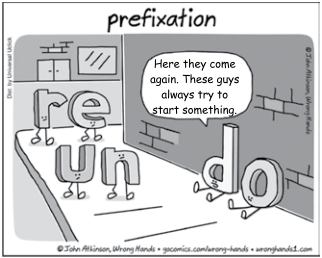
This cartoon can be used as a resource to teach or review
the use of prefixes in the English language. You may offer
your students the following words and ask them to choose
the alternative in which the prefix has the same meaning
as “un”. Your students should mark alternative
How monks helped invent sign language
For millennia people with hearing impairments encountered marginalization because it was believed that language could only be learned by hearing the spoken word. Ancient Greek philosopher Aristotle, for example, asserted that “Men that are deaf are in all cases also dumb.” Under Roman law people who were born deaf were denied the right to sign a will as they were “presumed to understand nothing; because it is not possible that they have been able to learn to read or write.”
Pushback against such ideas began in the 16th-century, with the creation of the first formal sign language for the hearing impaired, by Pedro Ponce de León, a Spanish Benedictine monk. His idea to use sign language was not a completely new one. Native Americans used hand gestures to communicate with other tribes and to facilitate trade with Europeans. Benedictine monks had used them to convey messages during their daily periods of silence. Inspired by the latter practice, Ponce de León adapted the gestures used in his monastery to create a method for teaching the deaf to communicate, paving the way for systems now used all over the world.
Building on Ponce de León’s work, another Spanish cleric and linguist, Juan Pablo Bonet, proposed that deaf people learn to pronounce words and progressively construct meaningful phrases. Bonet’s approach combined oralism – using sounds to communicate – with sign language. The system had its challenges, especially when learning the words for abstract terms, or intangible forms such as conjunctions like “for,” “nor,” or “yet.”
In 1755 the French Catholic priest Charles-Michel de l’Épée established a more comprehensive method for educating the deaf, which culminated in the founding of the first public school for deaf children, in Paris. Students came to the institute from all over France, bringing signs they had used to communicate with at home. Insistent that sign language needed to be a complete language, his system was complex enough to express prepositions, conjunctions, and other grammatical elements.
Épée’s standardized sign language quickly spread across Europe and to the United States. In 1814 Thomas Gallaudet went to France to learn Épée’s language system. Three years later, Gallaudet established the American School for the Deaf in his hometown in Connecticut. Students from across the United States attended, and they brought signs they used to communicate with at home.American Sign Language became a combination of these signs and those from French Sign Language.
Thanks to the development of formal sign languages, people with hearing impairment can access spoken language in all its variety. The world’s many modern signing systems have different rules for pronunciation, word order, and grammar. New visual languages can even express regional accents to reflect the complexity and richness of local speech.
(Ines Anton Rayas. www.nationalgeographic.com. 28.05.2019. Adaptado)
How monks helped invent sign language
For millennia people with hearing impairments encountered marginalization because it was believed that language could only be learned by hearing the spoken word. Ancient Greek philosopher Aristotle, for example, asserted that “Men that are deaf are in all cases also dumb.” Under Roman law people who were born deaf were denied the right to sign a will as they were “presumed to understand nothing; because it is not possible that they have been able to learn to read or write.”
Pushback against such ideas began in the 16th-century, with the creation of the first formal sign language for the hearing impaired, by Pedro Ponce de León, a Spanish Benedictine monk. His idea to use sign language was not a completely new one. Native Americans used hand gestures to communicate with other tribes and to facilitate trade with Europeans. Benedictine monks had used them to convey messages during their daily periods of silence. Inspired by the latter practice, Ponce de León adapted the gestures used in his monastery to create a method for teaching the deaf to communicate, paving the way for systems now used all over the world.
Building on Ponce de León’s work, another Spanish cleric and linguist, Juan Pablo Bonet, proposed that deaf people learn to pronounce words and progressively construct meaningful phrases. Bonet’s approach combined oralism – using sounds to communicate – with sign language. The system had its challenges, especially when learning the words for abstract terms, or intangible forms such as conjunctions like “for,” “nor,” or “yet.”
In 1755 the French Catholic priest Charles-Michel de l’Épée established a more comprehensive method for educating the deaf, which culminated in the founding of the first public school for deaf children, in Paris. Students came to the institute from all over France, bringing signs they had used to communicate with at home. Insistent that sign language needed to be a complete language, his system was complex enough to express prepositions, conjunctions, and other grammatical elements.
Épée’s standardized sign language quickly spread across Europe and to the United States. In 1814 Thomas Gallaudet went to France to learn Épée’s language system. Three years later, Gallaudet established the American School for the Deaf in his hometown in Connecticut. Students from across the United States attended, and they brought signs they used to communicate with at home.American Sign Language became a combination of these signs and those from French Sign Language.
Thanks to the development of formal sign languages, people with hearing impairment can access spoken language in all its variety. The world’s many modern signing systems have different rules for pronunciation, word order, and grammar. New visual languages can even express regional accents to reflect the complexity and richness of local speech.
(Ines Anton Rayas. www.nationalgeographic.com. 28.05.2019. Adaptado)
How monks helped invent sign language
For millennia people with hearing impairments encountered marginalization because it was believed that language could only be learned by hearing the spoken word. Ancient Greek philosopher Aristotle, for example, asserted that “Men that are deaf are in all cases also dumb.” Under Roman law people who were born deaf were denied the right to sign a will as they were “presumed to understand nothing; because it is not possible that they have been able to learn to read or write.”
Pushback against such ideas began in the 16th-century, with the creation of the first formal sign language for the hearing impaired, by Pedro Ponce de León, a Spanish Benedictine monk. His idea to use sign language was not a completely new one. Native Americans used hand gestures to communicate with other tribes and to facilitate trade with Europeans. Benedictine monks had used them to convey messages during their daily periods of silence. Inspired by the latter practice, Ponce de León adapted the gestures used in his monastery to create a method for teaching the deaf to communicate, paving the way for systems now used all over the world.
Building on Ponce de León’s work, another Spanish cleric and linguist, Juan Pablo Bonet, proposed that deaf people learn to pronounce words and progressively construct meaningful phrases. Bonet’s approach combined oralism – using sounds to communicate – with sign language. The system had its challenges, especially when learning the words for abstract terms, or intangible forms such as conjunctions like “for,” “nor,” or “yet.”
In 1755 the French Catholic priest Charles-Michel de l’Épée established a more comprehensive method for educating the deaf, which culminated in the founding of the first public school for deaf children, in Paris. Students came to the institute from all over France, bringing signs they had used to communicate with at home. Insistent that sign language needed to be a complete language, his system was complex enough to express prepositions, conjunctions, and other grammatical elements.
Épée’s standardized sign language quickly spread across Europe and to the United States. In 1814 Thomas Gallaudet went to France to learn Épée’s language system. Three years later, Gallaudet established the American School for the Deaf in his hometown in Connecticut. Students from across the United States attended, and they brought signs they used to communicate with at home.American Sign Language became a combination of these signs and those from French Sign Language.
Thanks to the development of formal sign languages, people with hearing impairment can access spoken language in all its variety. The world’s many modern signing systems have different rules for pronunciation, word order, and grammar. New visual languages can even express regional accents to reflect the complexity and richness of local speech.
(Ines Anton Rayas. www.nationalgeographic.com. 28.05.2019. Adaptado)
How monks helped invent sign language
For millennia people with hearing impairments encountered marginalization because it was believed that language could only be learned by hearing the spoken word. Ancient Greek philosopher Aristotle, for example, asserted that “Men that are deaf are in all cases also dumb.” Under Roman law people who were born deaf were denied the right to sign a will as they were “presumed to understand nothing; because it is not possible that they have been able to learn to read or write.”
Pushback against such ideas began in the 16th-century, with the creation of the first formal sign language for the hearing impaired, by Pedro Ponce de León, a Spanish Benedictine monk. His idea to use sign language was not a completely new one. Native Americans used hand gestures to communicate with other tribes and to facilitate trade with Europeans. Benedictine monks had used them to convey messages during their daily periods of silence. Inspired by the latter practice, Ponce de León adapted the gestures used in his monastery to create a method for teaching the deaf to communicate, paving the way for systems now used all over the world.
Building on Ponce de León’s work, another Spanish cleric and linguist, Juan Pablo Bonet, proposed that deaf people learn to pronounce words and progressively construct meaningful phrases. Bonet’s approach combined oralism – using sounds to communicate – with sign language. The system had its challenges, especially when learning the words for abstract terms, or intangible forms such as conjunctions like “for,” “nor,” or “yet.”
In 1755 the French Catholic priest Charles-Michel de l’Épée established a more comprehensive method for educating the deaf, which culminated in the founding of the first public school for deaf children, in Paris. Students came to the institute from all over France, bringing signs they had used to communicate with at home. Insistent that sign language needed to be a complete language, his system was complex enough to express prepositions, conjunctions, and other grammatical elements.
Épée’s standardized sign language quickly spread across Europe and to the United States. In 1814 Thomas Gallaudet went to France to learn Épée’s language system. Three years later, Gallaudet established the American School for the Deaf in his hometown in Connecticut. Students from across the United States attended, and they brought signs they used to communicate with at home.American Sign Language became a combination of these signs and those from French Sign Language.
Thanks to the development of formal sign languages, people with hearing impairment can access spoken language in all its variety. The world’s many modern signing systems have different rules for pronunciation, word order, and grammar. New visual languages can even express regional accents to reflect the complexity and richness of local speech.
(Ines Anton Rayas. www.nationalgeographic.com. 28.05.2019. Adaptado)
How monks helped invent sign language
For millennia people with hearing impairments encountered marginalization because it was believed that language could only be learned by hearing the spoken word. Ancient Greek philosopher Aristotle, for example, asserted that “Men that are deaf are in all cases also dumb.” Under Roman law people who were born deaf were denied the right to sign a will as they were “presumed to understand nothing; because it is not possible that they have been able to learn to read or write.”
Pushback against such ideas began in the 16th-century, with the creation of the first formal sign language for the hearing impaired, by Pedro Ponce de León, a Spanish Benedictine monk. His idea to use sign language was not a completely new one. Native Americans used hand gestures to communicate with other tribes and to facilitate trade with Europeans. Benedictine monks had used them to convey messages during their daily periods of silence. Inspired by the latter practice, Ponce de León adapted the gestures used in his monastery to create a method for teaching the deaf to communicate, paving the way for systems now used all over the world.
Building on Ponce de León’s work, another Spanish cleric and linguist, Juan Pablo Bonet, proposed that deaf people learn to pronounce words and progressively construct meaningful phrases. Bonet’s approach combined oralism – using sounds to communicate – with sign language. The system had its challenges, especially when learning the words for abstract terms, or intangible forms such as conjunctions like “for,” “nor,” or “yet.”
In 1755 the French Catholic priest Charles-Michel de l’Épée established a more comprehensive method for educating the deaf, which culminated in the founding of the first public school for deaf children, in Paris. Students came to the institute from all over France, bringing signs they had used to communicate with at home. Insistent that sign language needed to be a complete language, his system was complex enough to express prepositions, conjunctions, and other grammatical elements.
Épée’s standardized sign language quickly spread across Europe and to the United States. In 1814 Thomas Gallaudet went to France to learn Épée’s language system. Three years later, Gallaudet established the American School for the Deaf in his hometown in Connecticut. Students from across the United States attended, and they brought signs they used to communicate with at home.American Sign Language became a combination of these signs and those from French Sign Language.
Thanks to the development of formal sign languages, people with hearing impairment can access spoken language in all its variety. The world’s many modern signing systems have different rules for pronunciation, word order, and grammar. New visual languages can even express regional accents to reflect the complexity and richness of local speech.
(Ines Anton Rayas. www.nationalgeographic.com. 28.05.2019. Adaptado)
How monks helped invent sign language
For millennia people with hearing impairments encountered marginalization because it was believed that language could only be learned by hearing the spoken word. Ancient Greek philosopher Aristotle, for example, asserted that “Men that are deaf are in all cases also dumb.” Under Roman law people who were born deaf were denied the right to sign a will as they were “presumed to understand nothing; because it is not possible that they have been able to learn to read or write.”
Pushback against such ideas began in the 16th-century, with the creation of the first formal sign language for the hearing impaired, by Pedro Ponce de León, a Spanish Benedictine monk. His idea to use sign language was not a completely new one. Native Americans used hand gestures to communicate with other tribes and to facilitate trade with Europeans. Benedictine monks had used them to convey messages during their daily periods of silence. Inspired by the latter practice, Ponce de León adapted the gestures used in his monastery to create a method for teaching the deaf to communicate, paving the way for systems now used all over the world.
Building on Ponce de León’s work, another Spanish cleric and linguist, Juan Pablo Bonet, proposed that deaf people learn to pronounce words and progressively construct meaningful phrases. Bonet’s approach combined oralism – using sounds to communicate – with sign language. The system had its challenges, especially when learning the words for abstract terms, or intangible forms such as conjunctions like “for,” “nor,” or “yet.”
In 1755 the French Catholic priest Charles-Michel de l’Épée established a more comprehensive method for educating the deaf, which culminated in the founding of the first public school for deaf children, in Paris. Students came to the institute from all over France, bringing signs they had used to communicate with at home. Insistent that sign language needed to be a complete language, his system was complex enough to express prepositions, conjunctions, and other grammatical elements.
Épée’s standardized sign language quickly spread across Europe and to the United States. In 1814 Thomas Gallaudet went to France to learn Épée’s language system. Three years later, Gallaudet established the American School for the Deaf in his hometown in Connecticut. Students from across the United States attended, and they brought signs they used to communicate with at home.American Sign Language became a combination of these signs and those from French Sign Language.
Thanks to the development of formal sign languages, people with hearing impairment can access spoken language in all its variety. The world’s many modern signing systems have different rules for pronunciation, word order, and grammar. New visual languages can even express regional accents to reflect the complexity and richness of local speech.
(Ines Anton Rayas. www.nationalgeographic.com. 28.05.2019. Adaptado)
How monks helped invent sign language
For millennia people with hearing impairments encountered marginalization because it was believed that language could only be learned by hearing the spoken word. Ancient Greek philosopher Aristotle, for example, asserted that “Men that are deaf are in all cases also dumb.” Under Roman law people who were born deaf were denied the right to sign a will as they were “presumed to understand nothing; because it is not possible that they have been able to learn to read or write.”
Pushback against such ideas began in the 16th-century, with the creation of the first formal sign language for the hearing impaired, by Pedro Ponce de León, a Spanish Benedictine monk. His idea to use sign language was not a completely new one. Native Americans used hand gestures to communicate with other tribes and to facilitate trade with Europeans. Benedictine monks had used them to convey messages during their daily periods of silence. Inspired by the latter practice, Ponce de León adapted the gestures used in his monastery to create a method for teaching the deaf to communicate, paving the way for systems now used all over the world.
Building on Ponce de León’s work, another Spanish cleric and linguist, Juan Pablo Bonet, proposed that deaf people learn to pronounce words and progressively construct meaningful phrases. Bonet’s approach combined oralism – using sounds to communicate – with sign language. The system had its challenges, especially when learning the words for abstract terms, or intangible forms such as conjunctions like “for,” “nor,” or “yet.”
In 1755 the French Catholic priest Charles-Michel de l’Épée established a more comprehensive method for educating the deaf, which culminated in the founding of the first public school for deaf children, in Paris. Students came to the institute from all over France, bringing signs they had used to communicate with at home. Insistent that sign language needed to be a complete language, his system was complex enough to express prepositions, conjunctions, and other grammatical elements.
Épée’s standardized sign language quickly spread across Europe and to the United States. In 1814 Thomas Gallaudet went to France to learn Épée’s language system. Three years later, Gallaudet established the American School for the Deaf in his hometown in Connecticut. Students from across the United States attended, and they brought signs they used to communicate with at home.American Sign Language became a combination of these signs and those from French Sign Language.
Thanks to the development of formal sign languages, people with hearing impairment can access spoken language in all its variety. The world’s many modern signing systems have different rules for pronunciation, word order, and grammar. New visual languages can even express regional accents to reflect the complexity and richness of local speech.
(Ines Anton Rayas. www.nationalgeographic.com. 28.05.2019. Adaptado)
How monks helped invent sign language
For millennia people with hearing impairments encountered marginalization because it was believed that language could only be learned by hearing the spoken word. Ancient Greek philosopher Aristotle, for example, asserted that “Men that are deaf are in all cases also dumb.” Under Roman law people who were born deaf were denied the right to sign a will as they were “presumed to understand nothing; because it is not possible that they have been able to learn to read or write.”
Pushback against such ideas began in the 16th-century, with the creation of the first formal sign language for the hearing impaired, by Pedro Ponce de León, a Spanish Benedictine monk. His idea to use sign language was not a completely new one. Native Americans used hand gestures to communicate with other tribes and to facilitate trade with Europeans. Benedictine monks had used them to convey messages during their daily periods of silence. Inspired by the latter practice, Ponce de León adapted the gestures used in his monastery to create a method for teaching the deaf to communicate, paving the way for systems now used all over the world.
Building on Ponce de León’s work, another Spanish cleric and linguist, Juan Pablo Bonet, proposed that deaf people learn to pronounce words and progressively construct meaningful phrases. Bonet’s approach combined oralism – using sounds to communicate – with sign language. The system had its challenges, especially when learning the words for abstract terms, or intangible forms such as conjunctions like “for,” “nor,” or “yet.”
In 1755 the French Catholic priest Charles-Michel de l’Épée established a more comprehensive method for educating the deaf, which culminated in the founding of the first public school for deaf children, in Paris. Students came to the institute from all over France, bringing signs they had used to communicate with at home. Insistent that sign language needed to be a complete language, his system was complex enough to express prepositions, conjunctions, and other grammatical elements.
Épée’s standardized sign language quickly spread across Europe and to the United States. In 1814 Thomas Gallaudet went to France to learn Épée’s language system. Three years later, Gallaudet established the American School for the Deaf in his hometown in Connecticut. Students from across the United States attended, and they brought signs they used to communicate with at home.American Sign Language became a combination of these signs and those from French Sign Language.
Thanks to the development of formal sign languages, people with hearing impairment can access spoken language in all its variety. The world’s many modern signing systems have different rules for pronunciation, word order, and grammar. New visual languages can even express regional accents to reflect the complexity and richness of local speech.
(Ines Anton Rayas. www.nationalgeographic.com. 28.05.2019. Adaptado)

 Conheça nossos planos