🎯 Saiba o que estudar

Avançado com Treinador a partir de R$ 0,76/dia

Questões de Concurso Sobre inglês

Questões Discursivas

Foram encontradas 25.355 questões

Q1765214 Inglês

Text I


While viruses do not respect borders, their spread and their chances of survival have long depended greatly on the laws, policies and acts of states. However, not all states are up to the job, writes Adam Roberts. 


A.J.P. Taylor often observed that great events can have very small causes. The 2020 COVID-19 pandemic is fresh evidence for this proposition. The cause is in all likelihood tiny and accidental: a genetic mutation in a virus, which then spreads into the human population. Like earlier epidemics throughout history, it could have happened with no human intentionality. Its consequences are already momentous and will be even more so before it is over.


The novel coronavirus can easily be seen as a profoundly anti-democratic force. In its first eight months, from early January to mid-August, it produced over 20 million cases of the COVID-19 disease. That disease has killed over 800,000 people and counting; put millions out of work; drastically curtailed travel; precipitated states of emergency; and caused citizens to be placed under detailed and intrusive administrative control, demonstrations to be banned, and elections to be rescheduled or postponed. Bitter disagreements have arisen about when and how to ease restrictions on movement. COVID-19 has generated a revival of conspiracy theories and unjustified recriminations, and prompted absurd denials of medical reality by certain political leaders. Among states, the pandemic has actually heightened some long-existing disputes, most notably those on trade and other matters between China and the United States. The capacity of the United Nations system to address epidemics has been called into question, not least in harsh American criticisms of the World Health Organization (WHO).


It is too simple to cast the pandemic crisis merely as a narrative of rampant authoritarianism versus embattled democracy. The long history of pandemics, earthquakes and other disasters reminds us of the enduring complexity of disaster management, and of the many controversies surrounding it, including the causes of and responses to plagues. States respond in different ways, raising questions regarding the relative effectiveness of democratic versus authoritarian states. International health organisations, especially the WHO, have important roles in dealing with epidemics, whether regional or global. Yet their formal powers are limited and their effectiveness depends on state cooperation. Epidemics, and action to control them, do sometimes play a part in increased authoritarianism, but they can also give rise to more positive initiatives of various kinds.


Adapted from: https://www.iiss.org/. Accessed on March 20, 2021.
According to the text I, COVID-19 can be understood as a/an:
Alternativas
Q1755096 Inglês
Instruction: answer question based on the following text.


  1. (Avaliable in: https://www.cambridgeenglish.org/blog/12-tips-for-teaching-an-online-english-class/ – text adapted specially for this test).


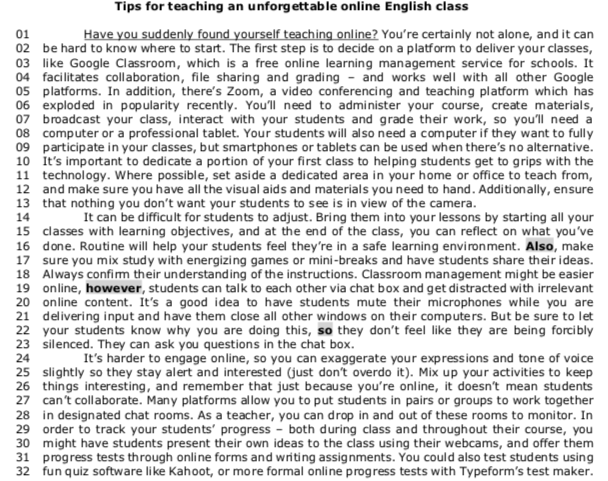
About the phrase “It’s harder to engage online” (l. 24), we can say that: I. It’s a comparative structure. II. “Harder” could be replaced by “most difficult” with no changes in meaning. III. “Harder” follows the same spelling rules as “bigger”. Which statements are correct?
Alternativas
Q1755095 Inglês
Instruction: answer question based on the following text.


  1. (Avaliable in: https://www.cambridgeenglish.org/blog/12-tips-for-teaching-an-online-english-class/ – text adapted specially for this test).


Consider the meaning of the highlighted words in paragraph two in the context presented in the article, and match them, in order, to the idea they convey.
Alternativas
Q1755094 Inglês
Instruction: answer question based on the following text.


  1. (Avaliable in: https://www.cambridgeenglish.org/blog/12-tips-for-teaching-an-online-english-class/ – text adapted specially for this test).


What is the verb tense of the underlined sentence in line 01?
Alternativas
Q1755093 Inglês
Instruction: answer question based on the following text.


  1. (Avaliable in: https://www.cambridgeenglish.org/blog/12-tips-for-teaching-an-online-english-class/ – text adapted specially for this test).


Which topic is NOT mentioned in the text?
Alternativas
Q1755092 Inglês
Instruction: answer question based on the following text.


  1. (Avaliable in: https://www.cambridgeenglish.org/blog/12-tips-for-teaching-an-online-english-class/ – text adapted specially for this test).


Considering the content of the text, which is the main question answered by the author?
Alternativas
Q1753960 Inglês
    The pandemic has exposed a contradiction in modern society. We are more connected than ever – proven by the speed and truly global spread of the virus; nevertheless, we are also deeply divided.
    Today’s connectedness, enforced by social distancing, has pushed the role of technology in every aspect of our lives to a new level. The tech industry is now in a challenging space: trapped between the increasing politicization of technology, the still superficial social debate around its impact and the slow adaptation of appropriate legislation. Right now, the industry needs to enable and push forward this ethical debate, recognizing its responsibility in this historic moment.
    The first step is to end the myth of tech neutrality. We need to acknowledge that technology is caught between private economic interests and its social value. Some tech business models, for example, prioritize commodification of data or advertising revenue over the social value of their services — the sharing of knowledge, connecting people, etc.
    The social impact of tech is deeper than we usually perceive and most of the time invisible to us. Digital architecture determines, increasingly, social interactions in our digital society. An example of this is the invisible influence of search engine and social media algorithms, the results of which shape our understanding of the world.
    In this moment of crisis, technology can play a fundamental role in overcoming the economic recession and reducing the systemic injustices that have been exposed.
Social exclusion - the next pandemic.
Internet: <www.thoughtworks.com> (adapted)

Concerning the ideas stated in the text and the words used in it, judge the following items.
The words “trapped” (in the second sentence of the second paragraph) and “caught” (in the second sentence of the third paragraph) can be considered synonyms and are used with similar meanings in the text.
Alternativas
Q1753959 Inglês
    The pandemic has exposed a contradiction in modern society. We are more connected than ever – proven by the speed and truly global spread of the virus; nevertheless, we are also deeply divided.
    Today’s connectedness, enforced by social distancing, has pushed the role of technology in every aspect of our lives to a new level. The tech industry is now in a challenging space: trapped between the increasing politicization of technology, the still superficial social debate around its impact and the slow adaptation of appropriate legislation. Right now, the industry needs to enable and push forward this ethical debate, recognizing its responsibility in this historic moment.
    The first step is to end the myth of tech neutrality. We need to acknowledge that technology is caught between private economic interests and its social value. Some tech business models, for example, prioritize commodification of data or advertising revenue over the social value of their services — the sharing of knowledge, connecting people, etc.
    The social impact of tech is deeper than we usually perceive and most of the time invisible to us. Digital architecture determines, increasingly, social interactions in our digital society. An example of this is the invisible influence of search engine and social media algorithms, the results of which shape our understanding of the world.
    In this moment of crisis, technology can play a fundamental role in overcoming the economic recession and reducing the systemic injustices that have been exposed.
Social exclusion - the next pandemic.
Internet: <www.thoughtworks.com> (adapted)

Concerning the ideas stated in the text and the words used in it, judge the following items.
Understanding that digital technology does not play an impartial role in the tense dynamics between private and social spheres is an important stage in the debate in the text.
Alternativas
Q1753958 Inglês
    The pandemic has exposed a contradiction in modern society. We are more connected than ever – proven by the speed and truly global spread of the virus; nevertheless, we are also deeply divided.
    Today’s connectedness, enforced by social distancing, has pushed the role of technology in every aspect of our lives to a new level. The tech industry is now in a challenging space: trapped between the increasing politicization of technology, the still superficial social debate around its impact and the slow adaptation of appropriate legislation. Right now, the industry needs to enable and push forward this ethical debate, recognizing its responsibility in this historic moment.
    The first step is to end the myth of tech neutrality. We need to acknowledge that technology is caught between private economic interests and its social value. Some tech business models, for example, prioritize commodification of data or advertising revenue over the social value of their services — the sharing of knowledge, connecting people, etc.
    The social impact of tech is deeper than we usually perceive and most of the time invisible to us. Digital architecture determines, increasingly, social interactions in our digital society. An example of this is the invisible influence of search engine and social media algorithms, the results of which shape our understanding of the world.
    In this moment of crisis, technology can play a fundamental role in overcoming the economic recession and reducing the systemic injustices that have been exposed.
Social exclusion - the next pandemic.
Internet: <www.thoughtworks.com> (adapted)

Concerning the ideas stated in the text and the words used in it, judge the following items.
The sentence “the industry needs to enable and push forward this ethical debate” (in the last sentence of the second paragraph) can be correctly rephrased as the industry ought to facilitate and advance forward this ethical debate, without changing the meaning of the text
Alternativas
Q1753957 Inglês
    The pandemic has exposed a contradiction in modern society. We are more connected than ever – proven by the speed and truly global spread of the virus; nevertheless, we are also deeply divided.
    Today’s connectedness, enforced by social distancing, has pushed the role of technology in every aspect of our lives to a new level. The tech industry is now in a challenging space: trapped between the increasing politicization of technology, the still superficial social debate around its impact and the slow adaptation of appropriate legislation. Right now, the industry needs to enable and push forward this ethical debate, recognizing its responsibility in this historic moment.
    The first step is to end the myth of tech neutrality. We need to acknowledge that technology is caught between private economic interests and its social value. Some tech business models, for example, prioritize commodification of data or advertising revenue over the social value of their services — the sharing of knowledge, connecting people, etc.
    The social impact of tech is deeper than we usually perceive and most of the time invisible to us. Digital architecture determines, increasingly, social interactions in our digital society. An example of this is the invisible influence of search engine and social media algorithms, the results of which shape our understanding of the world.
    In this moment of crisis, technology can play a fundamental role in overcoming the economic recession and reducing the systemic injustices that have been exposed.
Social exclusion - the next pandemic.
Internet: <www.thoughtworks.com> (adapted)

Concerning the ideas stated in the text and the words used in it, judge the following items.
The word “nevertheless” introduces an idea of condition in the first paragraph.
Alternativas
Q1750587 Inglês
Let’s keep the lights on when she’s your age. What sort of world will this little girl grow up in? Many experts agree that it will be a considerably more energyhungry one. There are already seven billion people on our planet. And the forecast is that there will be around two billion more by 2050. So if we’re going to keep the lights on for her, we will need to look at every possible energy source. At Shell we’re exploring a broad mix of energies. We’re making our fuels and lubricants more advanced and more efficient than before. With our partner in Brazil, we’re also producing ethanol, a biofuel made from renewable sugar cane. And we’re delivering natural gas to more countries than any other energy company. When used to generate electricity, natural gas emits around half the CO2 of coal. Let’s broaden the world’s energy mix. (Newsweek. June 25, 2012. Cover. Adapted.)
In “Let’s keep the lights on when she’s your age. ” the underlined words mean that
Alternativas
Q1750586 Inglês
Let’s keep the lights on when she’s your age. What sort of world will this little girl grow up in? Many experts agree that it will be a considerably more energyhungry one. There are already seven billion people on our planet. And the forecast is that there will be around two billion more by 2050. So if we’re going to keep the lights on for her, we will need to look at every possible energy source. At Shell we’re exploring a broad mix of energies. We’re making our fuels and lubricants more advanced and more efficient than before. With our partner in Brazil, we’re also producing ethanol, a biofuel made from renewable sugar cane. And we’re delivering natural gas to more countries than any other energy company. When used to generate electricity, natural gas emits around half the CO2 of coal. Let’s broaden the world’s energy mix. (Newsweek. June 25, 2012. Cover. Adapted.)
The sentence “Let’s broaden the world’s energy mix.” means that
Alternativas
Q1750585 Inglês
Let’s keep the lights on when she’s your age. What sort of world will this little girl grow up in? Many experts agree that it will be a considerably more energyhungry one. There are already seven billion people on our planet. And the forecast is that there will be around two billion more by 2050. So if we’re going to keep the lights on for her, we will need to look at every possible energy source. At Shell we’re exploring a broad mix of energies. We’re making our fuels and lubricants more advanced and more efficient than before. With our partner in Brazil, we’re also producing ethanol, a biofuel made from renewable sugar cane. And we’re delivering natural gas to more countries than any other energy company. When used to generate electricity, natural gas emits around half the CO2 of coal. Let’s broaden the world’s energy mix. (Newsweek. June 25, 2012. Cover. Adapted.)
In “And the forecast is that there will be around two billion more by 2050” the underlined word means
Alternativas
Q1750584 Inglês
Mark the alternative that doesn’t have a prepositional verb:
Alternativas
Q1750583 Inglês
Assinale a alternativa em que todos os substantivos estão corretamente escritos no plural de acordo com as normas da Gramática da Língua Inglesa:
Alternativas
Q1750582 Inglês

Complete the sentence with the right adverbial clause.


“____bottles of milk do you want?” 

Alternativas
Q1750581 Inglês
Mark the sentence that doesn’t have a verb in passive voice
Alternativas
Q1750580 Inglês
The PAST TENSE indicates that an action is in the past relative to the speaker or writer. Choose a right preposition to the past sentence below. “I lived in Florida ___ ten years, and then I returned to Salem.”
Alternativas
Q1750579 Inglês
Complete the sentence below with the right verb and adjective. “I know I can ___ a product that is ___ than what almost everybody else in the market is making.”
Alternativas
Q1750578 Inglês
Ler (reading), escrever (writing), ouvir (listening) e falar (speaking) são quatro habilidades básicas que permitem agir socialmente. Ou seja, essas são as habilidades linguísticas que as pessoas desenvolvem ao se relacionarem e comunicarem umas com as outras. Sobre elas, pode-se afirmar com certeza apenas o exposto na seguinte alternativa:
Alternativas
Respostas
14201: A
14202: A
14203: A
14204: C
14205: D
14206: B
14207: C
14208: C
14209: E
14210: E
14211: A
14212: D
14213: D
14214: B
14215: B
14216: C
14217: B
14218: A
14219: D
14220: C