🎯 Saiba o que estudar

Avançado com Treinador a partir de R$ 0,76/dia

Questões de Concurso Sobre inglês

Questões Discursivas

Foram encontradas 25.340 questões

Q1975065 Inglês
Text for the item from.


Can learning language help prevent dementia?
Internet: <https://glasgowmemoryclinic.com> (adapted).
According to the text, judge the item from. 

In line 11, “has been” is an example of the Present Perfect tense, which is formed by the Present Simple form of the verb to have and the Present Perfect form of the main verb. 
Alternativas
Q1975064 Inglês
Text for the item from.


Can learning language help prevent dementia?
Internet: <https://glasgowmemoryclinic.com> (adapted).
According to the text, judge the item from. 

The text states that speaking one more language may lower the rates of dementia and memory problems in more advanced ages. 
Alternativas
Q1975063 Inglês
Text for the item from.


Can learning language help prevent dementia?
Internet: <https://glasgowmemoryclinic.com> (adapted).
According to the text, judge the item from. 

According to the text, people who learn a new language are free from developing mental diseases. 
Alternativas
Q1967460 Inglês

According to the text, judge the item.


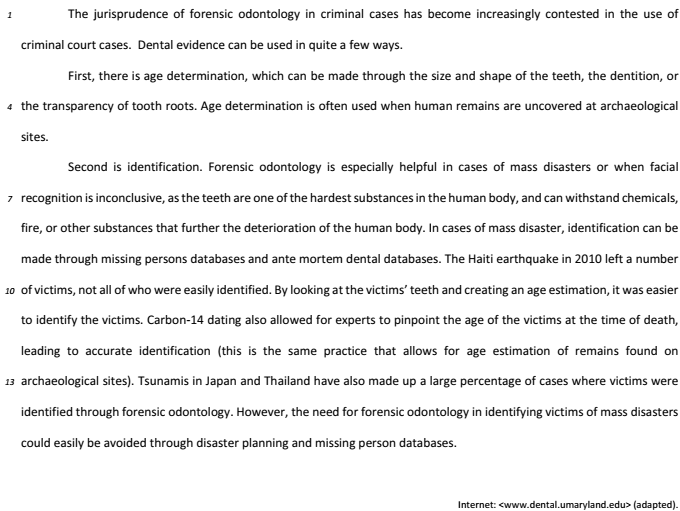
The terms “especially” (line 6), “inconclusive” (line 7) and “substances” (line 7) are Portuguese false cognates.

Alternativas
Q1967459 Inglês

According to the text, judge the item.


Without changing the meaning of the text, the term “which” (line 3) could be correctly replace by that, and the term “that” (line 12) could be correctly replaced by which

Alternativas
Q1967458 Inglês

According to the text, judge the item.


The terms “easier” (line 10) and “further” (line 8) belong to the same word class: they are both examples of adjectives.

Alternativas
Q1967457 Inglês

According to the text, judge the item.


The term “could” (line 15) is the past tense of can.

Alternativas
Q1967456 Inglês

According to the text, judge the item.


Forensic odontology can determine the age and gender of a person based on the size and the shape of the teeth, while Carbon-14 dating determines the time of death.

Alternativas
Q1967455 Inglês

Imagem associada para resolução da questão


According to the text, judge the item.


Only the forensic odontology was able to easily identify all the victims from the Haiti earthquake just by looking at the victims’ teeth.

Alternativas
Q1967454 Inglês
According to the text, judge the item.
Differently from other parts of the human body, the teeth can resist to chemicals, fire and other substances. 

Alternativas
Q1967453 Inglês
According to the text, judge the item.


According to the text, there are many ways in which dental evidences can help solve criminal cases. 
Alternativas
Q1967220 Inglês
Text for the item from.


Paridhi Agrawal & Pradnya Nikhade. Artificial Intelligence in Dentistry: Past, Present, and Future. Cureus, v. 14, n.º 7, 2022 (adapted).
According to the text, judge the item.

The term “However” (line 10) can be correctly replaced by the conjunction Hence, without changing its meaning. 
Alternativas
Q1967219 Inglês
Text for the item from.


Paridhi Agrawal & Pradnya Nikhade. Artificial Intelligence in Dentistry: Past, Present, and Future. Cureus, v. 14, n.º 7, 2022 (adapted).
According to the text, judge the item.

The term “were” (line 6) agrees with the subject “technology”. 
Alternativas
Q1967218 Inglês
Text for the item from.


Paridhi Agrawal & Pradnya Nikhade. Artificial Intelligence in Dentistry: Past, Present, and Future. Cureus, v. 14, n.º 7, 2022 (adapted).
According to the text, judge the item.

The expression “have shown” (line 4) agrees with the subject “models” (line 3).  
Alternativas
Q1967217 Inglês
Text for the item from.


Paridhi Agrawal & Pradnya Nikhade. Artificial Intelligence in Dentistry: Past, Present, and Future. Cureus, v. 14, n.º 7, 2022 (adapted).
According to the text, judge the item.

The term “its” (line 1) is a possessive adjective and refers to Artificial Intelligence (line 1). 
Alternativas
Q1967216 Inglês
Text for the item from.


Paridhi Agrawal & Pradnya Nikhade. Artificial Intelligence in Dentistry: Past, Present, and Future. Cureus, v. 14, n.º 7, 2022 (adapted).
According to the text, judge the item.

Despite being very useful to the sector, AI models has low applicability in real life situations.  
Alternativas
Q1967215 Inglês
Text for the item from.


Paridhi Agrawal & Pradnya Nikhade. Artificial Intelligence in Dentistry: Past, Present, and Future. Cureus, v. 14, n.º 7, 2022 (adapted).
According to the text, judge the item.

It is necessary to have human intelligence to make decisions in the healthcare sector; for that reason, AI should not be used to take complex predictions in endodontics.  
Alternativas
Q1967214 Inglês
Text for the item from.


Paridhi Agrawal & Pradnya Nikhade. Artificial Intelligence in Dentistry: Past, Present, and Future. Cureus, v. 14, n.º 7, 2022 (adapted).
According to the text, judge the item.

According to the text, Artificial Intelligence is able to imitate the intelligence of humans. It has increased in the dentistry sector and has a variety of applications in endodontics.
Alternativas
Q1967213 Inglês
Text for the item from.


Paridhi Agrawal & Pradnya Nikhade. Artificial Intelligence in Dentistry: Past, Present, and Future. Cureus, v. 14, n.º 7, 2022 (adapted).
According to the text, judge the item.

Artificial Intelligence is very effective in detecting diseases in endodontics. 
Alternativas
Q1962997 Inglês
     In 1863, in an effort to reduce street traffic, London opened the world’s first underground line, the Metropolitan Railway. Its birth can be traced back two decades before to the building of the world’s first under-river tunnel below the Thames, which swiftly became both popular with pedestrians and a huge tourist attraction.

      Initially, what would become the London Underground consisted of tracks dug slightly below the surface and then covered over, but as the technology improved, and trains switched from steam-powered to electric, the lines went deeper. Now the ground beneath Londoners’ feet hums with an extensive network of Tube lines ferrying people about the city speedily, efficiently — and out of sight. 

      Along with trains, powerlines, pipes, and cables, there’s another piece of infrastructure some have long wished to bury — roads. To some, these thick asphalt ribbons crisscrossing countries and cleaving apart communities and ecosystems no longer seem fit for purpose. As they sprawl longer and wider in the hopes of speeding up traffic, congestion ticks upwards and cars continue to pollute the air and spew greenhouse gases.

      No one has suggested burying every single one of the world’s roads. But what would happen if we did relocate them all below the surface? In a time of increasing urbanization, soaring inequality and climate crisis, imagining the impact this could have raises important questions about how our global transport system is developing — and prompts us to consider where we really want it to go.


What if all roads went underground? Internet: <www.bbc.com> (adapted)

Based on the previous text, judge the following item.


The adverbs “swiftly” and “speedily” (first and second paragraphs, respectively) both mean quickly.  

Alternativas
Respostas
13041: E
13042: C
13043: E
13044: E
13045: C
13046: C
13047: E
13048: E
13049: C
13050: C
13051: E
13052: E
13053: E
13054: C
13055: C
13056: E
13057: E
13058: C
13059: C
13060: C