Questões de Concurso Sobre inglês
Foram encontradas 25.340 questões


( ) The “spray-and-pray” business model belongs to a late period in the history of ransomware.
( ) The analysis indicates that cybercrime is far from mushrooming.
( ) The text argues that solutions to cybercrime can be reached in a jiffy.
The statements are, respectively
Read Text II and answer the question that follow it.
Text II
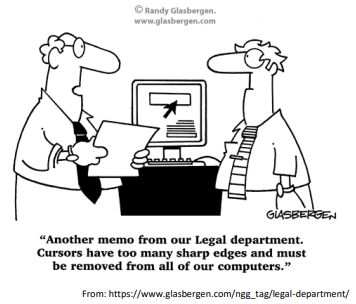
Read Text II and answer the question that follow it.
Text II
From: https://www.glasbergen.com/ngg_tag/legal-department/
Read text I and answer the question that follow it.
Text I
The New Rules of Data Privacy
The data harvested from our personal devices, along with our trail of electronic transactions and data from other sources, now provides the foundation for some of the world’s largest companies. […] For the past two decades, the commercial use of personal data has grown in wild-west fashion. But now, because of consumer mistrust, government actions, and competition for customers, those days are quickly coming to an end.
For most of its existence, the data economy was structured around a “digital curtain” designed to obscure the industry’s practices from lawmakers and the public. Data was considered company property and a proprietary secret, even though the data originated from customers’ private behavior. That curtain has since been lifted and a convergence of consumer, government, and market forces are now giving users more control over the data they generate. Instead of serving as a resource that can be freely harvested, countries in every region of the world have begun to treat personal data as an asset owned by individuals and held in trust by firms.
This will be a far better organizing principle for the data economy. Giving individuals more control has the potential to curtail the sector’s worst excesses while generating a new wave of customer-driven innovation, as customers begin to express what sort of personalization and opportunity they want their data to enable. And while Adtech firms in particular will be hardest hit, any firm with substantial troves of customer data will have to make sweeping changes to its practices, particularly large firms such as financial institutions, healthcare firms, utilities, and major manufacturers and retailers.
Leading firms are already adapting to the new reality as it unfolds. The key to this transition — based upon our research on data and trust, and our experience working on this issue with a wide variety of firms— is for companies to reorganize their data operations around the new fundamental rules of consent, insight, and flow.
[…]
Federal lawmakers are moving to curtail the power of big tech. Meanwhile, in 2021 state legislatures proposed or passed at least 27 online privacy bills regulating data markets and protecting personal digital rights. Lawmakers from California to China are implementing legislation that mirrors Europe’s GDPR, while the EU itself has turned its attention to regulating the use of AI. Where once companies were always ahead of regulators, now they struggle to keep up with compliance requirements across multiple jurisdictions.
Adapted from: https://hbr.org/2022/02/the-new-rules-of-data-privacy
February 25, 2022 – Retrieved September 6, 2022
Read text I and answer the question that follow it.
Text I
The New Rules of Data Privacy
The data harvested from our personal devices, along with our trail of electronic transactions and data from other sources, now provides the foundation for some of the world’s largest companies. […] For the past two decades, the commercial use of personal data has grown in wild-west fashion. But now, because of consumer mistrust, government actions, and competition for customers, those days are quickly coming to an end.
For most of its existence, the data economy was structured around a “digital curtain” designed to obscure the industry’s practices from lawmakers and the public. Data was considered company property and a proprietary secret, even though the data originated from customers’ private behavior. That curtain has since been lifted and a convergence of consumer, government, and market forces are now giving users more control over the data they generate. Instead of serving as a resource that can be freely harvested, countries in every region of the world have begun to treat personal data as an asset owned by individuals and held in trust by firms.
This will be a far better organizing principle for the data economy. Giving individuals more control has the potential to curtail the sector’s worst excesses while generating a new wave of customer-driven innovation, as customers begin to express what sort of personalization and opportunity they want their data to enable. And while Adtech firms in particular will be hardest hit, any firm with substantial troves of customer data will have to make sweeping changes to its practices, particularly large firms such as financial institutions, healthcare firms, utilities, and major manufacturers and retailers.
Leading firms are already adapting to the new reality as it unfolds. The key to this transition — based upon our research on data and trust, and our experience working on this issue with a wide variety of firms— is for companies to reorganize their data operations around the new fundamental rules of consent, insight, and flow.
[…]
Federal lawmakers are moving to curtail the power of big tech. Meanwhile, in 2021 state legislatures proposed or passed at least 27 online privacy bills regulating data markets and protecting personal digital rights. Lawmakers from California to China are implementing legislation that mirrors Europe’s GDPR, while the EU itself has turned its attention to regulating the use of AI. Where once companies were always ahead of regulators, now they struggle to keep up with compliance requirements across multiple jurisdictions.
Adapted from: https://hbr.org/2022/02/the-new-rules-of-data-privacy
February 25, 2022 – Retrieved September 6, 2022
Read text I and answer the question that follow it.
Text I
The New Rules of Data Privacy
The data harvested from our personal devices, along with our trail of electronic transactions and data from other sources, now provides the foundation for some of the world’s largest companies. […] For the past two decades, the commercial use of personal data has grown in wild-west fashion. But now, because of consumer mistrust, government actions, and competition for customers, those days are quickly coming to an end.
For most of its existence, the data economy was structured around a “digital curtain” designed to obscure the industry’s practices from lawmakers and the public. Data was considered company property and a proprietary secret, even though the data originated from customers’ private behavior. That curtain has since been lifted and a convergence of consumer, government, and market forces are now giving users more control over the data they generate. Instead of serving as a resource that can be freely harvested, countries in every region of the world have begun to treat personal data as an asset owned by individuals and held in trust by firms.
This will be a far better organizing principle for the data economy. Giving individuals more control has the potential to curtail the sector’s worst excesses while generating a new wave of customer-driven innovation, as customers begin to express what sort of personalization and opportunity they want their data to enable. And while Adtech firms in particular will be hardest hit, any firm with substantial troves of customer data will have to make sweeping changes to its practices, particularly large firms such as financial institutions, healthcare firms, utilities, and major manufacturers and retailers.
Leading firms are already adapting to the new reality as it unfolds. The key to this transition — based upon our research on data and trust, and our experience working on this issue with a wide variety of firms— is for companies to reorganize their data operations around the new fundamental rules of consent, insight, and flow.
[…]
Federal lawmakers are moving to curtail the power of big tech. Meanwhile, in 2021 state legislatures proposed or passed at least 27 online privacy bills regulating data markets and protecting personal digital rights. Lawmakers from California to China are implementing legislation that mirrors Europe’s GDPR, while the EU itself has turned its attention to regulating the use of AI. Where once companies were always ahead of regulators, now they struggle to keep up with compliance requirements across multiple jurisdictions.
Adapted from: https://hbr.org/2022/02/the-new-rules-of-data-privacy
February 25, 2022 – Retrieved September 6, 2022
Read text I and answer the question that follow it.
Text I
The New Rules of Data Privacy
The data harvested from our personal devices, along with our trail of electronic transactions and data from other sources, now provides the foundation for some of the world’s largest companies. […] For the past two decades, the commercial use of personal data has grown in wild-west fashion. But now, because of consumer mistrust, government actions, and competition for customers, those days are quickly coming to an end.
For most of its existence, the data economy was structured around a “digital curtain” designed to obscure the industry’s practices from lawmakers and the public. Data was considered company property and a proprietary secret, even though the data originated from customers’ private behavior. That curtain has since been lifted and a convergence of consumer, government, and market forces are now giving users more control over the data they generate. Instead of serving as a resource that can be freely harvested, countries in every region of the world have begun to treat personal data as an asset owned by individuals and held in trust by firms.
This will be a far better organizing principle for the data economy. Giving individuals more control has the potential to curtail the sector’s worst excesses while generating a new wave of customer-driven innovation, as customers begin to express what sort of personalization and opportunity they want their data to enable. And while Adtech firms in particular will be hardest hit, any firm with substantial troves of customer data will have to make sweeping changes to its practices, particularly large firms such as financial institutions, healthcare firms, utilities, and major manufacturers and retailers.
Leading firms are already adapting to the new reality as it unfolds. The key to this transition — based upon our research on data and trust, and our experience working on this issue with a wide variety of firms— is for companies to reorganize their data operations around the new fundamental rules of consent, insight, and flow.
[…]
Federal lawmakers are moving to curtail the power of big tech. Meanwhile, in 2021 state legislatures proposed or passed at least 27 online privacy bills regulating data markets and protecting personal digital rights. Lawmakers from California to China are implementing legislation that mirrors Europe’s GDPR, while the EU itself has turned its attention to regulating the use of AI. Where once companies were always ahead of regulators, now they struggle to keep up with compliance requirements across multiple jurisdictions.
Adapted from: https://hbr.org/2022/02/the-new-rules-of-data-privacy
February 25, 2022 – Retrieved September 6, 2022
( ) Empresas de publicidade serão fortemente afetadas por mudanças nas regras de privacidade de dados.
( ) Anteriormente, o controle de dados pessoais para fins comerciais seguia diretrizes rígidas.
( ) Atualmente, os legisladores têm sido negligentes com o consentimento dos usuários para seus dados.
As declarações são, respectivamente,

“Despite” in “Despite young people around the world being more educated” can be replaced without change in meaning by
( ) Advertising firms will be majorly affected by changes in data privacy rules. ( ) Formerly, control over personal data for commercial purposes followed tight guidelines. ( ) Legislators have currently been lax on users’ assent of their data.
The statements are, respectively,
Text I
Empowering the workforce of tomorrow:
The role of business in tackling the skills mismatch among youth
The future of work is changing fast. Technology, socio-economic trends, and developments and crises like COVID-19 are changing the world of work and the demand for skills at a pace and depth that poses serious challenges to people, business, and society. Young people and future generations, especially when they are from disadvantaged groups, are disproportionately affected by these disruptions.
A key challenge to shaping a sustainable future of work is addressing the skills mismatch among youth. Despite young people around the world being more educated than ever before, hundreds of millions of individuals are coming of age and finding themselves unemployed and unemployable, lacking the right skills to take up the jobs available today and, even more, the skills that will be needed in the future. Neglecting the skills mismatch among youth can result in young people feeling disenfranchised and disillusioned about their prospects in the labor market, fueling social unrest, stunting economic growth and ultimately creating a more volatile operating environment for business.
In contrast, by equipping youth with relevant skills, businesses can empower young people, support their access to employment opportunities and enable them to thrive personally, professionally and as active members of society. Investing in the skills of young people has an essential role to play in helping to realize the ambitions of the Sustainable Development Goals (SDGs) and the World Business Council for Sustainable Development’s (WBCSD) Vision2050, which aims to create a world where over 9 billion people live well and within planetary boundaries by mid-century.
From: https://www.unicef.org/media/103176/file/ Empowering%20the%20workforce%20of%20tomorrow.pdf
The extract “stunting economic growth” (2nd paragraph) implies
Text I
Empowering the workforce of tomorrow:
The role of business in tackling the skills mismatch among youth
The future of work is changing fast. Technology, socio-economic trends, and developments and crises like COVID-19 are changing the world of work and the demand for skills at a pace and depth that poses serious challenges to people, business, and society. Young people and future generations, especially when they are from disadvantaged groups, are disproportionately affected by these disruptions.
A key challenge to shaping a sustainable future of work is addressing the skills mismatch among youth. Despite young people around the world being more educated than ever before, hundreds of millions of individuals are coming of age and finding themselves unemployed and unemployable, lacking the right skills to take up the jobs available today and, even more, the skills that will be needed in the future. Neglecting the skills mismatch among youth can result in young people feeling disenfranchised and disillusioned about their prospects in the labor market, fueling social unrest, stunting economic growth and ultimately creating a more volatile operating environment for business.
In contrast, by equipping youth with relevant skills, businesses can empower young people, support their access to employment opportunities and enable them to thrive personally, professionally and as active members of society. Investing in the skills of young people has an essential role to play in helping to realize the ambitions of the Sustainable Development Goals (SDGs) and the World Business Council for Sustainable Development’s (WBCSD) Vision2050, which aims to create a world where over 9 billion people live well and within planetary boundaries by mid-century.
From: https://www.unicef.org/media/103176/file/ Empowering%20the%20workforce%20of%20tomorrow.pdf
Text I
Empowering the workforce of tomorrow:
The role of business in tackling the skills mismatch among youth
The future of work is changing fast. Technology, socio-economic trends, and developments and crises like COVID-19 are changing the world of work and the demand for skills at a pace and depth that poses serious challenges to people, business, and society. Young people and future generations, especially when they are from disadvantaged groups, are disproportionately affected by these disruptions.
A key challenge to shaping a sustainable future of work is addressing the skills mismatch among youth. Despite young people around the world being more educated than ever before, hundreds of millions of individuals are coming of age and finding themselves unemployed and unemployable, lacking the right skills to take up the jobs available today and, even more, the skills that will be needed in the future. Neglecting the skills mismatch among youth can result in young people feeling disenfranchised and disillusioned about their prospects in the labor market, fueling social unrest, stunting economic growth and ultimately creating a more volatile operating environment for business.
In contrast, by equipping youth with relevant skills, businesses can empower young people, support their access to employment opportunities and enable them to thrive personally, professionally and as active members of society. Investing in the skills of young people has an essential role to play in helping to realize the ambitions of the Sustainable Development Goals (SDGs) and the World Business Council for Sustainable Development’s (WBCSD) Vision2050, which aims to create a world where over 9 billion people live well and within planetary boundaries by mid-century.
From: https://www.unicef.org/media/103176/file/ Empowering%20the%20workforce%20of%20tomorrow.pdf
Based on Text I, mark the statements below as true (T) or false (F).
( ) According to the text, the world of work is hardly being affected by current adversities.
( ) Young people who have the opportunity to graduate are more prepared for the jobs of the future.
( ) The problem of skills mismatch stretches beyond national borders.
The statements are, respectively,

In the cartoon above, the preposition “Due to” could be
correctly replaced with
Windows Defender Firewall helps prevent hackers and malicious software from gaining access to your PC through the internet or a network. Your organization might require you to turn it on before you can access their network resources from your device.
To turn on Windows Defender Firewall: go to Start and open Control Panel; select System and Security > Windows Defender Firewall; choose Turn Windows Firewall on or off; select Turn on Windows Firewall for domain, private, and public network settings. Still need help? Contact your IT support person. Check the Company Portal website for contact information.
Internet: <https://learn.microsoft.com/>
A technical manual is a well-defined document that explains the means for operating, maintaining, supporting or installing a machine, process, system, or piece of equipment.
Internet:<https://ww2.eagle.org/>.
According to the text, choose the correct alternative.

 Conheça nossos planos