Questões de Concurso Sobre inglês
Foram encontradas 26.151 questões


Ano: 2023
Banca:
FGV
Órgão:
SEE-MG
Prova:
FGV - 2023 - SEE-MG - Professor de Educação Básica (PEB) - Língua Inglesa |
Q2291646
Inglês
Texto associado
READ TEXT III AND ANSWER QUESTION
Text III
English as an Additional Language:
Enhancing Critical Digital Literacy
EAL classrooms are spaces to build communicative
competence in the English language. That language has a unique
role for many people around the world. For those without
financial resources who do not live in English dominant countries,
the digital sphere is perhaps the only space in which authentic
use of the language is likely to take place. For learners situated in
inner circle countries, effective use of the language can make the
difference between social, economic and political exclusion, or
inclusion. This is also true for a lesser extent in outer circle
countries. For those in expanding circle countries, English is
becoming a language of the global elite in political, economic,
and academic life. In all of these circles, it is often used as a lingua
franca. Sociocultural theory states that true competence in
encoding and decoding language can only exist when there is an
understanding of the cultural realities attached to the
communication when it is used. Digital media provide the vector
of communication for a tremendous number of communicative
acts in all of the circles, but communication in the digital medium
carries special attributes that are not necessarily obvious or
transparent. Therefore, it seems imperative to arm language
users with an understanding of communication issues the digital
realm as well as an understanding of the implication of
communication in this space. Furthermore, there is an ethical
responsibility to empower language users from a variety of
background with equal agency and therefore equal voice. Doing
so requires more than just technical skills, but also skills of
critique and critical language awareness, productive ability, and
an understanding of agency and rights claims that stretch from
the linguistic to the economic and political. By reimagining Critical
Language Awareness as a component of a multiliteracy approach
that encompasses the full spectrum of analogue to digital
communication in English, teachers, students, and policy makers
can work toward making language studies as relevant, authentic,
and empowering as possible.
Adapted from: (PDF) English as an Additional Language: Enhancing Critical Digital
Literacy (researchgate.net)
The extract “For those in expanding circle countries, English is
becoming a language of the global elite” means that in these
contexts English
Ano: 2023
Banca:
FGV
Órgão:
SEE-MG
Prova:
FGV - 2023 - SEE-MG - Professor de Educação Básica (PEB) - Língua Inglesa |
Q2291645
Inglês
Texto associado
READ TEXT III AND ANSWER QUESTION
Text III
English as an Additional Language:
Enhancing Critical Digital Literacy
EAL classrooms are spaces to build communicative
competence in the English language. That language has a unique
role for many people around the world. For those without
financial resources who do not live in English dominant countries,
the digital sphere is perhaps the only space in which authentic
use of the language is likely to take place. For learners situated in
inner circle countries, effective use of the language can make the
difference between social, economic and political exclusion, or
inclusion. This is also true for a lesser extent in outer circle
countries. For those in expanding circle countries, English is
becoming a language of the global elite in political, economic,
and academic life. In all of these circles, it is often used as a lingua
franca. Sociocultural theory states that true competence in
encoding and decoding language can only exist when there is an
understanding of the cultural realities attached to the
communication when it is used. Digital media provide the vector
of communication for a tremendous number of communicative
acts in all of the circles, but communication in the digital medium
carries special attributes that are not necessarily obvious or
transparent. Therefore, it seems imperative to arm language
users with an understanding of communication issues the digital
realm as well as an understanding of the implication of
communication in this space. Furthermore, there is an ethical
responsibility to empower language users from a variety of
background with equal agency and therefore equal voice. Doing
so requires more than just technical skills, but also skills of
critique and critical language awareness, productive ability, and
an understanding of agency and rights claims that stretch from
the linguistic to the economic and political. By reimagining Critical
Language Awareness as a component of a multiliteracy approach
that encompasses the full spectrum of analogue to digital
communication in English, teachers, students, and policy makers
can work toward making language studies as relevant, authentic,
and empowering as possible.
Adapted from: (PDF) English as an Additional Language: Enhancing Critical Digital
Literacy (researchgate.net)
Analyse the assertions below based on Text III:
I. Digital literacy involves issues that go beyond technical skills.
II. English as a lingua franca is not used by outer circle countries.
III. Awareness of cultural realities is needed when communicating in English.
Choose the correct answer:
I. Digital literacy involves issues that go beyond technical skills.
II. English as a lingua franca is not used by outer circle countries.
III. Awareness of cultural realities is needed when communicating in English.
Choose the correct answer:
Ano: 2023
Banca:
FGV
Órgão:
SEE-MG
Prova:
FGV - 2023 - SEE-MG - Professor de Educação Básica (PEB) - Língua Inglesa |
Q2291644
Inglês
Texto associado

READ TEXT II AND ANSWER QUESTION
Text II
From: https://www.facebook.com/photo
As used in Text II, the correct definition of “costume” is a
Ano: 2023
Banca:
FGV
Órgão:
SEE-MG
Prova:
FGV - 2023 - SEE-MG - Professor de Educação Básica (PEB) - Língua Inglesa |
Q2291643
Inglês
Texto associado
READ TEXT II AND ANSWER QUESTION
Text II
From: https://www.facebook.com/photo
In Text II, the verb that is similar in meaning to “made it up” is
Ano: 2023
Banca:
FGV
Órgão:
SEE-MG
Prova:
FGV - 2023 - SEE-MG - Professor de Educação Básica (PEB) - Língua Inglesa |
Q2291642
Inglês
Texto associado
READ TEXT II AND ANSWER QUESTION
Text II
From: https://www.facebook.com/photo
The correct form of reporting the first sentence of the speech in
the second panel is:
Ano: 2023
Banca:
FGV
Órgão:
SEE-MG
Prova:
FGV - 2023 - SEE-MG - Professor de Educação Básica (PEB) - Língua Inglesa |
Q2291641
Inglês
Texto associado
READ TEXT II AND ANSWER QUESTION
Text II
From: https://www.facebook.com/photo
In the third panel, Nancy, who is speaking, takes the girl’s
comment as a(n)
Ano: 2023
Banca:
FGV
Órgão:
SEE-MG
Prova:
FGV - 2023 - SEE-MG - Professor de Educação Básica (PEB) - Língua Inglesa |
Q2291640
Inglês
Texto associado
READ TEXT II AND ANSWER QUESTION
Text II
From: https://www.facebook.com/photo
Text II is a
Ano: 2023
Banca:
FGV
Órgão:
SEE-MG
Prova:
FGV - 2023 - SEE-MG - Professor de Educação Básica (PEB) - Língua Inglesa |
Q2291639
Inglês
Texto associado
READ TEXT I AND ANSWER QUESTION
Text I
English Language Learning In Brazil
According to the BNCC1
, learning English enables students to
engage and participate in a globalized and pluralistic world. It
allows students to develop a critical mindset and exercise their
citizenship rights while expanding the possibilities of interaction
and mobility. In this sense, the BNCC outlines three critical
implications for the English curriculum. The first is the globalized
nature of English, in which the concepts of language, territory
and culture are reconsidered since English speakers are no longer
found only in countries where English is the official language. The
second implication concerns broadening the definition of literacy,
bringing the concept of “multi-literacies” to the Brazilian
curriculum as students expand their linguistic knowledge, and
English becomes a symbolic asset for Brazilians to express
themselves in a different language. Finally, the third implication
concerns different teaching approaches, which implies embracing
the culture and traditions of the language, not only the formal
grammatical standards, breaking with aspects related to
“correctness”, “accuracy”, and “proficiency”.
[…]
Even in a challenging context, it is clear that Brazil has made
significant progress by approving a new and flexible curriculum
for upper secondary schools and putting English mandatory in the
standard part of the curriculum. However, major efforts are still
required to ensure the smooth implementation of this reform,
which the pandemic and the difficulties in coordination across
the national and subnational levels have already hindered.
1BNCC: Base Nacional Comum Curricular
Adapted from: https://www.thedialogue.org/analysis/english-language-learning-inbrazil/
The excerpt “major efforts are still required” (2nd paragraph)
is in the
Ano: 2023
Banca:
FGV
Órgão:
SEE-MG
Prova:
FGV - 2023 - SEE-MG - Professor de Educação Básica (PEB) - Língua Inglesa |
Q2291638
Inglês
Texto associado
READ TEXT I AND ANSWER QUESTION
Text I
English Language Learning In Brazil
According to the BNCC1
, learning English enables students to
engage and participate in a globalized and pluralistic world. It
allows students to develop a critical mindset and exercise their
citizenship rights while expanding the possibilities of interaction
and mobility. In this sense, the BNCC outlines three critical
implications for the English curriculum. The first is the globalized
nature of English, in which the concepts of language, territory
and culture are reconsidered since English speakers are no longer
found only in countries where English is the official language. The
second implication concerns broadening the definition of literacy,
bringing the concept of “multi-literacies” to the Brazilian
curriculum as students expand their linguistic knowledge, and
English becomes a symbolic asset for Brazilians to express
themselves in a different language. Finally, the third implication
concerns different teaching approaches, which implies embracing
the culture and traditions of the language, not only the formal
grammatical standards, breaking with aspects related to
“correctness”, “accuracy”, and “proficiency”.
[…]
Even in a challenging context, it is clear that Brazil has made
significant progress by approving a new and flexible curriculum
for upper secondary schools and putting English mandatory in the
standard part of the curriculum. However, major efforts are still
required to ensure the smooth implementation of this reform,
which the pandemic and the difficulties in coordination across
the national and subnational levels have already hindered.
1BNCC: Base Nacional Comum Curricular
Adapted from: https://www.thedialogue.org/analysis/english-language-learning-inbrazil/
The word “citizenship” (1st paragraph) is formed by
Ano: 2023
Banca:
FGV
Órgão:
SEE-MG
Prova:
FGV - 2023 - SEE-MG - Professor de Educação Básica (PEB) - Língua Inglesa |
Q2291637
Inglês
Texto associado
READ TEXT I AND ANSWER QUESTION
Text I
English Language Learning In Brazil
According to the BNCC1
, learning English enables students to
engage and participate in a globalized and pluralistic world. It
allows students to develop a critical mindset and exercise their
citizenship rights while expanding the possibilities of interaction
and mobility. In this sense, the BNCC outlines three critical
implications for the English curriculum. The first is the globalized
nature of English, in which the concepts of language, territory
and culture are reconsidered since English speakers are no longer
found only in countries where English is the official language. The
second implication concerns broadening the definition of literacy,
bringing the concept of “multi-literacies” to the Brazilian
curriculum as students expand their linguistic knowledge, and
English becomes a symbolic asset for Brazilians to express
themselves in a different language. Finally, the third implication
concerns different teaching approaches, which implies embracing
the culture and traditions of the language, not only the formal
grammatical standards, breaking with aspects related to
“correctness”, “accuracy”, and “proficiency”.
[…]
Even in a challenging context, it is clear that Brazil has made
significant progress by approving a new and flexible curriculum
for upper secondary schools and putting English mandatory in the
standard part of the curriculum. However, major efforts are still
required to ensure the smooth implementation of this reform,
which the pandemic and the difficulties in coordination across
the national and subnational levels have already hindered.
1BNCC: Base Nacional Comum Curricular
Adapted from: https://www.thedialogue.org/analysis/english-language-learning-inbrazil/
In the excerpt “since English speakers are no longer found” (1st
paragraph), “since” is used to
Ano: 2023
Banca:
FGV
Órgão:
SEE-MG
Prova:
FGV - 2023 - SEE-MG - Professor de Educação Básica (PEB) - Língua Inglesa |
Q2291636
Inglês
Texto associado
READ TEXT I AND ANSWER QUESTION
Text I
English Language Learning In Brazil
According to the BNCC1
, learning English enables students to
engage and participate in a globalized and pluralistic world. It
allows students to develop a critical mindset and exercise their
citizenship rights while expanding the possibilities of interaction
and mobility. In this sense, the BNCC outlines three critical
implications for the English curriculum. The first is the globalized
nature of English, in which the concepts of language, territory
and culture are reconsidered since English speakers are no longer
found only in countries where English is the official language. The
second implication concerns broadening the definition of literacy,
bringing the concept of “multi-literacies” to the Brazilian
curriculum as students expand their linguistic knowledge, and
English becomes a symbolic asset for Brazilians to express
themselves in a different language. Finally, the third implication
concerns different teaching approaches, which implies embracing
the culture and traditions of the language, not only the formal
grammatical standards, breaking with aspects related to
“correctness”, “accuracy”, and “proficiency”.
[…]
Even in a challenging context, it is clear that Brazil has made
significant progress by approving a new and flexible curriculum
for upper secondary schools and putting English mandatory in the
standard part of the curriculum. However, major efforts are still
required to ensure the smooth implementation of this reform,
which the pandemic and the difficulties in coordination across
the national and subnational levels have already hindered.
1BNCC: Base Nacional Comum Curricular
Adapted from: https://www.thedialogue.org/analysis/english-language-learning-inbrazil/
By holding that English has a “globalized nature” (1st paragraph),
the text implies that it
Ano: 2023
Banca:
FGV
Órgão:
SEE-MG
Prova:
FGV - 2023 - SEE-MG - Professor de Educação Básica (PEB) - Língua Inglesa |
Q2291635
Inglês
Texto associado
READ TEXT I AND ANSWER QUESTION
Text I
English Language Learning In Brazil
According to the BNCC1
, learning English enables students to
engage and participate in a globalized and pluralistic world. It
allows students to develop a critical mindset and exercise their
citizenship rights while expanding the possibilities of interaction
and mobility. In this sense, the BNCC outlines three critical
implications for the English curriculum. The first is the globalized
nature of English, in which the concepts of language, territory
and culture are reconsidered since English speakers are no longer
found only in countries where English is the official language. The
second implication concerns broadening the definition of literacy,
bringing the concept of “multi-literacies” to the Brazilian
curriculum as students expand their linguistic knowledge, and
English becomes a symbolic asset for Brazilians to express
themselves in a different language. Finally, the third implication
concerns different teaching approaches, which implies embracing
the culture and traditions of the language, not only the formal
grammatical standards, breaking with aspects related to
“correctness”, “accuracy”, and “proficiency”.
[…]
Even in a challenging context, it is clear that Brazil has made
significant progress by approving a new and flexible curriculum
for upper secondary schools and putting English mandatory in the
standard part of the curriculum. However, major efforts are still
required to ensure the smooth implementation of this reform,
which the pandemic and the difficulties in coordination across
the national and subnational levels have already hindered.
1BNCC: Base Nacional Comum Curricular
Adapted from: https://www.thedialogue.org/analysis/english-language-learning-inbrazil/
Text I aims at
Ano: 2023
Banca:
FGV
Órgão:
SEE-MG
Prova:
FGV - 2023 - SEE-MG - Professor de Educação Básica (PEB) - Língua Inglesa |
Q2291634
Inglês
Texto associado
READ TEXT I AND ANSWER QUESTION
Text I
English Language Learning In Brazil
According to the BNCC1
, learning English enables students to
engage and participate in a globalized and pluralistic world. It
allows students to develop a critical mindset and exercise their
citizenship rights while expanding the possibilities of interaction
and mobility. In this sense, the BNCC outlines three critical
implications for the English curriculum. The first is the globalized
nature of English, in which the concepts of language, territory
and culture are reconsidered since English speakers are no longer
found only in countries where English is the official language. The
second implication concerns broadening the definition of literacy,
bringing the concept of “multi-literacies” to the Brazilian
curriculum as students expand their linguistic knowledge, and
English becomes a symbolic asset for Brazilians to express
themselves in a different language. Finally, the third implication
concerns different teaching approaches, which implies embracing
the culture and traditions of the language, not only the formal
grammatical standards, breaking with aspects related to
“correctness”, “accuracy”, and “proficiency”.
[…]
Even in a challenging context, it is clear that Brazil has made
significant progress by approving a new and flexible curriculum
for upper secondary schools and putting English mandatory in the
standard part of the curriculum. However, major efforts are still
required to ensure the smooth implementation of this reform,
which the pandemic and the difficulties in coordination across
the national and subnational levels have already hindered.
1BNCC: Base Nacional Comum Curricular
Adapted from: https://www.thedialogue.org/analysis/english-language-learning-inbrazil/
Based on Text I, mark the statements below as true (T) or false
(F).
( ) The BNCC suggests that grammatical rules should obliterate cultural aspects.
( ) The text supports the view that English language teaching should be compulsory in secondary schools.
( ) Some factors, including the pandemic, have affected the implementation of the curriculum reform mentioned.
The statements are, respectively,
( ) The BNCC suggests that grammatical rules should obliterate cultural aspects.
( ) The text supports the view that English language teaching should be compulsory in secondary schools.
( ) Some factors, including the pandemic, have affected the implementation of the curriculum reform mentioned.
The statements are, respectively,
Ano: 2023
Banca:
FUNDATEC
Órgão:
Prefeitura de Sapucaia do Sul - RS
Prova:
FUNDATEC - 2023 - Prefeitura de Sapucaia do Sul - RS - Professor A2 – Língua Inglesa |
Q2286504
Inglês
In the comic below we see a dialogue between internal organs, where the pancreas
is asked the following questions:

The last question is an example of a tag question. In which of the alternatives below the structure of the tag question is INCORRECT?
The last question is an example of a tag question. In which of the alternatives below the structure of the tag question is INCORRECT?
Ano: 2023
Banca:
FUNDATEC
Órgão:
Prefeitura de Sapucaia do Sul - RS
Prova:
FUNDATEC - 2023 - Prefeitura de Sapucaia do Sul - RS - Professor A2 – Língua Inglesa |
Q2286503
Inglês
According to José Carlos Libâneo (2013), the planning of the school year involves
organizing and coordinating activities to achieve the goals that were previously established, as well as
reviewing and adjusting them through the year. He says that planning serves many purposes related
to school, teaching, and classroom management. Analyze the statements about the author’s take on
these purposes and mark T, if true, or F, if false.
( ) The planning should explain the principles, guidelines, and procedures of teaching that ensure the articulation between the school's tasks and the criteria of the social context.
( ) It should be as detailed as possible, so the school can ensure teachers and students follow the plan exactly as described, no matter the circumstances.
( ) It should decide the objectives, contents and methods, based on the demands posed by social reality and individual conditions of the students.
The correct order of filling the parentheses, from top to bottom, is:
( ) The planning should explain the principles, guidelines, and procedures of teaching that ensure the articulation between the school's tasks and the criteria of the social context.
( ) It should be as detailed as possible, so the school can ensure teachers and students follow the plan exactly as described, no matter the circumstances.
( ) It should decide the objectives, contents and methods, based on the demands posed by social reality and individual conditions of the students.
The correct order of filling the parentheses, from top to bottom, is:
Ano: 2023
Banca:
FUNDATEC
Órgão:
Prefeitura de Sapucaia do Sul - RS
Prova:
FUNDATEC - 2023 - Prefeitura de Sapucaia do Sul - RS - Professor A2 – Língua Inglesa |
Q2286502
Inglês
Celso Vasconcellos (2011) writes about didactics in class planning and teacher
formation. He says that for a student to actually learn something there are six key-elements. Which
of the sentences below does NOT represent a key-element to learning?
Ano: 2023
Banca:
FUNDATEC
Órgão:
Prefeitura de Sapucaia do Sul - RS
Prova:
FUNDATEC - 2023 - Prefeitura de Sapucaia do Sul - RS - Professor A2 – Língua Inglesa |
Q2286501
Inglês
Texto associado
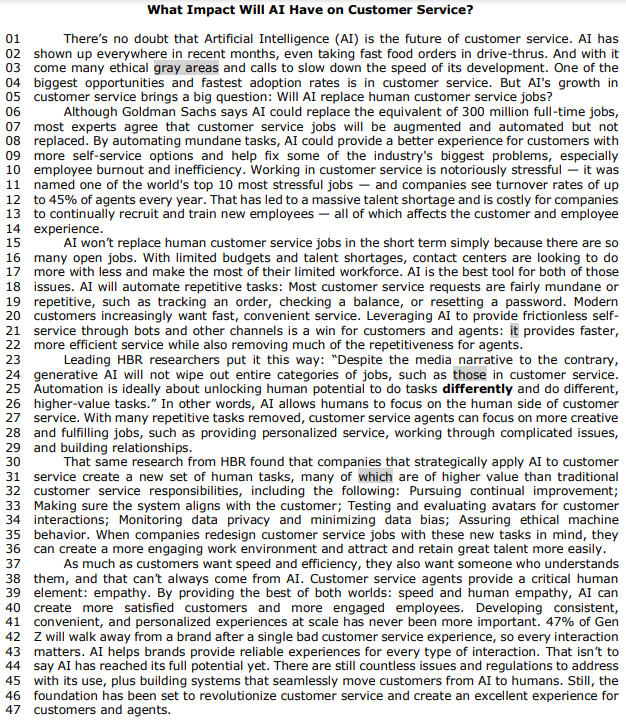
(Available at: https://www.forbes.com/sites/blakemorgan/2023/08/16/what-impact-will-ai-have-on-customer-
service/ - text especially adapted for this test).
*Bot: a computer program that works automatically, especially one that searches for and finds
information on the internet. (www.dictionary.cambridge.org 09/09/23).
In the excerpt from the text “every interaction matters” (l. 42-43), the use of
“matters” is:
Ano: 2023
Banca:
FUNDATEC
Órgão:
Prefeitura de Sapucaia do Sul - RS
Prova:
FUNDATEC - 2023 - Prefeitura de Sapucaia do Sul - RS - Professor A2 – Língua Inglesa |
Q2286500
Inglês
Texto associado
(Available at: https://www.forbes.com/sites/blakemorgan/2023/08/16/what-impact-will-ai-have-on-customer-
service/ - text especially adapted for this test).
*Bot: a computer program that works automatically, especially one that searches for and finds
information on the internet. (www.dictionary.cambridge.org 09/09/23).
The highlighted expression “gray areas” (l. 03) means that:
Ano: 2023
Banca:
FUNDATEC
Órgão:
Prefeitura de Sapucaia do Sul - RS
Prova:
FUNDATEC - 2023 - Prefeitura de Sapucaia do Sul - RS - Professor A2 – Língua Inglesa |
Q2286499
Inglês
Texto associado
(Available at: https://www.forbes.com/sites/blakemorgan/2023/08/16/what-impact-will-ai-have-on-customer-
service/ - text especially adapted for this test).
*Bot: a computer program that works automatically, especially one that searches for and finds
information on the internet. (www.dictionary.cambridge.org 09/09/23).
Analyze the following statements about the text:
I. In “AI could provide a better experience” (l. 08), the word “better” is the superlative form of the irregular adjective “good”.
II. In “One of the world’s top 10 most stressful jobs” (l. 11), “most stressful” is a superlative structure and “most” is used because “stressful” is a long adjective.
III. In “It provides faster, more efficient service” (l. 21-22) there are two comparative structures. We add -er to the short adjective “fast”, and “more” to “efficient” because it is an irregular adjective.
Which ones are correct?
I. In “AI could provide a better experience” (l. 08), the word “better” is the superlative form of the irregular adjective “good”.
II. In “One of the world’s top 10 most stressful jobs” (l. 11), “most stressful” is a superlative structure and “most” is used because “stressful” is a long adjective.
III. In “It provides faster, more efficient service” (l. 21-22) there are two comparative structures. We add -er to the short adjective “fast”, and “more” to “efficient” because it is an irregular adjective.
Which ones are correct?
Ano: 2023
Banca:
FUNDATEC
Órgão:
Prefeitura de Sapucaia do Sul - RS
Prova:
FUNDATEC - 2023 - Prefeitura de Sapucaia do Sul - RS - Professor A2 – Língua Inglesa |
Q2286498
Inglês
Texto associado
(Available at: https://www.forbes.com/sites/blakemorgan/2023/08/16/what-impact-will-ai-have-on-customer-
service/ - text especially adapted for this test).
*Bot: a computer program that works automatically, especially one that searches for and finds
information on the internet. (www.dictionary.cambridge.org 09/09/23).
Consider the following excerpt from the text “The foundation has been set to
revolutionize customer service” (l. 45-46). Which of the alternatives below shows the sentence
correctly rewritten in the interrogative form?

 Conheça nossos planos