Questões de Concurso Sobre inglês
Foram encontradas 26.136 questões


Ano: 2025
Banca:
Quadrix
Órgão:
CORE-SP
Provas:
Quadrix - 2025 - CORE-SP - Analista de Tecnologia da Informação
|
Quadrix - 2025 - CORE-SP - Assistente Jurídico |
Quadrix - 2025 - CORE-SP - Contador |
Q3748899
Inglês
Texto associado
Since the 1950s, researchers, inventors and
entrepreneurs have been fascinated by the idea of
Artificial Intelligence (AI) to replicate human behaviour
and thinking into technology. Over time AI has evolved to
mimic human behaviour in information technology (IT)
with key milestones like machine learning, natural
language processing and understanding, generative AI
and orchestrating decision making and now the latest
advancement: agentic AI.
Today, AI is not just a technology but a critical
part of modern IT strategies. AI in the IT industry has been
a transformative force, automating tasks, analysing vast
amounts of data and improving operational processes. By
using AI for ITSM, organisations can adapt to a changing
technology landscape and complex digital environments
and keep their IT infrastructure future proof.
AI has come a long way from theory to software
to recent innovations like machine learning (ML). ML is
about developing AI algorithms and models that help
systems learn and make decisions based on patterns and
relationships in data. Instead of programming each decision
manually, systems can make decisions on their own based
on large amounts of data. Continuous learning on data
allows systems to get better over time. At the next level
is natural language processing (NLP), a branch of machine
learning that’s about interpreting human language and
generating intelligent and contextual responses. By using
ML algorithms on language, machines can do things
like response generation, speech recognition, language
translation and more. NLP is the foundation for modern
day chatbots that can understand user intent and generate
responses to user requests.
AI is revolutionizing ITSM by introducing innovative
solutions such as an AI service desk that enhances IT
operations. With automated ticket triaging, routing,
deflection, and process automation, organizations can
streamline tasks that IT agents encounter daily.
By providing agents with agent assist capabilities
and an AI Copilot, organizations can reduce redundant
and repetitive service tasks and improve productivity,
thereby minimizing the need for human intervention
in these repetitive tasks. With AIOps, organizations can
also stay ahead of potential incidents and outages with
proactive detection and remediation, as well as automated
incident management.
AI also plays a big role in software development
and testing. It helps quality assurance teams by generating
test cases and predicting defects. This means they can catch
and fix bugs much earlier which prevents bigger issues
down the line. When it comes to data center security,
computer vision is a powerful tool. It allows systems to
analyze images and videos to monitor infrastructure and
spot anything unusual. Additionally, machine learning
models can analyze network traffic in real time to detect
cyber threats and fraud and allow teams to respond quickly
and protect their systems.
Internet:<aisera.com> (adapted).
According to the text, Artificial Intelligence in IT is helping
multiple organizations due to its
Ano: 2025
Banca:
OBJETIVA
Órgão:
Prefeitura de São José do Ouro - RS
Prova:
OBJETIVA - 2025 - Prefeitura de São José do Ouro - RS - Professor – Português-Habilitação Língua Inglesa |
Q3747836
Inglês
Which part of the word "misunderstanding" is a prefix?
Ano: 2025
Banca:
OBJETIVA
Órgão:
Prefeitura de São José do Ouro - RS
Prova:
OBJETIVA - 2025 - Prefeitura de São José do Ouro - RS - Professor – Português-Habilitação Língua Inglesa |
Q3747835
Inglês
Mark the item that CORRECTLY fills in the blank below.
World War I (WWI) took place ______ the 20th century.
World War I (WWI) took place ______ the 20th century.
Ano: 2025
Banca:
OBJETIVA
Órgão:
Prefeitura de São José do Ouro - RS
Prova:
OBJETIVA - 2025 - Prefeitura de São José do Ouro - RS - Professor – Português-Habilitação Língua Inglesa |
Q3747834
Inglês
Jane Austen’s “Pride and Prejudice” is a classic novel that
explores themes of:
Ano: 2025
Banca:
OBJETIVA
Órgão:
Prefeitura de São José do Ouro - RS
Prova:
OBJETIVA - 2025 - Prefeitura de São José do Ouro - RS - Professor – Português-Habilitação Língua Inglesa |
Q3747833
Inglês
There are many approaches to teaching English as an
additional language. Although methods can differ
significantly, there is no single best method for teaching a
second language. One of the most widely practiced
approaches is content based instruction, which consists of:
Ano: 2025
Banca:
OBJETIVA
Órgão:
Prefeitura de São José do Ouro - RS
Prova:
OBJETIVA - 2025 - Prefeitura de São José do Ouro - RS - Professor – Português-Habilitação Língua Inglesa |
Q3747832
Inglês
Texto associado
We might be confronted on a weekly basis by a
different trend or TikTok 'aesthetic' to try, but all the bestdressed people in the world stick to what they know works
best. Having distinctive personal style is all about defining
what suits you and never venturing too far from it. Of
course, this makes getting dressed every morning easier and
leads to a lot less stress when shopping – but embracing
your own uniqueness in fashion can have a positive impact
on your mental health more generally.
According to the fashion psychologist Shakaila
Forbes-Bell, standing out via your clothing is all about
gaining validation, and this can boost your confidence and
change the way that others interact with you.
“As humans, our desire to stand out is ingrained
because achieving special recognition and validation boosts
our self-image and increases our likelihood of being
rewarded,” she explains.
Source: Harper’s Bazaar. Adaptation.
Mark the item that displays the CORRECT translation for
the text below.
Having distinctive personal style is all about defining what suits you and never venturing too far from it.
Having distinctive personal style is all about defining what suits you and never venturing too far from it.
Ano: 2025
Banca:
OBJETIVA
Órgão:
Prefeitura de São José do Ouro - RS
Prova:
OBJETIVA - 2025 - Prefeitura de São José do Ouro - RS - Professor – Português-Habilitação Língua Inglesa |
Q3747831
Inglês
Texto associado
We might be confronted on a weekly basis by a
different trend or TikTok 'aesthetic' to try, but all the bestdressed people in the world stick to what they know works
best. Having distinctive personal style is all about defining
what suits you and never venturing too far from it. Of
course, this makes getting dressed every morning easier and
leads to a lot less stress when shopping – but embracing
your own uniqueness in fashion can have a positive impact
on your mental health more generally.
According to the fashion psychologist Shakaila
Forbes-Bell, standing out via your clothing is all about
gaining validation, and this can boost your confidence and
change the way that others interact with you.
“As humans, our desire to stand out is ingrained
because achieving special recognition and validation boosts
our self-image and increases our likelihood of being
rewarded,” she explains.
Source: Harper’s Bazaar. Adaptation.
The underlined phrasal verb in the 3rd paragraph of the
text means:
Ano: 2025
Banca:
OBJETIVA
Órgão:
Prefeitura de São José do Ouro - RS
Prova:
OBJETIVA - 2025 - Prefeitura de São José do Ouro - RS - Professor – Português-Habilitação Língua Inglesa |
Q3747830
Inglês
Texto associado
We might be confronted on a weekly basis by a
different trend or TikTok 'aesthetic' to try, but all the bestdressed people in the world stick to what they know works
best. Having distinctive personal style is all about defining
what suits you and never venturing too far from it. Of
course, this makes getting dressed every morning easier and
leads to a lot less stress when shopping – but embracing
your own uniqueness in fashion can have a positive impact
on your mental health more generally.
According to the fashion psychologist Shakaila
Forbes-Bell, standing out via your clothing is all about
gaining validation, and this can boost your confidence and
change the way that others interact with you.
“As humans, our desire to stand out is ingrained
because achieving special recognition and validation boosts
our self-image and increases our likelihood of being
rewarded,” she explains.
Source: Harper’s Bazaar. Adaptation.
According to the text, clothing has a positive impact on
our mental health because:
Ano: 2025
Banca:
EDUCA
Órgão:
Prefeitura de Brejo do Cruz - PB
Prova:
EDUCA - 2025 - Prefeitura de Brejo do Cruz - PB - Professor Classe B – Inglês |
Q3747553
Inglês
Texto associado
TEXT 2
English Should Not Be Taught Like It’s Physics:
Rethinking How We Teach Beginner Level Learners
Introduction
When teaching English to beginner-level learners, one of
the biggest mistakes we make is treating the language like
a set of scientific formulas to be memorized. In the
quintessential classroom of traditional, test-focused
educational systems, English is often taught as though it
were physics; it’s rigid, theoretical, and abstract. Language,
however, is a far cry from the aforementioned descriptions.
Language is dynamic, flexible, and has a certain “feel” to
it.
The problem with the “Physics” Approach
Picture this: you walk into a physics class and sit down.
Immediately, all sorts of theories, equations, and
vocabulary you’ve never heard before are being thrown at
you without any context. Doesn’t feel good, does it? That’s
how many beginner-level English learners feel. This
method relies heavily on grammar drills, vocabulary lists,
and some pretty unnatural textbook dialogues. Learners
may know the structure of the present perfect tense, but
they choke when asked, “How was your weekend?” Why? Because they’ve been trained to decode language
like a formula; not use it as a tool for expression.
What language really is
Language is instinctive. We don’t learn our first language
by studying grammar rules, but rather through interaction,
repetition, and real-life use. Babies don’t sit down with
textbooks in their lap. They listen, observe, repeat, and
gradually experiment; with zero fear of making mistakes.
This is how language sticks. For beginner-level learners,
especially adults, we need to replicate that natural process
as much as possible. The focus should shift from
knowledge about the language to using the language. There
should also be some emphasis on making sure the process
is enjoyable.
Rethinking success
We need to redefine what success looks like in beginner
English classes. It’s not about perfect grammar. It’s about
confidence, connection, and the ability to navigate simple
conversations. It’s about the listener’s ability to understand
what is being said by the speaker and vice-versa. I
remember when I’d tease my grandma for mispronouncing
words (for example, she’d say “brade” instead of “blade”),
and her retort would be, “You understood me though, didn’t
you?!”
It’s a win if a student can say, “I like sushi. You?” If they
can ask, “Where is the toilet?” when they’re pressed,
they’ve got more success than someone who has 50 verbs
memorized but can’t use them.
Conclusion
English is NOT physics. It’s not about solving problems on
paper; it’s about expressing thoughts and being understood,
building relationships and making life easier in an everchanging global world. If we want our students to thrive, as
well as keep being interested in improving and using
English long after moving on from our lessons together, we
need to stop treating the language like a set of scientific
formulas and start treating it like what it truly is: a human
skill.
Let’s make the classroom a space of interaction and
communication, not calculation.
Content extracted and adapted from:
https://www.hltmag.co.uk/oct25/english-should-not-be-taught-like-it-sphysics
Take into account that certain English words are very
similar in spelling and meaning to their Brazilian
Portuguese counterparts because they come from the
same origin. These words are known as “cognates”.
With this in mind, choose the only option that correctly
lists five English real cognates present in Text 2:
Ano: 2025
Banca:
EDUCA
Órgão:
Prefeitura de Brejo do Cruz - PB
Prova:
EDUCA - 2025 - Prefeitura de Brejo do Cruz - PB - Professor Classe B – Inglês |
Q3747552
Inglês
Texto associado
TEXT 2
English Should Not Be Taught Like It’s Physics:
Rethinking How We Teach Beginner Level Learners
Introduction
When teaching English to beginner-level learners, one of
the biggest mistakes we make is treating the language like
a set of scientific formulas to be memorized. In the
quintessential classroom of traditional, test-focused
educational systems, English is often taught as though it
were physics; it’s rigid, theoretical, and abstract. Language,
however, is a far cry from the aforementioned descriptions.
Language is dynamic, flexible, and has a certain “feel” to
it.
The problem with the “Physics” Approach
Picture this: you walk into a physics class and sit down.
Immediately, all sorts of theories, equations, and
vocabulary you’ve never heard before are being thrown at
you without any context. Doesn’t feel good, does it? That’s
how many beginner-level English learners feel. This
method relies heavily on grammar drills, vocabulary lists,
and some pretty unnatural textbook dialogues. Learners
may know the structure of the present perfect tense, but
they choke when asked, “How was your weekend?” Why? Because they’ve been trained to decode language
like a formula; not use it as a tool for expression.
What language really is
Language is instinctive. We don’t learn our first language
by studying grammar rules, but rather through interaction,
repetition, and real-life use. Babies don’t sit down with
textbooks in their lap. They listen, observe, repeat, and
gradually experiment; with zero fear of making mistakes.
This is how language sticks. For beginner-level learners,
especially adults, we need to replicate that natural process
as much as possible. The focus should shift from
knowledge about the language to using the language. There
should also be some emphasis on making sure the process
is enjoyable.
Rethinking success
We need to redefine what success looks like in beginner
English classes. It’s not about perfect grammar. It’s about
confidence, connection, and the ability to navigate simple
conversations. It’s about the listener’s ability to understand
what is being said by the speaker and vice-versa. I
remember when I’d tease my grandma for mispronouncing
words (for example, she’d say “brade” instead of “blade”),
and her retort would be, “You understood me though, didn’t
you?!”
It’s a win if a student can say, “I like sushi. You?” If they
can ask, “Where is the toilet?” when they’re pressed,
they’ve got more success than someone who has 50 verbs
memorized but can’t use them.
Conclusion
English is NOT physics. It’s not about solving problems on
paper; it’s about expressing thoughts and being understood,
building relationships and making life easier in an everchanging global world. If we want our students to thrive, as
well as keep being interested in improving and using
English long after moving on from our lessons together, we
need to stop treating the language like a set of scientific
formulas and start treating it like what it truly is: a human
skill.
Let’s make the classroom a space of interaction and
communication, not calculation.
Content extracted and adapted from:
https://www.hltmag.co.uk/oct25/english-should-not-be-taught-like-it-sphysics
The expression “zero fear of making mistakes”,
extracted from Text 2, emphasizes the importance of:
Ano: 2025
Banca:
EDUCA
Órgão:
Prefeitura de Brejo do Cruz - PB
Prova:
EDUCA - 2025 - Prefeitura de Brejo do Cruz - PB - Professor Classe B – Inglês |
Q3747551
Inglês
Texto associado
TEXT 2
English Should Not Be Taught Like It’s Physics:
Rethinking How We Teach Beginner Level Learners
Introduction
When teaching English to beginner-level learners, one of
the biggest mistakes we make is treating the language like
a set of scientific formulas to be memorized. In the
quintessential classroom of traditional, test-focused
educational systems, English is often taught as though it
were physics; it’s rigid, theoretical, and abstract. Language,
however, is a far cry from the aforementioned descriptions.
Language is dynamic, flexible, and has a certain “feel” to
it.
The problem with the “Physics” Approach
Picture this: you walk into a physics class and sit down.
Immediately, all sorts of theories, equations, and
vocabulary you’ve never heard before are being thrown at
you without any context. Doesn’t feel good, does it? That’s
how many beginner-level English learners feel. This
method relies heavily on grammar drills, vocabulary lists,
and some pretty unnatural textbook dialogues. Learners
may know the structure of the present perfect tense, but
they choke when asked, “How was your weekend?” Why? Because they’ve been trained to decode language
like a formula; not use it as a tool for expression.
What language really is
Language is instinctive. We don’t learn our first language
by studying grammar rules, but rather through interaction,
repetition, and real-life use. Babies don’t sit down with
textbooks in their lap. They listen, observe, repeat, and
gradually experiment; with zero fear of making mistakes.
This is how language sticks. For beginner-level learners,
especially adults, we need to replicate that natural process
as much as possible. The focus should shift from
knowledge about the language to using the language. There
should also be some emphasis on making sure the process
is enjoyable.
Rethinking success
We need to redefine what success looks like in beginner
English classes. It’s not about perfect grammar. It’s about
confidence, connection, and the ability to navigate simple
conversations. It’s about the listener’s ability to understand
what is being said by the speaker and vice-versa. I
remember when I’d tease my grandma for mispronouncing
words (for example, she’d say “brade” instead of “blade”),
and her retort would be, “You understood me though, didn’t
you?!”
It’s a win if a student can say, “I like sushi. You?” If they
can ask, “Where is the toilet?” when they’re pressed,
they’ve got more success than someone who has 50 verbs
memorized but can’t use them.
Conclusion
English is NOT physics. It’s not about solving problems on
paper; it’s about expressing thoughts and being understood,
building relationships and making life easier in an everchanging global world. If we want our students to thrive, as
well as keep being interested in improving and using
English long after moving on from our lessons together, we
need to stop treating the language like a set of scientific
formulas and start treating it like what it truly is: a human
skill.
Let’s make the classroom a space of interaction and
communication, not calculation.
Content extracted and adapted from:
https://www.hltmag.co.uk/oct25/english-should-not-be-taught-like-it-sphysics
Consider this sentence extracted from Text 2: “Learners
may know the structure of the present perfect tense”.
Now, preserving its original meaning and use in the
given context, choose the option that correctly classify
the underlined word (“may”):
Ano: 2025
Banca:
EDUCA
Órgão:
Prefeitura de Brejo do Cruz - PB
Prova:
EDUCA - 2025 - Prefeitura de Brejo do Cruz - PB - Professor Classe B – Inglês |
Q3747550
Inglês
Texto associado
TEXT 2
English Should Not Be Taught Like It’s Physics:
Rethinking How We Teach Beginner Level Learners
Introduction
When teaching English to beginner-level learners, one of
the biggest mistakes we make is treating the language like
a set of scientific formulas to be memorized. In the
quintessential classroom of traditional, test-focused
educational systems, English is often taught as though it
were physics; it’s rigid, theoretical, and abstract. Language,
however, is a far cry from the aforementioned descriptions.
Language is dynamic, flexible, and has a certain “feel” to
it.
The problem with the “Physics” Approach
Picture this: you walk into a physics class and sit down.
Immediately, all sorts of theories, equations, and
vocabulary you’ve never heard before are being thrown at
you without any context. Doesn’t feel good, does it? That’s
how many beginner-level English learners feel. This
method relies heavily on grammar drills, vocabulary lists,
and some pretty unnatural textbook dialogues. Learners
may know the structure of the present perfect tense, but
they choke when asked, “How was your weekend?” Why? Because they’ve been trained to decode language
like a formula; not use it as a tool for expression.
What language really is
Language is instinctive. We don’t learn our first language
by studying grammar rules, but rather through interaction,
repetition, and real-life use. Babies don’t sit down with
textbooks in their lap. They listen, observe, repeat, and
gradually experiment; with zero fear of making mistakes.
This is how language sticks. For beginner-level learners,
especially adults, we need to replicate that natural process
as much as possible. The focus should shift from
knowledge about the language to using the language. There
should also be some emphasis on making sure the process
is enjoyable.
Rethinking success
We need to redefine what success looks like in beginner
English classes. It’s not about perfect grammar. It’s about
confidence, connection, and the ability to navigate simple
conversations. It’s about the listener’s ability to understand
what is being said by the speaker and vice-versa. I
remember when I’d tease my grandma for mispronouncing
words (for example, she’d say “brade” instead of “blade”),
and her retort would be, “You understood me though, didn’t
you?!”
It’s a win if a student can say, “I like sushi. You?” If they
can ask, “Where is the toilet?” when they’re pressed,
they’ve got more success than someone who has 50 verbs
memorized but can’t use them.
Conclusion
English is NOT physics. It’s not about solving problems on
paper; it’s about expressing thoughts and being understood,
building relationships and making life easier in an everchanging global world. If we want our students to thrive, as
well as keep being interested in improving and using
English long after moving on from our lessons together, we
need to stop treating the language like a set of scientific
formulas and start treating it like what it truly is: a human
skill.
Let’s make the classroom a space of interaction and
communication, not calculation.
Content extracted and adapted from:
https://www.hltmag.co.uk/oct25/english-should-not-be-taught-like-it-sphysics
Consider the following excerpt extracted from Text 2:
“This is how language sticks”. Now, choose the
alternative that correctly corresponds to the topic(s) in
which it is associated in its original context:
Ano: 2025
Banca:
EDUCA
Órgão:
Prefeitura de Brejo do Cruz - PB
Prova:
EDUCA - 2025 - Prefeitura de Brejo do Cruz - PB - Professor Classe B – Inglês |
Q3747549
Inglês
Texto associado
TEXT 2
English Should Not Be Taught Like It’s Physics:
Rethinking How We Teach Beginner Level Learners
Introduction
When teaching English to beginner-level learners, one of
the biggest mistakes we make is treating the language like
a set of scientific formulas to be memorized. In the
quintessential classroom of traditional, test-focused
educational systems, English is often taught as though it
were physics; it’s rigid, theoretical, and abstract. Language,
however, is a far cry from the aforementioned descriptions.
Language is dynamic, flexible, and has a certain “feel” to
it.
The problem with the “Physics” Approach
Picture this: you walk into a physics class and sit down.
Immediately, all sorts of theories, equations, and
vocabulary you’ve never heard before are being thrown at
you without any context. Doesn’t feel good, does it? That’s
how many beginner-level English learners feel. This
method relies heavily on grammar drills, vocabulary lists,
and some pretty unnatural textbook dialogues. Learners
may know the structure of the present perfect tense, but
they choke when asked, “How was your weekend?” Why? Because they’ve been trained to decode language
like a formula; not use it as a tool for expression.
What language really is
Language is instinctive. We don’t learn our first language
by studying grammar rules, but rather through interaction,
repetition, and real-life use. Babies don’t sit down with
textbooks in their lap. They listen, observe, repeat, and
gradually experiment; with zero fear of making mistakes.
This is how language sticks. For beginner-level learners,
especially adults, we need to replicate that natural process
as much as possible. The focus should shift from
knowledge about the language to using the language. There
should also be some emphasis on making sure the process
is enjoyable.
Rethinking success
We need to redefine what success looks like in beginner
English classes. It’s not about perfect grammar. It’s about
confidence, connection, and the ability to navigate simple
conversations. It’s about the listener’s ability to understand
what is being said by the speaker and vice-versa. I
remember when I’d tease my grandma for mispronouncing
words (for example, she’d say “brade” instead of “blade”),
and her retort would be, “You understood me though, didn’t
you?!”
It’s a win if a student can say, “I like sushi. You?” If they
can ask, “Where is the toilet?” when they’re pressed,
they’ve got more success than someone who has 50 verbs
memorized but can’t use them.
Conclusion
English is NOT physics. It’s not about solving problems on
paper; it’s about expressing thoughts and being understood,
building relationships and making life easier in an everchanging global world. If we want our students to thrive, as
well as keep being interested in improving and using
English long after moving on from our lessons together, we
need to stop treating the language like a set of scientific
formulas and start treating it like what it truly is: a human
skill.
Let’s make the classroom a space of interaction and
communication, not calculation.
Content extracted and adapted from:
https://www.hltmag.co.uk/oct25/english-should-not-be-taught-like-it-sphysics
Supported by Text 2, choose the alternative that
correctly reflects characteristic(s) of the teaching
approach criticized by the author:
Ano: 2025
Banca:
EDUCA
Órgão:
Prefeitura de Brejo do Cruz - PB
Prova:
EDUCA - 2025 - Prefeitura de Brejo do Cruz - PB - Professor Classe B – Inglês |
Q3747548
Inglês
Texto associado
TEXT 2
English Should Not Be Taught Like It’s Physics:
Rethinking How We Teach Beginner Level Learners
Introduction
When teaching English to beginner-level learners, one of
the biggest mistakes we make is treating the language like
a set of scientific formulas to be memorized. In the
quintessential classroom of traditional, test-focused
educational systems, English is often taught as though it
were physics; it’s rigid, theoretical, and abstract. Language,
however, is a far cry from the aforementioned descriptions.
Language is dynamic, flexible, and has a certain “feel” to
it.
The problem with the “Physics” Approach
Picture this: you walk into a physics class and sit down.
Immediately, all sorts of theories, equations, and
vocabulary you’ve never heard before are being thrown at
you without any context. Doesn’t feel good, does it? That’s
how many beginner-level English learners feel. This
method relies heavily on grammar drills, vocabulary lists,
and some pretty unnatural textbook dialogues. Learners
may know the structure of the present perfect tense, but
they choke when asked, “How was your weekend?” Why? Because they’ve been trained to decode language
like a formula; not use it as a tool for expression.
What language really is
Language is instinctive. We don’t learn our first language
by studying grammar rules, but rather through interaction,
repetition, and real-life use. Babies don’t sit down with
textbooks in their lap. They listen, observe, repeat, and
gradually experiment; with zero fear of making mistakes.
This is how language sticks. For beginner-level learners,
especially adults, we need to replicate that natural process
as much as possible. The focus should shift from
knowledge about the language to using the language. There
should also be some emphasis on making sure the process
is enjoyable.
Rethinking success
We need to redefine what success looks like in beginner
English classes. It’s not about perfect grammar. It’s about
confidence, connection, and the ability to navigate simple
conversations. It’s about the listener’s ability to understand
what is being said by the speaker and vice-versa. I
remember when I’d tease my grandma for mispronouncing
words (for example, she’d say “brade” instead of “blade”),
and her retort would be, “You understood me though, didn’t
you?!”
It’s a win if a student can say, “I like sushi. You?” If they
can ask, “Where is the toilet?” when they’re pressed,
they’ve got more success than someone who has 50 verbs
memorized but can’t use them.
Conclusion
English is NOT physics. It’s not about solving problems on
paper; it’s about expressing thoughts and being understood,
building relationships and making life easier in an everchanging global world. If we want our students to thrive, as
well as keep being interested in improving and using
English long after moving on from our lessons together, we
need to stop treating the language like a set of scientific
formulas and start treating it like what it truly is: a human
skill.
Let’s make the classroom a space of interaction and
communication, not calculation.
Content extracted and adapted from:
https://www.hltmag.co.uk/oct25/english-should-not-be-taught-like-it-sphysics
According to Text 2, the author believes that success,
for beginner learners of English language, should be
measured by:
Ano: 2025
Banca:
EDUCA
Órgão:
Prefeitura de Brejo do Cruz - PB
Prova:
EDUCA - 2025 - Prefeitura de Brejo do Cruz - PB - Professor Classe B – Inglês |
Q3747547
Inglês
Texto associado
TEXT 2
English Should Not Be Taught Like It’s Physics:
Rethinking How We Teach Beginner Level Learners
Introduction
When teaching English to beginner-level learners, one of
the biggest mistakes we make is treating the language like
a set of scientific formulas to be memorized. In the
quintessential classroom of traditional, test-focused
educational systems, English is often taught as though it
were physics; it’s rigid, theoretical, and abstract. Language,
however, is a far cry from the aforementioned descriptions.
Language is dynamic, flexible, and has a certain “feel” to
it.
The problem with the “Physics” Approach
Picture this: you walk into a physics class and sit down.
Immediately, all sorts of theories, equations, and
vocabulary you’ve never heard before are being thrown at
you without any context. Doesn’t feel good, does it? That’s
how many beginner-level English learners feel. This
method relies heavily on grammar drills, vocabulary lists,
and some pretty unnatural textbook dialogues. Learners
may know the structure of the present perfect tense, but
they choke when asked, “How was your weekend?” Why? Because they’ve been trained to decode language
like a formula; not use it as a tool for expression.
What language really is
Language is instinctive. We don’t learn our first language
by studying grammar rules, but rather through interaction,
repetition, and real-life use. Babies don’t sit down with
textbooks in their lap. They listen, observe, repeat, and
gradually experiment; with zero fear of making mistakes.
This is how language sticks. For beginner-level learners,
especially adults, we need to replicate that natural process
as much as possible. The focus should shift from
knowledge about the language to using the language. There
should also be some emphasis on making sure the process
is enjoyable.
Rethinking success
We need to redefine what success looks like in beginner
English classes. It’s not about perfect grammar. It’s about
confidence, connection, and the ability to navigate simple
conversations. It’s about the listener’s ability to understand
what is being said by the speaker and vice-versa. I
remember when I’d tease my grandma for mispronouncing
words (for example, she’d say “brade” instead of “blade”),
and her retort would be, “You understood me though, didn’t
you?!”
It’s a win if a student can say, “I like sushi. You?” If they
can ask, “Where is the toilet?” when they’re pressed,
they’ve got more success than someone who has 50 verbs
memorized but can’t use them.
Conclusion
English is NOT physics. It’s not about solving problems on
paper; it’s about expressing thoughts and being understood,
building relationships and making life easier in an everchanging global world. If we want our students to thrive, as
well as keep being interested in improving and using
English long after moving on from our lessons together, we
need to stop treating the language like a set of scientific
formulas and start treating it like what it truly is: a human
skill.
Let’s make the classroom a space of interaction and
communication, not calculation.
Content extracted and adapted from:
https://www.hltmag.co.uk/oct25/english-should-not-be-taught-like-it-sphysics
Based on Text 2, related to its general idea, the English
language classroom should focus primarily on:
Ano: 2025
Banca:
EDUCA
Órgão:
Prefeitura de Brejo do Cruz - PB
Prova:
EDUCA - 2025 - Prefeitura de Brejo do Cruz - PB - Professor Classe B – Inglês |
Q3747546
Inglês
Texto associado
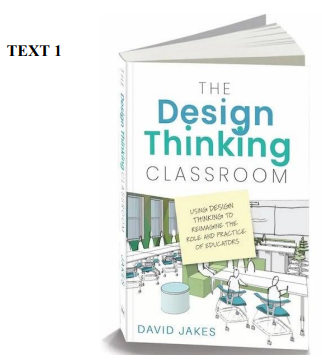
The Design Thinking Classroom: Using Design
Thinking to Reimagine the Role and Practice of
Educators (English Edition)
By David Jakes (Author) | ☆☆☆☆☆
A Design-Oriented Approach That Can Best Serve
Today's Students and Educators Alike
How can we make schools more relevant, engaging, and
capable of supporting the development of skills and
dispositions that will help students themselves design a life
worth living?
Drawing from his ample experience in the classroom, as a
school administrator, and as a designer, author David Jakes
makes the case that design thinking offers an approach to
education that is responsive, collaborative, and well-suited
to the opportunities of the twenty-first century. Full of
exercises and suggestions for how design thinking can
change educators’ approach to classroom layout, virtual
learning, assessment, and more, this book shows how we
can make today's classrooms better places to teach and
learn.
The Design Thinking Classroom helps create the
conditions for K–12 teachers and school leaders to innovate
and improve a new kind of educational experience. It’s a
book for readers who are invested in rising to the challenges
faced by modern institutions and a powerful argument for
the ways design thinking can transform education.
Excerpt extracted and adapted from:
https://www.amazon.com.br/Design-Thinking-Classroom-ReimagineEducators-ebook/dp/B0BR8MPY76?ref_=ast_author_mpb
Which of the following sentences is the only one
correctly expressed in passive voice?
Ano: 2025
Banca:
EDUCA
Órgão:
Prefeitura de Brejo do Cruz - PB
Prova:
EDUCA - 2025 - Prefeitura de Brejo do Cruz - PB - Professor Classe B – Inglês |
Q3747545
Inglês
Texto associado
The Design Thinking Classroom: Using Design
Thinking to Reimagine the Role and Practice of
Educators (English Edition)
By David Jakes (Author) | ☆☆☆☆☆
A Design-Oriented Approach That Can Best Serve
Today's Students and Educators Alike
How can we make schools more relevant, engaging, and
capable of supporting the development of skills and
dispositions that will help students themselves design a life
worth living?
Drawing from his ample experience in the classroom, as a
school administrator, and as a designer, author David Jakes
makes the case that design thinking offers an approach to
education that is responsive, collaborative, and well-suited
to the opportunities of the twenty-first century. Full of
exercises and suggestions for how design thinking can
change educators’ approach to classroom layout, virtual
learning, assessment, and more, this book shows how we
can make today's classrooms better places to teach and
learn.
The Design Thinking Classroom helps create the
conditions for K–12 teachers and school leaders to innovate
and improve a new kind of educational experience. It’s a
book for readers who are invested in rising to the challenges
faced by modern institutions and a powerful argument for
the ways design thinking can transform education.
Excerpt extracted and adapted from:
https://www.amazon.com.br/Design-Thinking-Classroom-ReimagineEducators-ebook/dp/B0BR8MPY76?ref_=ast_author_mpb
In Text 1, it is said that “This book shows how we can
make today's classrooms better places to teach and
learn”. Based on this excerpt, choose the alternative that correctly rewrite this sentence from Present Simple to
Present Perfect tense:
Ano: 2025
Banca:
EDUCA
Órgão:
Prefeitura de Brejo do Cruz - PB
Prova:
EDUCA - 2025 - Prefeitura de Brejo do Cruz - PB - Professor Classe B – Inglês |
Q3747544
Inglês
Texto associado
The Design Thinking Classroom: Using Design
Thinking to Reimagine the Role and Practice of
Educators (English Edition)
By David Jakes (Author) | ☆☆☆☆☆
A Design-Oriented Approach That Can Best Serve
Today's Students and Educators Alike
How can we make schools more relevant, engaging, and
capable of supporting the development of skills and
dispositions that will help students themselves design a life
worth living?
Drawing from his ample experience in the classroom, as a
school administrator, and as a designer, author David Jakes
makes the case that design thinking offers an approach to
education that is responsive, collaborative, and well-suited
to the opportunities of the twenty-first century. Full of
exercises and suggestions for how design thinking can
change educators’ approach to classroom layout, virtual
learning, assessment, and more, this book shows how we
can make today's classrooms better places to teach and
learn.
The Design Thinking Classroom helps create the
conditions for K–12 teachers and school leaders to innovate
and improve a new kind of educational experience. It’s a
book for readers who are invested in rising to the challenges
faced by modern institutions and a powerful argument for
the ways design thinking can transform education.
Excerpt extracted and adapted from:
https://www.amazon.com.br/Design-Thinking-Classroom-ReimagineEducators-ebook/dp/B0BR8MPY76?ref_=ast_author_mpb
The expression “a life worth living” (extracted from
Text 1) suggests:
Ano: 2025
Banca:
EDUCA
Órgão:
Prefeitura de Brejo do Cruz - PB
Prova:
EDUCA - 2025 - Prefeitura de Brejo do Cruz - PB - Professor Classe B – Inglês |
Q3747543
Inglês
Texto associado
The Design Thinking Classroom: Using Design
Thinking to Reimagine the Role and Practice of
Educators (English Edition)
By David Jakes (Author) | ☆☆☆☆☆
A Design-Oriented Approach That Can Best Serve
Today's Students and Educators Alike
How can we make schools more relevant, engaging, and
capable of supporting the development of skills and
dispositions that will help students themselves design a life
worth living?
Drawing from his ample experience in the classroom, as a
school administrator, and as a designer, author David Jakes
makes the case that design thinking offers an approach to
education that is responsive, collaborative, and well-suited
to the opportunities of the twenty-first century. Full of
exercises and suggestions for how design thinking can
change educators’ approach to classroom layout, virtual
learning, assessment, and more, this book shows how we
can make today's classrooms better places to teach and
learn.
The Design Thinking Classroom helps create the
conditions for K–12 teachers and school leaders to innovate
and improve a new kind of educational experience. It’s a
book for readers who are invested in rising to the challenges
faced by modern institutions and a powerful argument for
the ways design thinking can transform education.
Excerpt extracted and adapted from:
https://www.amazon.com.br/Design-Thinking-Classroom-ReimagineEducators-ebook/dp/B0BR8MPY76?ref_=ast_author_mpb
Considering the following excerpt extracted from Text
1, where it says “A Design-Oriented Approach That
Can Best Serve Today's Students and Educators Alike”,
the underlined word (“Alike”) can be correctly replaced
(preserving its original meaning and use in its original
context) by:
Ano: 2025
Banca:
EDUCA
Órgão:
Prefeitura de Brejo do Cruz - PB
Prova:
EDUCA - 2025 - Prefeitura de Brejo do Cruz - PB - Professor Classe B – Inglês |
Q3747542
Inglês
Texto associado
The Design Thinking Classroom: Using Design
Thinking to Reimagine the Role and Practice of
Educators (English Edition)
By David Jakes (Author) | ☆☆☆☆☆
A Design-Oriented Approach That Can Best Serve
Today's Students and Educators Alike
How can we make schools more relevant, engaging, and
capable of supporting the development of skills and
dispositions that will help students themselves design a life
worth living?
Drawing from his ample experience in the classroom, as a
school administrator, and as a designer, author David Jakes
makes the case that design thinking offers an approach to
education that is responsive, collaborative, and well-suited
to the opportunities of the twenty-first century. Full of
exercises and suggestions for how design thinking can
change educators’ approach to classroom layout, virtual
learning, assessment, and more, this book shows how we
can make today's classrooms better places to teach and
learn.
The Design Thinking Classroom helps create the
conditions for K–12 teachers and school leaders to innovate
and improve a new kind of educational experience. It’s a
book for readers who are invested in rising to the challenges
faced by modern institutions and a powerful argument for
the ways design thinking can transform education.
Excerpt extracted and adapted from:
https://www.amazon.com.br/Design-Thinking-Classroom-ReimagineEducators-ebook/dp/B0BR8MPY76?ref_=ast_author_mpb
Based on Text 1, choose the only one option that
correctly presents Daniel Jakes’ opinion about Design
Thinking:

 Conheça nossos planos