Questões de Concurso Sobre inglês
Foram encontradas 26.136 questões


Ano: 2025
Banca:
FEPESE
Órgão:
Prefeitura de Cunha Porã - SC
Prova:
FEPESE - 2025 - Prefeitura de Cunha Porã - SC - Professor de Inglês |
Q3768705
Inglês
Read the following news fragment.
A small town in southern England has become famous for its “Book Exchange Phone Box.” The red telephone booth, once used for calls, is now filled with books. Locals can take a book, leave one, or just stop by to read. The project started when residents wanted to save the old phone booth from being removed. Now, it has become a symbol of community and creativity.
Study these sentences and decide if they are true ( T ) or false ( F ), according to the news fragment.
( ) The new use of the old phone box is a small library.
( ) The project started to save the old phone booth.
( ) The phone box symbolizes technology now.
( ) “Book Exchange Phone Box” was used for calls only.
Now, choose the alternative which presents the correct sequence from top to bottom:
A small town in southern England has become famous for its “Book Exchange Phone Box.” The red telephone booth, once used for calls, is now filled with books. Locals can take a book, leave one, or just stop by to read. The project started when residents wanted to save the old phone booth from being removed. Now, it has become a symbol of community and creativity.
Study these sentences and decide if they are true ( T ) or false ( F ), according to the news fragment.
( ) The new use of the old phone box is a small library.
( ) The project started to save the old phone booth.
( ) The phone box symbolizes technology now.
( ) “Book Exchange Phone Box” was used for calls only.
Now, choose the alternative which presents the correct sequence from top to bottom:
Ano: 2025
Banca:
FEPESE
Órgão:
Prefeitura de Cunha Porã - SC
Prova:
FEPESE - 2025 - Prefeitura de Cunha Porã - SC - Professor de Inglês |
Q3768704
Inglês
Texto associado
Text
Arjun had always felt most comfortable behind the
scenes, quietly working as a stagehand at the town’s
community theater. One day, when the lead actor
suddenly fell ill hours before the premiere of the
much-anticipated play, panic gripped the cast and
crew. The director, in desperation, turned to Arjun and
asked him to step in.
Although reluctant, Arjun agreed. He spent every
spare moment backstage absorbing the script and
mimicking the lead actor’s delivery. When the curtains
finally rose, Arjun’s heart pounded as he stepped into
the spotlight. His voice trembled at first, but as the
story unfolded, something remarkable happened.
He connected with the character and felt a surge of
confidence.
By the end of the play, Arjun had not only delivered
a stellar performance but also received a standing
ovation. For years, he had believed that his place
was behind the scenes. But that night, Arjun realized
that true potential is often discovered in moments
of adversity. The experience left him wondering how
many hidden talents lie dormant simply because of
fear or hesitation.
Adapted from:readlearnexcel.com
Analyze the sentences according to structure and
grammar use, form the narrative passage.
1. The words in bold, in the following sentence: By the end of the play, Arjun had not only delivered a stellar performance but also received a standing ovation, are being used as a correlative conjunction.
2. The underlined words in: had always felt (paragraph 1) and spent (paragraph 2) are verbs in the present perfect tense and simple past tense, respectively.
3. The underlined words in the narrative adversity and simply (last paragraph), are examples of a noun and an adverb.
4. In the sentence: The director, in desperation, turned to Arjun and asked him to step in, the pronoun in bold refers to the director.
Select the alternative that indicates all the correct sentences.
1. The words in bold, in the following sentence: By the end of the play, Arjun had not only delivered a stellar performance but also received a standing ovation, are being used as a correlative conjunction.
2. The underlined words in: had always felt (paragraph 1) and spent (paragraph 2) are verbs in the present perfect tense and simple past tense, respectively.
3. The underlined words in the narrative adversity and simply (last paragraph), are examples of a noun and an adverb.
4. In the sentence: The director, in desperation, turned to Arjun and asked him to step in, the pronoun in bold refers to the director.
Select the alternative that indicates all the correct sentences.
Ano: 2025
Banca:
FEPESE
Órgão:
Prefeitura de Cunha Porã - SC
Prova:
FEPESE - 2025 - Prefeitura de Cunha Porã - SC - Professor de Inglês |
Q3768703
Inglês
Texto associado
Text
Arjun had always felt most comfortable behind the
scenes, quietly working as a stagehand at the town’s
community theater. One day, when the lead actor
suddenly fell ill hours before the premiere of the
much-anticipated play, panic gripped the cast and
crew. The director, in desperation, turned to Arjun and
asked him to step in.
Although reluctant, Arjun agreed. He spent every
spare moment backstage absorbing the script and
mimicking the lead actor’s delivery. When the curtains
finally rose, Arjun’s heart pounded as he stepped into
the spotlight. His voice trembled at first, but as the
story unfolded, something remarkable happened.
He connected with the character and felt a surge of
confidence.
By the end of the play, Arjun had not only delivered
a stellar performance but also received a standing
ovation. For years, he had believed that his place
was behind the scenes. But that night, Arjun realized
that true potential is often discovered in moments
of adversity. The experience left him wondering how
many hidden talents lie dormant simply because of
fear or hesitation.
Adapted from:readlearnexcel.com
Study these sentences and decide if they are
true ( T ) or false ( F ), according to the Text.
( ) Arjun had the scriptwriter’s role before stepping into the spotlight.
( ) The Arjun’s transformation on stage symbolizes the discovery of hidden potential during challenging times. ( ) Arjun felt nervous but grew confident when he first started performing.
( ) The central theme of the passage is overcoming fear and realizing one’s hidden abilities.
Choose the alternative which presents the correct sequence, from top to bottom.
( ) Arjun had the scriptwriter’s role before stepping into the spotlight.
( ) The Arjun’s transformation on stage symbolizes the discovery of hidden potential during challenging times. ( ) Arjun felt nervous but grew confident when he first started performing.
( ) The central theme of the passage is overcoming fear and realizing one’s hidden abilities.
Choose the alternative which presents the correct sequence, from top to bottom.
Ano: 2025
Banca:
UECE-CEV
Órgão:
Prefeitura de Tauá - CE
Prova:
UECE-CEV - 2025 - Prefeitura de Tauá - CE - Professor de Educação Básica Nível II - Língua Inglesa |
Q3768182
Inglês
Texto associado
T E X T 1
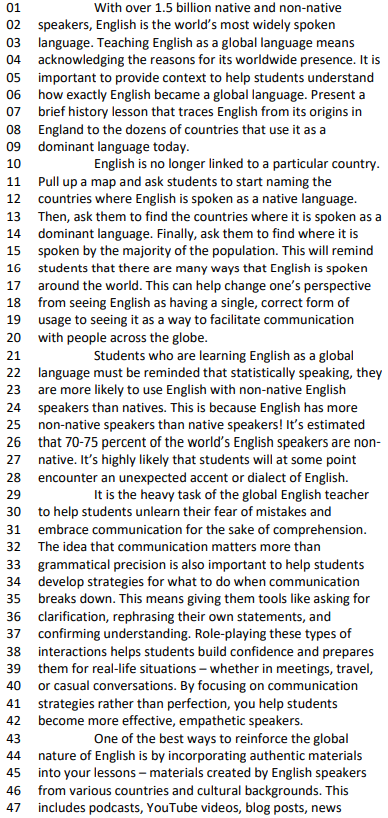
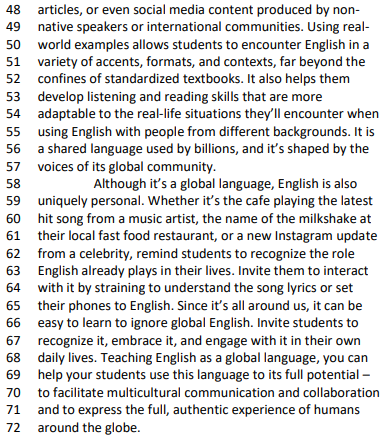
Teaching English as a Global Language
Adapted from: https://bridge.edu/tefl/March 21, 2025
T E X T 2
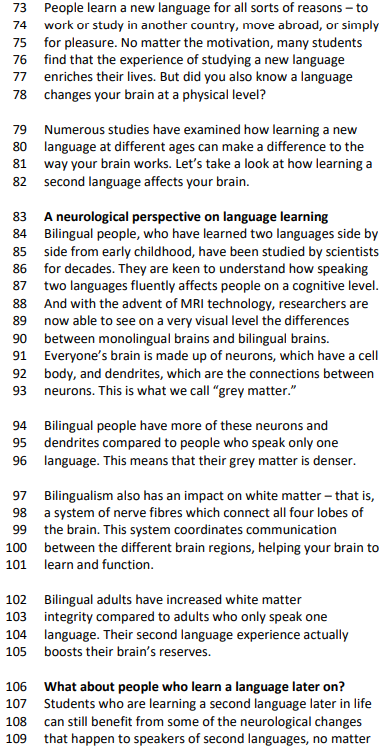
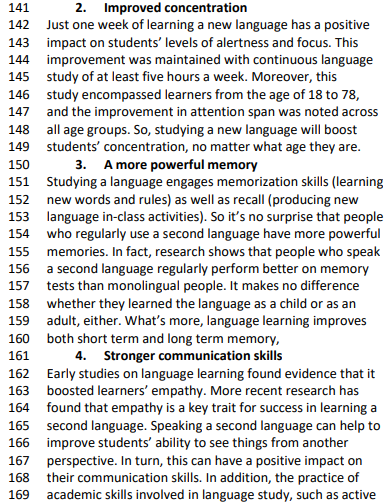
How learning a new language changes your brain
Adapted from: https://www.cambridge.org/elt/blog/2022/04/29.
Mark the alternative that correctly fills in the blanks of the
quote below according to the following indication: simple past of
the verb TO LOOK1
, the past perfect of the verb TO MEET2
, the past
perfect of the verb TO APPRECIATE3
, and the past perfect of the
verb TO GO4
.
“Now that I think of it, she _________ 1 splendid. I wish I _________ 2 her somewhere else. I wish I _________ 3 her as she deserved. I wish that everything _________ 4 differently.”
Alice Munro
“Now that I think of it, she _________ 1 splendid. I wish I _________ 2 her somewhere else. I wish I _________ 3 her as she deserved. I wish that everything _________ 4 differently.”
Alice Munro
Ano: 2025
Banca:
UECE-CEV
Órgão:
Prefeitura de Tauá - CE
Prova:
UECE-CEV - 2025 - Prefeitura de Tauá - CE - Professor de Educação Básica Nível II - Língua Inglesa |
Q3768181
Inglês
Texto associado
T E X T 1
Teaching English as a Global Language
Adapted from: https://bridge.edu/tefl/March 21, 2025
T E X T 2
How learning a new language changes your brain
Adapted from: https://www.cambridge.org/elt/blog/2022/04/29.
In the sentences “All the world's a stage, and all the men and
women merely players. They have their exits and their entrances;
And one man in his time plays many parts.” (William Shakespeare), all
the verbs are in the
Ano: 2025
Banca:
UECE-CEV
Órgão:
Prefeitura de Tauá - CE
Prova:
UECE-CEV - 2025 - Prefeitura de Tauá - CE - Professor de Educação Básica Nível II - Língua Inglesa |
Q3768180
Inglês
Texto associado
T E X T 1
Teaching English as a Global Language
Adapted from: https://bridge.edu/tefl/March 21, 2025
T E X T 2
How learning a new language changes your brain
Adapted from: https://www.cambridge.org/elt/blog/2022/04/29.
Mark the alternative that correctly fills in the blanks of the
quote below according to the following indication: the present
perfect of the verb TO BE1
, the comparative form of the adjective
STRONG2
, the present perfect of the verb TO TEACH3
, and the
comparative form of the adjective GOOD4
.
“Suffering _________ 1_________ 2 than all other teaching, and _________ 3 me to understand what your heart used to be. I have been bent and broken, but - I hope - into a _________ 4 shape.”
Charles Dickens
“Suffering _________ 1_________ 2 than all other teaching, and _________ 3 me to understand what your heart used to be. I have been bent and broken, but - I hope - into a _________ 4 shape.”
Charles Dickens
Ano: 2025
Banca:
UECE-CEV
Órgão:
Prefeitura de Tauá - CE
Prova:
UECE-CEV - 2025 - Prefeitura de Tauá - CE - Professor de Educação Básica Nível II - Língua Inglesa |
Q3768179
Inglês
Texto associado
T E X T 1
Teaching English as a Global Language
Adapted from: https://bridge.edu/tefl/March 21, 2025
T E X T 2
How learning a new language changes your brain
Adapted from: https://www.cambridge.org/elt/blog/2022/04/29.
Mark the alternative that correctly fills in the blanks of the
quote below according to the following indication: the simple past
of the verb TO COME1
, the simple past of verb THERE TO BE2
, the
superlative form of the adjective HAPPY3
, and the simple past of
the verb TO KNOW4
.
“When spring _________ 1 , even the false spring, _________ 2 no problems except where to be _________ 3 .” “By then I _________ 4 that everything good and bad left an emptiness when it stopped.”
Ernest Hemingway
“When spring _________ 1 , even the false spring, _________ 2 no problems except where to be _________ 3 .” “By then I _________ 4 that everything good and bad left an emptiness when it stopped.”
Ernest Hemingway
Ano: 2025
Banca:
UECE-CEV
Órgão:
Prefeitura de Tauá - CE
Prova:
UECE-CEV - 2025 - Prefeitura de Tauá - CE - Professor de Educação Básica Nível II - Língua Inglesa |
Q3768178
Inglês
Texto associado
T E X T 1
Teaching English as a Global Language
Adapted from: https://bridge.edu/tefl/March 21, 2025
T E X T 2
How learning a new language changes your brain
Adapted from: https://www.cambridge.org/elt/blog/2022/04/29.
Mark the alternative that correctly fills in the blanks of the
quotes below with the appropriate reflexive pronoun.
“Could we change our attitude, we should not only see life
differently, but life _________
1would come to be different. Life
would undergo a change of appearance because we _________
2
had undergone a change of attitude.”
Katherine Mansfield
“I saw _________ 3 driving through Eternity in a timeless taxi.” Katherine Mansfield
“The fool doth think he is wise, but the wise man knows _________ 4 to be a fool.”
“I saw _________ 3 driving through Eternity in a timeless taxi.” Katherine Mansfield
“The fool doth think he is wise, but the wise man knows _________ 4 to be a fool.”
Ano: 2025
Banca:
UECE-CEV
Órgão:
Prefeitura de Tauá - CE
Prova:
UECE-CEV - 2025 - Prefeitura de Tauá - CE - Professor de Educação Básica Nível II - Língua Inglesa |
Q3768177
Inglês
Texto associado
T E X T 1
Teaching English as a Global Language
Adapted from: https://bridge.edu/tefl/March 21, 2025
T E X T 2
How learning a new language changes your brain
Adapted from: https://www.cambridge.org/elt/blog/2022/04/29.
In the sentences “Language learning skills will help learners in
all areas of their lives.” (lines 183-184) and “Ultimately, this all goes
towards enriching their personal, social and professional
relationships.” (lines 186-187), the tenses of the verbs in bold are
respectively
Ano: 2025
Banca:
UECE-CEV
Órgão:
Prefeitura de Tauá - CE
Prova:
UECE-CEV - 2025 - Prefeitura de Tauá - CE - Professor de Educação Básica Nível II - Língua Inglesa |
Q3768176
Inglês
Texto associado
T E X T 1
Teaching English as a Global Language
Adapted from: https://bridge.edu/tefl/March 21, 2025
T E X T 2
How learning a new language changes your brain
Adapted from: https://www.cambridge.org/elt/blog/2022/04/29.
The forms of the adjectives in bold used in the sentences
“Language learning is arguably one of the most complex mental
activities you can do.” (lines 123-124) and “Language learning is
such an effective brain workout and protects older learners against
dementia and other degenerative neurological conditions.” (lines
118-121) are respectively
Ano: 2025
Banca:
UECE-CEV
Órgão:
Prefeitura de Tauá - CE
Prova:
UECE-CEV - 2025 - Prefeitura de Tauá - CE - Professor de Educação Básica Nível II - Língua Inglesa |
Q3768175
Inglês
Texto associado
T E X T 1
Teaching English as a Global Language
Adapted from: https://bridge.edu/tefl/March 21, 2025
T E X T 2
How learning a new language changes your brain
Adapted from: https://www.cambridge.org/elt/blog/2022/04/29.
The sentences “Through the study of a new language,
students learn new words and grammatical constructs and build on
their previous knowledge as part of the learning process.” (lines
115-117) and “When researchers analyzed 20 studies on language
learning and its impact on academic performance, they observed a
better performance of language learners across a range of
academic subjects” (lines 133-136) are respectively
Ano: 2025
Banca:
UECE-CEV
Órgão:
Prefeitura de Tauá - CE
Prova:
UECE-CEV - 2025 - Prefeitura de Tauá - CE - Professor de Educação Básica Nível II - Língua Inglesa |
Q3768174
Inglês
Texto associado
T E X T 1
Teaching English as a Global Language
Adapted from: https://bridge.edu/tefl/March 21, 2025
T E X T 2
How learning a new language changes your brain
Adapted from: https://www.cambridge.org/elt/blog/2022/04/29.
The pronouns in bold used in the sentences “Everyone’s brain
is made up of neurons, which have a cell body, and dendrites, the
connections between neurons.” (lines 91-93) and “Bilingual people
have more of these neurons and dendrites compared to people
who speak only one language.” (94-96) are respectively
Ano: 2025
Banca:
UECE-CEV
Órgão:
Prefeitura de Tauá - CE
Prova:
UECE-CEV - 2025 - Prefeitura de Tauá - CE - Professor de Educação Básica Nível II - Língua Inglesa |
Q3768173
Inglês
Texto associado
T E X T 1
Teaching English as a Global Language
Adapted from: https://bridge.edu/tefl/March 21, 2025
T E X T 2
How learning a new language changes your brain
Adapted from: https://www.cambridge.org/elt/blog/2022/04/29.
In the sentence “Bilingual people, who have learned two
languages side by side from early childhood, have been studied by
scientists for decades.” (lines 84-86) the verb tenses are,
respectively,
Ano: 2025
Banca:
UECE-CEV
Órgão:
Prefeitura de Tauá - CE
Prova:
UECE-CEV - 2025 - Prefeitura de Tauá - CE - Professor de Educação Básica Nível II - Língua Inglesa |
Q3768172
Inglês
Texto associado
T E X T 1
Teaching English as a Global Language
Adapted from: https://bridge.edu/tefl/March 21, 2025
T E X T 2
How learning a new language changes your brain
Adapted from: https://www.cambridge.org/elt/blog/2022/04/29.
When analyzing the influence of learning a second language
on other academic areas, researchers found that it benefits
subjects such as
Ano: 2025
Banca:
UECE-CEV
Órgão:
Prefeitura de Tauá - CE
Prova:
UECE-CEV - 2025 - Prefeitura de Tauá - CE - Professor de Educação Básica Nível II - Língua Inglesa |
Q3768171
Inglês
Texto associado
T E X T 1
Teaching English as a Global Language
Adapted from: https://bridge.edu/tefl/March 21, 2025
T E X T 2
How learning a new language changes your brain
Adapted from: https://www.cambridge.org/elt/blog/2022/04/29.
Learning a new language boosts the level of attentiveness
and focus in learners who are
Ano: 2025
Banca:
UECE-CEV
Órgão:
Prefeitura de Tauá - CE
Prova:
UECE-CEV - 2025 - Prefeitura de Tauá - CE - Professor de Educação Básica Nível II - Língua Inglesa |
Q3768170
Inglês
Texto associado
T E X T 1
Teaching English as a Global Language
Adapted from: https://bridge.edu/tefl/March 21, 2025
T E X T 2
How learning a new language changes your brain
Adapted from: https://www.cambridge.org/elt/blog/2022/04/29.
As to the neurological changes that happen when a person
studies a second language, researchers have observed that they
apply
Ano: 2025
Banca:
UECE-CEV
Órgão:
Prefeitura de Tauá - CE
Prova:
UECE-CEV - 2025 - Prefeitura de Tauá - CE - Professor de Educação Básica Nível II - Língua Inglesa |
Q3768169
Inglês
Texto associado
T E X T 1
Teaching English as a Global Language
Adapted from: https://bridge.edu/tefl/March 21, 2025
T E X T 2
How learning a new language changes your brain
Adapted from: https://www.cambridge.org/elt/blog/2022/04/29.
Studying and comparing the brains of monolingual and
bilingual people, researchers have found that
Ano: 2025
Banca:
UECE-CEV
Órgão:
Prefeitura de Tauá - CE
Prova:
UECE-CEV - 2025 - Prefeitura de Tauá - CE - Professor de Educação Básica Nível II - Língua Inglesa |
Q3768168
Inglês
Texto associado
T E X T 1
Teaching English as a Global Language
Adapted from: https://bridge.edu/tefl/March 21, 2025
T E X T 2
How learning a new language changes your brain
Adapted from: https://www.cambridge.org/elt/blog/2022/04/29.
In the sentences “Students who are learning English as a
global language…” (lines 21-22), and “…English has more nonnative speakers than native speakers!” (lines 24-25), the verb
tenses are, respectively,
Ano: 2025
Banca:
UECE-CEV
Órgão:
Prefeitura de Tauá - CE
Prova:
UECE-CEV - 2025 - Prefeitura de Tauá - CE - Professor de Educação Básica Nível II - Língua Inglesa |
Q3768167
Inglês
Texto associado
T E X T 1
Teaching English as a Global Language
Adapted from: https://bridge.edu/tefl/March 21, 2025
T E X T 2
How learning a new language changes your brain
Adapted from: https://www.cambridge.org/elt/blog/2022/04/29.
The sentences “One of the best ways to reinforce the global
nature of English is by incorporating authentic materials into your
lessons.” (lines 43-45) and “Whether it’s the cafe playing the latest
hit song from a music artist…” (lines 59-60) contain adjectives that
are, respectively, in their
Ano: 2025
Banca:
UECE-CEV
Órgão:
Prefeitura de Tauá - CE
Prova:
UECE-CEV - 2025 - Prefeitura de Tauá - CE - Professor de Educação Básica Nível II - Língua Inglesa |
Q3768166
Inglês
Texto associado
T E X T 1
Teaching English as a Global Language
Adapted from: https://bridge.edu/tefl/March 21, 2025
T E X T 2
How learning a new language changes your brain
Adapted from: https://www.cambridge.org/elt/blog/2022/04/29.
In the sentence “It also helps them develop listening and
reading skills that are more adaptable to the real-life situations
they’ll encounter…” (lines 52-54), the personal pronouns It, them
and they are classified, respectively, as

 Conheça nossos planos