Questões de Concurso Sobre inglês
Foram encontradas 25.479 questões


Q29737
Inglês

The founders of the ILO believed that
Q29736
Inglês
The International Labour Organization seeks to
Q29735
Inglês
Texto associado
Minister calls for wider fl exible working rights
British government ministers are considering giving all
employees the right to ask for fl exible working hours "from
the beginning" of a new job as part of plans to encourage a
fundamental shift in working habits.
The Work and Pensions Secretary, Yvette Cooper, says her
offi ce is working with employers and organisations such as
the federation of small businesses to draw up new ways of
supporting men as well as women and non-parents as well
as parents working more fl exible hours.
The current rules are limited to parents of children under 16
and carers, and Cooper wants to extend them. "You want
people to offer fl exible working from the beginning and
we need to look again at how the legislation can support
different ways of doing that," she said.
"There will be some areas where it's not possible to fi t
round particular school hours or particular things where the
nature of the business makes it hard - but what you need
is the cultural change for everybody to think differently."
Cooper's proposals come as the government announced
that fathers will be given the right to six months' paternity
leave.
There will be a legal right to take the mother's place at
home for the last three months of a nine-month maternity
break; they would receive £123 a week in statutory pay.
Fathers would then be entitled to take a further three
months' unpaid leave. The move was criticised by some
business leaders.
(From: The Guardian, Friday 29 January 2010 -slightly adapted)
British government ministers are considering giving all
employees the right to ask for fl exible working hours "from
the beginning" of a new job as part of plans to encourage a
fundamental shift in working habits.
The Work and Pensions Secretary, Yvette Cooper, says her
offi ce is working with employers and organisations such as
the federation of small businesses to draw up new ways of
supporting men as well as women and non-parents as well
as parents working more fl exible hours.
The current rules are limited to parents of children under 16
and carers, and Cooper wants to extend them. "You want
people to offer fl exible working from the beginning and
we need to look again at how the legislation can support
different ways of doing that," she said.
"There will be some areas where it's not possible to fi t
round particular school hours or particular things where the
nature of the business makes it hard - but what you need
is the cultural change for everybody to think differently."
Cooper's proposals come as the government announced
that fathers will be given the right to six months' paternity
leave.
There will be a legal right to take the mother's place at
home for the last three months of a nine-month maternity
break; they would receive £123 a week in statutory pay.
Fathers would then be entitled to take a further three
months' unpaid leave. The move was criticised by some
business leaders.
(From: The Guardian, Friday 29 January 2010 -slightly adapted)
Ms Cooper hopes her new proposals will give more fl exible working hours
Q29734
Inglês
Texto associado
Minister calls for wider fl exible working rights
British government ministers are considering giving all
employees the right to ask for fl exible working hours "from
the beginning" of a new job as part of plans to encourage a
fundamental shift in working habits.
The Work and Pensions Secretary, Yvette Cooper, says her
offi ce is working with employers and organisations such as
the federation of small businesses to draw up new ways of
supporting men as well as women and non-parents as well
as parents working more fl exible hours.
The current rules are limited to parents of children under 16
and carers, and Cooper wants to extend them. "You want
people to offer fl exible working from the beginning and
we need to look again at how the legislation can support
different ways of doing that," she said.
"There will be some areas where it's not possible to fi t
round particular school hours or particular things where the
nature of the business makes it hard - but what you need
is the cultural change for everybody to think differently."
Cooper's proposals come as the government announced
that fathers will be given the right to six months' paternity
leave.
There will be a legal right to take the mother's place at
home for the last three months of a nine-month maternity
break; they would receive £123 a week in statutory pay.
Fathers would then be entitled to take a further three
months' unpaid leave. The move was criticised by some
business leaders.
(From: The Guardian, Friday 29 January 2010 -slightly adapted)
British government ministers are considering giving all
employees the right to ask for fl exible working hours "from
the beginning" of a new job as part of plans to encourage a
fundamental shift in working habits.
The Work and Pensions Secretary, Yvette Cooper, says her
offi ce is working with employers and organisations such as
the federation of small businesses to draw up new ways of
supporting men as well as women and non-parents as well
as parents working more fl exible hours.
The current rules are limited to parents of children under 16
and carers, and Cooper wants to extend them. "You want
people to offer fl exible working from the beginning and
we need to look again at how the legislation can support
different ways of doing that," she said.
"There will be some areas where it's not possible to fi t
round particular school hours or particular things where the
nature of the business makes it hard - but what you need
is the cultural change for everybody to think differently."
Cooper's proposals come as the government announced
that fathers will be given the right to six months' paternity
leave.
There will be a legal right to take the mother's place at
home for the last three months of a nine-month maternity
break; they would receive £123 a week in statutory pay.
Fathers would then be entitled to take a further three
months' unpaid leave. The move was criticised by some
business leaders.
(From: The Guardian, Friday 29 January 2010 -slightly adapted)
The Work and Pensions Secretary
Q29733
Inglês
Texto associado
Minister calls for wider fl exible working rights
British government ministers are considering giving all
employees the right to ask for fl exible working hours "from
the beginning" of a new job as part of plans to encourage a
fundamental shift in working habits.
The Work and Pensions Secretary, Yvette Cooper, says her
offi ce is working with employers and organisations such as
the federation of small businesses to draw up new ways of
supporting men as well as women and non-parents as well
as parents working more fl exible hours.
The current rules are limited to parents of children under 16
and carers, and Cooper wants to extend them. "You want
people to offer fl exible working from the beginning and
we need to look again at how the legislation can support
different ways of doing that," she said.
"There will be some areas where it's not possible to fi t
round particular school hours or particular things where the
nature of the business makes it hard - but what you need
is the cultural change for everybody to think differently."
Cooper's proposals come as the government announced
that fathers will be given the right to six months' paternity
leave.
There will be a legal right to take the mother's place at
home for the last three months of a nine-month maternity
break; they would receive £123 a week in statutory pay.
Fathers would then be entitled to take a further three
months' unpaid leave. The move was criticised by some
business leaders.
(From: The Guardian, Friday 29 January 2010 -slightly adapted)
British government ministers are considering giving all
employees the right to ask for fl exible working hours "from
the beginning" of a new job as part of plans to encourage a
fundamental shift in working habits.
The Work and Pensions Secretary, Yvette Cooper, says her
offi ce is working with employers and organisations such as
the federation of small businesses to draw up new ways of
supporting men as well as women and non-parents as well
as parents working more fl exible hours.
The current rules are limited to parents of children under 16
and carers, and Cooper wants to extend them. "You want
people to offer fl exible working from the beginning and
we need to look again at how the legislation can support
different ways of doing that," she said.
"There will be some areas where it's not possible to fi t
round particular school hours or particular things where the
nature of the business makes it hard - but what you need
is the cultural change for everybody to think differently."
Cooper's proposals come as the government announced
that fathers will be given the right to six months' paternity
leave.
There will be a legal right to take the mother's place at
home for the last three months of a nine-month maternity
break; they would receive £123 a week in statutory pay.
Fathers would then be entitled to take a further three
months' unpaid leave. The move was criticised by some
business leaders.
(From: The Guardian, Friday 29 January 2010 -slightly adapted)
With regard to paternity leave, the government has given men the right to
Q29732
Inglês
Texto associado
Minister calls for wider fl exible working rights
British government ministers are considering giving all
employees the right to ask for fl exible working hours "from
the beginning" of a new job as part of plans to encourage a
fundamental shift in working habits.
The Work and Pensions Secretary, Yvette Cooper, says her
offi ce is working with employers and organisations such as
the federation of small businesses to draw up new ways of
supporting men as well as women and non-parents as well
as parents working more fl exible hours.
The current rules are limited to parents of children under 16
and carers, and Cooper wants to extend them. "You want
people to offer fl exible working from the beginning and
we need to look again at how the legislation can support
different ways of doing that," she said.
"There will be some areas where it's not possible to fi t
round particular school hours or particular things where the
nature of the business makes it hard - but what you need
is the cultural change for everybody to think differently."
Cooper's proposals come as the government announced
that fathers will be given the right to six months' paternity
leave.
There will be a legal right to take the mother's place at
home for the last three months of a nine-month maternity
break; they would receive £123 a week in statutory pay.
Fathers would then be entitled to take a further three
months' unpaid leave. The move was criticised by some
business leaders.
(From: The Guardian, Friday 29 January 2010 -slightly adapted)
British government ministers are considering giving all
employees the right to ask for fl exible working hours "from
the beginning" of a new job as part of plans to encourage a
fundamental shift in working habits.
The Work and Pensions Secretary, Yvette Cooper, says her
offi ce is working with employers and organisations such as
the federation of small businesses to draw up new ways of
supporting men as well as women and non-parents as well
as parents working more fl exible hours.
The current rules are limited to parents of children under 16
and carers, and Cooper wants to extend them. "You want
people to offer fl exible working from the beginning and
we need to look again at how the legislation can support
different ways of doing that," she said.
"There will be some areas where it's not possible to fi t
round particular school hours or particular things where the
nature of the business makes it hard - but what you need
is the cultural change for everybody to think differently."
Cooper's proposals come as the government announced
that fathers will be given the right to six months' paternity
leave.
There will be a legal right to take the mother's place at
home for the last three months of a nine-month maternity
break; they would receive £123 a week in statutory pay.
Fathers would then be entitled to take a further three
months' unpaid leave. The move was criticised by some
business leaders.
(From: The Guardian, Friday 29 January 2010 -slightly adapted)
According to the text, current British laws on working timetables are designed mainly for
Q29731
Inglês
Texto associado
Companies in the rich world are confronted with a rapidly
ageing workforce. Nearly one in three American workers
will be over 50 by 2012, and America is a young country
compared with Japan and Germany. China is also ageing
rapidly, thanks to its one-child policy. This means that
companies will have to learn how to manage older workers
better.
Most companies are remarkably ill-prepared. There was a
fl icker of interest in the problem a few years ago but it was
snuffed out by the recession. The management literature
on older workers is a mere molehill compared with the
mountain devoted to recruiting and retaining the young.
Companies are still stuck with an antiquated model for
dealing with ageing, which assumes that people should
get pay rises and promotions on the basis of age. They
have dealt with the burdens of this model by periodically
"downsizing" older workers or encouraging them to take
early retirement. This has created a dual labour market for
older workers, of cosseted insiders on the one hand and
unemployed or retired outsiders on the other.
But this model cannot last. The number of young people,
particularly those with valuable science and engineering
skills, is shrinking. And governments are raising retirement
ages and making it more diffi cult for companies to shed
older workers, in a desperate attempt to cope with their
underfunded pension systems.
Feb 4th 2010 | From The Economist print edition [adapted]
ageing workforce. Nearly one in three American workers
will be over 50 by 2012, and America is a young country
compared with Japan and Germany. China is also ageing
rapidly, thanks to its one-child policy. This means that
companies will have to learn how to manage older workers
better.
Most companies are remarkably ill-prepared. There was a
fl icker of interest in the problem a few years ago but it was
snuffed out by the recession. The management literature
on older workers is a mere molehill compared with the
mountain devoted to recruiting and retaining the young.
Companies are still stuck with an antiquated model for
dealing with ageing, which assumes that people should
get pay rises and promotions on the basis of age. They
have dealt with the burdens of this model by periodically
"downsizing" older workers or encouraging them to take
early retirement. This has created a dual labour market for
older workers, of cosseted insiders on the one hand and
unemployed or retired outsiders on the other.
But this model cannot last. The number of young people,
particularly those with valuable science and engineering
skills, is shrinking. And governments are raising retirement
ages and making it more diffi cult for companies to shed
older workers, in a desperate attempt to cope with their
underfunded pension systems.
Feb 4th 2010 | From The Economist print edition [adapted]
The text suggests that the governments of industrialized countries are
Q29730
Inglês
Texto associado
Companies in the rich world are confronted with a rapidly
ageing workforce. Nearly one in three American workers
will be over 50 by 2012, and America is a young country
compared with Japan and Germany. China is also ageing
rapidly, thanks to its one-child policy. This means that
companies will have to learn how to manage older workers
better.
Most companies are remarkably ill-prepared. There was a
fl icker of interest in the problem a few years ago but it was
snuffed out by the recession. The management literature
on older workers is a mere molehill compared with the
mountain devoted to recruiting and retaining the young.
Companies are still stuck with an antiquated model for
dealing with ageing, which assumes that people should
get pay rises and promotions on the basis of age. They
have dealt with the burdens of this model by periodically
"downsizing" older workers or encouraging them to take
early retirement. This has created a dual labour market for
older workers, of cosseted insiders on the one hand and
unemployed or retired outsiders on the other.
But this model cannot last. The number of young people,
particularly those with valuable science and engineering
skills, is shrinking. And governments are raising retirement
ages and making it more diffi cult for companies to shed
older workers, in a desperate attempt to cope with their
underfunded pension systems.
Feb 4th 2010 | From The Economist print edition [adapted]
ageing workforce. Nearly one in three American workers
will be over 50 by 2012, and America is a young country
compared with Japan and Germany. China is also ageing
rapidly, thanks to its one-child policy. This means that
companies will have to learn how to manage older workers
better.
Most companies are remarkably ill-prepared. There was a
fl icker of interest in the problem a few years ago but it was
snuffed out by the recession. The management literature
on older workers is a mere molehill compared with the
mountain devoted to recruiting and retaining the young.
Companies are still stuck with an antiquated model for
dealing with ageing, which assumes that people should
get pay rises and promotions on the basis of age. They
have dealt with the burdens of this model by periodically
"downsizing" older workers or encouraging them to take
early retirement. This has created a dual labour market for
older workers, of cosseted insiders on the one hand and
unemployed or retired outsiders on the other.
But this model cannot last. The number of young people,
particularly those with valuable science and engineering
skills, is shrinking. And governments are raising retirement
ages and making it more diffi cult for companies to shed
older workers, in a desperate attempt to cope with their
underfunded pension systems.
Feb 4th 2010 | From The Economist print edition [adapted]
In paragraph 2, the author claims that the recent economic recession has
Q29729
Inglês
Texto associado
Companies in the rich world are confronted with a rapidly
ageing workforce. Nearly one in three American workers
will be over 50 by 2012, and America is a young country
compared with Japan and Germany. China is also ageing
rapidly, thanks to its one-child policy. This means that
companies will have to learn how to manage older workers
better.
Most companies are remarkably ill-prepared. There was a
fl icker of interest in the problem a few years ago but it was
snuffed out by the recession. The management literature
on older workers is a mere molehill compared with the
mountain devoted to recruiting and retaining the young.
Companies are still stuck with an antiquated model for
dealing with ageing, which assumes that people should
get pay rises and promotions on the basis of age. They
have dealt with the burdens of this model by periodically
"downsizing" older workers or encouraging them to take
early retirement. This has created a dual labour market for
older workers, of cosseted insiders on the one hand and
unemployed or retired outsiders on the other.
But this model cannot last. The number of young people,
particularly those with valuable science and engineering
skills, is shrinking. And governments are raising retirement
ages and making it more diffi cult for companies to shed
older workers, in a desperate attempt to cope with their
underfunded pension systems.
Feb 4th 2010 | From The Economist print edition [adapted]
ageing workforce. Nearly one in three American workers
will be over 50 by 2012, and America is a young country
compared with Japan and Germany. China is also ageing
rapidly, thanks to its one-child policy. This means that
companies will have to learn how to manage older workers
better.
Most companies are remarkably ill-prepared. There was a
fl icker of interest in the problem a few years ago but it was
snuffed out by the recession. The management literature
on older workers is a mere molehill compared with the
mountain devoted to recruiting and retaining the young.
Companies are still stuck with an antiquated model for
dealing with ageing, which assumes that people should
get pay rises and promotions on the basis of age. They
have dealt with the burdens of this model by periodically
"downsizing" older workers or encouraging them to take
early retirement. This has created a dual labour market for
older workers, of cosseted insiders on the one hand and
unemployed or retired outsiders on the other.
But this model cannot last. The number of young people,
particularly those with valuable science and engineering
skills, is shrinking. And governments are raising retirement
ages and making it more diffi cult for companies to shed
older workers, in a desperate attempt to cope with their
underfunded pension systems.
Feb 4th 2010 | From The Economist print edition [adapted]
According to the text, businesses
Ano: 2010
Banca:
CESPE / CEBRASPE
Órgão:
Instituto Rio Branco
Prova:
CESPE - 2010 - Instituto Rio Branco - Diplomata - 2ª Etapa C |
Q29306
Inglês

In the text,

Ano: 2010
Banca:
CESPE / CEBRASPE
Órgão:
Instituto Rio Branco
Prova:
CESPE - 2010 - Instituto Rio Branco - Diplomata - 2ª Etapa C |
Q29305
Inglês
In the text,

Ano: 2010
Banca:
CESPE / CEBRASPE
Órgão:
Instituto Rio Branco
Prova:
CESPE - 2010 - Instituto Rio Branco - Diplomata - 2ª Etapa C |
Q29302
Inglês
The overall view the author outlines of late '70s South Africa is
Ano: 2010
Banca:
CESPE / CEBRASPE
Órgão:
Instituto Rio Branco
Prova:
CESPE - 2010 - Instituto Rio Branco - Diplomata - 2ª Etapa C |
Q29301
Inglês
The author creates in the reader's mind the distinct impression that her father was
Ano: 2010
Banca:
CESPE / CEBRASPE
Órgão:
Instituto Rio Branco
Prova:
CESPE - 2010 - Instituto Rio Branco - Diplomata - 2ª Etapa C |
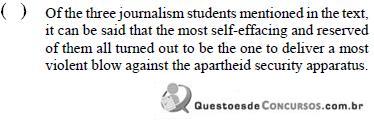
Q29297
Inglês
Based on the text, judge - right (C) or wrong (E) - the items below.
Ano: 2010
Banca:
CESPE / CEBRASPE
Órgão:
Instituto Rio Branco
Prova:
CESPE - 2010 - Instituto Rio Branco - Diplomata - 2ª Etapa C |
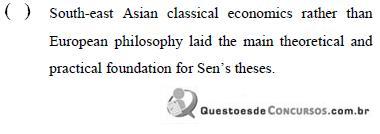
Q29289
Inglês

According to the text, judge - right (C) or wrong (E) - the items below.
Ano: 2010
Banca:
CESPE / CEBRASPE
Órgão:
Instituto Rio Branco
Prova:
CESPE - 2010 - Instituto Rio Branco - Diplomata - 2ª Etapa C |
Q29288
Inglês
In the fragment, "even capabilities cannot always trump other values" (l.18-19), the verb "trump" means
Ano: 2010
Banca:
CESPE / CEBRASPE
Órgão:
Instituto Rio Branco
Prova:
CESPE - 2010 - Instituto Rio Branco - Diplomata - 2ª Etapa C |
Q29287
Inglês
Based on the text above, it can be said that the relationship established between the ideas of "unfailingly courteous" (R.9) and "cross" (R.10) is one of
Ano: 2010
Banca:
CESPE / CEBRASPE
Órgão:
Instituto Rio Branco
Prova:
CESPE - 2010 - Instituto Rio Branco - Diplomata - 2ª Etapa C |
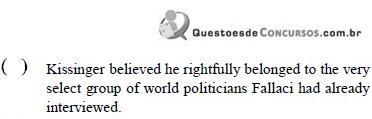
Q29285
Inglês

Based on the text, judge - right (C) or wrong (E) the following items.
Ano: 2010
Banca:
CESPE / CEBRASPE
Órgão:
Instituto Rio Branco
Prova:
CESPE - 2010 - Instituto Rio Branco - Diplomata - 2ª Etapa C |
Q29278
Inglês
In the fragment, "lured him into boasting that Americans admired him" (l.38-39), the words "lured" and "boasting" mean, respectively,
Ano: 2010
Banca:
CESPE / CEBRASPE
Órgão:
Instituto Rio Branco
Prova:
CESPE - 2010 - Instituto Rio Branco - Diplomata - 2ª Etapa C |
Q29277
Inglês
From the previous text, it can be inferred that Oriana Fallaci

 Conheça nossos planos