Questões de Concurso Sobre inglês
Foram encontradas 25.447 questões


Q200117
Inglês


In terms of reference,
Q200115
Inglês
In the fragments “…this will inspire people to come up with new ideas that will revolutionize the long-term strategic and financial prospects of the company.” (lines 19-22) and “…customers can’t rely on what they’re going to get.” (lines 52-53), “come up with” and “rely on” could be replaced in the text with, respectively,
Q200114
Inglês
In “…only a limited number of people in any company really needs to be innovative.” (lines 34-35), the fragment “really needs to be” transmits the idea of
Q200113
Inglês
The fragment “…to teach everyone how to think outside the box.” (lines 15-16) suggests that company leaders are
Ano: 2011
Banca:
CESGRANRIO
Órgão:
Petrobras
Provas:
CESGRANRIO - 2011 - Petrobras - Assistente Social Júnior - 2011
|
CESGRANRIO - 2011 - Petrobras - Advogado |
CESGRANRIO - 2011 - Petrobras - Analista de Sistemas Júnior - Processos de Negócios - 2011 |
CESGRANRIO - 2011 - Petrobras - Analista de Sistemas Júnior - Infra-Estrutura - 2011 |
CESGRANRIO - 2011 - Petrobras - Engenheiro de Equipamento Júnior - Elétrica 2011 |
Q199943
Inglês
Texto associado
Off the Deep End in Brazil
Gerald Herbert
With crude still hemorrhaging into the Gulf of Mexico, deep-water drilling might seem taboo just now. In fact, extreme oil will likely be the new normal. Despite the gulf tragedy, the quest for oil and gas in the most difficult places on the planet is just getting underway. Prospecting proceeds apace in the ultradeepwater reserves off the coasts of Ghana and Nigeria, the sulfur-laden depths of the Black Sea, and the tar sands of Venezuela’s Orinoco Basin. Brazil’s Petrobras, which already controls a quarter of global deepwater operations, is just starting to plumb its 9 to 15 billion barrels of proven reserves buried some four miles below the Atlantic. The reason is simple: after a century and a half of breakneck oil prospecting, the easy stuff is history. Blistering growth in emerging nations has turned the power grid upside down. India and China will consume 28 percent of global energy by 2030, triple the juice they required in 1990. China is set to overtake the U.S. in energy consumption by 2014. And now that the Great Recession is easing, the earth’s hoard of conventional oil is waning even faster. The International Energy Agency reckons the world will need to find 65 million additional barrels a day by 2030. If the U.S. offshore-drilling moratorium drags on, look for idled rigs heading to other shores. Available in: Retrieved on: June 19, 2011.
Gerald Herbert
With crude still hemorrhaging into the Gulf of Mexico, deep-water drilling might seem taboo just now. In fact, extreme oil will likely be the new normal. Despite the gulf tragedy, the quest for oil and gas in the most difficult places on the planet is just getting underway. Prospecting proceeds apace in the ultradeepwater reserves off the coasts of Ghana and Nigeria, the sulfur-laden depths of the Black Sea, and the tar sands of Venezuela’s Orinoco Basin. Brazil’s Petrobras, which already controls a quarter of global deepwater operations, is just starting to plumb its 9 to 15 billion barrels of proven reserves buried some four miles below the Atlantic. The reason is simple: after a century and a half of breakneck oil prospecting, the easy stuff is history. Blistering growth in emerging nations has turned the power grid upside down. India and China will consume 28 percent of global energy by 2030, triple the juice they required in 1990. China is set to overtake the U.S. in energy consumption by 2014. And now that the Great Recession is easing, the earth’s hoard of conventional oil is waning even faster. The International Energy Agency reckons the world will need to find 65 million additional barrels a day by 2030. If the U.S. offshore-drilling moratorium drags on, look for idled rigs heading to other shores. Available in: Retrieved on: June 19, 2011.
In Text II, Herbert illustrates the possibility of “...idled rigs heading to other shores." (line 26) EXCEPT when he mentions
Ano: 2011
Banca:
CESGRANRIO
Órgão:
Petrobras
Provas:
CESGRANRIO - 2011 - Petrobras - Analista de Sistemas Júnior - Engenharia de Software
|
CESGRANRIO - 2011 - Petrobras - Assistente Social Júnior - 2011 |
CESGRANRIO - 2011 - Petrobrás - Contador Júnior - 2011 |
CESGRANRIO - 2011 - Petrobras - Advogado |
CESGRANRIO - 2011 - Petrobras - Analista de Sistemas Júnior - Processos de Negócios - 2011 |
CESGRANRIO - 2011 - Petrobras - Analista de Sistemas Júnior - Infra-Estrutura - 2011 |
CESGRANRIO - 2011 - Petrobras - Engenheiro de Equipamento Júnior - Elétrica 2011 |
CESGRANRIO - 2011 - Petrobras - Arquiteto |
CESGRANRIO - 2011 - Petrobras - Engenheiro de Equipamento Júnior - Eletrônica - 2011 |
CESGRANRIO - 2011 - Petrobras - Engenheiro de Produção Júnior - 2011 |
CESGRANRIO - 2011 - Petrobras - Geofísico Júnior - Geologia - 2011 |
CESGRANRIO - 2011 - Petrobras - Geólogo Júnior - 2011 |
Q199885
Inglês
Texto associado
Off the Deep End in Brazil
Gerald Herbert
With crude still hemorrhaging into the Gulf of Mexico, deep-water drilling might seem taboo just now. In fact, extreme oil will likely be the new normal. Despite the gulf tragedy, the quest for oil and gas in the most difficult places on the planet is just getting underway. Prospecting proceeds apace in the ultradeepwater reserves off the coasts of Ghana and Nigeria, the sulfur-laden depths of the Black Sea, and the tar sands of Venezuela’s Orinoco Basin. Brazil’s Petrobras, which already controls a quarter of global deepwater operations, is just starting to plumb its 9 to 15 billion barrels of proven reserves buried some four miles below the Atlantic. The reason is simple: after a century and a half of breakneck oil prospecting, the easy stuff is history. Blistering growth in emerging nations has turned the power grid upside down. India and China will consume 28 percent of global energy by 2030, triple the juice they required in 1990. China is set to overtake the U.S. in energy consumption by 2014. And now that the Great Recession is easing, the earth’s hoard of conventional oil is waning even faster. The International Energy Agency reckons the world will need to find 65 million additional barrels a day by 2030. If the U.S. offshore-drilling moratorium drags on, look for idled rigs heading to other shores. Available in: Retrieved on: June 19, 2011.
Gerald Herbert
With crude still hemorrhaging into the Gulf of Mexico, deep-water drilling might seem taboo just now. In fact, extreme oil will likely be the new normal. Despite the gulf tragedy, the quest for oil and gas in the most difficult places on the planet is just getting underway. Prospecting proceeds apace in the ultradeepwater reserves off the coasts of Ghana and Nigeria, the sulfur-laden depths of the Black Sea, and the tar sands of Venezuela’s Orinoco Basin. Brazil’s Petrobras, which already controls a quarter of global deepwater operations, is just starting to plumb its 9 to 15 billion barrels of proven reserves buried some four miles below the Atlantic. The reason is simple: after a century and a half of breakneck oil prospecting, the easy stuff is history. Blistering growth in emerging nations has turned the power grid upside down. India and China will consume 28 percent of global energy by 2030, triple the juice they required in 1990. China is set to overtake the U.S. in energy consumption by 2014. And now that the Great Recession is easing, the earth’s hoard of conventional oil is waning even faster. The International Energy Agency reckons the world will need to find 65 million additional barrels a day by 2030. If the U.S. offshore-drilling moratorium drags on, look for idled rigs heading to other shores. Available in: Retrieved on: June 19, 2011.
Comparing Texts I and II,
Ano: 2011
Banca:
CESGRANRIO
Órgão:
Petrobras
Provas:
CESGRANRIO - 2011 - Petrobras - Analista de Sistemas Júnior - Engenharia de Software
|
CESGRANRIO - 2011 - Petrobras - Assistente Social Júnior - 2011 |
CESGRANRIO - 2011 - Petrobrás - Contador Júnior - 2011 |
CESGRANRIO - 2011 - Petrobras - Advogado |
CESGRANRIO - 2011 - Petrobras - Analista de Sistemas Júnior - Processos de Negócios - 2011 |
CESGRANRIO - 2011 - Petrobras - Analista de Sistemas Júnior - Infra-Estrutura - 2011 |
CESGRANRIO - 2011 - Petrobras - Engenheiro de Equipamento Júnior - Elétrica 2011 |
CESGRANRIO - 2011 - Petrobras - Arquiteto |
CESGRANRIO - 2011 - Petrobras - Engenheiro de Equipamento Júnior - Eletrônica - 2011 |
CESGRANRIO - 2011 - Petrobras - Engenheiro de Produção Júnior - 2011 |
CESGRANRIO - 2011 - Petrobras - Geofísico Júnior - Geologia - 2011 |
CESGRANRIO - 2011 - Petrobras - Geólogo Júnior - 2011 |
Q199881
Inglês
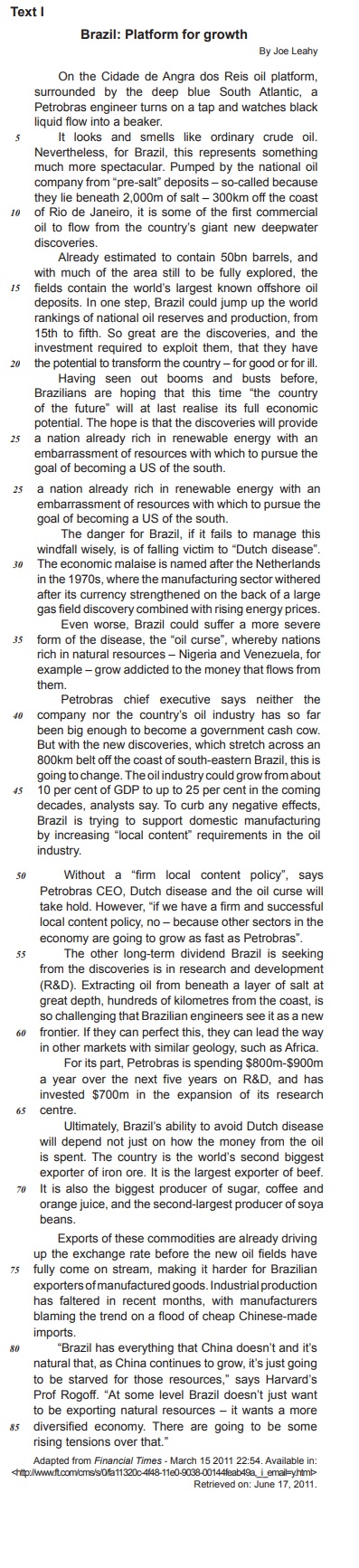
Based on the meanings in Text I, the two words are antonymous in
Ano: 2011
Banca:
CESPE / CEBRASPE
Órgão:
EBC
Prova:
CESPE - 2011 - EBC - Gestor de Atividade Jornalística - Conhecimentos Básicos |
Q199070
Inglês

Based on the text above, judge the following items.
The UNESCO Office in Brasilia is interested in the superior courts so as to assure freedom of expression and of press.
The UNESCO Office in Brasilia is interested in the superior courts so as to assure freedom of expression and of press.
Ano: 2011
Banca:
CESPE / CEBRASPE
Órgão:
EBC
Prova:
CESPE - 2011 - EBC - Gestor de Atividade Jornalística - Conhecimentos Básicos |
Q199069
Inglês
Based on the text above, judge the following items.
Digitalization and media convergence changes made not only Brazil but some other countries the world over to become obliged to develop specific policies concerning the media role nowadays.
Digitalization and media convergence changes made not only Brazil but some other countries the world over to become obliged to develop specific policies concerning the media role nowadays.
Ano: 2011
Banca:
CESPE / CEBRASPE
Órgão:
EBC
Prova:
CESPE - 2011 - EBC - Gestor de Atividade Jornalística - Conhecimentos Básicos |
Q199068
Inglês
Based on the text above, judge the following items.
It is now international, common knowledge, the importance the media has for the development of present-day democratic societies.
It is now international, common knowledge, the importance the media has for the development of present-day democratic societies.
Ano: 2011
Banca:
CESPE / CEBRASPE
Órgão:
EBC
Prova:
CESPE - 2011 - EBC - Gestor de Atividade Jornalística - Conhecimentos Básicos |
Q199067
Inglês
Based on the text above, judge the following items.
Digitalization and media convergence have encouraged the debate about the most efficient legal frameworks to organize “media ecosystems”.
Digitalization and media convergence have encouraged the debate about the most efficient legal frameworks to organize “media ecosystems”.
Ano: 2011
Banca:
CESPE / CEBRASPE
Órgão:
EBC
Prova:
CESPE - 2011 - EBC - Gestor de Atividade Jornalística - Conhecimentos Básicos |
Q199066
Inglês
Based on the text above, judge the following items.
Notorious specialists will take part in field events.
Notorious specialists will take part in field events.
Ano: 2011
Banca:
CESPE / CEBRASPE
Órgão:
EBC
Prova:
CESPE - 2011 - EBC - Gestor de Atividade Jornalística - Conhecimentos Básicos |
Q199065
Inglês
Based on the text above, judge the following items.
The forthcoming projects will encompass at least three activities.
The forthcoming projects will encompass at least three activities.
Ano: 2011
Banca:
CESPE / CEBRASPE
Órgão:
EBC
Prova:
CESPE - 2011 - EBC - Gestor de Atividade Jornalística - Conhecimentos Básicos |
Q199064
Inglês
Based on the text above, judge the following items.
In the text, “brought about” (l.7) is the same as about to be brought.
In the text, “brought about” (l.7) is the same as about to be brought.
Ano: 2011
Banca:
CESPE / CEBRASPE
Órgão:
EBC
Prova:
CESPE - 2011 - EBC - Gestor de Atividade Jornalística - Conhecimentos Básicos |
Q199063
Inglês
Based on the text above, judge the following items.
Brazil is yet to participate in the international agenda of media development.
Brazil is yet to participate in the international agenda of media development.
Ano: 2011
Banca:
CESPE / CEBRASPE
Órgão:
EBC
Prova:
CESPE - 2011 - EBC - Jornalista - Jornalismo - Conhecimentos Básicos |
Q198863
Inglês
Texto associado


Based on the text above, judge the items below.
Based on the text above, judge the items below.
Communication is a complex procedure which involves interchanging messages.
Ano: 2011
Banca:
CESPE / CEBRASPE
Órgão:
EBC
Prova:
CESPE - 2011 - EBC - Jornalista - Jornalismo - Conhecimentos Básicos |
Q198862
Inglês
Texto associado
Based on the text above, judge the items below.
Based on the text above, judge the items below.
In the text, “left out” (L.30) is the same as given up.
Ano: 2011
Banca:
CESPE / CEBRASPE
Órgão:
EBC
Prova:
CESPE - 2011 - EBC - Jornalista - Jornalismo - Conhecimentos Básicos |
Q198861
Inglês
Texto associado
Based on the text above, judge the items below.
Based on the text above, judge the items below.
Public communication should not be free of any prejudice as far as lexical choice, philosophies, ideologies, gender, race or religious beliefs are concerned.
Ano: 2011
Banca:
CESPE / CEBRASPE
Órgão:
EBC
Prova:
CESPE - 2011 - EBC - Jornalista - Jornalismo - Conhecimentos Básicos |
Q198860
Inglês
Texto associado
Based on the text above, judge the items below.
Based on the text above, judge the items below.
The range of public communication encompasses diverse situations.
Ano: 2011
Banca:
CESPE / CEBRASPE
Órgão:
EBC
Prova:
CESPE - 2011 - EBC - Jornalista - Jornalismo - Conhecimentos Básicos |
Q198859
Inglês
Texto associado
Based on the text above, judge the items below.
Based on the text above, judge the items below.
An outdoor advertising can be used to persuade people to purchase a product or service.

 Conheça nossos planos