Questões de Concurso Sobre inglês
Foram encontradas 26.340 questões


Ano: 2013
Banca:
CESPE / CEBRASPE
Órgão:
ANCINE
Provas:
CESPE - 2013 - ANCINE - Todos os Cargos - Especialista em Regulação da Atividade Cinematográfica e Audiovisual Área III
|
CESPE - 2013 - ANCINE - Todos os Cargos - Especialista em Regulação da Atividade Cinematográfica e Audiovisual Áreas I e II |
Q428560
Inglês

Based on the text above, judge the items below.
The expression “thanks to” (l.4) can be replaced by due to, without changing the original meaning of sentence.
The expression “thanks to” (l.4) can be replaced by due to, without changing the original meaning of sentence.
Ano: 2013
Banca:
CESPE / CEBRASPE
Órgão:
ANCINE
Prova:
CESPE - 2013 - ANCINE - Todos os Cargos - Especialista em Regulação da Atividade Cinematográfica e Audiovisual Área III |
Q428380
Inglês
Texto associado
The Butler
The long White House service of an African-American butler
Cecil Ganes (Forest Whitaker) is used as a prism through
which we view the development of the civil-rights movement.
As the liveried Cecil, silent and dignified, serves sandwiches
and coffee and exchanges courtesies with a variety of chief
executives, Cecil’s son, Louis (David Oyelowo), becomes a
militant and manages to hit every highlight, including the
Freedom Rides in 1961, and Martin Luther King’s motel room
on the day that he’s shot. The movie’s right-mindedness is
relieved now and then by scenes at Cecil’s house, where his
wife, Gloria (Oprah Winfrey), grows restive and resentful,
drinks and dallies with a neighbor.
Elysium
The title of Neil Blomkamp’s new film, set in the year 2154,
refers to a space station: a haven for the wealthy, spinning just
beyond the limits of our polluted planet. Our hero is Max (Matt
Damon), who, like the majority of humans, toils and sweats on
Earth, where the cops are intemperate robots. After an accident
at work, he takes on a reckless task, assailing an evil billionaire
(William Fichtner) and winding up on a shuttle to Elysium,
hell-bent on reaching this artificial heaven and obtaining
justice. Rather than viewing a future world from a distance and
admiring its digital enhancements, we feel thrust into the thick
of it with such immediacy and sensory impact that, like most of
its inhabitants, we can only dream of escape.
Enough Said
This mild romantic comedy has an up-front twist that’s beside
the point. Eva (Julia Louis-Dreyfus), a California divorcée who
works as a masseuse, goes to a party and meets Marianne
(Catherine Keener), a poet who becomes a client and a friend,
and Albert (James Gandolfini), a TV historian, who soon
becomes Eva’s boyfriend – and who turns out to be Marianne’s
ex-husband. Much else is beside the point, too, such as Eva’s
trivial conflicts with her daughter, Ellen (Tracey Fairaway),
who’s about to leave home for college, as is Albert and
Marianne’s daughter, Tess (Eve Hewson).
The New Yorker. September 23, 2013, p. 22 (adapted).
Based on the three film summaries presented above, judge the following items.
In The Butler, Oprah Winfrey plays the role of the main character’s drunk and unfaithful wife.
In The Butler, Oprah Winfrey plays the role of the main character’s drunk and unfaithful wife.
Ano: 2013
Banca:
CESPE / CEBRASPE
Órgão:
ANCINE
Prova:
CESPE - 2013 - ANCINE - Todos os Cargos - Especialista em Regulação da Atividade Cinematográfica e Audiovisual Área III |
Q428378
Inglês
Texto associado
The Butler
The long White House service of an African-American butler
Cecil Ganes (Forest Whitaker) is used as a prism through
which we view the development of the civil-rights movement.
As the liveried Cecil, silent and dignified, serves sandwiches
and coffee and exchanges courtesies with a variety of chief
executives, Cecil’s son, Louis (David Oyelowo), becomes a
militant and manages to hit every highlight, including the
Freedom Rides in 1961, and Martin Luther King’s motel room
on the day that he’s shot. The movie’s right-mindedness is
relieved now and then by scenes at Cecil’s house, where his
wife, Gloria (Oprah Winfrey), grows restive and resentful,
drinks and dallies with a neighbor.
Elysium
The title of Neil Blomkamp’s new film, set in the year 2154,
refers to a space station: a haven for the wealthy, spinning just
beyond the limits of our polluted planet. Our hero is Max (Matt
Damon), who, like the majority of humans, toils and sweats on
Earth, where the cops are intemperate robots. After an accident
at work, he takes on a reckless task, assailing an evil billionaire
(William Fichtner) and winding up on a shuttle to Elysium,
hell-bent on reaching this artificial heaven and obtaining
justice. Rather than viewing a future world from a distance and
admiring its digital enhancements, we feel thrust into the thick
of it with such immediacy and sensory impact that, like most of
its inhabitants, we can only dream of escape.
Enough Said
This mild romantic comedy has an up-front twist that’s beside
the point. Eva (Julia Louis-Dreyfus), a California divorcée who
works as a masseuse, goes to a party and meets Marianne
(Catherine Keener), a poet who becomes a client and a friend,
and Albert (James Gandolfini), a TV historian, who soon
becomes Eva’s boyfriend – and who turns out to be Marianne’s
ex-husband. Much else is beside the point, too, such as Eva’s
trivial conflicts with her daughter, Ellen (Tracey Fairaway),
who’s about to leave home for college, as is Albert and
Marianne’s daughter, Tess (Eve Hewson).
The New Yorker. September 23, 2013, p. 22 (adapted).
The long White House service of an African-American butler
Cecil Ganes (Forest Whitaker) is used as a prism through
which we view the development of the civil-rights movement.
As the liveried Cecil, silent and dignified, serves sandwiches
and coffee and exchanges courtesies with a variety of chief
executives, Cecil’s son, Louis (David Oyelowo), becomes a
militant and manages to hit every highlight, including the
Freedom Rides in 1961, and Martin Luther King’s motel room
on the day that he’s shot. The movie’s right-mindedness is
relieved now and then by scenes at Cecil’s house, where his
wife, Gloria (Oprah Winfrey), grows restive and resentful,
drinks and dallies with a neighbor.
Elysium
The title of Neil Blomkamp’s new film, set in the year 2154,
refers to a space station: a haven for the wealthy, spinning just
beyond the limits of our polluted planet. Our hero is Max (Matt
Damon), who, like the majority of humans, toils and sweats on
Earth, where the cops are intemperate robots. After an accident
at work, he takes on a reckless task, assailing an evil billionaire
(William Fichtner) and winding up on a shuttle to Elysium,
hell-bent on reaching this artificial heaven and obtaining
justice. Rather than viewing a future world from a distance and
admiring its digital enhancements, we feel thrust into the thick
of it with such immediacy and sensory impact that, like most of
its inhabitants, we can only dream of escape.
Enough Said
This mild romantic comedy has an up-front twist that’s beside
the point. Eva (Julia Louis-Dreyfus), a California divorcée who
works as a masseuse, goes to a party and meets Marianne
(Catherine Keener), a poet who becomes a client and a friend,
and Albert (James Gandolfini), a TV historian, who soon
becomes Eva’s boyfriend – and who turns out to be Marianne’s
ex-husband. Much else is beside the point, too, such as Eva’s
trivial conflicts with her daughter, Ellen (Tracey Fairaway),
who’s about to leave home for college, as is Albert and
Marianne’s daughter, Tess (Eve Hewson).
The New Yorker. September 23, 2013, p. 22 (adapted).
Based on the three film summaries presented above, judge the following items.
In one of the films, the main theme is a man/woman relationship.
In one of the films, the main theme is a man/woman relationship.
Ano: 2013
Banca:
CESPE / CEBRASPE
Órgão:
ANCINE
Prova:
CESPE - 2013 - ANCINE - Todos os Cargos - Analista Administrativo Áreas I, II e III |
Q427854
Inglês

According to the text above, judge the items below.
The number of films released in Spain in 2013 is less than half the number of foreign films released in the same period.
The number of films released in Spain in 2013 is less than half the number of foreign films released in the same period.
Ano: 2013
Banca:
CESPE / CEBRASPE
Órgão:
ANCINE
Prova:
CESPE - 2013 - ANCINE - Todos os Cargos - Analista Administrativo Áreas I, II e III |
Q427853
Inglês
According to the text above, judge the items below.
The pronoun “those” (l.15) refers to “3 million euros” (l.14-15).
The pronoun “those” (l.15) refers to “3 million euros” (l.14-15).
Ano: 2013
Banca:
CESPE / CEBRASPE
Órgão:
ANCINE
Prova:
CESPE - 2013 - ANCINE - Todos os Cargos - Analista Administrativo Áreas I, II e III |
Q427852
Inglês
According to the text above, judge the items below.
The number of films produced in Spain in 2013 is smaller in comparison with 2012.
The number of films produced in Spain in 2013 is smaller in comparison with 2012.
Ano: 2013
Banca:
CESPE / CEBRASPE
Órgão:
ANCINE
Prova:
CESPE - 2013 - ANCINE - Todos os Cargos - Analista Administrativo Áreas I, II e III |
Q427851
Inglês
According to the text above, judge the items below.
There was an increase in the total box office earnings in 2013 destined for Spanish films.
There was an increase in the total box office earnings in 2013 destined for Spanish films.
Ano: 2013
Banca:
CESPE / CEBRASPE
Órgão:
ANCINE
Prova:
CESPE - 2013 - ANCINE - Todos os Cargos - Analista Administrativo Áreas I, II e III |
Q427850
Inglês
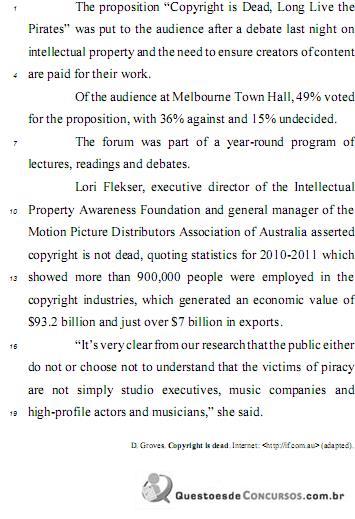
Based on the text above, judge the following items.
Statistics show there is more than nine hundred thousand people who depend on the copyright industries for their income.
Statistics show there is more than nine hundred thousand people who depend on the copyright industries for their income.
Ano: 2013
Banca:
CESPE / CEBRASPE
Órgão:
ANCINE
Prova:
CESPE - 2013 - ANCINE - Todos os Cargos - Analista Administrativo Áreas I, II e III |
Q427849
Inglês
Based on the text above, judge the following items
The debate was part of a one-year forum on intellectual property and piracy.
The debate was part of a one-year forum on intellectual property and piracy.
Ano: 2013
Banca:
CESPE / CEBRASPE
Órgão:
ANCINE
Prova:
CESPE - 2013 - ANCINE - Todos os Cargos - Analista Administrativo Áreas I, II e III |
Q427848
Inglês
Based on the text above, judge the following items
The text criticizes those who are against the defense of intellectual property.
The text criticizes those who are against the defense of intellectual property.
Ano: 2013
Banca:
CESPE / CEBRASPE
Órgão:
ANCINE
Prova:
CESPE - 2013 - ANCINE - Todos os Cargos - Analista Administrativo Áreas I, II e III |
Q427847
Inglês
Based on the text above, judge the following items.
The verb form “ensure” (l.3) could be replaced by make certain without changing the meaning of the text.
The verb form “ensure” (l.3) could be replaced by make certain without changing the meaning of the text.
Q424792
Inglês
Texto associado
Complications of Replacement Therapy
Complications of replacement therapy include:
- Developing antibodies (proteins) that attack the clotting factor
- Developing viral infections from human clotting factors
- Damage to joints, muscles, or other parts of the body resulting from delays in treatment
Antibodies to the clotting factor.
Antibodies can destroy the clotting factor before it has a chance to work. This is a very serious problem. It prevents the main treatment for hemophilia (replacement therapy) from working. These antibodies, also called inhibitors, develop in about 20-30 percent of people who have severe hemophilia A. Inhibitors develop in 2-5 percent of people who have hemophilia B
When antibodies develop, doctors may use larger doses of clotting factor or try different clotting factor sources. Sometimes the antibodies go away. Researchers are studying new ways to deal with antibodies to clotting factors.
Viruses from human clotting factors.
Clotting factors made from human blood can carry the viruses that cause HIV/AIDS and hepatitis. ....I.... , the risk of getting an infectious disease from human clotting factors is very small due to:
- Careful screening of blood donors
- Testing of donated blood products
- Treating donated blood products with a detergent and heat to destroy viruses - Vaccinating people who have hemophilia for hepatitis A and B
Damage to joints, muscles, and other parts of the body.
Delays in treatment can cause damage such as:
- Bleeding into a joint. If this happens many times, it can lead to changes in the shape of the joint and impair the joint's function.
- Swelling of the membrane around a joint. - Pain, swelling, and redness of a joint.
- Pressure on a joint from swelling, which can destroy the joint.
(Adapted from http://www.nhlbi.nih.gov/health/health-topics/ topics/hemophilia/treatment.html)
Preenche corretamente a lacuna I do texto:
Q424791
Inglês
Texto associado
Complications of Replacement Therapy
Complications of replacement therapy include:
- Developing antibodies (proteins) that attack the clotting factor
- Developing viral infections from human clotting factors
- Damage to joints, muscles, or other parts of the body resulting from delays in treatment
Antibodies to the clotting factor.
Antibodies can destroy the clotting factor before it has a chance to work. This is a very serious problem. It prevents the main treatment for hemophilia (replacement therapy) from working. These antibodies, also called inhibitors, develop in about 20-30 percent of people who have severe hemophilia A. Inhibitors develop in 2-5 percent of people who have hemophilia B
When antibodies develop, doctors may use larger doses of clotting factor or try different clotting factor sources. Sometimes the antibodies go away. Researchers are studying new ways to deal with antibodies to clotting factors.
Viruses from human clotting factors.
Clotting factors made from human blood can carry the viruses that cause HIV/AIDS and hepatitis. ....I.... , the risk of getting an infectious disease from human clotting factors is very small due to:
- Careful screening of blood donors
- Testing of donated blood products
- Treating donated blood products with a detergent and heat to destroy viruses - Vaccinating people who have hemophilia for hepatitis A and B
Damage to joints, muscles, and other parts of the body.
Delays in treatment can cause damage such as:
- Bleeding into a joint. If this happens many times, it can lead to changes in the shape of the joint and impair the joint's function.
- Swelling of the membrane around a joint. - Pain, swelling, and redness of a joint.
- Pressure on a joint from swelling, which can destroy the joint.
(Adapted from http://www.nhlbi.nih.gov/health/health-topics/ topics/hemophilia/treatment.html)
Complications of replacement therapy include:
- Developing antibodies (proteins) that attack the clotting factor
- Developing viral infections from human clotting factors
- Damage to joints, muscles, or other parts of the body resulting from delays in treatment
Antibodies to the clotting factor.
Antibodies can destroy the clotting factor before it has a chance to work. This is a very serious problem. It prevents the main treatment for hemophilia (replacement therapy) from working. These antibodies, also called inhibitors, develop in about 20-30 percent of people who have severe hemophilia A. Inhibitors develop in 2-5 percent of people who have hemophilia B
When antibodies develop, doctors may use larger doses of clotting factor or try different clotting factor sources. Sometimes the antibodies go away. Researchers are studying new ways to deal with antibodies to clotting factors.
Viruses from human clotting factors.
Clotting factors made from human blood can carry the viruses that cause HIV/AIDS and hepatitis. ....I.... , the risk of getting an infectious disease from human clotting factors is very small due to:
- Careful screening of blood donors
- Testing of donated blood products
- Treating donated blood products with a detergent and heat to destroy viruses - Vaccinating people who have hemophilia for hepatitis A and B
Damage to joints, muscles, and other parts of the body.
Delays in treatment can cause damage such as:
- Bleeding into a joint. If this happens many times, it can lead to changes in the shape of the joint and impair the joint's function.
- Swelling of the membrane around a joint. - Pain, swelling, and redness of a joint.
- Pressure on a joint from swelling, which can destroy the joint.
(Adapted from http://www.nhlbi.nih.gov/health/health-topics/ topics/hemophilia/treatment.html)
De acordo com o texto,
Ano: 2013
Banca:
FCC
Órgão:
MPE-CE
Prova:
FCC - 2013 - MPE-CE - Analista Ministerial - Ciências da Computação |
Q408457
Inglês
Texto associado
Atenção: Para responder às questões de números 23 e 24, considere a charge abaixo.

As informações veiculadas na charge têm um tom ...... e podem ser interpretadas como ...... .
Segundo o contexto, a alternativa que preenche, respectivamente, as lacunas da frase acima é
Ano: 2013
Banca:
FCC
Órgão:
MPE-CE
Prova:
FCC - 2013 - MPE-CE - Analista Ministerial - Ciências da Computação |
Q408456
Inglês
Texto associado
Atenção: Para responder às questões de números 23 e 24, considere a charge abaixo.
Na charge editorial, os funcionários têm algo em comum. Nota-se em suas falas que todos
Ano: 2013
Banca:
FCC
Órgão:
MPE-CE
Prova:
FCC - 2013 - MPE-CE - Analista Ministerial - Ciências da Computação |
Q408455
Inglês
Texto associado
Atenção: Para responder às questões de números 20 a 22, considere o texto abaixo.
A BOLD AND FOOLISH EFFORT TO PREDICT THE FUTURE OF COMPUTING
What today's prophets of technology say about the day after tomorrow
By Ed Regis
PREDICTING WHAT NEXT YEAR'S (OR NEXT WEEK'S) IPAD IS GOING to be like is hard enough. Knowing what computers in general will be like 150 years from now - an eternity in technology development - is . On the other hand, technology prophets, computer pioneers and researchers have never been known for their reticence on the subject of the future. So we thought it wouldn't hurt to ask them. For starters, will there even be computers in the far future? "There will definitely be computers," says nanotechnology oracle Eric Drexler of the University of Oxford. "They're more fundamental than the wheel."
George Dyson, author of books about computers and global intelligence, says, "I can't tell you a lot about computing 50, 100 and 150 years ago but really nothing about computing 50, 100 or 150 years in the future. It's just truly impossible to predict: all I can guarantee is that any prediction will be wrong!" He then relents and makes one: "In 150 years most of the important computation will be analog computation (for the same reason that most of the important numbers are real numbers but not integers) and the notion of alldigital computation will be a quaint relic."
Ivan Sutherland, who invented Sketchpad, the basis for today's ubiquitous graphical user interface says, "I have no clue about the state of the world 150 years from now. If you want to know the future, ask the young people who will create it."
(Disponível em: Magazine Scientific American. janeiro de 2013. v. 308. p. 30, Adaptado)
A BOLD AND FOOLISH EFFORT TO PREDICT THE FUTURE OF COMPUTING
What today's prophets of technology say about the day after tomorrow
By Ed Regis
PREDICTING WHAT NEXT YEAR'S (OR NEXT WEEK'S) IPAD IS GOING to be like is hard enough. Knowing what computers in general will be like 150 years from now - an eternity in technology development - is
. On the other hand, technology prophets, computer pioneers and researchers have never been known for their reticence on the subject of the future. So we thought it wouldn't hurt to ask them. For starters, will there even be computers in the far future? "There will definitely be computers," says nanotechnology oracle Eric Drexler of the University of Oxford. "They're more fundamental than the wheel."George Dyson, author of books about computers and global intelligence, says, "I can't tell you a lot about computing 50, 100 and 150 years ago but really nothing about computing 50, 100 or 150 years in the future. It's just truly impossible to predict: all I can guarantee is that any prediction will be wrong!" He then relents and makes one: "In 150 years most of the important computation will be analog computation (for the same reason that most of the important numbers are real numbers but not integers) and the notion of alldigital computation will be a quaint relic."
Ivan Sutherland, who invented Sketchpad, the basis for today's ubiquitous graphical user interface says, "I have no clue about the state of the world 150 years from now. If you want to know the future, ask the young people who will create it."
(Disponível em: Magazine Scientific American. janeiro de 2013. v. 308. p. 30, Adaptado)
O texto exibe opiniões sobre a existência de computadores no futuro. Além disso, segundo o texto, há também o questionamento sobre
Ano: 2013
Banca:
FCC
Órgão:
MPE-CE
Prova:
FCC - 2013 - MPE-CE - Analista Ministerial - Ciências da Computação |
Q408454
Inglês
Texto associado
Atenção: Para responder às questões de números 20 a 22, considere o texto abaixo.
A BOLD AND FOOLISH EFFORT TO PREDICT THE FUTURE OF COMPUTING
What today's prophets of technology say about the day after tomorrow
By Ed Regis
PREDICTING WHAT NEXT YEAR'S (OR NEXT WEEK'S) IPAD IS GOING to be like is hard enough. Knowing what computers in general will be like 150 years from now - an eternity in technology development - is . On the other hand, technology prophets, computer pioneers and researchers have never been known for their reticence on the subject of the future. So we thought it wouldn't hurt to ask them. For starters, will there even be computers in the far future? "There will definitely be computers," says nanotechnology oracle Eric Drexler of the University of Oxford. "They're more fundamental than the wheel."
George Dyson, author of books about computers and global intelligence, says, "I can't tell you a lot about computing 50, 100 and 150 years ago but really nothing about computing 50, 100 or 150 years in the future. It's just truly impossible to predict: all I can guarantee is that any prediction will be wrong!" He then relents and makes one: "In 150 years most of the important computation will be analog computation (for the same reason that most of the important numbers are real numbers but not integers) and the notion of alldigital computation will be a quaint relic."
Ivan Sutherland, who invented Sketchpad, the basis for today's ubiquitous graphical user interface says, "I have no clue about the state of the world 150 years from now. If you want to know the future, ask the young people who will create it."
(Disponível em: Magazine Scientific American. janeiro de 2013. v. 308. p. 30, Adaptado)
A BOLD AND FOOLISH EFFORT TO PREDICT THE FUTURE OF COMPUTING
What today's prophets of technology say about the day after tomorrow
By Ed Regis
PREDICTING WHAT NEXT YEAR'S (OR NEXT WEEK'S) IPAD IS GOING to be like is hard enough. Knowing what computers in general will be like 150 years from now - an eternity in technology development - is
. On the other hand, technology prophets, computer pioneers and researchers have never been known for their reticence on the subject of the future. So we thought it wouldn't hurt to ask them. For starters, will there even be computers in the far future? "There will definitely be computers," says nanotechnology oracle Eric Drexler of the University of Oxford. "They're more fundamental than the wheel."George Dyson, author of books about computers and global intelligence, says, "I can't tell you a lot about computing 50, 100 and 150 years ago but really nothing about computing 50, 100 or 150 years in the future. It's just truly impossible to predict: all I can guarantee is that any prediction will be wrong!" He then relents and makes one: "In 150 years most of the important computation will be analog computation (for the same reason that most of the important numbers are real numbers but not integers) and the notion of alldigital computation will be a quaint relic."
Ivan Sutherland, who invented Sketchpad, the basis for today's ubiquitous graphical user interface says, "I have no clue about the state of the world 150 years from now. If you want to know the future, ask the young people who will create it."
(Disponível em: Magazine Scientific American. janeiro de 2013. v. 308. p. 30, Adaptado)
Um dos especialistas em computação citados no texto
Ano: 2013
Banca:
FCC
Órgão:
MPE-CE
Prova:
FCC - 2013 - MPE-CE - Analista Ministerial - Ciências da Computação |
Q408453
Inglês
Texto associado
Atenção: Para responder às questões de números 20 a 22, considere o texto abaixo.
A BOLD AND FOOLISH EFFORT TO PREDICT THE FUTURE OF COMPUTING
What today's prophets of technology say about the day after tomorrow
By Ed Regis
PREDICTING WHAT NEXT YEAR'S (OR NEXT WEEK'S) IPAD IS GOING to be like is hard enough. Knowing what computers in general will be like 150 years from now - an eternity in technology development - is . On the other hand, technology prophets, computer pioneers and researchers have never been known for their reticence on the subject of the future. So we thought it wouldn't hurt to ask them. For starters, will there even be computers in the far future? "There will definitely be computers," says nanotechnology oracle Eric Drexler of the University of Oxford. "They're more fundamental than the wheel."
George Dyson, author of books about computers and global intelligence, says, "I can't tell you a lot about computing 50, 100 and 150 years ago but really nothing about computing 50, 100 or 150 years in the future. It's just truly impossible to predict: all I can guarantee is that any prediction will be wrong!" He then relents and makes one: "In 150 years most of the important computation will be analog computation (for the same reason that most of the important numbers are real numbers but not integers) and the notion of alldigital computation will be a quaint relic."
Ivan Sutherland, who invented Sketchpad, the basis for today's ubiquitous graphical user interface says, "I have no clue about the state of the world 150 years from now. If you want to know the future, ask the young people who will create it."
(Disponível em: Magazine Scientific American. janeiro de 2013. v. 308. p. 30, Adaptado)
A BOLD AND FOOLISH EFFORT TO PREDICT THE FUTURE OF COMPUTING
What today's prophets of technology say about the day after tomorrow
By Ed Regis
PREDICTING WHAT NEXT YEAR'S (OR NEXT WEEK'S) IPAD IS GOING to be like is hard enough. Knowing what computers in general will be like 150 years from now - an eternity in technology development - is
. On the other hand, technology prophets, computer pioneers and researchers have never been known for their reticence on the subject of the future. So we thought it wouldn't hurt to ask them. For starters, will there even be computers in the far future? "There will definitely be computers," says nanotechnology oracle Eric Drexler of the University of Oxford. "They're more fundamental than the wheel."George Dyson, author of books about computers and global intelligence, says, "I can't tell you a lot about computing 50, 100 and 150 years ago but really nothing about computing 50, 100 or 150 years in the future. It's just truly impossible to predict: all I can guarantee is that any prediction will be wrong!" He then relents and makes one: "In 150 years most of the important computation will be analog computation (for the same reason that most of the important numbers are real numbers but not integers) and the notion of alldigital computation will be a quaint relic."
Ivan Sutherland, who invented Sketchpad, the basis for today's ubiquitous graphical user interface says, "I have no clue about the state of the world 150 years from now. If you want to know the future, ask the young people who will create it."
(Disponível em: Magazine Scientific American. janeiro de 2013. v. 308. p. 30, Adaptado)
Os termos que, de acordo com o contexto, preenchem adequadamente a lacuna
 no primeiro parágrafo do texto são
Ano: 2013
Banca:
FCC
Órgão:
MPE-CE
Prova:
FCC - 2013 - MPE-CE - Analista Ministerial - Ciências da Computação |
Q408452
Inglês
Texto associado
Atenção: Para responder às questões de números 17 a 19, considere o texto abaixo.
Facebook and mobile phones
Will Home work?
Apr 4th 2013, 23:24 by M.G | SAN FRANCISCO

A DAY after the mobile phone celebrated its 40th birthday, Facebook has produced something that it hopes will make certain of the devices even more useful. On April 4th the giant social network unveiled Home, new software that is designed to give it more prominence on mobile phones powered by Android, an operating system developed by Google.
This matters because more and more folk are now accessing social networks from mobile devices rather than from desktop computers and because mobile advertising revenues are growing fast, albeit from a low base. Without a robust mobile presence, Facebook could see some of its users siphoned off by rivals born in the mobile era. And it could miss out on a potentially massive source of new revenue.
There had been speculation that Facebook was working on a phone of its own, or at least on a mobile operating system to rival Android or Apple’s iOS. But dabbling in hardware at this stage of its development would be a huge risk for Facebook and developing a rival operating system would risk alienating Apple and Google, whose mobile platforms have helped power its advertising growth. EMarketer, a research firm, reckons Facebook is on track to win 11% of the $13.6 billion likely to be spent around the world on mobile ads this year.
(Adaptado de http://www.economist.com/blogs/babbage/2013/04/facebook-and-mobile-phones; Acessado em 08/04/2013)
Facebook and mobile phones
Will Home work?
Apr 4th 2013, 23:24 by M.G | SAN FRANCISCO
A DAY after the mobile phone celebrated its 40th birthday, Facebook has produced something that it hopes will make certain of the devices even more useful. On April 4th the giant social network unveiled Home, new software that is designed to give it more prominence on mobile phones powered by Android, an operating system developed by Google.
This matters because more and more folk are now accessing social networks from mobile devices rather than from desktop computers and because mobile advertising revenues are growing fast, albeit from a low base. Without a robust mobile presence, Facebook could see some of its users siphoned off by rivals born in the mobile era. And it could miss out on a potentially massive source of new revenue.
There had been speculation that Facebook was working on a phone of its own, or at least on a mobile operating system to rival Android or Apple’s iOS. But dabbling in hardware at this stage of its development would be a huge risk for Facebook and developing a rival operating system would risk alienating Apple and Google, whose mobile platforms have helped power its advertising growth. EMarketer, a research firm, reckons Facebook is on track to win 11% of the $13.6 billion likely to be spent around the world on mobile ads this year.
(Adaptado de http://www.economist.com/blogs/babbage/2013/04/facebook-and-mobile-phones; Acessado em 08/04/2013)
As palavras it e whose, que aparecem sublinhadas no texto, referem-se, respectivamente, a
Ano: 2013
Banca:
FCC
Órgão:
MPE-CE
Prova:
FCC - 2013 - MPE-CE - Analista Ministerial - Ciências da Computação |
Q408451
Inglês
Texto associado
Atenção: Para responder às questões de números 17 a 19, considere o texto abaixo.
Facebook and mobile phones
Will Home work?
Apr 4th 2013, 23:24 by M.G | SAN FRANCISCO
A DAY after the mobile phone celebrated its 40th birthday, Facebook has produced something that it hopes will make certain of the devices even more useful. On April 4th the giant social network unveiled Home, new software that is designed to give it more prominence on mobile phones powered by Android, an operating system developed by Google.
This matters because more and more folk are now accessing social networks from mobile devices rather than from desktop computers and because mobile advertising revenues are growing fast, albeit from a low base. Without a robust mobile presence, Facebook could see some of its users siphoned off by rivals born in the mobile era. And it could miss out on a potentially massive source of new revenue.
There had been speculation that Facebook was working on a phone of its own, or at least on a mobile operating system to rival Android or Apple’s iOS. But dabbling in hardware at this stage of its development would be a huge risk for Facebook and developing a rival operating system would risk alienating Apple and Google, whose mobile platforms have helped power its advertising growth. EMarketer, a research firm, reckons Facebook is on track to win 11% of the $13.6 billion likely to be spent around the world on mobile ads this year.
(Adaptado de http://www.economist.com/blogs/babbage/2013/04/facebook-and-mobile-phones; Acessado em 08/04/2013)
Da leitura do texto, tem-se a informação de que

 Conheça nossos planos