Questões de Concurso
Comentadas sobre pronomes | pronouns em inglês
Foram encontradas 782 questões
Texto 04
Gottman, John. The Relationship Cure. New York: Three Rivers Press.
Strengthening Relationships at Work
There is a number of things managers can do to strengthen relationships with workers. Strengthening connections with workers can lead to a win-win situation, in that workers may feel respected and valued, and can become much more engaged and productive in their work. And, managers may find that it is much easier to deal with a worker’s negative emotions or psychological health struggles when the foundation of their relationship with the worker is strong.
We can effectively build connections with workers by verbally or nonverbally seeking contact with them (i.e., making what psychologist Dr. John Gottman calls “connection bids”). A connection bid is an attempt to create connections between two people, and is essential for building, maintaining and improving relationships. A connection bid can be anything that we do to seek contact with another person:
- Asking for information: e.g., asking a worker how to solve a work problem. “Would you mind helping me with interpreting this spreadsheet? I’m struggling to get my head around the numbers.”
- Showing interest: e.g., asking workers about their hobbies or recent holidays. “Have you been doing any hiking lately?”
- Expressing affirmation and approval: e.g., complimenting a worker on his latest accomplishment. “Your presentation yesterday was excellent!”
- Expressing caring or support: e.g., demonstrating concern about a worker’s health condition. “Your cough sounds awful. You should think about going home to recover.”
- Offering assistance: e.g., offering support to a worker who is overloaded with tasks. “Would you like me to ask Jocelyn to help you with that project?”
- Making a humorous comment: e.g., lighthearted joking with a worker about a mistake you made. “Sometimes the hurrier I go, the behinder I get!”
- Sending non-verbal signals: e.g., a smile, a wink, a wave, a pat on the back or a thumbs up.
[…]
The way we respond to workers has a sizable impact on the nature of the relationships that result. If we repeatedly turn against or turn away from workers, they may eventually stop reaching out. On the contrary, if we turn toward a person as often as we can, the relationship can be strengthened and become more positive and supportive.
(Disponível em: www.workplacestrategiesformentalhealth.com/mmhm)
Texto 01
Going Mobile, Going Further!
By Anderson Francisco Guimarães Maia – October 28, 2016
So what happens to “learning” if we add the word “mobile” to it? The increasing and rapidly developing use of mobile technology by English language learners is an unquestionable aspect of today’s classroom. However, the attitude EFL teachers develop towards the use of mobile devices as an aid for language teaching varies greatly.
The unique benefits of mobile learning for EFL teachers include the ability to bridge formal and informal learning, which for language learners may be realized through supplementary out-of-classroom practice, translation support when communicating with target language speakers and the capture of difficulties and discoveries which can be instantly shared as well as being brought back into the classroom. Mobile learning can deliver, supplement and extend formal language learning; or it can be the primary way for learners to explore a target language informally and direct their own development through immediacy of encounter and challenge within a social setting. We still miss sufficient explicit connection between these two modes of learning, one of which is mainly formal and the other informal. Consequently, there are missed opportunities in terms of mutual benefit: formal education remains somewhat detached from rapid socio-technological change, and informal learning is frequently sidelined or ignored when it could be used as a resource and a way to discover more about evolving personal and social motivations for learning.
One example of how mobile devices can bridge formal and informal learning is through instantmessaging applications. Both synchronous and asynchronous activities can be developed for language practice outside the classroom. For example, in a discussion group on Whatsapp, students can discuss short videos, practice vocabulary with picture collages, share recent news, create captions and punch lines for memes, and take turns to create a multimodal story. Teachers can also create applications specifically to practice new vocabulary and grammar to support classroom learning.
Digital and mobile media are changing and extending language use to new environments as well as creating opportunities to learn in different ways. Mobile technology enables us to get physically closer to social contexts of language use which will ultimately influence the ways that language is used and learned. Therefore, let us incorporate mobile learning into our EFL lessons and literally “have the world in our hands”.
(Disponível em http://www.richmondshare.com.br/going-mobile-going-further/)
Based on the text, judge the following item.
“everybody” in “everybody could record” (line 13) and
somebody are synonyms
Based on the text, judge the following item.
“They” in “They’re all” (line 4) refers to “two
superheroes” (line 1).
Based on the text, judge the following item.
The singular form of “These” (line 3) is either This or That.
Based on the text, judge the following item.
The relative pronoun “who”, in “people who meditated” (lines 6 and 7), cannot be adequately replaced by that
TEXT 1 below, retrieved and adapted from https://chroniclingamerica. loc.gov/lccn/sn83035487/1851-06-21/ed-1/seq-4/ on July 9th, 2018.
Text 1
Women’s rights convention – Sojourner Truth
One of the most unique and interesting speeches of the convention was made by Sojourner Truth, an emancipated slave. It is impossible to transfer it to paper or convey any adequate idea of the effect it produced upon the audience. Those only can appreciate it who saw her powerful form, her whole-souled, earnest gesture, and listened to her strong and truthful tones. She came forward to the platform and addressing the President said with great simplicity:
"May I say a few words?" Receiving an affirmative answer, she proceeded: I want to say a few words about this matter. I am a woman's rights. I have as much muscle as any man and can do as much work as any man. I have plowed and reaped and husked and chopped and mowed, and can any man do more than that? I have heard much about the sexes being equal. I can carry as much as any man, and can eat as much too, if I can get it. I am as strong as any man that is now. As for intellect, all I can say is, if a woman has a pint, and a man a quart -- why can't she have her little pint full? You need not be afraid to give us our rights for fear we will take too much; -- for we can't take more than our pint will hold. The poor men seem to be all in confusion, and don't know what to do. Why children, if you have woman's rights, give it to her and you will feel better. You will have your own rights, and they won't be so much trouble. I can't read, but I can hear. I have heard the bible and have learned that Eve caused man to sin. Well, if a woman upset the world, do give her a chance to set it right side up again. The Lady has spoken about Jesus, how he never spurned woman from him, and she was right. When Lazarus died, Mary and Martha came to him with faith and love and besought him to raise their brother. And Jesus wept and Lazarus came forth. And how came Jesus into the world? Through God who created him and the woman who bore him. Man, where was your part? But the women are coming up blessed be God and a few of the men are coming up with them. But man is in a tight place, the poor slave is on him, woman is coming on him, he is surely between a hawk and a buzzard.
Reference: Robinson, M. (1851, June 21). Women’s
rights convention: Sojourner Truth. Anti-slavery Bugle, vol. 6
no. 41, Page 160.
Question must be answered by looking at the following sentence from Text 1:
“One of the most unique and interesting speeches of the convention was made by Sojourner Truth, an emancipated slave.”
Without any other change added to the sentence,
the clause “an emancipated slave” could be preceded
by:
INSTRUCTION: Read the abstract and answer to the question.
Abstract
Scientists know greenhouse gas emissions cause climate change, but what causes greenhouse gas emissions in the first place? We assessed how many greenhouse gases are released to support the lifestyles of people living in different parts of Europe – in other words, we figured out people’s carbon footprint. We found that different lifestyle choices resulted in very different carbon footprints. In general, people with higher incomes (_____ bought more things and traveled more) had much higher carbon footprints than people ______ lived more modestly.
Understanding how our purchases affect greenhouse gas emissions is an important step to designing policies and guidelines for cutting emissions and addressing climate change.
Available at: <http://www.sciencejournalforkids.org/ uploads/5/4/2/8/54289603/footprint_article.pdf>.
Accessed on: Dec 7th, 2017.
“I recall closing the gates behind_________________”
Complete with the right pronoun.
TEXT II
Like Castles In An Aquarium, Offshore Drilling Platforms Are Sprawling With Residents
Just beneath the ocean’s surface, there’s an unseen world that most people will never have the opportunity to witness firsthand. A place where nature and mankind have struck a balance – a mutual respect, a friendship of sorts.
Offshore drilling platforms have become home to vast communities of sea life. Florid carpets of coral encrust their massive pylons, along with sponge, sea urchins, crabs, and snails. Swimming in the sanctuary of their enormous risers are schools of rockfish, bright orange garibaldi and angel fish. And splashing about on the surface is the occasional sea lion.
Now scientists have confirmed what some had suspected all along. Most of the sea life was actually created at the rig rather than having come from other parts of the ocean and settled there, according to the National Academy of Sciences. And fish that would otherwise perish in vast expanses of open ocean, settle within the safety of the structures.
Like castles in an aquarium, offshore platforms are sprawling with underwater residents. Scientists say these are the richest marine ecosystems on the entire planet. They are even more productive than coral reefs and estuaries, according to marine biologists.
The first thing anyone – trained scientist or casual recreational diver – notices around a rig is the big fish -- lots of them, say marine researchers and divers, alike.
For a decade and a half, researchers used submersibles to survey fish at 16 different platforms. When the researchers tabulated the data, they were surprised to discover that, by one standard, California’s oil rigs are among the most productive marine habitats ever recorded.
At the end of their production, however, the offshore rigs must be decommissioned. Scientific insight is adding momentum to efforts to convert some of these rigs into artificial reefs […].
(From http://thesurge.com/stories/like-castles-aquarium-offshore-drilling-platformssprawling-residents. Accessed July 18th, 2017)
The pronoun “them” in “The first thing anyone – trained scientist or casual recreational diver – notices around a rig is the big fish -- lots of them, say marine researchers and divers, alike” refers to:
The Operations Function
Although somewhat ‘invisible’ to the marketplace the operations function in a typical company accounts for well over half the employment and well over half the physical assets. That, in itself, makes the operations function important. In a company’s organization chart, operations often enjoys parity with the other major business functions: marketing, sales, product engineering, finance control (accounting), and human resources (personnel, labor relations). Sometimes, the operations function is organized as a single entity which stretches out across the entire company, but more often it is embedded in the district, typically product-defined divisions into which most major companies are organized.
In many service businesses, the operations function is typically more visible. Service businesses are often organized into many branches, often with geographic responsibilities – field offices, retail outlets. In such tiers of the organization, operations are paramount.
The operations function itself is, often divided
.................two major groupings .................tasks:
line management and support services. Line management generally refers.................those managers directly concerned................the manufacture of the product or the delivery of the service. They are the ones who are typically close enough to the product or service that they can ‘touch’ it. Line management supervises the hourly, blue-collar workforce. In a manufacturing company, line management frequently extends to the stockroom (where material, parts, and semi-finished products – termed ‘work-in-process inventory – are stored), materials handling, the tool room, maintenance, the warehouse (where finished goods are stored), and distribution, as well as the so-called ‘factory floor’. In a service operation, what is considered line management can broaden considerably. Often, order-taking roles, in addition to orderfilling roles, are supervised by service line managers.
Support services for line management’s operations can be numerous. Within a manufacturing environment, support services carry titles such as quality control, production planning and scheduling, purchasing, inventory control, production control (which determines the status of jobs in the factory and what to do about jobs that may have fallen behind schedule), industrial engineering (which is work methods oriented), manufacturing engineering (which is hardware-oriented), on-going product engineering, and field service. In a service environment, some of the same roles are played but sometimes under vastly different names.
Thus, the managers for whom operational issues are central can hold a variety of titles. In manufacturing, the titles can range from vice-president – manufacturing, works manager, plant manager, and similar titles at the top of the hierarchy, through such titles as manufacturing or production manager, general superintendent, department manager, materials manager, director of quality control, and down to general foreman or foreman. Within service businesses, ‘operations manager’ is sometimes used but frequently the title is more general – business manager, branch manager, retail manager, and so on.
SCHMENNER, Roger W. Production/Operations Management.
5th Edition. Prentice-Hall, 1993.
The Operations Function
Although somewhat ‘invisible’ to the marketplace the operations function in a typical company accounts for well over half the employment and well over half the physical assets. That, in itself, makes the operations function important. In a company’s organization chart, operations often enjoys parity with the other major business functions: marketing, sales, product engineering, finance control (accounting), and human resources (personnel, labor relations). Sometimes, the operations function is organized as a single entity which stretches out across the entire company, but more often it is embedded in the district, typically product-defined divisions into which most major companies are organized.
In many service businesses, the operations function is typically more visible. Service businesses are often organized into many branches, often with geographic responsibilities – field offices, retail outlets. In such tiers of the organization, operations are paramount.
The operations function itself is, often divided
.................two major groupings .................tasks:
line management and support services. Line management generally refers.................those managers directly concerned................the manufacture of the product or the delivery of the service. They are the ones who are typically close enough to the product or service that they can ‘touch’ it. Line management supervises the hourly, blue-collar workforce. In a manufacturing company, line management frequently extends to the stockroom (where material, parts, and semi-finished products – termed ‘work-in-process inventory – are stored), materials handling, the tool room, maintenance, the warehouse (where finished goods are stored), and distribution, as well as the so-called ‘factory floor’. In a service operation, what is considered line management can broaden considerably. Often, order-taking roles, in addition to orderfilling roles, are supervised by service line managers.
Support services for line management’s operations can be numerous. Within a manufacturing environment, support services carry titles such as quality control, production planning and scheduling, purchasing, inventory control, production control (which determines the status of jobs in the factory and what to do about jobs that may have fallen behind schedule), industrial engineering (which is work methods oriented), manufacturing engineering (which is hardware-oriented), on-going product engineering, and field service. In a service environment, some of the same roles are played but sometimes under vastly different names.
Thus, the managers for whom operational issues are central can hold a variety of titles. In manufacturing, the titles can range from vice-president – manufacturing, works manager, plant manager, and similar titles at the top of the hierarchy, through such titles as manufacturing or production manager, general superintendent, department manager, materials manager, director of quality control, and down to general foreman or foreman. Within service businesses, ‘operations manager’ is sometimes used but frequently the title is more general – business manager, branch manager, retail manager, and so on.
SCHMENNER, Roger W. Production/Operations Management.
5th Edition. Prentice-Hall, 1993.
‘…line management frequently extends to the stockroom…’ and ‘…management can broaden considerably.’
Are being used in these sentences as examples of:

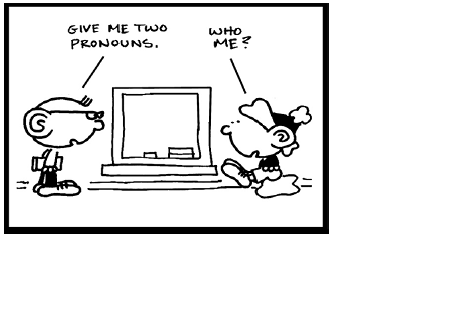
Look at the picture and choose the CORRECT alternative.
Find the alternative that best completes the blank.
“The girls got a skirt ______ at that store.”
Mark the best alternative to complete the blank.
“Phoebe hurt ______ last game, then, she might not play tomorrow.”
Mark the alternative that completes the blank.
“Janice found a shirt ______ at her room.”
“A teacher _____ had an accident last weekend, so we don’t have classes this afternoon.”
Complete the sentence with the best alternative.
“That old machine cleans ________!”
Choose the best alternative to complete the sentence.
“The girls climbed that tree _____.”