Questões de Concurso Comentadas sobre pronomes | pronouns em inglês

Foram encontradas 815 questões

Q2298709 Inglês

Two US banks collapse 


Last week, Silicon Valley Bank failed, and it left customers in a tough spot as the government took ______ 1


The so-called bank run happened because there ______ 2 news that the bank couldn’t meet its deposit obligations. It means that it had invested the money in various things that weren’t making the money back. Typically, thats the point where the Federal Deposit Insurance Corporation, ______ 3 insures deposits ______ 4 250,000 dollars, comes in. However, 98% of Silicon Valley Bank customers didn’t have 250,000 dollars but billions of dollars. The government announced that it would step in and secure the depositors, with US president Joe Biden ______ 5 that the US banking system was safe. 


Shortly after the fall of Silicon Valley Bank, regulators closed New York-based Signature Bank, too, citing systemic risk. Experts said that these stories would continue repeating themselves because many corporations were overleveraged in dollar debt.


After the collapse, European banks lost 100 billion dollars in value in a week, and despite tough regulations that should make a similar banking failure in Europe unlikely, the contagion is accelerating.


Source: https://www.newsinlevels.com/products/two-usbanks-collapse-level-3/

The blanks numbered as “3” and “4” could be CORRECTLY filled with, RESPECTIVELY: 
Alternativas
Q2281245 Inglês
Text CB1A2-I

        Oppenheimer’s brief advance into astrophysics began with a 1938 paper about neutron stars, which continued in a 1939 installment that further incorporated the principles of Einstein’s general theory of relativity. He then published a third paper on black holes on September 1st, 1939—but at the time, it was scarcely noticed because this was the very day Germany invaded Poland, launching World War II. Oppenheimer never wrote on the topic again.
        Even if it hadn’t been overshadowed by war, Oppenheimer’s work on neutron stars and black holes “was not understood to be terribly significant at the time,” says Cathryn Carson, a historian of science at the University of California, Berkeley.
        Each paper was written with a different member of the swarm of graduate students that Oppenheimer carefully cultivated. These protégés facilitated his ability to jump between research topics—and ultimately, helped him develop some of his most important contributions to physics.
        Oppenheimer’s climactic third paper, written with his student Hartland Snyder, explores the implications of general relativity on the universe’s most massive stars. Although the physicists needed to include some assumptions to simplify the question, they determined that a large enough star would gravitationally collapse indefinitely—and within a finite amount of time, meaning that the objects we now know as black holes could exist.

Internet: <scientificamerican.com> (adapted)
Based on the vocabulary and linguistic aspects of text CB1A2-I, judge the following item.
The pronoun “they” (last sentence of the last paragraph) refers to the word “assumptions”.
Alternativas
Q2273301 Inglês

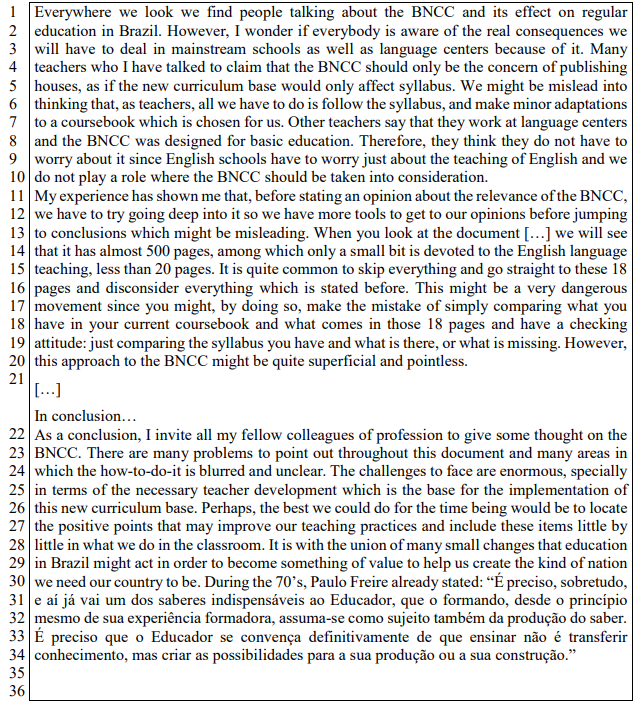
TEXT I – Tema: O papel da Língua Inglesa na BNCC


IS THE BNCC REALLY GOING TO AFFECT MY CLASSES?

(by Lúcia Rodrigues Alves)


(Adapted from: https://www.luciarodriguesalves.com.br/is-the-bncc-really-going-to-affect-my-classes/.      Accessed on July 1 , 2023)

In the sentence “[…] in terms of the necessary teacher development  which is the base for the implementation of this new curriculum base” (lines 2 and 2 ), the word in bold:
Alternativas
Q2267405 Inglês
Choose the CORRECT answer.
Talking to my child: “I know that this situation is difficult. _________ me just a little longer. Soon it will be over!” 
Alternativas
Q2267402 Inglês
Choose the CORRECT answer.
“John works with another mate _________ name I can't remember.” 
Alternativas
Q2267391 Inglês
Choose the CORRECT answer.
“That bird has broken _________ wing.” 
Alternativas
Q2256150 Inglês
Google Adds a Safeguard on Privacy for Searchers
By MIGUEL HELFT

        SAN FRANCISCO, March 14 — Web search companies collect records of the searches that people conduct, a fact that has long generated …16… among privacy advocates and some Internet users that valuable personal data could be misused.
        Now Google is taking a step to ease those concerns. The company keeps logs of all searches, along with digital identifiers linking them to specific computers and Internet browsers. It said on Wednesday that it would start to make those logs anonymous after 18 to 24 months, making it much harder to connect search records to a person. Under current practices, the company keeps the logs intact indefinitely.
        “We have decided to make this change with feedback from privacy advocates, regulators worldwide and, of course, from our users,” said Nicole Wong, Google’s deputy general counsel.
        But it is unclear whether the change will have its intended effect. Privacy advocates reacted with a mix of praise and dismay to it.
        “This is really the first time we have seen them make a decision to try and work out the conflict between wanting to be pro-privacy and collecting all the world’s information,” said Ari Schwartz, deputy director of the Center for Democracy and Technology, an advocacy group. “They are not going to keep a profile on you indefinitely.”
        Others were less enthusiastic. “I think it is an absolute disaster for online privacy,” said Marc Rotenberg, executive director of the Electronic Privacy Information Center.
        Ms. Wong said Google uses the search data internally only to improve its search engine and other services. She added that Google would release search data only if compelled by a subpoena. Even so, Google was the only major search engine to resist a Justice Department subpoena for vast amounts of search data last year — a move that drew praise from privacy advocates.
        Just how personally revealing such data can be became evident last year, when AOL released records of the searches conducted by 657,000 Americans for the benefit of researchers. …17… AOL did not identify the people behind the searches, reporters from The New York Times were able to track down some of them quickly through their search requests.
        The ensuing flap caused AOL to tighten its privacy policies. The company now keeps search histories for only 13 months and does not link them to Internet protocol addresses — digital tags that can identify a specific computer.
        For its part, Yahoo keeps search data for “as long as it is useful,” said a spokeswoman, Nissa Anklesaria. And Microsoft said that while it does not keep search histories alongside I.P. addresses, it can connect the two if law enforcement requests it.

(Adapted from
http://www.nytimes.com/2007/03/15/technology/15googles.html_r=1&ore f=login)
No texto, o pronome sublinhado them refere-se a
Alternativas
Q2254270 Inglês
The Internet at Risk

    Some 12,000 people convened last week in Tunisia for a United Nations conference about the Internet. Many delegates want an end to the U.S. Commerce Department's control over the assignment of Web site addresses (for example, http://www.washington-%20post.com/ ) and e-mail accounts (for example, [email protected]). The delegates' argument is that unilateral U.S. control over these domain names reflects no more than the historical accident of the Internet's origins. Why should the United States continue to control the registration of French and Chinese Internet addresses? It doesn't control the registration of French and Chinese cars, whatever Henry Ford's historic role in democratizing travel was.
    The reformers' argument is attractive in theory and dangerous in practice. In an ideal world, unilateralism should be avoided. But in an imperfect world, unilateral solutions that run efficiently can be better than multilateral ones that  ....51....
        The job of assigning domain names offers huge opportunities for abuse. ....52.... controls this function can decide to keep certain types of individuals or organizations offline (dissidents or opposition political groups, for example). Or it can allow them on in exchange for large fees. The striking feature of U.S. oversight of the Internet is that such abuses have not occurred.
        It's possible that a multilateral overseer of the Internet might be just as efficient. But the ponderous International Telecommunication Union, the U.N. body that would be a leading candidate to take over the domain registry, has a record of resisting innovation - including the advent of the Internet. Moreover, a multilateral domain-registering body would be caught between the different visions of its members: on the one side, autocratic regimes such as Saudi Arabia and China that want to restrict access to the Internet; on the other side, open societies that want low barriers to entry. These clashes of vision would probably make multilateral regulation inefficiently political. You may say that this is a fair price to pay to uphold the principle of sovereignty. If a country wants to keep certain users from registering domain names (Nazi groups, child pornographers, criminals), then perhaps it has a right to do so. But the clinching argument is that countries can exercise that sovereignty to a reasonable degree without controlling domain names. They can order Internet users in their territory to take offensive material down. They can order their banks or credit card companies to refuse to process payments to unsavory Web sites based abroad. Indeed, governments' ample ability to regulate the Internet has already been demonstrated by some of the countries pushing for reform, such as authoritarian China. The sovereign nations of the world have no need to wrest control of the Internet from the United States, because they already have it.

(Adapted from Washington Post, November 21, 2005; A14)
O pronome it, no final do texto, refere-se a
Alternativas
Q2254263 Inglês
The Internet at Risk

    Some 12,000 people convened last week in Tunisia for a United Nations conference about the Internet. Many delegates want an end to the U.S. Commerce Department's control over the assignment of Web site addresses (for example, http://www.washington-%20post.com/ ) and e-mail accounts (for example, [email protected]). The delegates' argument is that unilateral U.S. control over these domain names reflects no more than the historical accident of the Internet's origins. Why should the United States continue to control the registration of French and Chinese Internet addresses? It doesn't control the registration of French and Chinese cars, whatever Henry Ford's historic role in democratizing travel was.
    The reformers' argument is attractive in theory and dangerous in practice. In an ideal world, unilateralism should be avoided. But in an imperfect world, unilateral solutions that run efficiently can be better than multilateral ones that  ....51....
        The job of assigning domain names offers huge opportunities for abuse. ....52.... controls this function can decide to keep certain types of individuals or organizations offline (dissidents or opposition political groups, for example). Or it can allow them on in exchange for large fees. The striking feature of U.S. oversight of the Internet is that such abuses have not occurred.
        It's possible that a multilateral overseer of the Internet might be just as efficient. But the ponderous International Telecommunication Union, the U.N. body that would be a leading candidate to take over the domain registry, has a record of resisting innovation - including the advent of the Internet. Moreover, a multilateral domain-registering body would be caught between the different visions of its members: on the one side, autocratic regimes such as Saudi Arabia and China that want to restrict access to the Internet; on the other side, open societies that want low barriers to entry. These clashes of vision would probably make multilateral regulation inefficiently political. You may say that this is a fair price to pay to uphold the principle of sovereignty. If a country wants to keep certain users from registering domain names (Nazi groups, child pornographers, criminals), then perhaps it has a right to do so. But the clinching argument is that countries can exercise that sovereignty to a reasonable degree without controlling domain names. They can order Internet users in their territory to take offensive material down. They can order their banks or credit card companies to refuse to process payments to unsavory Web sites based abroad. Indeed, governments' ample ability to regulate the Internet has already been demonstrated by some of the countries pushing for reform, such as authoritarian China. The sovereign nations of the world have no need to wrest control of the Internet from the United States, because they already have it.

(Adapted from Washington Post, November 21, 2005; A14)
No texto, a palavra que preenche corretamente a lacuna é 
Alternativas
Ano: 2003 Banca: FCC Órgão: CVM Prova: FCC - 2003 - CVM - Inspetor |
Q2244803 Inglês
From the IPO to the First Trade: Is Underpricing Related to the Trading Mechanism?

Sonia Falconieri, Albert Murphy and Daniel Weaver

      As documented by a vast empirical literature, IPOs are characterized by underpricing. Most of the theoretical literature has linked the size of underpricing to the IPO procedure used on the primary market. In this paper, by using a matched sample of NYSE and Nasdaq IPOs, we show that the size of underpricing also depends on the trading method used in the IPO aftermarket.
        There are two major methods of opening trading of initial public offerings (IPOs) in the U.S. The NYSE is an order-driven market ...56... a call auction allows supply and demand to be aggregated (at one location) prior to the start of trading. ...57... , Nasdaq is a quote-driven market. Dealers can only specify their best quotes, and participants have ...58... idea of supply and demand away from the inside quotes.
         We propose a new proxy for ex ante uncertainty of firm value and test it. Our results show that there is a larger level of uncertainty at the beginning of trading on Nasdaq than on the NYSE. This in turn is associated with larger levels of underpricing for Nasdaq IPOs. We suggest that this may be due to the different informational efficiency of the two trading systems.


(http://www.nyse.com/marketinfo/p1020656068262.html?displayPage=%
2Fmarketinfo%2Fmarketinfo.html)
Para responder à questão, assinale, na folha de resposta, a letra correspondente à alternativa que preenche corretamente a lacuna do texto apresentado (...58...).
Alternativas
Q2243760 Inglês
      Michael R. Bloomberg is the 108th Mayor of the City of New York. He was born on February 14, 1942 to middle class parents in Medford, Massachusetts, where his father was the bookkeeper at a local dairy. Mayor Bloomberg's thirst for information and fascination with technology was evident at an early age, and led him to Johns Hopkins University, where he parked cars and took out loans to finance his education. After his college graduation, he gained an MBA from Harvard and in the summer of 1966, he was hired by Salomon Brothers to work on Wall Street.

    He quickly advanced through the ranks, and became a partner in 1972. Soon after, he was supervising all of Salomon's stock trading, sales and later, its information systems. He was fired in 1981 after another company acquired Salomon. Michael Bloomberg used his stake from the Salomon sale to start his ...39... company, an endeavor that would revolutionize the way that Wall Street ....40.... business. As a young trader, he had been amazed at the archaic nature in which information was stored. When he needed to see how a stock had been trading three weeks earlier, he had to find a copy of the Wall Street Journal from the date in question, and the records system consisted of clerks penciling trades in oversize ledgers. ...41... , he created a financial information computer that would collect and analyze different combinations of past and present securities data and deliver it immediately to the user.

       In 1982, Bloomberg LP sold 20 subscriptions to its service; 20 years ....42... , Bloomberg LP has over 165,000 subscribers worldwide. As the business proved its viability, the company branched out and in 1990 Bloomberg LP entered the media business, launching a news service, and then radio, television, Internet, and publishing operations.
   
         Nearly 20 years after its founding, Bloomberg LP now employs more than 8,000 people − including 2,500 in New York City − in more than 100 offices worldwide. As the company enjoyed tremendous growth, Michael Bloomberg dedicated more of his time and energy to philanthropy and civic affairs. His desire to improve education, advance medical research and increase access to the arts, has provided the motivation for much of his philanthropy.

         The Mayor served as the Chairman of the Board of Trustees of Johns Hopkins University until May 2002. Recently, he was honored by Johns Hopkins University, when its School of Hygiene and Public Health was renamed "The Bloomberg School of Public Health," a tribute to his leadership and use of philanthropy to improve the human ....43... .

     In 1997, Michael Bloomberg published his autobiography, Bloomberg by Bloomberg. All of the royalties from sales of the book are donated to the Committee to Protect Journalists.

(Adapted from http://home.nyc.gov/portal/index.jsp?pageID=nyc_mayor_bio&catID=119 4&cc=unused1196&rc=1194&ndi=-1)
In the text, 5th paragraph, the underlined pronoun its refers to
Alternativas
Q2243754 Inglês
      Michael R. Bloomberg is the 108th Mayor of the City of New York. He was born on February 14, 1942 to middle class parents in Medford, Massachusetts, where his father was the bookkeeper at a local dairy. Mayor Bloomberg's thirst for information and fascination with technology was evident at an early age, and led him to Johns Hopkins University, where he parked cars and took out loans to finance his education. After his college graduation, he gained an MBA from Harvard and in the summer of 1966, he was hired by Salomon Brothers to work on Wall Street.

    He quickly advanced through the ranks, and became a partner in 1972. Soon after, he was supervising all of Salomon's stock trading, sales and later, its information systems. He was fired in 1981 after another company acquired Salomon. Michael Bloomberg used his stake from the Salomon sale to start his ...39... company, an endeavor that would revolutionize the way that Wall Street ....40.... business. As a young trader, he had been amazed at the archaic nature in which information was stored. When he needed to see how a stock had been trading three weeks earlier, he had to find a copy of the Wall Street Journal from the date in question, and the records system consisted of clerks penciling trades in oversize ledgers. ...41... , he created a financial information computer that would collect and analyze different combinations of past and present securities data and deliver it immediately to the user.

       In 1982, Bloomberg LP sold 20 subscriptions to its service; 20 years ....42... , Bloomberg LP has over 165,000 subscribers worldwide. As the business proved its viability, the company branched out and in 1990 Bloomberg LP entered the media business, launching a news service, and then radio, television, Internet, and publishing operations.
   
         Nearly 20 years after its founding, Bloomberg LP now employs more than 8,000 people − including 2,500 in New York City − in more than 100 offices worldwide. As the company enjoyed tremendous growth, Michael Bloomberg dedicated more of his time and energy to philanthropy and civic affairs. His desire to improve education, advance medical research and increase access to the arts, has provided the motivation for much of his philanthropy.

         The Mayor served as the Chairman of the Board of Trustees of Johns Hopkins University until May 2002. Recently, he was honored by Johns Hopkins University, when its School of Hygiene and Public Health was renamed "The Bloomberg School of Public Health," a tribute to his leadership and use of philanthropy to improve the human ....43... .

     In 1997, Michael Bloomberg published his autobiography, Bloomberg by Bloomberg. All of the royalties from sales of the book are donated to the Committee to Protect Journalists.

(Adapted from http://home.nyc.gov/portal/index.jsp?pageID=nyc_mayor_bio&catID=119 4&cc=unused1196&rc=1194&ndi=-1)
Para responder à questão, assinale, na folha de respostas, a letra correspondente à alternativa que preencha corretamente a lacuna do texto apresentado (...39...). 
Alternativas
Q2243146 Inglês
Maya Angelou, known in literature for her autobiographical works, is the author of:
Alternativas
Q2242137 Inglês
The hard cell

The hard cell Thanks to politics, stem cell research in the United States is suffering. But not so in Sweden, which is poised to capture what could be the biggest new market to hit biotech in a decade.

By Stephan Herrera
February 13, 2003

New York, January 1, 2006:
Sweden announces that one of its biotechnology companies is the first in the world to enter clinical trials with a new drug that could cure Alzheimer's disease. Four years ago this type of research was all but stopped in the United States by political and ethical questions − which is ____ (61) Sweden now seems in the best position to capture a $25 billion market.

      Any day now, the U.S. Congress is expected to pass a sweeping new law that could dramatically inhibit researchers from working with stem cells taken from human embryos. Such cells, which can be used to grow a whole host of new cells and organs, could fundamentally change the way we treat heretofore intractable maladies like Alzheimer's disease, Parkinson's disease, cancer, stroke, liver failure, and heart disease. The only problem is that these cells by definition are derived from human embryos, many of which are cloned or come from unused fetuses collected at fertility clinics. The argument, from a certain segment of the American political spectrum, is that ____ (62) methods are morally wrong. They are _____ (63) a form of abortion or an activity that could eventually lead to human cloning.

      Those working in stem cell research say the short-term effect of the legislation will be to further chill all forms of scientific inquiry and commercialization efforts in the field. Entrepreneurs and investors are already eschewing such research − in large part because of the additional uncertainty and risk that politics introduce.

      Of the nearly 50 private stem cell companies in the United States, only a handful are still viable. Meanwhile, across the Atlantic, Sweden has avoided many of the political and ethical quagmires surrounding this type of research. It currently has 40 private stem cell companies, a number that's growing. Sweden's leading research universities have 32 percent of the world's stem cell inventory, close on the heels of the United States' 35 percent.

        Sweden, say analysts, is now in the best position to capture a worldwide market for drugs based on stem cell therapies that could grow to $25 billion in the next three to five years − nearly equal to the whole biotech industry at present. This estimate doesn't even address the market for stem cells capable of repairing damaged vital organs like the brain, heart, and kidneys. If the United States offers an object lesson of what can happen when scientific inquiry and investment capital fall victim to politics, Sweden and its leading stem cell startup, NeuroNova, offer the opposite example. How odd that the United States, which for generations has been the envy of the world for its progressive views of science and commercialization, should now have a biomedical climate chillier than a Swedish winter.

       One company feeling a lot of pain is StemCells, which at first glance seems to have it all: founding scientists include Stanford's Dr. Weissman and Fred Gage of the Salk Institute in La Jolla, California. An equally well-regarded expert in the treatment of Alzheimer's, Dr. Gage spent five years in Sweden as a researcher and now sits on a national committee on stem cell research there. The firm's chairman is Roger Perlmutter, Amgen's head of research.

    Yet over the past two years, none of management's efforts to help investors and even critics reconsider the stem cell field have worked. At press time, the stock was thinly traded and sitting in the neighborhood of 50 cents. With less than $15 million in cash, the company likely won't exist at this time next year. (CEO Martin McGlynn, who joined the firm in January 2001, would not talk to Red Herring, despite repeated efforts.)

      Some observers on Wall Street are asking, If StemCells can't make it, who can? Geron, the only other publicly held stem cell firm to speak of, is in a fix, too. The company's stock price is also moribund, at $3.85 per share. Thanks to some capital infusions a few years ago, when money came easy, Geron still has $40 million on hand, but by the end of next year, that too will likely be gone. Once a media darling, Geron focuses on diagnostic tests and drugs derived from stem cells, a strategy that's not going well. For the nine months ended last September, revenue fell 68 percent to $955,000 and net loss widened 18 percent to $26.7 million. The company's financials were also hit hard after it terminated an agreement with Pharmacia and acquired research technology from Lynx Therapeutics, which Geron bought in a desperate attempt to be seen as something more than just a stem cell company.

     The situation is quite different, however, for Sweden's NeuroNova, which has 30 academic partners and a staff of 20. NeuroNova is working on ways to inject stem cells into the human brain to trigger a process called neurogenesis (the growth of new neural cells), which could combat diseases like Parkinson's, Alzheimer's, and even schizophrenia.

       If NeuroNova is the first to develop a drug capable of treating one of several central nervous system disorders − by far the most lucrative after heart disease products − it will have done so not because it raised more money or got more media buzz than the rest. It will have succeeded because the science is solid, and academe, government, and the investment community are supportive. Meanwhile, the United States will look on with envy and wonder how it, a country known for its entrepreneurial innovation, ever got so short-sighted.

(Adapted from
http://www.redherring.com/investor/2003/02/biotech021303.html)

Instruções: Para responder a questão, assinale, na folha de respostas, a letra correspondente a alternativa que preenche corretamente a lacuna do texto apresentado.
Alternativas
Q2231441 Inglês
(§1º)Budelli Island is part of the La Maddalena Archipelago and is home to Spiaggia Rosa - a stretch of pink sand that's been protected by the Italian government since 1992.

(§2º)The pink shade is caused by the crushed shells of a micro-organism mixing with the sand when it dies. But when the beach started to lose its rose-tinted hue because of over-tourism, visitors were banned in a bit to protect the pink sand.

(§3º)The colour has since returned but a new wave of unauthorised daytrippers are threatening the pink shores. While it is strictly forbidden to step foot on the beach, holidaymakers are able to admire the pink sand from the safety of a boat. But according to one expert, some holidaymakers are flouting the ban.

(§4º)In an article in the Times, Fabrizio Fonnesu, director of the Maddalena archipelago national park said: "The beach is again in danger as people arrive by boat, clamber up the beach, then post photos, which allow us to fine them up to 500 euros (£430)."

(§5º)Tourists who've attempted to take Sardinia's pink sand away as a souvenir can up fined up to 3,500 euros (£3,007). And according to the Guardian, a couple were fined 1,000 euros (£860) in 2001 after they were caught filling a plastic bottle with sand.

(§6º)Brits who want to visit the island will need to book themself onto a private boat tour or a ferry service to glimpse this secluded spot from afar. Other beaches on the island have also brought in measures to minimise the impact of tourists. Only 1,600 people can visit Cala Sisine while Santa Maria Navarrese only permits 1,300 euros.

(§7º)Fewer still are able to visit Cala Mariolu, with only 550 people allowed in per day and each having to pay a 1 euro fee. Elsewhere, Pelosa Beach has banned towels and asked visitors to instead bring mats which gather less sand. Anyone visiting will have to pay 3.50 euros.

(§8º)Meanwhile, tourists wanting to visit the beaches of Cala Coticcio and Cala Brigantina in the archipelago of La Maddalena will have to pay 3 euros per person for access each day after new rules were brought in. The archipelago itself is a national park and only accessible with a guide, which will cost 25 euros for five hours.

(§9º)And anyone caught visiting the archipelago without a guide could face prosecution. Just 60 people will be permitted on each beach per day, as the local authorities look at ways to protect the sites from the impact of tourism.

(§10º)Slots must be booked in advance by contacting a local guide but it is hoped that an app will be launched soon. Here are several other pink beaches holidaymakers can visit across Europe - and one's in the UK. And a beach in the Canary Islands even has sand that looks like popcorn, due to the shape of the coral.

itssfnneed
w.thesun.co.uk/travel/22667535/pink-beach-italy-bundelli-tourists-fined/
Identify the grammatical class of the word "unauthorised" (§3º) in the text: 
Alternativas
Q2217913 Inglês


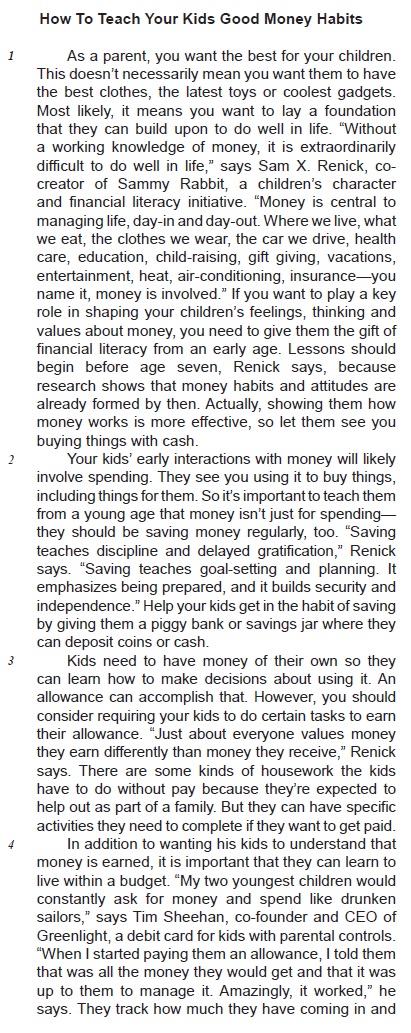
Available at: https://www.forbes.com/advisor/personal-finance/ how-to-teach-your-kids-good-money-habits/ Retrieved on: Jan. 2, 2023. Adapted.
In the segment of paragraph 2, “Saving teaches goalsetting and planning. It emphasizes being prepared, and it builds security and independence.” the word “it” is a reference to
Alternativas
Q2210441 Inglês

Fill out the gaps below with one the following words: that / where / which / who.


1. That’s the store ___ they buy their shoes.

2. The book, ___ we’ve been reading at school, was written long ago.

3. These are the directors and movies ___ I like.

4. Marie Curie is the woman ___ discovered radium.


Mark the alternative that fills out, correctly and respectively, the gaps in the sentences above. 

Alternativas
Q2210429 Inglês

Stop Wasting Time: A 15-minute Planning Session That Will Save You Hours


(Available at: https://www.classycareergirl.com/5-simple-time-management-tips-for-a-great-week/– textespecially adapted for this test).
Mark the alternative that shows to what the highlighted pronouns are referring to, in the order they appear in the text: “it” (l. 15), “These” (l. 21), and “This” (l. 23). 
Alternativas
Q2209847 Inglês


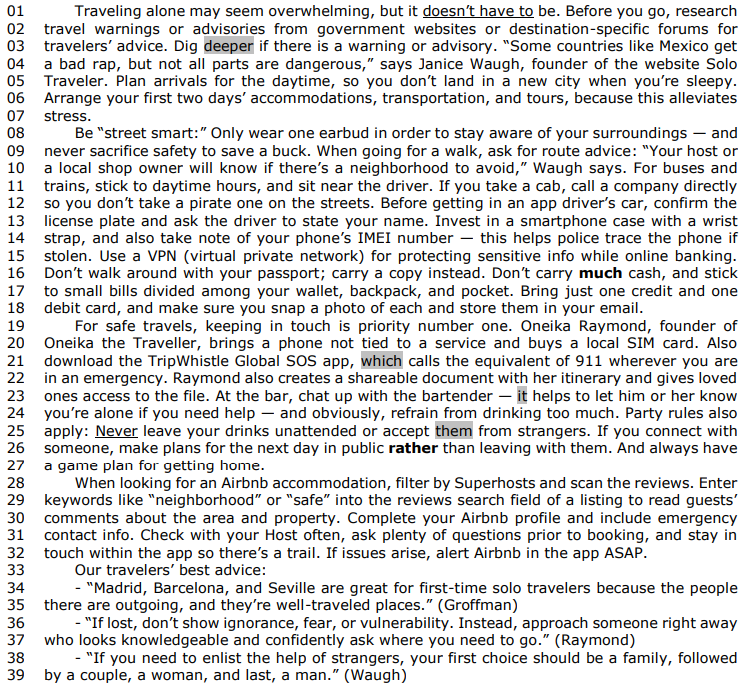
Try these expert tips for a safer solo trip


(Available at: https://news.airbnb.com/try-these-expert-tips-for-a-safer-solo-trip/ – text especially adapted for this text).

Mark the alternative that shows what the highlighted pronouns are referring to, in the order they appear in the text: “which” (l. 21), “it” (l. 23), and “them” (l. 25).
Alternativas
Q2209568 Inglês
"Call me Ishmael." - Herman Melville, Moby Dick
What is the grammatical function of "me" in the opening sentence of Herman Melville's novel "Moby Dick"? 
Alternativas
Respostas
481: A
482: E
483: E
484: B
485: E
486: B
487: D
488: D
489: E
490: A
491: C
492: E
493: C
494: A
495: A
496: A
497: A
498: A
499: D
500: A