Questões de Concurso Comentadas sobre pronomes | pronouns em inglês

Foram encontradas 815 questões

Q3031081 Inglês
Text for the question.

    In today’s rapidly evolving technological landscape, IT professionals are increasingly playing a pivotal role in enhancing the fields of physiotherapy and occupational therapy. By integrating advanced technology into therapeutic practices, IT experts are helping to create innovative solutions that improve patient outcomes and streamline clinical processes.
    One significant contribution is the development of sophisticated software and applications that enable therapists to design personalized treatment plans. These digital tools allow for precise tracking of patient progress, making it easier to adjust therapies in real‑time based on data analytics. For instance, motion‑sensing technology and wearable devices can monitor a patient’s physical movements during exercises, providing immediate feedback to both the therapist and the patient.
    Additionally, virtual reality (VR) and augmented reality (AR) are revolutionizing rehabilitation methods. IT professionals are creating immersive VR environments where patients can perform therapeutic exercises in a controlled, engaging setting. This approach is particularly beneficial for those recovering from injuries or surgeries, as it can make repetitive exercises more enjoyable and less monotonous.
    Telehealth platforms are another area where IT expertise is crucial. These platforms enable remote consultations and therapy sessions, ensuring that patients have access to care regardless of their location. IT professionals ensure that these systems are secure, user‑friendly, and efficient, thereby expanding the reach of physiotherapists and occupational therapists.
    Moreover, data security and patient confidentiality are paramount in healthcare. IT professionals implement robust cybersecurity measures to protect sensitive patient information. By doing so, they help maintain trust and compliance with regulatory standards, ensuring that therapeutic practices are both effective and safe.
    In conclusion, the collaboration between IT professionals and therapists is fostering a new era of healthcare where technology and therapy converge. This synergy not only enhances the quality of care but also empowers patients on their journey to recovery, demonstrating the invaluable role of IT in advancing physiotherapy and occupational therapy.
In the sentence, “By integrating advanced technology into therapeutic practices, IT experts are helping to create innovative solutions that improve patient outcomes and streamline clinical processes”, the subject pronoun that could correctly replace “IT experts” is
Alternativas
Q3028602 Inglês
Text I: 'Quiet quitting' isn't really quitting


    Clocking out at 5 p.m. on the dot, only doing your assigned daily tasks, limiting chats with colleagues and not working overtime. These are the distinctive features of "quiet quitting," a term coined to describe how people are approaching their jobs and professional lives differently to manage burnout.

    The phrase, which isn't actually intended to lead to a resignation, exploded into the popular lexicon in 2022 when a TikTok video went viral. The creator, Zaid Khan, said in the video "I recently learned about this term 'quiet quitting,' where you're not outright quitting your job, but you're quitting the idea of going above and beyond." Nonetheless, “quiet quitting” is a misnomer, at least according to Karen K. Ho, a freelance business and culture reporter. She said that the term doesn't account for the fact that people are watching their grocery bills, fuel costs and housing prices go up, often without so much as a salary increase. "You're literally stagnating as a result of not earning more, not being promoted – and that's why a lot of people are leaving jobs," she completed.

   While the words "quiet quitting" are loaded, evoking images of a slacker or ne'er-do-well for some, others say that the approach frees up time to spend with family and friends or to take care of oneself. In short, it's a renewed commitment to life beyond the workplace. On the other hand, the term “quiet quitting” has also received criticism, even from those who generally favor the idea behind it.

   However, while the term "quiet quitting" may be a new invention, the mentality behind it is not. The phrase "work to rule," for example, describes a labor action in which employees strictly perform the work laid out in their contract, without taking on additional work. In 2020, the COVID-19 pandemic triggered a major economic movement, The Great Resignation, which saw people leaving their jobs or switching professions in droves, as they re-evaluated their relationship with work during a lifechanging health crisis.

  A May 2022 survey by RBC Insurance suggested that more than one-third of recently retired Canadians aged 55-75 had retired sooner than they planned. Another third decided to retire sooner because of the pandemic. Moreover, Statistics Canada reported that the third quarter of 2021 saw a 60% increase in job vacancies compared to pre-pandemic levels in the country.

    Both Quiet Quitting and The Great Resignation indicate a marked cultural shift from the early and mid-2010s when "hustle culture" paved the way to "grinding" and "girl-bossing" – two ideas that prioritized work over everything else, with the belief that such effort made employees more desirable to managers, therefore helping them climb up the corporate ladder faster and generating more income.

    In addition, it is important to highlight that employees have been re-evaluating how much time they spend commuting, working overtime and generally investing in low-pay, low-reward jobs. It seems they have realized that they work in systems where they are constantly immersed in a hustle culture – which has been repeatedly shown to be only beneficial for corporations and their managers, through bonuses, through increased productivity, through increased revenue and profits and the like.

    Furthermore, some employees are advocating for policies, benefits and working conditions that strengthen work-life balance. But critics say it doesn't work as well as it should, with a glaring loophole that allows employers to take advantage by vaguely wording their policies.


Adapted from: https://www.cbc.ca/news/business/quiet-quitting-workerdisengagement-1.6560226 Last Updated: August 25, 2022
Analyze the excerpts below.

I. “… or to take care of oneself” [Reflexive pronoun].
II. “In 2020, the COVID-19 pandemic …” [Preposition].
III. “… with a glaring loophole that allows…” [Superlative adverb].
IV. “…and professional lives differently to manage burnout” [Phrasal verb].

The information in brackets correctly describes the underlined word/expression in the excerpt(s): 
Alternativas
Q3016397 Inglês

Read the following passage and identify the correct object pronoun to complete the sentence:


"Tom invited ____ to join him at the concert, and he promised to save a seat for ____." 

Alternativas
Q3016394 Inglês

Choose the alternative in which there is, correctly and respectively the bold words:


“The blue car is hers and the red car is ours,” 

Alternativas
Q3016387 Inglês

Choose the CORRECT answer:


“The cat is playing with ______ toy.” 

Alternativas
Q3016386 Inglês
Mark the option which contains an object pronoun:
Alternativas
Q3016385 Inglês

Consider the title of the article:


“An adventure that explores the hidden gems of the city.”


The other word that could replace the pronoun that is:

Alternativas
Q3010798 Inglês
Pronouns make links to what has already been said and help avoid repetition. Pronouns can be used as cohesive devices in order to create cohesion. A pronoun is a word that stands in for a noun, often to avoid the need to repeat the same noun over and over. Like nouns, pronouns can refer to people, things, concepts, and places. Most sentences contain at least one noun or pronoun. Pronouns do more than helping avoid repetitiveness. They provide context, make sentences’ meanings clearer, and shape how we perceive people and things. Read the sentences that follow and do what is required.

I. Her aunt will be vacating next week.
II. That toy on the shelf is mine.
III. Did you do it yourself?
IV. She is the girl I was talking to you about.
V. I am going home today evening.
VI. All my friends are coming home for my birthday party.

In the order they were respectively underlined and written in bold letters, the pronouns written in the sentences above have specific functions, check the answer whose pronouns types are correspondent to the ones read above. 
Alternativas
Q2934936 Inglês

O texto a seguir refere-se às questões 29, 30, 31 e 32.


Learning to quit


Jodi Hall started smoking at age 9.

By the time she was 16, she was up to a pack a day – and she wanted to quit. A couple of reasons: one, her health; two, a guy named Mony. “He said that when he kissed me, it was like kissing an ashtray”, Jodi says.

Earlier this year, Jodi, along with 25 of her classmates at Johnson High School, in Savannah, GA, enrolled in the school’s first stop-smoking class. During the eight-week Tobacco Free Teen class, they learned what smoking can do to their body, their wallet and their grades (some kids end up cutting class to satisfy their nicotine cravings). But it wasn’t just about scare tactics. The goal is behavior modification, not punishment, so students are taught techniques for handling stress and resisting the urge to light up even when friends or parents do.

According to the American Lung Association (ALA), which sponsors the class, about half the adults who smoke were regular smokers by age 18. “Theses numbers are only going to get worse,” says Kristine Lewis of the ALA. “The tobacco industry is turning to teens.”

How did the students do? Jodi has been cigaretteless for three months. But she’s the only one. Her classmate Adam Cushman is slowly putting his way back to three packs a day. The 16-year-old says he wants to stop, “but the way things are going, I doubt I’ll be able to.”


Seventeen, June 1996.

O pronome they em “they learned what smoking can do to…” refere-se a Jodi e:

Alternativas
Q2913999 Inglês

THERE ARE 10 QUESTIONS OF MULTIPLE CHOICE IN YOUR TEST. EACH QUESTION HAS 4 ALTERNATIVES (A, B, C, AND D) FROM WHICH ONLY ONE IS CORRECT. CHECK THE CORRECT ONE.


A Framework for Understanding Cross-Cultural Misunderstandings

Successful communication between human beings, either within a culture or between cultures, requires that the message and meaning intended by the speaker is correctly received and interpreted by the listener. Sustainable error free communication is rare, and in most human interactions there is some degree of miscommunication.
The message sent from speaker to listener contains a wide array of features, such as words, grammar, syntax, idioms, tone of voice, emphasis, speed, emotion, and body language, and the interpretation requires the listener to attend to all of these features, while at the same time constructing an understanding of the speaker's intentions, emotions, politeness, seriousness, character, beliefs, priorities, motivations, and style of communicating. In addition, the listener must also evaluate whether the utterance is a question or a statement and how and to what extent a statement matters to the speaker (Maltz and Borker, 1982).
Each of the components of the communication provides one or more kind of information. Words convey abstract logic, tone of voice conveys attitudes, emotions and emphases, and body language communicates "requests versus commands, the stages of greeting, and turn-taking" (Schneller 1988, p. 154).
Even assuming that words and body language were perfectly understood, there is more information necessary to successfully communicate across cultures. For example, in some countries it is polite to refuse the first few offers of refreshment: "Many foreign guests have gone hungry because their U.S. host or hostess never presented a third offer" (Samovar and Porter 1988, p. 326). In understanding communication, a listener must pay attention not just to what is said and when, but also to how many times something is said, under what circumstances, and by whom. Given all this complexity, the reason human communication can often succeed is because people learn how to communicate and understand through interacting with one another throughout their lives. Therefore, it is no surprise that culture and socialization are critical determinants of communication and interpretation. "The entire inference process, from observation through categorization is a function of one's socialization" Detweiler (1975). Socialization influences how input will be received, and how perceptions will be organized conceptually and associated with memories.

The importance of culture to communication

Some theorists have gone so far as to claim that culture not only influences interpretation, but constitutes interpretation. The interpretation of communicative intent is not predictable on the basis of referential meaning alone. Matters of context, social presuppositions, knowledge of the world, and individual background all play an important role in interpretation (Gumperz, 1978b).
Even knowledgeable translators can have difficulty with cross-cultural translations. There may not be corresponding words or equivalent concepts in both cultures, jokes and implications may be overlooked, and literal translations can present a host of difficulties. Some language pairs are very difficult to translate, while others, usually in more similar languages, are much easier (Sechrest, Fay and Zaidi 1988).
While some of the incremental difficulties can be traced to the underlying linguistic commonalities between the languages, there may be a more elusive cultural and ecological basis for difficulty in translation. It would be interesting to test how much of the variance in communication could be accounted for by the ease with which the languages in question could be translated into one another.
Although it may facilitate cross-cultural translations, similarity of languages and cultures also increases the likelihood that communicators will erroneously assume similarity of meanings. This may make them more likely to misunderstand speech and behavior without being aware that they may have misinterpreted the speaker's message.
In general, cross-cultural miscommunication can be thought to derive from the mistaken belief that emics are etics, that words and deeds mean the same thing across cultures, and this miscalculation is perhaps more likely when cultures are similar in surface attributes but different in important underlying ways. In this case miscommunication may occur instead of non-communication.

(http://www.dattnerconsulting.com/cross.html )

The pronoun them in “This may make them more likely to misunderstand speech and behavior without being aware that they may have misinterpreted the speaker's message” refers to

Alternativas
Q2847467 Inglês

Empowering language learning through assessment 

By Liying Cheng & Janna Fox


 Introduction

Like you, we are teachers. We both began our careers teaching English to students ______ first languages were not English. We taught many of these students in Asia, the Middle East, Africa, and North America, navigating our way through the teaching, learning, and assessment of our students with little guidance from theory or resources. Over the years, we became increasingly sensitive to the negative influence and consequences of ill-considered assessment and testing practices. Although we could increasingly find resources on language teaching methods, strategies, and techniques, very few of these resources provided systematic and coherent support for our day-to-day assessment practices. There were no ready answers to our questions in the research literature either – researchers tended to write for other researchers, and their findings, although interesting, were not readily applicable in our classrooms. Years later, our long-term interest in assessment led us to teaching courses to pre-service and in-service teachers: helping them to support their students’ learning through sound assessment practices. This thread has centrally run through our work. Again, we searched for resources that could answer the questions and address the issues arising in the classroom; we realised that the narrow scope of resources on classroom assessment rarely moved beyond test design and test analysis, and was more appropriate for large-scale testing than for on-going classroom assessment.

In the present educational climate, we are continually faced with complex assessment issues. For example, there is a great deal of discussion now about alignment as a guiding principle for high quality assessment: that is, the degree of agreement amongst standards, curriculum, learning outcomes, assessment tasks (including tests), and instruction. Alignment, validity, reliability, fairness, consequences, and practicality are viewed as central aspects of assessment practice that supports learning.

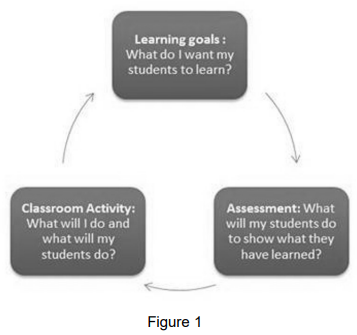
The alignment of learning goals, assessment, and classroom activity 


Figure 1 depicts assessment practices three-dimensionally and asks us as teachers to revisit our own classroom practices. Think about what it means to us in achieving instructional goals through teaching and assessment. In the center of this triangle is our students’ learning. The first question we need to ask relates to the learning goals we have for our students: What do I want my students to learn? What do I want them to know, value, and / or be able to do as an outcome of my teaching? Moving to the next question in Figure 1, on assessment, we need to ask how we will monitor and evaluate learning – or what information is essential in order to determine whether our students have met or exceeded the required expectations: What will my students do to show what they have learned? Given the evidence that we plan to collect during a course, we then need to identify the actual classroom activities that will support our students’ learning and development: What will I do as a teacher, and what will my students do as learners?

Assessment serves as the key to check on learning, providing essential information to teachers. This is an on-going, iterative, and cyclical way of supporting learners through assessment and teaching. In this sense, teaching and assessment are one integral and interconnected process. Teachers need to constantly ask themselves: Have my students learned? And how well have they progressed as a result of my assessment practices?


Assessment ofas, and for learning 

For teachers to support student learning through assessment, teachers need to engage themselves as well as their students in the discussion of assessment of learning, assessment for learning, and assessment as learning. We argue that it is inaccurate to view assessment only as judgments on learner progress at the conclusion of a unit of teaching and learning. Rather, it should also be viewed as a way of obtaining evidence for where students are in reaching their learning goals and what they need in order to progress towards these goals. Assessment as learning puts the focus on the students themselves taking responsibility for their own learning through self and peer-assessment, monitoring their own progress toward their goals and employing strategies for achieving them. We know that alignment and assessment of, for, and as learning ultimately empower our students’ language development.


Available at: https://www.onestopenglish.com/methodology-theworld-of-elt/applied-linguistics-empowering-language-learningthrough-assessment/555928.article. Accessed on: April 29, 2024.  
The correct relative pronoun to complete the sentence: “Like you, we are teachers. We both began our careers teaching English to students ______ first languages were not English.” is
Alternativas
Q2815876 Inglês

Fill in the blanks with the correct pronoun.


They are late. Can you call ______?

This is the car. Can you fix it for _____?

Claudia is sick. I will make soup for _____.


Select the CORRECT answer.

Alternativas
Q2815871 Inglês

Complete the following sentences with the correct conjunction.


Give this letter to Anne __________ you see her.

Do you know _______could give me better instructions?

It started to rain _____ I washed the clothes.

We have to work ______ the day before the sun goes down.


Select the CORRECT answer.

Alternativas
Q2815867 Inglês

Match Column A with Column B to fill in with the appropriate question word.


COLUMN A


I. Where.

II. Who.

III. When.

IV. How.

V. How much.


COLUMN B


( ) ______ do you live? In Icapuí.

( ) ______ is your best friend? It’s Sam.

( ) ______ old are you? I am 19

( ) ______ is your party? Tomorrow morning.

( ) ______ is the ticket? It's free.


Select the CORRECT answer

Alternativas
Q2808944 Inglês

All1 that we see or seem is but a dream within a dream." (Edgar Allan Poe)

“As a writer, I'm more interested in what people tell themselves2 happened rather than what actually happened.” (Kazuo Ishiguro)

“That is what learning is. You suddenly understand something3 you've understood all your life, but in a new way.” (Doris Lessing)

“There is nothing4 either good or bad but thinking makes it so.” (William Shakespeare)


In these sentences, the pronouns in bold are, respectively,

Alternativas
Q2808938 Inglês

“There are four questions of value in life. What is sacred? Of what is the spirit made? What is worth living for and what is worth dying for? The answer to each is the same. Only love.” (Lord Byron)

“But soft! What light through yonder window breaks? It is the east, and Juliet is the sun.” (William Shakespeare)


In terms of grammatical features, the two passages above have two aspects in common, which are the use of

Alternativas
Q2808909 Inglês

“Poetry, Painting & Music, the three Powers in man of conversing with Paradise, which1 the flood did not sweep away.” (William Blake)

“Keep away from people who2 try to belittle your ambitions. Small people always do that, but the really great make you feel that you, too, can become great.” (Mark Twain)

The way to read a fairy tale is to throw yourself3 in.” (W.H. Auden)


The pronouns in bold in the three sentences above are, respectively,

Alternativas
Q2808869 Inglês

Read the following passage then mark the alternative that correctly fills in the blanks.


“And this I believe: that the free, exploring mind of the individual human is the most valuable thing in the world. And this I would fight for: the freedom of the mind to take any direction it wishes, undirected. And this I must fight against: any idea, religion, or government which limits or destroys the individual. This is what I am and what I am about.” (John Steinbeck)


This passage contains the recurrent use of a ______1 pronoun and an example of a ______2 adjective.

Alternativas
Q2799281 Inglês

INSTRUCTIONS: Read the text carefully and then answer the questions from 33 to 38 by choosing the correct alternative.


Brazil corruption scandals: All you need to know

For the past three years, Brazil has been gripped by a scandal which started with a state-owned oil company and grew to encapsulate people at the very top of business - and even presidents.

On the face of it, it is a straightforward corruption scandal - albeit one involving millions of dollars in kickbacks and more than 80 politicians and members of the business elite.

But as the tentacles of the investigation dubbed Operation Car Wash fanned out, other scandals emerged.

It has led to some of those who have found themselves accused claiming they are the victims of political plots, designed to bar them from office.

What is Operation Car Wash?

Operation Car Wash began in March 2014 as an investigation into allegations that Brazil's biggest construction firms overcharged state-oil company Petrobras for building contracts.

Investigators accused directors at the firm - named the world's most ethical oil and gas company in 2008 - of skimming the extra money off the top as a bribe for awarding the contract.

Which is bad enough - but then the Workers' Party found itself dragged into the corruption scandal amid allegations of having funneled some of these funds to pay off politicians and buy their votes and help with political campaigns.

Among those accused in the scandal were dozens of politicians, and Luiz Inacio Lula da Silva - the country's extremely popular former president, known affectionately as "Lula".

The pronouns IT (line 07), THEY (line 07) and ITSELF (line 14), refer respectively to:

Alternativas
Q2776449 Inglês

“I recall closing the gates behind_________________”

Complete with the right pronoun.

Alternativas
Respostas
361: E
362: A
363: A
364: B
365: B
366: C
367: A
368: B
369: B
370: B
371: D
372: A
373: E
374: A
375: C
376: D
377: B
378: C
379: B
380: D