Questões de Concurso
Comentadas sobre pronomes | pronouns em inglês
Foram encontradas 815 questões


Reading skill will help you to improve your understanding of the language and build your vocabulary.
Social Media Across Generations
Today’s grandparents are joining their grandchildren on social media, but the different generations’ online habits couldn’t be more different. In the UK the over-55s are joining Facebook in increasing numbers, meaning that they will soon be the site’s second biggest user group, with 3.5 million users aged 55-64 and 2.9 million over-65s.
Sheila, aged 59, says, I joined to see what my grandchildren are doing, as my daughter posts videos and photos of them. It’s a much better way to see what they’re doing than waiting for letters and photos in the post. That’s how we did it when I was a child, but I think I’m lucky I get to see so much more of their lives than my grandparents did.
Ironically, Sheila’s grandchildren are less likely to use Facebook themselves. Children under 17 in the UK are leaving the site – only 2.2 million users are under 17 – but they’re not going far from their smartphones. Chloe, aged 15, even sleeps with her phone. It’s my alarm clock so I have to she says. I look at it before I go to sleep and as soon as I wake up.
Unlike her grandmother’s generation, Chloe’s age group is spending so much time.......... their phones.......... home that they are missing out on spending time with their friends in real life. Sheila, on the other hand, has made contact with old friends from school she hasn’t heard...................40 years. We use Facebook to arrange to meet all over the country, she says. It’s changed my social life completely.
Teenagers might have their parents to thank for their smartphone and social media addiction as their parents were the early adopters of the smartphone. Peter, 38 and father of two teenagers, reports that he used to be on his phone or laptop constantly. I was always connected and I felt like I was always working, he says. How could I tell my kids to get off their phones if I was always in front of a screen myself? So, in the evenings and at weekends, he takes his SIM card out of his smartphone and puts it into an old-style mobile phone that can only make calls and send text messages. I’m not completely cut off from the world in case of emergencies, but the important thing is I’m setting a better example to my kids and spending more quality time with them.
( ) grandmother’s generation and Chloe’s age group (paragraph 4), the (‘s) are examples of the genitive case.
( ) The pronouns themselves, they and, their (in bold in the 3rd paragraph of the text) are respectively: reflexive pronoun, subject pronoun and possessive pronoun.
( ) The underlined words in the text biggest and better are adjectives in the superlative and comparative form, respectively.
( ) In It’s changed my social life completely, the (‘s) is the contracted form of has.
( ) The discourse marker on the other hand (in the 4th paragraph of the text), is being used to show a logical connection.
Select the option that presents the correct sequence from top to bottom.
Read the following sentences about “Uso e formação de Wh-questions e outras estruturas interrogativas.”
1. Wh-questions begin with what, when, where, who, whom, which, whose, why and how.
2. We use the ‘wh-questions’ to ask for information. The answer can be yes or no. We expect an answer which gives information.
3. We usually form ‘wh-questions’ with wh- + an auxiliary verb (be, do or have) + subject + infinitive verb or with wh- + a modal verb + subject + main verb.
4. When what, who, which or whose is the subject or part of the subject, we do not use the auxiliary. We use the word order subject + verb.
Select the option that presents the correct sentences.
Text
Reading skill will help you to improve your understanding of the language and build your vocabulary.
Read the text below carefully.
Social media, magazines and shop windows bombard people daily with things to buy, and British consumers are buying more clothes and shoes than ever before. Online shopping means it is easy for customers to buy without thinking, while major brands offer such cheap clothes that they can be treated like disposable items – worn two or three times and then thrown away
In Britain, the average person spends more than £1,000 on new clothes a year, which is around four per cent of their income. That might not sound like much, but that figure hides two far more worrying trends for society and for the environment. First, a lot of that consumer spending is via credit cards. British people currently owe approximately £670 per adult to credit card companies. That’s 66 per cent of the average wardrobe budget. Also, not only are people spending money they don’t have, they’re using it to buy things they don’t need. Britain throws away 300,000 tons of clothing a year, most of which goes into landfill sites.
People might not realize they are part of the disposable clothing problem because they donate their unwanted clothes to charities. But charity shops can’t sell all those unwanted clothes. Fast fashion goes out of fashion as quickly as it came in and is often too poor quality to recycle; people don’t want to buy it second-hand. Huge quantities end up being thrown away, and a lot of clothes that charities can’t sell are sent abroad, causing even more economic and environmental problems.
However, a different trend is springing up in opposition to consumerism – the ‘buy nothing’ trend. The idea originated in Canada in the early 1990s and then moved to the US, where it became a rejection of the overspending and overconsumption of Black Friday and Cyber Monday during Thanksgiving weekend. On Buy Nothing Day people organize various types of protests and cut up their credit cards. Throughout the year, Buy Nothing groups organize the exchange and repair of items they already own.
The trend has now reached influencers on social media who usually share posts of clothing and make- -up that they recommend for people to buy. Some YouTube stars now encourage their viewers not to buy anything at all for periods as long as a year. Two friends in Canada spent a year working towards buying only food. For the first three months they learned how to live without buying electrical goods, clothes or things for the house. For the next stage, they gave up services, for example haircuts, eating out at restaurants or buying petrol for their cars. In one year, they’d saved $55,000.
The changes they made meant two fewer cars on the roads, a reduction in plastic and paper packaging and a positive impact on the environment from all the energy saved. If everyone followed a similar plan, the results would be impressive. But even if you can’t manage a full year without going shopping, you can participate in the anti-consumerist movement by refusing to buy things you don’t need. Buy Nothing groups send a clear message to companies that people are no longer willing to accept the environmental and human cost of overconsumption.
source: learnenglish.britishcouncil.org
Read the sentences below and determine whether they are true ( T ) or false ( F ), according to structure and grammar use.
( ) The verbs worn and thrown (1st paragraph of the text) has its infinitive form as wear and throw.
( ) The underlined words in the text: nothing, anything and, everyone are examples of relative pronouns.
( ) The singular form of the following words from the text clothes and goods are, respectively cloth and good.
( ) The following sentence from the text: “Fast fashion goes out of fashion as quickly as it came in …” (3rd paragraph of the text). The words in bold are being used to compare things that are equal in some way.
( ) The negative form of the sentence “In one year, they’d saved $55,000.” (5th paragraph of the text), is “In one year, they hadn’t saved $55,000.”
Select the option that presents the correct sequence from top to bottom.
Technology Consultant Fast Track: How to Get Your Dream Job in IT Consulting (IT Consulting Career Guide).
(English Edition) eBook Kindle only.
Jumpstart your IT job search and land your dream job while your peers are still "freshening up" their resumes!
Proven techniques to land your dream job as a high-paid IT consultant—you don’t want to miss these, if you are serious about a career in IT!
Answers to IT consulting career questions most people fail to ask; actionable advice and real-life stories from seasoned IT consultants!
As a fresh graduate looking for your first job, if you just do what almost everybody else is doing…you will land a hellhole job with lousy pay, long hours, nasty coworkers, and exclusively clients from hell (because you thought it was your only option to go forward in your career). If you are serious and can apply simple instructions, this book can help you become a high-paid IT consultant in your dream job by the end of the month!
If you already have your first or second job in the field of IT, or even have 20 years of work experience, this book will tell you what a great option a career in IT consulting can be. With this book, you can find out why your current job is not satisfying your career aspirations and turn your career around for the better!
Containing lessons from a PhD with 12 years of experience and 15,000 billable hours from Accenture and Coala, this is the book movers and shakers in the IT industry are talking about. Recommended by university professors, last-year students, as well as seasoned consultants. Even my mom says you have to read this book, or you have to answer to her!
By reading this book, you will learn:
What your college professor didn't tell you about the consulting business.
The Pro’s and Con’s of a career in technology consulting.
What other options do you have besides working for one of the global consulting giants such as Accenture, Capgemini, Deloitte, Ernst & Young (EY), KPMG, or PricewaterhouseCoopers (PwC).
The must-have characteristics to succeed in IT consulting (if you don't have these, you are doomed to FAIL!).
How to find your money-making niche in IT consulting.
How to get the best results with the least possible effort in your job search.
Best ways to prepare for the job interview in 30 minutes or less. What questions to ask in the interview to avoid nasty surprises when you are selected.
Hear what others are saying:
★★★★★ “The book gives a strong and realistic description of IT consultancy. Thus, every IT student should read the book before they graduate as it will increase their probability of landing a dream job.” Samuli Pekkola, Professor, PhD, in Information Systems Sciences, Tampere University
★★★★★ “The book gives insight into technology consulting and provides great tips for job search. I believe it will be very valuable when I start looking for a position in IT. The section on how to stand out as a candidate for a job was an eyeopener.” Saku Sikiö, Information Systems Student, University of Jyväskylä
★★★★★ “This is the book I would have needed on the verge of graduation!” Teijo Kelander, MSc, Quality Consultant and Agile Coach
★★★★★ “If you are serious about IT consultancy as a profession, this book is a must-read! As a recruiter, I would prefer that applicants would better understand what this is all about.” Petteri Laamanen, MSc, CEO & Founder, Coala
★★★★★ “This book gave me valuable insights into the IT consultant’s working life, making it easier to consider the pros and cons in relation to my own values and goals.” Janita Kingelin, MSc, Marketing Manager, SoulCore
★ If you want great results in your technology consultant job search, get this book right now!
https://www.amazon.com.br/Technology-Consultant-Fast-Track-Consultingebook/dp/B0918JB48D
The pronoun her refers to
Na frase abaixo, o termo destacado trata-se de um:
“Joe should always take care of himself.”
Read Text II and answer question
University Degree Sill Best Way into Good Job
How do you get a good job? It might literally be a milliondollar question. And researchers from Georgetown University in the US have an answer: the best way is still to get a college education, even if you're a little late. That's their simple answer – one they came up with after looking at US government data for more than 8,000 Americans who were born in the early 1980s. They found that getting a bachelor's degree by the age of 26 gave people a 56% chance of getting a good job by the age of 30. For their study, the researchers defined a "good job" as one paying at least $ 38,000 for workers under the age of 45.
According to The Wall Street Journal, the research didn't focus on people who went straight to college after finishing high school because they already have a high chance of getting a good job. Instead, it looked at different pathways that people who didn't go straight to college after high school could take to increase their chances of getting a good job. For example, even just beginning a bachelor's degree by age 22 increased the likelihood of getting a good job by 16 percentage points, according to the report. But despite this evidence, according to a separate Wall Street Journal survey, more than half of people don't feel that doing a four-year degree is worth the cost, because students may finish without specific job skills and with a large amount of debt.
According to US News, in the academic year that ended in the summer of 2023, the average cost of going to an American university for a year started at about $ 10,000 for a public university, and went as high as almost $ 40,000 for a private school. And Zach Mabel, one of the authors of the Georgetown report, admits that although a university education is likely to be beneficial, for financial reasons "the risk of pursuing higher education is higher than it's ever been."
Source: https://engoo.com.br/app/daily-news/article/study-university-degree-stillbest-way-into-good-job/crbIxBR3Ee6ComdOtgdXYw
Check the sentence below:
“Let’s go out!”
What is the ’s a contraction of?
TEXT 1
Why is music good for the brain?
October 7, 2020
By Andrew E. Budson, MD, Editorial Advisory Board Member, Harvard Health Publishing

1. Can music really affect your well-being, learning, cognitive function, quality of life, and even happiness? Hand in a recent survey on music and brain health conducted by AARP revealed some interesting findings about the impact of music on cognitive and emotional well-being: music listeners had higher scores for mental well-being and slightly reduced levels of anxiety and depression compared to people overall.
2. Of survey respondents who currently go to musical performances, 69% rated their brain health as “excellent” or “very good,” compared to 58% for those who went in the past and 52% for those who never attended. Of those who reported often being exposed to music as a child, 68% rated their ability to learn new things as “excellent” or “very good,” compared to 50% of those who were not exposed to music.
3. Active musical engagement, including those over age 50, was associated with higher rates of happiness and good cognitive function. Adults with no early music exposure but who currently engage in some music appreciation show above average mental well-being scores. Those are pretty impressive results, to be sure. However, this 20-minute online survey has some limitations. For one, it included 3,185 US adults ages 18 and older; that is a small number if you are extrapolating to 328 million people across the country. For another, it is really a survey of people’s opinions. For example, although people might report their brain health as “excellent,” there was no objective measure of brain health such as an MRI scan, or even a test to measure their cognition.
4. Lastly, even if the ratings were true, the findings are only correlations. They do not prove that, for example, it was the exposure to music as a child that led to one’s improved ability to learn new things. It may be equally likely that those children brought up in more affluent households were both more likely to be exposed to music and to be given a good education that led to their being able to easily learn new things later in life.
5. Music has been shown to activate some of the broadest and most diverse networks of the brain. Of course, music activates the auditory cortex in the temporal lobes close to your ears, but that’s just the beginning. The parts of the brain involved in emotion are not only activated during emotional music, they are also synchronized. Music also activates a variety of memory regions. And, interestingly, music activates the motor system. In fact, it has been theorized that it is the activation of the brain’s motor system that allows us to pick out the beat of the music even before we start tapping our foot to it!
6. Okay, get along! so music activates just about all of the brain. Why is that so important? Well, have you ever heard the expression, “If you don’t use it, you’ll lose it”? It turns out this is actually true in the brain. Brain pathways — and even whole networks — are strengthened when they are used and are weakened when they are not used. The reason is that the brain is efficient; it isn’t going to bother keeping a brain pathway strong when it hasn’t been used in many years. The brain will use the neurons in that pathway for something else. These types of changes should be intuitively obvious to you — that’s why it is harder to speak that foreign language if you haven’t used it in 20 years; many of the old pathways have degraded and the neurons are being used for other purposes.
BUDSON, Andrew E. Why is music good for the brain? Harvard Health Publishing, 7 out. 2020. Disponível em:
“The professional of Teaching English as a Foreign Language”
Author: Anderson Francisco Guimarães Maia
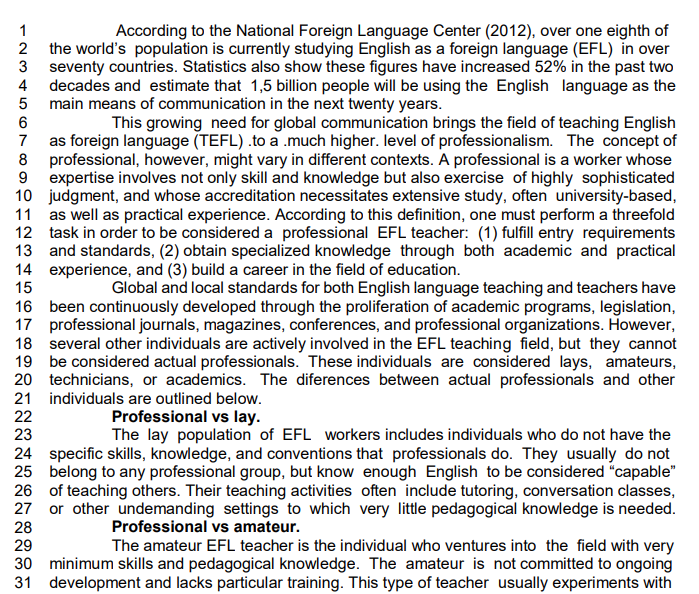
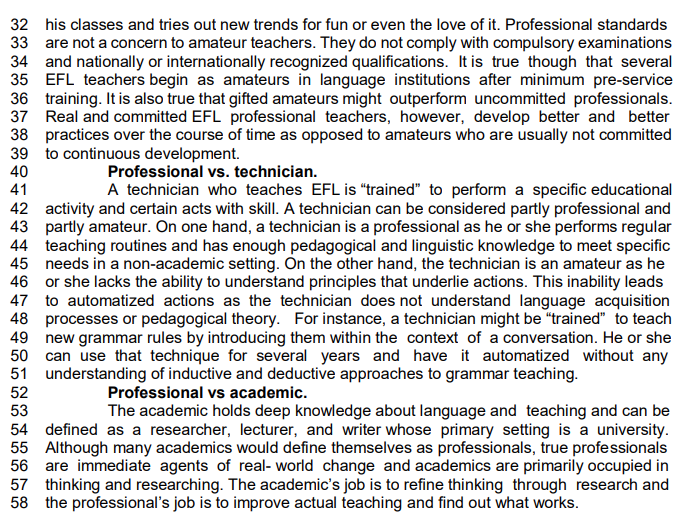
I. The article is about different ways to perform as a professional EFL teacher.
II. The word “whose” in line 10 refers to “worker” in the same sentence.
III. The words “requirements” (line 12) and “standards” (line 13) are synonyms.
IV. The article is predominantly denotative.
The following statement(s) is/are true

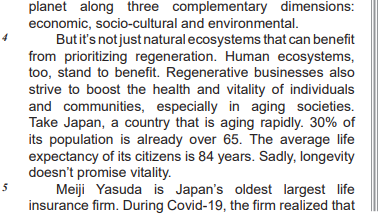

Available at: https://www.weforum.org/agenda/2024/06/businesses
-are-moving-beyond-sustainability-welcome-to-the-age-ofregeneration/. Retrieved on: Jun 14, 2024. Adapted.
Read the text III to answer the question.
TEXT III
A new report into world education shows Finland has the best system. The global study is called "The Learning Curve" and is from the British magazine "The Economist". It aims to help governments provide a better education to students. The 52-page report looked at the education system in 50 countries. Researchers analysed millions of statistics on exam grades, literacy rates, attendance, and university graduation rates. Asia did well in the report, with South Korea, Hong Kong, Japan and Singapore finishing second, third, fourth and fifth. The United States came 17th in the study, while Mexico, Brazil and Indonesia filled the bottom three positions in the top 50.
The Learning Curve reported on five things that education leaders should remember. The first is that spending lots of money on schools and teachers does not always mean students will learn. Second is that "good teachers are essential to high-quality education". The report said teachers should be "treated as the valuable professionals they are, not as technicians in a huge, educational machine". Numbers three and four are that a country's culture must have a strong focus on the importance of education, and parents have a key part to play. Finally, countries need to "educate for the future, not just the present." The report said: "Many of today's job titles…simply did not exist 20 years ago."
Sources:
http://www.timeshighereducation.co.uk/story.asp?sectioncode=26&storycode=421944&c=1
http://thelearningcurve.pearson.com/content/download/bankname/components/filename/FINAL%20LearningCurve_Final.pdf
3

 Conheça nossos planos