Questões de Concurso
Comentadas sobre pronome subjetivo | subjective pronoun em inglês
Foram encontradas 67 questões


In the first line of the text, the verb “to look” is conjugated in the 3rd person singular to agree with the subject “Agronomy”, which could be correctly replaced by the pronoun he.
Julgue o item subsequente.
Pronouns, including personal pronouns like “he” and “she,”
replace nouns to avoid repetition. Understanding the
nuances of different pronoun types—personal,
demonstrative, relative—is essential for constructing clear
and concise sentences, contributing to effective
communication in English.
The pronoun “they” (last sentence of the last paragraph) refers to the word “assumptions”.
The Amazon Forest
The Amazon is often called the lungs of the earth and produces 20% of the world’s oxygen. For this reason, many people are trying to stop deforestation in the rainforest. Brazil, for example, is working hard to help the rainforest survive.
A few years ago, the Brazilian government put forward a plan called ARPA (Amazon Region Protected Areas). It had the support of many international agencies, including the World Bank, and the German Development Bank, KfW. The main aim was to build new areas of protected rainforest, maintain areas of the rainforest that hadn’t yet been destroyed, and stop deforestation. Deforestation contributes greatly to global warming because carbon dioxide is released into the atmosphere when trees get cut down and burned.
One of the first areas to be recognized as part of ARPA was the Tumucumaque Mountains National Park. It is 38,800 km2 and is the same size as Switzerland, a small country in Central Europe. It’s the world’s largest protected tropical national park, and the second largest national park. It is home to certain species of jaguar, eagle, and lizard, which can only survive in the rainforest. Many of these species are under threat from climate change and deforestation.
In order to work in the park, conservationists need
a reliable map. However, no map existed, and they
didn’t have enough knowledge to make one on their
own. They came up with the idea of involving local
tribes to help them, combining modern and ancient
methods to produce a map. The tribes learned to use
global positioning system handsets (GPS), in conjunction with their local knowledge of the area, which
included fishing and hunting grounds, and places of
historical or mythical importance. Aerial photos were
a 20useful aid in the process as well. This method of
map-making is now the key to the future of rainforests,
in Brazil and the rest of the world too.
Text for the item.

According to the text, judge the item.
The term “their” (line 18) is an example of subject pronoun.
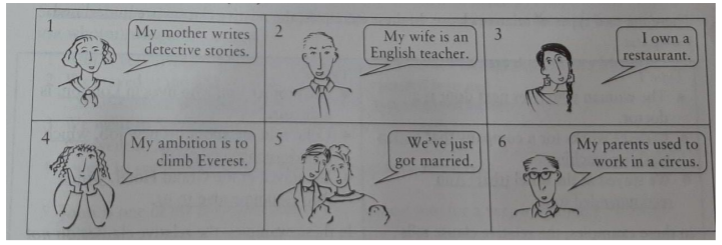 Fonte: Murphy Raymond: English Grammar in Use (1997).
 Later you tell a friend about the people you met. Complete the sentences using WHO or WHOSE. 1 - I met somebody... 2 - I met Jacob... 3 - I met Mary... 4 - I met Carol... 5 - I met Jhon and Ann.. 6 - I met Enzo...

Gombrich, E. H. The Story of Art. Phaidon, 16th.
Ed. 1995. pp.65-6, with adaptations.
The two instances of “whom” in “whom he worshipped and whom he had represented” (lines 31 and 32) can, in an informal context, be replaced with who, but “whom” and “who” play very distinct grammar roles in a sentence.
“Do ____ know Andy?”
Sure, he is in my class, I study with ____. Why?”
“Oh, nothing. I want ____ to help me, that's all.”
“I have ____ 'phone number. Call him!”
“Ok, thanks!"
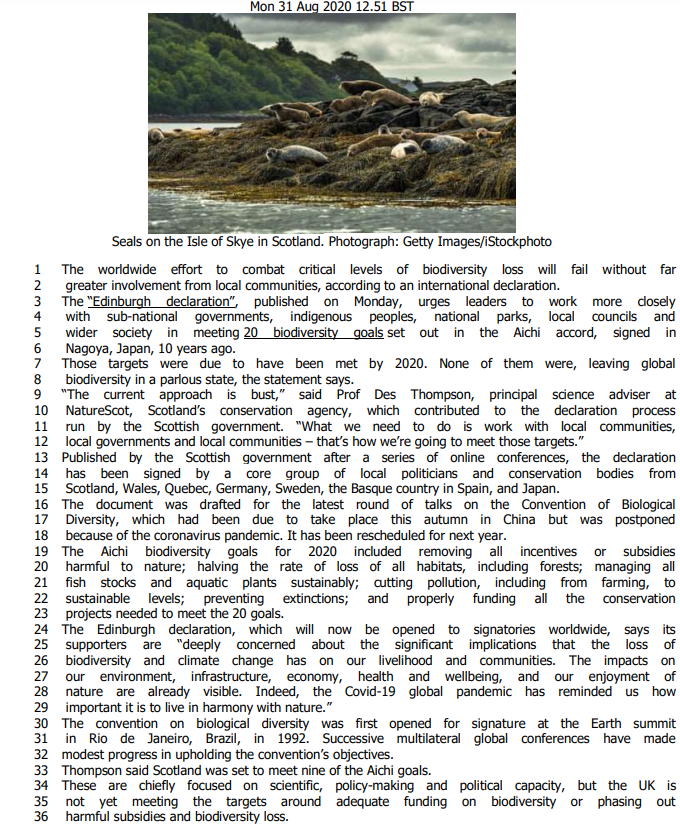
Available at:<https://www.theguardian.com/environment/2020/aug/31/involve-local-groups-in-protecting-biodiversityconservationists-urge> . Access on: 31st, Aug. 2020.
Analyze the sentences extracted from the article, then choose the alternative that best explains the underlined elements, respectively.
i. […] that’s how we’re going to meet those targets. (line 12) ii. These are chiefly focused on scientific, policymaking and political capacity […] (line 35)
CORONAVIRUS
Coronavirus is a newly discovered virus. It causes a disease called Covid-19. In some parts of the world, it has made lots ............ people sick. Corona is a Latin for crown, because ............. the microscope, these viruses look like a crown .............. spikes ending ............... little blobs.
A lot of symptoms are similar to the flu. You may have dry and itchy cough, fever, lots of sneezing and even hard to breathe. Most of people who has gotten sick with this coronavirus have had a mild case. It means you will not feel the disease. But, for people who are much older or who already have health problems are more likely to get sicker with coronavirus.
If anyone gets sick and feels like they may have coronavirus, they can immediately call their doctors and get help. If there is something we are not sure about the information, confused or worried about, don’t be afraid to ask someone we trust.
Here are some things you can do to protect yourself, family and friends from getting sick: 1) wash your hands often using soap and water. 2) Sneeze into your elbows. It is believed that coronavirus spread through little liquid from our lungs. If you sneeze into your elbows, you can prevent germs for going far into the air. 3) Avoid touching your face. Don’t pick your nose. Don’t touch your mouth. Don’t rub your eyes. They are the places where the virus enter our bodies.
Remember that this kind of virus can affect anybody. It
doesn’t matter where you come from or what country
you are from. Don’t forget, there are a lot of helpers
out there who are working to protect us from the virus.
We can take a part by keeping our health and stay at
home to stop the virus spread to others.
The difficult journey to Olympic success
For Jessica Morgan, a young athlete New Zealand, a typical day starts early. Most mornings, she gets up 4:30 a.m., while her family is still bed, and trains before school. As an elite rower, she is one the best in her country, and she aims to compete in the next Olympic Games.
Jessica’s weekly schedule is grueling. She trains twice
a day, six days a week, and competes in rowing events
on the weekends. However, she’s also a normal
schoolgirl, and like every other sixteen-year-old at
high school, she regularly does her homework, too.
Jessica’s motivation is impressive. She never hangs
out with friends or takes a vacation. She isn’t only an
amazing athlete – she usually gets good grades in
school, too. Of course, it isn’t easy to become successful. Being the best at your sport requires hard work,
determination, and the help of family and coaches.
Young athletes’ relationships with their family and
coaches can influence their success in the future. Jessica’s parents usually spend hours every week taking
her to training and competitions, and they help her
to eat a healthy diet. Her coach plans her training
and enters her for competitions. But both parents
and coach must offer emotional support, too – for
example, when Jessica loses a competition or she gets
an injury. Luckily for Jessica, she has a good relationship with both her coach and family. But in other cases,
these relationships can place too much pressure on
young athletes. For this reason, some of them lose
their motivation to do well.
For Jessica, the most important factor in her future
success is her own desire to win. “I know talented
young athletes who give up because they feel lonely
without their friends,” she says. “But I prefer not to
think negatively.” Jessica believes she is responsible
for securing her future success. “It’s my decision to
train every morning and go back to it again every
afternoon. It’s my decision not to have a social life, and
never to take a vacation.” Not everyone can cope with
this kind of lifestyle. But each day Jessica moves one
step closer to achieving her Olympic dream.
1. The negative form of the following sentence: “ Luckily for Jessica, she has a good relationship with both her coach and family” is “Luckily for Jessica, she hasn’t a good relationship with both her coach and family.” 2. The words ‘however, but, for these reason’, in bold in the text are adverbs. 3. In the following sentence: “For Jessica, the most important factor in her future success is her own desire to win.” The underlined words are in the superlative form. 4. The underlined words in the text: “it, they, her, them” are personal pronouns.
Choose the alternative with all the correct sentences
Read the text and mark the CORRECT alternative form question:
Windsurfing around Britain
Kevin Cookston, a 23-year-old engineering student, has been keen on windsurfing for many years. Recently, he set a new record for travelling all the way round the coast of Great Britain on a windsurf board.
'I don‟t really know why I did it,‟ says Kevin, ‟just for the fun of it, I suppose. It was there to be done, that was all.‟ Despite lacking both the obsessive ambition and the funds that normally go with attempts to break records, Kevin made the journey in eight weeks and six days, knocking one week off the previous record set in 1984.
Leaving from Exmouth in the south-west of England, Kevin travelled up the west coast of England and Wales, before going round the top of Scotland and then coming back down the other side. The journey officially covered 2.896 kilometres, although given the changes of direction to find the right wind paths, the actual distance Kevin travelled is probably closer to 4.000 km.
Kevin fitted his fitness training in around his final year university examinations. ‟I didn‟t have that much time to prepare,‟ he explains. ‟But I went running often and supplemented that with trips to the gym to do weight training. I found I got a lot better during the trip itself actually. At the start, I was tired and needed a rest after four hours, but by the end I found I could do ten hours in a row no trouble.‟
Kevin had a budget of £7.000 to cover the whole expedition. The previous record had been set with a budget twice that size, while a recent unsuccessful attempt had cost £40.000. Budgets have to meet the cost of fuel, food and accommodation for the support team, as well as the windsurfer's own equipment and expenses.
Previous contenders had been accompanied by a boat on which they slept at night, as well as a fleet of vehicles on land to carry their supplies. Kevin made do with an inflatable rubber boat and an old van manned by four friends who followed his progress. Overnight arrangements had to be found along the way. Apart from the odd occasion when they enjoyed the hospitality of friends, the team made use of the camping equipment carried in the van, and slept on the beach.
When asked if his athlete‟s diet was a closely kept secret, Kevin replied that he ate a lot of pasta and added the odd tin of tuna to keep up his energy. ‟Basically, we had anything that was on special offer in the nearest supermarket, he confided.
Such a prolongued period of gruelling windsurfing made relaxation important however, and for this, Kevin favoured the pub method. This also provided social opportunities.“The people we met were really encouraging he recalls“. 'They thought what we were doing was really great. It was hard work, but we had a lot of fun along the way“.
Kevin has been windsurfing since he was thirteen years old and he is also a highly-ranked competitor at national level. ‟I don‟t know where I‟m ranked now,‟ he says, `because I‟ve missed a lot of important competitions this year. But what I did has more than made up for that and I‟ll be doing my best to be up there amongst the winners once I get back into the competitive sport next season‟. Given his unique achievement this year, Kevin seems well-placed to take on the world‟s top windsurfers.
Fonte: First Certificate Practice Tests Plus 1, pg 116 Kenny/ Luque-Mortimer, Ed. Longman
Texto 01
Going Mobile, Going Further!
By Anderson Francisco Guimarães Maia – October 28, 2016
So what happens to “learning” if we add the word “mobile” to it? The increasing and rapidly developing use of mobile technology by English language learners is an unquestionable aspect of today’s classroom. However, the attitude EFL teachers develop towards the use of mobile devices as an aid for language teaching varies greatly.
The unique benefits of mobile learning for EFL teachers include the ability to bridge formal and informal learning, which for language learners may be realized through supplementary out-of-classroom practice, translation support when communicating with target language speakers and the capture of difficulties and discoveries which can be instantly shared as well as being brought back into the classroom. Mobile learning can deliver, supplement and extend formal language learning; or it can be the primary way for learners to explore a target language informally and direct their own development through immediacy of encounter and challenge within a social setting. We still miss sufficient explicit connection between these two modes of learning, one of which is mainly formal and the other informal. Consequently, there are missed opportunities in terms of mutual benefit: formal education remains somewhat detached from rapid socio-technological change, and informal learning is frequently sidelined or ignored when it could be used as a resource and a way to discover more about evolving personal and social motivations for learning.
One example of how mobile devices can bridge formal and informal learning is through instantmessaging applications. Both synchronous and asynchronous activities can be developed for language practice outside the classroom. For example, in a discussion group on Whatsapp, students can discuss short videos, practice vocabulary with picture collages, share recent news, create captions and punch lines for memes, and take turns to create a multimodal story. Teachers can also create applications specifically to practice new vocabulary and grammar to support classroom learning.
Digital and mobile media are changing and extending language use to new environments as well as creating opportunities to learn in different ways. Mobile technology enables us to get physically closer to social contexts of language use which will ultimately influence the ways that language is used and learned. Therefore, let us incorporate mobile learning into our EFL lessons and literally “have the world in our hands”.
(Disponível em http://www.richmondshare.com.br/going-mobile-going-further/)

Based on the text, judge the following item.
“They” in “They’re all” (line 4) refers to “two
superheroes” (line 1).
Read TEXT 3 and answer question.
TEXT 3
THE PAPERLESS CLASSROOM IS COMING
Michael Scherer
Back-to-school night this year in Mr. G’s sixth-grade classroom felt a bit like an inquisition.
Teacher Matthew Gudenius, a boyish, 36-year-old computer whiz who runs his class like a preteen tech startup, had prepared 26 PowerPoint slides filled with facts and footnotes to deflect the concerns of parents. But time was short, the worries were many, and it didn’t take long for the venting to begin.
“I like a paper book. I don’t like an e-book,” one father told him, as about 30 adults squeezed into a room for 22 students. Another dad said he could no longer help his son with homework because all the assignments were online. “I’m now kind of taking out of the routine.”, he complained. Rushing to finish, Gudenius passed a slide about the debate over teaching cursive, mumbling, “We don’t care about handwriting.” In a flash a mother objected: “Yeah, we do.”
At issue was far more than penmanship. The future of K-12 education is arriving fast, and it looks a lot like Mr. G’s classroom in the northern foothills of California’s wine country. Last year, President Obama announced a federal effort to get a laptop, tablet or smartphone into the hands of every student in every school in the U.S. and to pipe in enough bandwidth to get all 49.8 million American kids online simultaneously by 2017. Bulky textbooks will be replaced by flat screens. Worksheets will be stored in the cloud, not clunky Trapper Keepers. The Dewey decimal system will give way to Google. “This one is a big, big deal,” says Secretary of Education Arne Duncan.
It’s a deal Gudenius has been working to realize for years. He doesn’t just teach a computer on every student’s desk; he also tries to do it without any paper at all, saving, by his own estimate, 46,800 sheets a year, or about four trees. The paperless learning environment, while not the goals of most fledgling programs, represents the ultimate result of technology transforming classroom.
Gudenius started teaching as a computer-lab instructor, seeing students for just a few hours each month. That much time is still the norm for most kids. American schools have about 3.6 students for every classroom computing device, according to Education Market Research, and only 1 in 5 school buildings has the wiring to get all students online at once. But Gudenius always saw computers as a tool, not a subject. “We don’t have a paper-and-pencil lab, he says. When you are learning to be a mechanic, you don’t go to a wrench lab.”
Ask his students if they prefer the digital to the tree-based technology and everyone will say yes. It is not unusual for kids to groan when the bell rings because they don’t want to leave their work, which is often done in ways that were impossible just a few years ago. Instead of telling his students to show their work when they do an algebra equation, Gudenius asks them to create and narrate a video about the process, which can then be shown in class. History lessons are enlivened by brief videos that run on individual tablets. And spelling, grammar and vocabulary exercises have the feel of a game, with each student working at his own speed, until Gudenius – who tracks the kids’ progress on a smartphone – gives commands like “Spin it” to let the kids know to flip the screens of their devices around so that he can see their work and begin the next lesson.
Source: TIME- How to Eat Now. Education: The Paperless Classroom is Coming, p. 36-37; October 20, 2014

 Conheça nossos planos