Questões de Concurso Comentadas sobre presente perfeito | present perfect em inglês

Foram encontradas 150 questões

Q2541659 Inglês
Susan is talking to her colleague about her recent achievements. Fill in the blanks with the correct present perfect form.

"I ___ (implement) a new teaching strategy, and I ___ (notice) significant improvements in student engagement." 
Alternativas
Q2540484 Inglês
Considering the sentence: “I'm not sure where Amanda is. She _______________ home, I suppose.” which one of the following is the correct verb form?
Alternativas
Q2527205 Inglês
The Problems with the Classroom Environment

By Emma Foley


1.    My suggestions for changing the school environment are as follows: educate Teachers on Neurodevelopmental Disabilities: In my educational career, the majority of the ableism I experienced didn’t come from other students, but teachers and other school authorities I believed were supposed to help me. I remember in my Sophomore year of high school, I emailed my English teacher to let her know I had ADHD. Her only reply was to drop the class; it was too hard for someone like me. Mind you, the school year hadn’t even started. I still took the class, and received quite high marks, but she would belittle my efforts consistently, chastising me from everything to my discussion points being “wrong” to my handwriting. Thank God for my high school’s strictness about fair grading. Secondly, educating teachers about neurodivergencies would help them with classroom and coursework planning, as well as help them to better understand disabled students.

2.     Make Classrooms More Comfortable: Cramped, uncomfortable classrooms are no good for all students, thus we need to get rid of the desk-chair model, and provide students with larger desks that have unconnected chairs, as well as space out desks. Though this is a reach, lecture halls needs to be completely redesigned to space students out (which is also helpful to prevent the spread of COVID!) and allow them greater desk space, as well as leg space! Another issue is lighting, with many classrooms lit by bright, irritating industrial lights. All classrooms should have windows, or at least less abrasive lighting, in order to combat seasonal mental illnesses, and make the classroom appear more “open” than cramped. The spaces between desks should also be accessible, to prevent others from tripping, and for students with mobility issues to access the entire classroom.

3.     Classroom Rules: It was always embarrassing for me when I had to ask for the bathroom, especially when a teacher denied my request. These rules are generally ridiculous, especially for younger children, who often are barely potty-trained. Neurodivergent children, especially those with autism, often have gastrointestinal disorders as a result of their disabilities. Some neurodivergent children simply can’t hold it either, as often times our basic needs are only sensed by us when they’re demandingly present. Asking to go to the bathroom is frankly antiquated and only hurts the student, a child shouldn’t need permission to complete such a necessary task. Another issue is that neurodivergent students are often prohibited from engaging in focus-strategies, such as doodling or using fidget toys. Both of these are proven to help maintain a neurodivergent person’s focus and help them relax. Making sweeping generalization about if the student is listening or not is simply unfair to the student, as this doubts their ability.

4.    Class Structure: Many classes are just based upon listening to the teacher/professor, with little stress placed on applying the learned material within the classroom. Therefore, lessons should be much more dynamic, whether that be through inclusive, smaller-group discussions, or via hands-on activities. Just reading notes off of slides doesn’t cut it for most students anyways, so a more dynamic model of teaching is absolutely necessary! Teachers should also assign course-long classroom groups in larger classroom environments, which helps neurodivergent students initiate connects with their peers, and be able to seek help out easier, especially if these groups have TA leaders, which help coordinate the groups. 

5. Overall, the standardized learning environment that’s currently in place in most schools and universities totally excludes the needs of neurodivergent learners, and the need to be changed in order to benefit both disabled students and the student body as a whole.

Spring, E. (2022, March 17). The problems with the classroom environment.
Retrieved from
https://sites.psu.edu/emmaspring/2022/03/17/the-problems-with-the-classroom environment/.
Choose the sentence from the text 2 demonstrates the use of the present perfect tense?
Alternativas
Q2502385 Inglês
We use the present perfect in English to talk about:
Alternativas
Q2482284 Inglês

Julgue o item subsequente.


The sentence: "We have been to the beach last summer" the sentence as a whole is in the present perfect tense.

Alternativas
Q2423366 Inglês

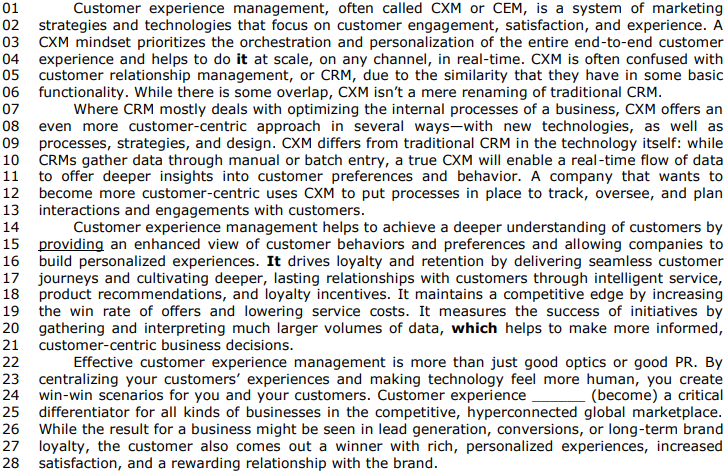
What is customer experience management?


(Available at: www.dynamics.microsoft.com/en-us/marketing/what-is-customer-experience-management-cxm/ – text specially adapted for this test).

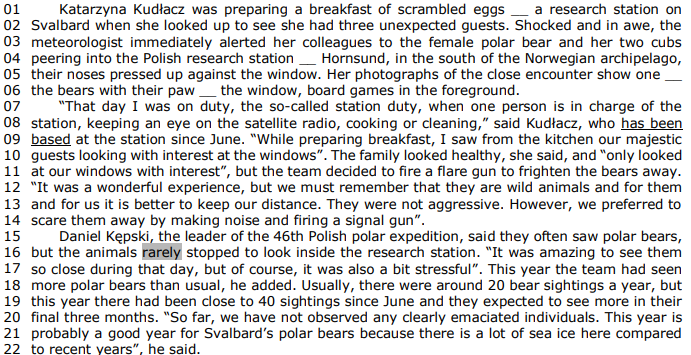
Mark the alternative that fills in correctly the gap in line 24 in the present perfect verb tense.
Alternativas
Q2387711 Inglês
Audit data analytics, machine learning, and full population testing


Technologies are evolving at an unprecedented pace and pose significant challenges and opportunities to companies and related parties, including the accounting profession. In today’s business environment, it is inevitable for companies to react quickly to changing conditions and markets. Many companies are seeking better ways to utilize emerging technologies to transform how they conduct business. We live in an age of information explosion, with technologies capable of making revolutionary changes in various industries and reshaping business models. At present, many companies view data as one of their most valuable assets. They amass an unprecedented amount of data from their daily business operation and strive to harness the power of data through analytics. Emerging technologies like robotic process automation, machine learning, and data analytics also impact the accounting profession. It is important for the profession to understand the impacts, opportunities, and challenges of these technologies.


Specifically, in audit and assurance areas, data analytics and machine learning will lead to many changes in the foreseeable future. Audit sampling is one such potential change. The use of sampling in audits has been criticized since it only provides a small snapshot of the entire population. To address this major issue, this study introduces the idea of applying audit data analytics and machine learning for full population testing through the concept of “audit-by-exception” and “exceptional exceptions.” In this way, the emphasis of audit work shifts from “transaction examination” to “exception examination” and prioritizes the exceptions based on different criteria. Consequently, auditors can assess the associated risk based on the entire population of the transactions and thus enhance the effectiveness and efficiency of the audit process.


Adapted from the introduction to a study published in: https://www.sciencedirect.com/science/article/pii/S240591882200006X
The verb form in “has been criticized” (2nd paragraph) is in the:
Alternativas
Q2350985 Inglês
“I have to work with computers and phones all the time in my work, either sitting in front of a screen or living by the apps on my mobile. I think the number of voice-to-voice phone calls has gone down a lot in the last few years, but with Facebook, Instagram, Twitter, and so on, I feel sort of chained to technology the entire length of the working week. So when the weekend comes, there’s nothing I like better than switching off the computer, the mobile and the landline and enjoying real peace and quiet. We live near to some fields and open country, and I can listen to the birds sing, go for long walks, maybe drop in at our local pub and have a drink with some of the locals. It’s not exciting, I grant you, but it’s very relaxing and helps me remember I’m a human being, not a part of some computerised machine. Of course, by Sunday night I’m already thinking about the working week ahead, but never mind. I’ve had those two days to recharge my batteries, as they say.”


Teaching English. The British Council, 2016. Adapted.
Which option correctly identifies the verb tense used in the following sentence from the extract?
"I’ve had those two days to recharge my batteries".
Alternativas
Q3560246 Inglês

Text 1


Green shoppers around the world


If you want to be a responsible consumer, think about not just how much you buy, but also about what’s good for the planet. Green Shoppers United is an international non-profit organization for the promotion of responsible consumerism.


Labels


Read the labels. Some...................the ingredients that manufacturers use in products, such as cosmetics or toiletries, can damage the environment. Some ingredients are only used...................make things prettier, or more colorful, but they might also be harmful. Don’t buy things that contain substances that harm you or the world you live................... For example, research shows a potential link...................the preservatives called parabens, often found in beauty products, and some types of cancer. 


Transport


In today’s global economy, it is easier for companies to buy products and materials where they’re cheap, and transport them over enormous distances to get them to customers. If you can, buy things locally. The local food movement has grown steadily in recent years, and it’s often possible to track down locally grown, or produced, products, rather than those that have been transported long distances. If we stop buying goods that have had to fly over continents to get to us, companies may stop transporting them around unnecessarily. A bargain may cost you less personally, but the real price we pay for it in the long run may turn out to be too high, as jet fuel continues to pollute our environment. 


Environment 


Responsible consumers recycle to reduce waste, and its negative impact on our environment. A lot of the plastic packaging we use for food and drink is recyclable, but not all of it. The most common packaging materials are still non-recyclable polyethylene and PVC. Seventy million tons are used every year. Look at the recycling labels carefully. Manufacturers should use recyclable plastics, like PET, wherever possible. Some have also begun using lighter materials, for example, 30% lighter PET plastic for drinks bottles, to reduce the amount of plastic waste. Transporting lighter materials is cheaper, and uses less fuel, too – so the solution may actually benefit everyone. 


Packaging


We’ve all purchased products wrapped in foil, then sealed in a bag, and then put in a box. Why? Write to companies that you think produce wasteful packaging. Ask them to think about what’s really necessary. Make them realize they can save money by using less packaging and, at the same time, help save our planet.


Consumers


A lot of us expect products these days to be more environmentally friendly. However, research has shown that we don’t want to pay more, and we don’t want to compromise on the quality of products, either. For example, one manufacturer recently had to switch back to less environmental packaging of potato chips, just because customers didn’t like the noise their “green” bags made when they were opened! Think about the effects of your shopping choices. Buy less to save the world, and join our effort to make shopping greener!


Study the underlined words in the following sentence.

“The local food movement has grown steadily in recent years, and it’s often possible to track down locally grown, or produced, products, rather than those that have been transported long distances.”

We can infer that the underlined words are being used in which verb tenses?
Alternativas
Q2430466 Inglês

Read the Text I and answer the five questions that follow it.


Text I


Correspondence


Human genome editing: potential seeds of conflict


Recently, The Lancet published an important declaration regarding the necessity of regulating and legislating for human genome editing. We agree with their opinions that the human genome editing technology and resulting research can have both positive and negative effects on human society. The use of genome editing for research and commercial purposes has sparked debates in both biological and political realms. However, most of them have mainly focused on the effects of human genome editing on the patients themselves, and little attention has been paid to their offspring.

Several films, such as Gattaca and Gundam SEED, have addressed the conflicts that arise from human genome editing. Such conflicts not only exist within the generation who have experienced editing but are also transmitted to their offspring. For example, in these films, the offspring of people without genome editing felt a sense of unfairness regarding the inferiority of their physical (or other non-edited domains) status, whereas the offspring of people with genome editing grew up in a biased, discriminated against, and ostracized environment. They could have lived in peace with a strong and well regulated government; however, when the tenuous grip of government weakens, jealousy and resentment can lead to ruins. Although these scenes still exist in films, they might become increasingly plausible in decades to come. Using the concept of preparedness, access, countermeasures, tools, and trust, we should prepare legitimate human genome editing, establish access to deal with imminent or potential discrimination, develop countermeasures and tools for prevention and resolution of conflict, and entrust future generations with the responsibility to use them wisely.

Bing-Yan Zeng, Ping-Tao Tseng, *Chih-Sung Liang


Adapted from: www.thelancet.com, vol. 401, June 24, 2023 athttps://www.thelancet.com/action/showPdf?pii=S0140-6736%2823%2901084-X

The main verb in “has sparked debates” is similar in meaning to

Alternativas
Q2348166 Inglês
     What is agronomy? An agronomist, or crop scientist, studies plants and how they can be grown, modified, and used to benefit society. They use science to carry out experiments that create new techniques for agriculture production. Agronomy has existed and been important for humans since the invention of farming.

Internet: <unity.edu> (with adaptations).


According to the text, judge the item from.

The last period of the text is in the present perfect tense in which “been” is the past participle of the verb to be.
Alternativas
Q2342556 Inglês
The sentence “Have you ever visited Paris?” employs the Present Perfect tense to discuss 
Alternativas
Q2335665 Inglês
TEXT:


How do people overcome fossilization and achieve nativelike fluency in second language acquisition?

There are a lot of common misconceptions about fossilization and language development. It's impossible to correct all of them in a post here, but I'll address a few that have been mentioned below.

Fossilization is a stage at which a second language speaker seems to cease making progress toward becoming more targetlike in his or her use of the language, so a "learning plateau" is a reasonable analogy. The comparison wherein "the L2 learner has his own linguistic system" that's still influenced by L1 and other things is known as the "interlanguage." The question researchers cannot conclusively answer is whether or not that "plateau" is reversible after a certain point, be it age, fluency level, etc., in order to start making progress again.

Different people are motivated by different things, which range from need (to pass a test, to get a job, to watch movies without subtitles, to make friends, etc.) to learning style (preferring to study from texts, liking/disliking impromptu, small-talk with people just to practice, preference for/against learning formal rules, and aptitude). It is easy to remember verb conjugations. There is no single formula.

Finding someone who can correct your errors tactfully and effectively most certainly does not need to be demotivating, depressing or draining whatsoever. I'm a very fluent non-native speaker of Spanish, and I actively request that my native speaker (NS) friends correct me when I make a mistake, or use a phrase that sounds funny in their dialect, etc. How else will I learn? It's fascinating to learn little details like that now after so many years. As long as they don't do it in a mocking or condescending way, or at a socially inappropriate time, why wouldn't I want their help? Of course, if you correct a beginner every time they try to utter a sentence, it could be discouraging - and obnoxious - but everything in moderation.

One of the biggest cognitive challenges is whether or not L2 speakers can learn to consciously notice differences between their L2 efforts and the way a NS talks. There are decades of research on this (my own included) and I'll gladly give references if anyone actually cares. Noticing falls into two broad categories. First, the ability to "notice the gap," i.e. hear a NS say a sentence and think, "Hmm, I understand what he meant but I've never heard that word before; it must mean ___" or "I know what he meant but it would not have occurred to me to say it that way; I'll try to remember that for later." The second is the ability to "notice the hole," i.e. when the L2 learner is trying to speak/ write and realizes that his "interlanguage" lacks a word, sound or structure needed to accurately convey his own thought. If he can seek the input necessary to fill the hole, he has a much stronger chance of acquiring it. The thought processes involved during that moment are holding the forms (or lack thereof) in working memory, and the longer it stays there for further processing, the greater the possibility that it is retained in long-term memory for later use. The NS interlocutor can help promote noticing through corrective feedback (also a subject of decades of research, for which I'm also happy to provide resources if anyone is genuinely interested.)

I have been using a variety of strategies for years as a language coach when working with my clients, whether helping IT executives from India and Egypt learn to write more grammatically accurate e-mail or helping priests from Nigeria improve prosodic aspects of their pronunciation (i.e. stress and intonation patterns.) Each person is different. I have found no evidence to support the argument that a person who has fossilized cannot begin to make progress again toward a more target-like L2 use at least in some areas, with the right motivation, input and effort. The question is only about how much progress, in what areas, in how much time, and through what methods.


Adapted form: https://www.quora.com/How-do-people-overcome-fossilization-andachieve-native-like-fluency-in-second-language-acquisition Acesso em 22/09/2023
Dentre as frases abaixo, todas retiradas do texto, aquela que pode ser reescrita no presente perfeito, sem que haja alteração no significado, é:
Alternativas
Q2330024 Inglês

Concerning the Present Perfect, analyze the following items.


I. We use the present perfect to talk about situations continuing up to now.


II. We often use the present perfect for actions repeated up to now.


III. We do not use the present perfect when we say how long they have lasted.


The CORRECT item(s) is(are):

Alternativas
Q2215006 Inglês
          As new technologies take on increasingly humanlike qualities, there’s been a push to make them genderless. Apple’s Siri digital assistant unveiled a gender-neutral option last year, and when asked about their gender identities, the AI chatbots ChatGPT and Google Bard each reply, “I do not have a gender.”
     There have been concerns over gendering technology, since doing so reinforces societal stereotypes. That happens because the stereotypes commonly associated with men, such as competitiveness and dominance, are more valued than those associated with women. That is likely true, says Ashley Martin, a professor at Stanford University. “People are stereotyping their gendered objects in very traditional ways,” she says.
          Removing gender from the picture altogether seems like a simple way to fix this. Yet, as Martin has found in her latest research, conducted with Malia Mason, of Columbia Universty, gender is one of the fundamental ways people form connections with objects, particularly those designed to evoke human characteristics.
          Throughout the experiments, Martin and Mason found that gender increased users’ feelings of attachment to devices such as digital voice assistants –– and their interest in purchasing them. For example, participants said they would be less likely to buy a genderless voice assistant than versions with male or female voices.

Hope Reese. Is That Self-Driving Car a Boy or a Girl? In: Insights by Stanford Business. Internet:<http://www.gsb.stanford.edu/>  (adapted)

Judge the following item, related to the vocabulary and to the grammar in the precedent text.


In the second paragraph, the word “since” determines the use of the present perfect continuous in “There have been concerns”.


Alternativas
Q2208082 Inglês
Complete the sentence below with the correct verb. Choose the CORRECT answer.
Me: I need to tell you something! Italy is my next holiday destination!
My best friend: Really! I'm so excited for you. I _________ to Italy. Can I come with you? Me: Absolutely!” 
Alternativas
Q2184920 Inglês
A questão foi desenvolvida em língua inglesa e/ou língua portuguesa oficial do Brasil. 
Use the simple past tense, the present perfect tense or the past perfect tense to complete the sentences.
I. The educators ______ (to teach) through the Paulo Freire Method.
II. Previously the students ______ (to learn) through an old and non-dynamic method, then the educators searched and found Freire’s method.
III. Firstly they had had long hours of boring studies when a group of educators ______ (to get) in touch with The Method Paulo Freire, everything changed. 
Alternativas
Q2180612 Inglês

Check the alternative that presents the tense of the sentence below:

“Pamela went to Paris last year.”

Alternativas
Q2178062 Inglês
Considering the differing between the perfect tenses, number the 2nd column according to the 1rst and, after that, check the alternative that presents the CORRECT sequence:
(1) Present perfect. (2) Past perfect.
(_) Dan hasn’t been sick this year. (_) I’d just have lunch. (_) We hadn’t cleaned it for weeks.
Alternativas
Respostas
21: A
22: E
23: C
24: B
25: E
26: E
27: D
28: C
29: B
30: D
31: C
32: D
33: A
34: C
35: E
36: B
37: A
38: D
39: B
40: A