Questões de Concurso
Comentadas sobre passado perfeito | past perfect em inglês
Foram encontradas 100 questões


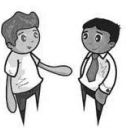
Bill: Why aren’t you coming out tonight? Zachary: Because I don’t have any money. If I ______, I with you Bill: Well, what about the movies tomorrow? Zachary: It depends. If my parents _____ me some money, ______ I . Bill: You always have an excuse! Why didn’t you come to Josh?s party last week? Zachary: I didn’t come because I lost my wallet and all my money. If I _____ my wallet, of course I _____ !
For question, choose the correct answer.
Mary ______ in Liverpool for five years, but now she
________ in Edinburgh since March.
For question, choose the correct answer.
Philip couldn’t remember where he ______ his car.
For question, choose the correct answer.
The Indians _______________ on the continent for about
twenty-five thousand years.
The alternative that contains the correct answer to the sentence above is:
Yesterday Paul and Sophia played tennis. They began at 09:30 and finished at 11 o’clock. So, at 10:30 they ______ tennis.
According to the sentence above is correct in relation to the verbs, EXCEPT:
A Brief and Simplified Description of Papermaking
The paper we use today is created from individual wood fibers that are first suspended in water and then pressed and dried into sheets. The process of converting the wood to a suspension of wood fibers in water is known as pulp making, while the manufacture of the dried and pressed sheets of paper is formally termed papermaking. The process of making paper has undergone a steady evolution, and larger and more sophisticated equipment and better technology continue to improve it.
The Wood yard and Wood rooms
The process at Androscogging began with receiving wood in the form of chips or of logs 4 or 8 feet in length. From 6 AM to 10 PM a steady stream of trucks and railroad cars were weighted and unloaded. About 40 percent were suplied by independents who were paid by weight their logs. The mill also received wood chips from lumber mills in the area. The chips and logs were stored in mammoth piles with separate piles for wood of different species (such as pine, spruce, hemlock).
When needed, logs were floated in flumes......(1).....the wood yard.....(2).....one of the mill’s three wood rooms. There, bark was rubbed......(3)........in long, ribbed debarking drums by tumbling the logs against one another. The logs then fell into a chipper;......(4)......seconds a large log was reduced to a pile of chips approximately 1 inch by 1 inch by 1/4 inch.
The chips were stored in silos. There were separate silos for softwoods (spruce, fir, hemlock, and pine) and hardwoods (maple, oak, beech, and birch). This separate and temporary storage of chips permitted the controlled mixing of chips into the precise recipe for the grade of paper being produced.
The wood chips were then sorted through large, flat vibrating screens. Oversized chips were rechipped, and ones that were too small were collected for burning in the power house. (The mill provided approximately 20 percent of all its own steam and electricity needs from burning waste. An additional 50 percent of total electricity needs was produced by harnessing the river for hydroelectric power.)
Once drawn from the silo into the digesters, there was no stopping the flow of chips into paper.
Pulpmaking
The pulp made at Androscoggin was of two types: Kraft pulp (produced chemically) and ground wood pulp (produced mechanically). Kraft pulp was far more important to the high quality white papers produced at Androscoggin, accounting for 80 percent of all the pulp used. Kraft pulp makes strong paper. (Kraft is German for strength. A German invented the Kraft pulp process in 1884.) A paper’s strength generally comes from the overlap and binding of long fibers of softwood; only chemically was it initially possible to separate long wood fibers for suspension in water. Hardwood fibers are generally smaller and thinner and help smooth the paper and make it less porous.
The ground wood pulping process was simpler and less expensive than the Kraft process. It took high quality spruce and fir logs and pressed them continuously against a revolving stone that broke apart the wood’s fibers. The fibers, however, were smaller than those produced by the Kraft process and, although used to make newsprint, were useful at Androscoggin in providing “fill” for the coated publication gloss papers of machines 2 and 3, as will be described later.
(A)The chemical Kraft process worked by dissolving the lignin that bonds wood fibers together. (B) It did this in a tall pressure cooker, called a digester, by “cooking” the chips in a solution of caustic soda (NaOH) and sodium sulfide (Na2S), which was termed the “white liquor.” (C)The two digesters at Androscoggin were continuous digesters; chips and liquor went into the top, were cooked together as they slowly settled down to the bottom, and were drawn off the bottom after about three hours. (D) By this time, the white liquor had changed chemically to “black liquor’’; the digested chips were then separated from this black liquor. (E)
In what was known as the “cold blow” process, the hot, pressurized chips were gradually cooled and depressurized. A “cold liquor’’ (170°F) was introduced to the bottom of the digester and served both to cool and to transport the digested chips to a diffusion washer that washed and depressurized the chips. Because so much of the lignin bonding the fibers together had been removed, the wood fiber in the chips literally fell apart at this stage.
The black liquor from the digester entered a separate four-step recovery process. Over 95 percent of the black liquor could be reconstituted as white liquor, thereby saving on chemical costs and significantly lowering pollution. The four-step process involved (1) washing the black liquor from the cooked fiber to produce weak black liquor, (2) evaporating the weak black liquor to a thicker consistency, (3) combustion of this heavy black liquor with sodium sulfate (Na2SO4 ), and redissolving the smelt, yielding a “green liquor” (sodium carbonate + sodium sulfide), and (4) adding lime, which reacted with the green liquor to produce white liquor. The last step was known as causticization.
Meanwhile, the wood-fiber pulp was purged of impurities like bark and dirt by mechanical screening and by spinning the mixture in centrifugal cleaners. The pulp was then concentrated by removing water from it so that it could be stored and bleached more economically.
By this time, depending on the type of pulp being made, it had been between 3 1/2 and 5 hours since the chips had entered the pulp mill.
All the Kraft pulp was then bleached. Bleaching took between 5 and 6 hours. It consisted of a three-step process in which (1) a mix of chlorine (Cl2 ) and chlorine dioxide (CIO2 ) was introduced to the pulp and the pulp was washed; (2) a patented mix of sodium hydroxide (NaOH), liquid oxygen, and hydrogen peroxide (H2 O2 ) was then added to the pulp and the pulp was again washed; and (3) chlorine dioxide (ClO2 ) was introduced and the pulp washed a final time. The result was like fluffy cream of wheat. By this time the pulp was nearly ready to be made into paper.
From the bleachery, the stock of pulp was held for a short time in storage (a maximum of 16 hours) and then proceeded through a series of blending operations that permitted a string of additives (for example, filler clay, resins, brighteners, alum, dyes) to be mixed into the pulp according to the recipe for the paper grade being produced. Here, too, “broke” (paper wastes from the mill itself) was recycled into the pulp. The pulp was then once again cleaned and blended into an even consistency before moving to the papermaking machine itself.
It made a difference whether the broke was of coated
or uncoated paper, and whether it was white or colored. White, uncoated paper could be recycled immediately. Colored, uncoated paper had to be rebleached.
Coated papers, because of the clays in them, could not
be reclaimed.
“(...) since he had to fight hard to be ableto study in a regular public school, from the age of seven. The principal argued that the stateinstitution was not supported to receive a student with a disability. His father, Francisco, was the one who had to build a special desk, without State aid, so that Daniel could write with his feet”.
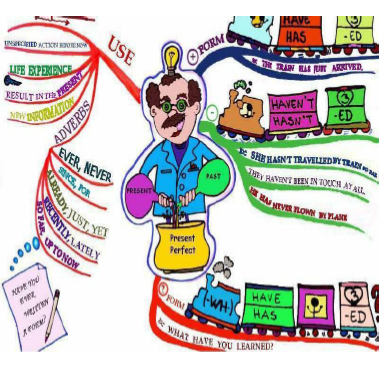
This is a mind map about:
“Katie is in love with Paris. She can get around pretty easily as she _________ French.”
‘‘At the train station - A: What is your train number? B: I ________ for the 8814.’’
‘‘Two years ago, I ________ Physics to my pupils.’’
CORONAVIRUS
Coronavirus is a newly discovered virus. It causes a disease called Covid-19. In some parts of the world, it has made lots ............ people sick. Corona is a Latin for crown, because ............. the microscope, these viruses look like a crown .............. spikes ending ............... little blobs.
A lot of symptoms are similar to the flu. You may have dry and itchy cough, fever, lots of sneezing and even hard to breathe. Most of people who has gotten sick with this coronavirus have had a mild case. It means you will not feel the disease. But, for people who are much older or who already have health problems are more likely to get sicker with coronavirus.
If anyone gets sick and feels like they may have coronavirus, they can immediately call their doctors and get help. If there is something we are not sure about the information, confused or worried about, don’t be afraid to ask someone we trust.
Here are some things you can do to protect yourself, family and friends from getting sick: 1) wash your hands often using soap and water. 2) Sneeze into your elbows. It is believed that coronavirus spread through little liquid from our lungs. If you sneeze into your elbows, you can prevent germs for going far into the air. 3) Avoid touching your face. Don’t pick your nose. Don’t touch your mouth. Don’t rub your eyes. They are the places where the virus enter our bodies.
Remember that this kind of virus can affect anybody. It
doesn’t matter where you come from or what country
you are from. Don’t forget, there are a lot of helpers
out there who are working to protect us from the virus.
We can take a part by keeping our health and stay at
home to stop the virus spread to others.
1. ________ that movie with Brad Pitt?
2. I _________ home when I saw the accident.
3. They were sleeping when I ______.
4. We ______ TV all night long last night.

 Conheça nossos planos