Questões de Concurso
Sobre interpretação de texto | reading comprehension em inglês
Foram encontradas 12.709 questões


Read Text 2 and answer the question.
Text 2
Here are four passages from an article on awareness of English as a lingua franca (ELF):
1) “Few will deny that research in the area of English as a lingua franca (ELF) has significantly contributed to our understanding of many different facets of communication involving non-native speakers of English. Such studies have added valuable insights to the growing research in the domain of critical applied linguistics and critical pedagogy and have prompted many scholars to problematize all aspects of English language teaching, learning, testing, curriculum designing, etc.”
2) “It is important at this stage to distinguish between the critical and the transformative perspective in ESOL teacher education. While they both share the element of reflection, they are different in a crucial way, although the former has often been seen as an umbrella term that subsumes the latter.”
3) “Critical pedagogy is invaluable in our attempt to understand the complex processes of the global spread of English and the intricate ways in which it continues to be localized and relocalized (Pennycook, 2010). It has the tools to help teachers appreciate the complications of context and the various underlying and often hidden discourses, from learner identity construction in the ESOL classroom (Norton and Toohey, 2011) to language testing (Shohamy, 2004) to the politics of pedagogy in the ‘classroom as a microcosm of the larger social and cultural world’” (Pennycook, 2001: 138).
4) “The value of an ELF-aware transformative perspective to ESOL teacher education lies in its power to help teachers define ELF for themselves and for their teaching contexts. In this way, teachers are involved in the co-construction of ELF and, in particular, in the development of one or more pedagogical frameworks for ELF. To achieve this, teachers have to have an informed awareness of the ELF construct, a critical awareness of their own deeper convictions about essential aspects of language, communication, and language teaching/learning, and the capability to bring about sustainable change in their teaching.”
From Sifakis, N. C. (2014). "ELF awareness as an opportunity for change: a
transformative perspective for ESOL teacher education". Journal of English as a
Lingua Franca, 3/2: 317-335
Read Text 2 and answer the question.
Text 2
Here are four passages from an article on awareness of English as a lingua franca (ELF):
1) “Few will deny that research in the area of English as a lingua franca (ELF) has significantly contributed to our understanding of many different facets of communication involving non-native speakers of English. Such studies have added valuable insights to the growing research in the domain of critical applied linguistics and critical pedagogy and have prompted many scholars to problematize all aspects of English language teaching, learning, testing, curriculum designing, etc.”
2) “It is important at this stage to distinguish between the critical and the transformative perspective in ESOL teacher education. While they both share the element of reflection, they are different in a crucial way, although the former has often been seen as an umbrella term that subsumes the latter.”
3) “Critical pedagogy is invaluable in our attempt to understand the complex processes of the global spread of English and the intricate ways in which it continues to be localized and relocalized (Pennycook, 2010). It has the tools to help teachers appreciate the complications of context and the various underlying and often hidden discourses, from learner identity construction in the ESOL classroom (Norton and Toohey, 2011) to language testing (Shohamy, 2004) to the politics of pedagogy in the ‘classroom as a microcosm of the larger social and cultural world’” (Pennycook, 2001: 138).
4) “The value of an ELF-aware transformative perspective to ESOL teacher education lies in its power to help teachers define ELF for themselves and for their teaching contexts. In this way, teachers are involved in the co-construction of ELF and, in particular, in the development of one or more pedagogical frameworks for ELF. To achieve this, teachers have to have an informed awareness of the ELF construct, a critical awareness of their own deeper convictions about essential aspects of language, communication, and language teaching/learning, and the capability to bring about sustainable change in their teaching.”
From Sifakis, N. C. (2014). "ELF awareness as an opportunity for change: a
transformative perspective for ESOL teacher education". Journal of English as a
Lingua Franca, 3/2: 317-335
Read Text 2 and answer the question.
Text 2
Here are four passages from an article on awareness of English as a lingua franca (ELF):
1) “Few will deny that research in the area of English as a lingua franca (ELF) has significantly contributed to our understanding of many different facets of communication involving non-native speakers of English. Such studies have added valuable insights to the growing research in the domain of critical applied linguistics and critical pedagogy and have prompted many scholars to problematize all aspects of English language teaching, learning, testing, curriculum designing, etc.”
2) “It is important at this stage to distinguish between the critical and the transformative perspective in ESOL teacher education. While they both share the element of reflection, they are different in a crucial way, although the former has often been seen as an umbrella term that subsumes the latter.”
3) “Critical pedagogy is invaluable in our attempt to understand the complex processes of the global spread of English and the intricate ways in which it continues to be localized and relocalized (Pennycook, 2010). It has the tools to help teachers appreciate the complications of context and the various underlying and often hidden discourses, from learner identity construction in the ESOL classroom (Norton and Toohey, 2011) to language testing (Shohamy, 2004) to the politics of pedagogy in the ‘classroom as a microcosm of the larger social and cultural world’” (Pennycook, 2001: 138).
4) “The value of an ELF-aware transformative perspective to ESOL teacher education lies in its power to help teachers define ELF for themselves and for their teaching contexts. In this way, teachers are involved in the co-construction of ELF and, in particular, in the development of one or more pedagogical frameworks for ELF. To achieve this, teachers have to have an informed awareness of the ELF construct, a critical awareness of their own deeper convictions about essential aspects of language, communication, and language teaching/learning, and the capability to bring about sustainable change in their teaching.”
From Sifakis, N. C. (2014). "ELF awareness as an opportunity for change: a
transformative perspective for ESOL teacher education". Journal of English as a
Lingua Franca, 3/2: 317-335

This exercise illustrates
Read Text 2 and answer the question.
Text 2
Here are four passages from an article on awareness of English as a lingua franca (ELF):
1) “Few will deny that research in the area of English as a lingua franca (ELF) has significantly contributed to our understanding of many different facets of communication involving non-native speakers of English. Such studies have added valuable insights to the growing research in the domain of critical applied linguistics and critical pedagogy and have prompted many scholars to problematize all aspects of English language teaching, learning, testing, curriculum designing, etc.”
2) “It is important at this stage to distinguish between the critical and the transformative perspective in ESOL teacher education. While they both share the element of reflection, they are different in a crucial way, although the former has often been seen as an umbrella term that subsumes the latter.”
3) “Critical pedagogy is invaluable in our attempt to understand the complex processes of the global spread of English and the intricate ways in which it continues to be localized and relocalized (Pennycook, 2010). It has the tools to help teachers appreciate the complications of context and the various underlying and often hidden discourses, from learner identity construction in the ESOL classroom (Norton and Toohey, 2011) to language testing (Shohamy, 2004) to the politics of pedagogy in the ‘classroom as a microcosm of the larger social and cultural world’” (Pennycook, 2001: 138).
4) “The value of an ELF-aware transformative perspective to ESOL teacher education lies in its power to help teachers define ELF for themselves and for their teaching contexts. In this way, teachers are involved in the co-construction of ELF and, in particular, in the development of one or more pedagogical frameworks for ELF. To achieve this, teachers have to have an informed awareness of the ELF construct, a critical awareness of their own deeper convictions about essential aspects of language, communication, and language teaching/learning, and the capability to bring about sustainable change in their teaching.”
From Sifakis, N. C. (2014). "ELF awareness as an opportunity for change: a
transformative perspective for ESOL teacher education". Journal of English as a
Lingua Franca, 3/2: 317-335
Read Text 2 and answer the question.
Text 2
Here are four passages from an article on awareness of English as a lingua franca (ELF):
1) “Few will deny that research in the area of English as a lingua franca (ELF) has significantly contributed to our understanding of many different facets of communication involving non-native speakers of English. Such studies have added valuable insights to the growing research in the domain of critical applied linguistics and critical pedagogy and have prompted many scholars to problematize all aspects of English language teaching, learning, testing, curriculum designing, etc.”
2) “It is important at this stage to distinguish between the critical and the transformative perspective in ESOL teacher education. While they both share the element of reflection, they are different in a crucial way, although the former has often been seen as an umbrella term that subsumes the latter.”
3) “Critical pedagogy is invaluable in our attempt to understand the complex processes of the global spread of English and the intricate ways in which it continues to be localized and relocalized (Pennycook, 2010). It has the tools to help teachers appreciate the complications of context and the various underlying and often hidden discourses, from learner identity construction in the ESOL classroom (Norton and Toohey, 2011) to language testing (Shohamy, 2004) to the politics of pedagogy in the ‘classroom as a microcosm of the larger social and cultural world’” (Pennycook, 2001: 138).
4) “The value of an ELF-aware transformative perspective to ESOL teacher education lies in its power to help teachers define ELF for themselves and for their teaching contexts. In this way, teachers are involved in the co-construction of ELF and, in particular, in the development of one or more pedagogical frameworks for ELF. To achieve this, teachers have to have an informed awareness of the ELF construct, a critical awareness of their own deeper convictions about essential aspects of language, communication, and language teaching/learning, and the capability to bring about sustainable change in their teaching.”
From Sifakis, N. C. (2014). "ELF awareness as an opportunity for change: a
transformative perspective for ESOL teacher education". Journal of English as a
Lingua Franca, 3/2: 317-335
Read the statements below and mark them as TRUE (T) or FALSE (F).
( ) Teachers’ lack of qualification may contribute to this perception.
( ) This is because local cultures and discursive practices are disregarded.
( ) To solve this problem, basic rules of grammar and vocabulary should be taught.
The statements are, respectively:
Read Text 2 and answer the question.
Text 2
Here are four passages from an article on awareness of English as a lingua franca (ELF):
1) “Few will deny that research in the area of English as a lingua franca (ELF) has significantly contributed to our understanding of many different facets of communication involving non-native speakers of English. Such studies have added valuable insights to the growing research in the domain of critical applied linguistics and critical pedagogy and have prompted many scholars to problematize all aspects of English language teaching, learning, testing, curriculum designing, etc.”
2) “It is important at this stage to distinguish between the critical and the transformative perspective in ESOL teacher education. While they both share the element of reflection, they are different in a crucial way, although the former has often been seen as an umbrella term that subsumes the latter.”
3) “Critical pedagogy is invaluable in our attempt to understand the complex processes of the global spread of English and the intricate ways in which it continues to be localized and relocalized (Pennycook, 2010). It has the tools to help teachers appreciate the complications of context and the various underlying and often hidden discourses, from learner identity construction in the ESOL classroom (Norton and Toohey, 2011) to language testing (Shohamy, 2004) to the politics of pedagogy in the ‘classroom as a microcosm of the larger social and cultural world’” (Pennycook, 2001: 138).
4) “The value of an ELF-aware transformative perspective to ESOL teacher education lies in its power to help teachers define ELF for themselves and for their teaching contexts. In this way, teachers are involved in the co-construction of ELF and, in particular, in the development of one or more pedagogical frameworks for ELF. To achieve this, teachers have to have an informed awareness of the ELF construct, a critical awareness of their own deeper convictions about essential aspects of language, communication, and language teaching/learning, and the capability to bring about sustainable change in their teaching.”
From Sifakis, N. C. (2014). "ELF awareness as an opportunity for change: a
transformative perspective for ESOL teacher education". Journal of English as a
Lingua Franca, 3/2: 317-335
Here, the writer is attributing this view to
Read Text 2 and answer the question.
Text 2
Here are four passages from an article on awareness of English as a lingua franca (ELF):
1) “Few will deny that research in the area of English as a lingua franca (ELF) has significantly contributed to our understanding of many different facets of communication involving non-native speakers of English. Such studies have added valuable insights to the growing research in the domain of critical applied linguistics and critical pedagogy and have prompted many scholars to problematize all aspects of English language teaching, learning, testing, curriculum designing, etc.”
2) “It is important at this stage to distinguish between the critical and the transformative perspective in ESOL teacher education. While they both share the element of reflection, they are different in a crucial way, although the former has often been seen as an umbrella term that subsumes the latter.”
3) “Critical pedagogy is invaluable in our attempt to understand the complex processes of the global spread of English and the intricate ways in which it continues to be localized and relocalized (Pennycook, 2010). It has the tools to help teachers appreciate the complications of context and the various underlying and often hidden discourses, from learner identity construction in the ESOL classroom (Norton and Toohey, 2011) to language testing (Shohamy, 2004) to the politics of pedagogy in the ‘classroom as a microcosm of the larger social and cultural world’” (Pennycook, 2001: 138).
4) “The value of an ELF-aware transformative perspective to ESOL teacher education lies in its power to help teachers define ELF for themselves and for their teaching contexts. In this way, teachers are involved in the co-construction of ELF and, in particular, in the development of one or more pedagogical frameworks for ELF. To achieve this, teachers have to have an informed awareness of the ELF construct, a critical awareness of their own deeper convictions about essential aspects of language, communication, and language teaching/learning, and the capability to bring about sustainable change in their teaching.”
From Sifakis, N. C. (2014). "ELF awareness as an opportunity for change: a
transformative perspective for ESOL teacher education". Journal of English as a
Lingua Franca, 3/2: 317-335
Read Text 2 and answer the question.
Text 2
Here are four passages from an article on awareness of English as a lingua franca (ELF):
1) “Few will deny that research in the area of English as a lingua franca (ELF) has significantly contributed to our understanding of many different facets of communication involving non-native speakers of English. Such studies have added valuable insights to the growing research in the domain of critical applied linguistics and critical pedagogy and have prompted many scholars to problematize all aspects of English language teaching, learning, testing, curriculum designing, etc.”
2) “It is important at this stage to distinguish between the critical and the transformative perspective in ESOL teacher education. While they both share the element of reflection, they are different in a crucial way, although the former has often been seen as an umbrella term that subsumes the latter.”
3) “Critical pedagogy is invaluable in our attempt to understand the complex processes of the global spread of English and the intricate ways in which it continues to be localized and relocalized (Pennycook, 2010). It has the tools to help teachers appreciate the complications of context and the various underlying and often hidden discourses, from learner identity construction in the ESOL classroom (Norton and Toohey, 2011) to language testing (Shohamy, 2004) to the politics of pedagogy in the ‘classroom as a microcosm of the larger social and cultural world’” (Pennycook, 2001: 138).
4) “The value of an ELF-aware transformative perspective to ESOL teacher education lies in its power to help teachers define ELF for themselves and for their teaching contexts. In this way, teachers are involved in the co-construction of ELF and, in particular, in the development of one or more pedagogical frameworks for ELF. To achieve this, teachers have to have an informed awareness of the ELF construct, a critical awareness of their own deeper convictions about essential aspects of language, communication, and language teaching/learning, and the capability to bring about sustainable change in their teaching.”
From Sifakis, N. C. (2014). "ELF awareness as an opportunity for change: a
transformative perspective for ESOL teacher education". Journal of English as a
Lingua Franca, 3/2: 317-335
Read Text 2 and answer the question.
Text 2
Here are four passages from an article on awareness of English as a lingua franca (ELF):
1) “Few will deny that research in the area of English as a lingua franca (ELF) has significantly contributed to our understanding of many different facets of communication involving non-native speakers of English. Such studies have added valuable insights to the growing research in the domain of critical applied linguistics and critical pedagogy and have prompted many scholars to problematize all aspects of English language teaching, learning, testing, curriculum designing, etc.”
2) “It is important at this stage to distinguish between the critical and the transformative perspective in ESOL teacher education. While they both share the element of reflection, they are different in a crucial way, although the former has often been seen as an umbrella term that subsumes the latter.”
3) “Critical pedagogy is invaluable in our attempt to understand the complex processes of the global spread of English and the intricate ways in which it continues to be localized and relocalized (Pennycook, 2010). It has the tools to help teachers appreciate the complications of context and the various underlying and often hidden discourses, from learner identity construction in the ESOL classroom (Norton and Toohey, 2011) to language testing (Shohamy, 2004) to the politics of pedagogy in the ‘classroom as a microcosm of the larger social and cultural world’” (Pennycook, 2001: 138).
4) “The value of an ELF-aware transformative perspective to ESOL teacher education lies in its power to help teachers define ELF for themselves and for their teaching contexts. In this way, teachers are involved in the co-construction of ELF and, in particular, in the development of one or more pedagogical frameworks for ELF. To achieve this, teachers have to have an informed awareness of the ELF construct, a critical awareness of their own deeper convictions about essential aspects of language, communication, and language teaching/learning, and the capability to bring about sustainable change in their teaching.”
From Sifakis, N. C. (2014). "ELF awareness as an opportunity for change: a
transformative perspective for ESOL teacher education". Journal of English as a
Lingua Franca, 3/2: 317-335
Read Text 2 and answer the question.
Text 2
Here are four passages from an article on awareness of English as a lingua franca (ELF):
1) “Few will deny that research in the area of English as a lingua franca (ELF) has significantly contributed to our understanding of many different facets of communication involving non-native speakers of English. Such studies have added valuable insights to the growing research in the domain of critical applied linguistics and critical pedagogy and have prompted many scholars to problematize all aspects of English language teaching, learning, testing, curriculum designing, etc.”
2) “It is important at this stage to distinguish between the critical and the transformative perspective in ESOL teacher education. While they both share the element of reflection, they are different in a crucial way, although the former has often been seen as an umbrella term that subsumes the latter.”
3) “Critical pedagogy is invaluable in our attempt to understand the complex processes of the global spread of English and the intricate ways in which it continues to be localized and relocalized (Pennycook, 2010). It has the tools to help teachers appreciate the complications of context and the various underlying and often hidden discourses, from learner identity construction in the ESOL classroom (Norton and Toohey, 2011) to language testing (Shohamy, 2004) to the politics of pedagogy in the ‘classroom as a microcosm of the larger social and cultural world’” (Pennycook, 2001: 138).
4) “The value of an ELF-aware transformative perspective to ESOL teacher education lies in its power to help teachers define ELF for themselves and for their teaching contexts. In this way, teachers are involved in the co-construction of ELF and, in particular, in the development of one or more pedagogical frameworks for ELF. To achieve this, teachers have to have an informed awareness of the ELF construct, a critical awareness of their own deeper convictions about essential aspects of language, communication, and language teaching/learning, and the capability to bring about sustainable change in their teaching.”
From Sifakis, N. C. (2014). "ELF awareness as an opportunity for change: a
transformative perspective for ESOL teacher education". Journal of English as a
Lingua Franca, 3/2: 317-335
( ) Both perspectives attribute value to reflection. ( ) The classroom should be seen as part of a wider context. ( ) ELF teachers are stimulated to reflect on their own teaching. ( ) ELF studies have had great impact on English language teaching.
Read Text 1 and answer the question.
Text 1
Multiliteracies

Read Text 1 and answer the question.
Text 1
Multiliteracies
1. Multiliteracies posture 2. The Audio Lingual method 3. The Grammar-Translation method 4. Communicative Language teaching
( ) Presenting target-language reading passages and answering questions that follow. ( ) Discussing cultural diversity through different means such as written texts and blogs. ( ) Repeating patterns until students are able to form new habits in the target language. ( ) Offering students authentic materials that may function as triggers for classroom interactions.
Mark the option which indicates the correct matching, from top to bottom.
Instructions: Question are based on the following text.
Source: http://languagemagazine.com/?page_id=124967
Instructions: Question are based on the following text.
Source: http://languagemagazine.com/?page_id=124967
Instructions: Question are based on the following text.
Source: http://languagemagazine.com/?page_id=124967
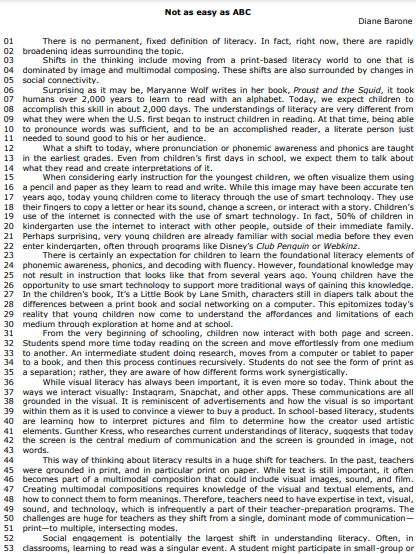
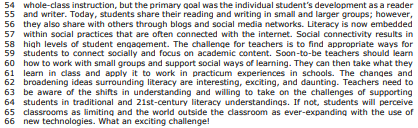
I. The understandings of literacy are different than they used to be. II. Young children are used to technology and this knowledge has an impact on the learning process. III. Half of kindergarten children use the internet regularly to interact with family and friends.
Which ones are correct?
TEXT
Dear Mayor Estrosi, Mayor Vivoni, Prime Minister
Manuel Valls, Former President Nicolas Sarkozy,
and other French officials who have supported
France’s burkini ban:
My name is Amara Majeed, and I am a 19-yearold Muslim Sri Lankan American. I am a student at Brown University, studying cognitive neuroscience and public policy.
When I look at the photo circulating of a woman in Nice being surrounded by armed police officers as she is coerced into removing her clothing, because French officials deemed the burkini to be inappropriate beach attire, I see infringement on a woman’s right to choose what she puts on her body by a group of white males. I see the scapegoating, ostracization, and criminalization of Muslims in the aftermath of the Nice terror attacks. I am a woman who wears the hijab, and I see an affront to the rights and civil liberties of women like me.
Deputy Mayor of Nice, Christian Estrosi: You have stated that you support this ban on “inappropriate clothing” in the wake of the Nice terror attacks. Mayor Vivoni, you have described the burkini ban as a necessary measure to “protect the population.” Former French president Nicolas Sarkozy, you have labeled the burkini as a symbol of extremism.
Let me respond to all of you by saying this: any conflation of the burkini with terrorism is invalid, virulent, and discriminatory. Tell me, in what way does our way of dress pose a threat to France’s national security? In what way does the burkini propagate hateful, violent ideologies? How is it that our way of dress poses a national security threat, yet some wetsuits, which take on strikingly similar designs to the burkini, aren’t? While France’s highest administrative court has now overturned the ban, the damage has already been done — this attack on the Muslim way of dress only serves as fodder to the already existing rising anti-Muslim sentiment and stigmatization of Muslims in France. If this institutionalized Islamophobia and fearmongering is being perpetrated by French officials and authorities, I fear how the general public’s poor treatment of hijab-clad women may be exacerbated in the coming weeks. We’re all well aware that hate crimes and violence targeting Muslim women wearing the hijab is not a new phenomenon in France.
As one burkini-clad woman who was forced to leave the beach states, “Because people who have nothing to do with my religion have killed, I no longer have the right to go to the beach.” In the eyes of many authority figures, our religious identity in and of itself is incriminating. Our way of dress is incriminating. Our sheer existence is incriminating.
Many of you have called the hijab an emblem of oppression. In April, France’s Minister for Women’s Rights equated women who choose to wear the hijab with “Negroes who were in favor of slavery.” More recently, France’s prime minister stated that the burkini is a tool of “enslavement,” and former French President Sarkozy insinuated that hijabclad women are imprisoned.
I am genuinely tired of individuals like you imposing your brand of colonial feminism on us and telling us that we are oppressed, that we have been indoctrinated, that this was not our choice, and that we need to be unshackled. Instead of continuing to pursue these offensive and failing attempts at liberating us, I implore you to liberate yourselves from this white savior complex and recognize that we don’t need your saving. The hijab does not oppress me. For me, the hijab is a symbol of feminism and freedom of expression — so who are you to invalidate my experiences, to invalidate a fundamental, inextricable aspect of my identity, and to label me as enslaved, as imprisoned, as oppressed? By depriving us of our rights to dress the way we want, by making public spaces inaccessible to us, by publicly humiliating us and coercing us to remove some of our clothing while we are trying to enjoy a day at the beach — you are oppressing us.
My news feed has been saturated with people posting photos of a Muslim woman at a beach being forced to strip, captioned with outrage and vitriol towards this form of discrimination. While your support of our rights is appreciated, I ask that you refrain from doing a disservice to this individual by circulating this photo. It may not seem like you are violating a woman’s privacy and liberties by sharing a picture revealing her arms or shoulders, but it is incumbent upon us to understand that she did not freely choose to show those parts of her body in public. Even if the intent is to excoriate the burkini ban while circulating these photos, I implore you to not be complicit, whether directly or indirectly, in systems of oppression that are stripping women, literally, of their right to choose what they wear.
Yours truly,
Amara Majeed – a muslin woman
(Source: http://www.bustle.com/articles/180721-an-open-letter-to-french-officials-who-support-the-burkini-ban-from-a-muslim-wo-man)
TEXT
Dear Mayor Estrosi, Mayor Vivoni, Prime Minister
Manuel Valls, Former President Nicolas Sarkozy,
and other French officials who have supported
France’s burkini ban:
My name is Amara Majeed, and I am a 19-yearold Muslim Sri Lankan American. I am a student at Brown University, studying cognitive neuroscience and public policy.
When I look at the photo circulating of a woman in Nice being surrounded by armed police officers as she is coerced into removing her clothing, because French officials deemed the burkini to be inappropriate beach attire, I see infringement on a woman’s right to choose what she puts on her body by a group of white males. I see the scapegoating, ostracization, and criminalization of Muslims in the aftermath of the Nice terror attacks. I am a woman who wears the hijab, and I see an affront to the rights and civil liberties of women like me.
Deputy Mayor of Nice, Christian Estrosi: You have stated that you support this ban on “inappropriate clothing” in the wake of the Nice terror attacks. Mayor Vivoni, you have described the burkini ban as a necessary measure to “protect the population.” Former French president Nicolas Sarkozy, you have labeled the burkini as a symbol of extremism.
Let me respond to all of you by saying this: any conflation of the burkini with terrorism is invalid, virulent, and discriminatory. Tell me, in what way does our way of dress pose a threat to France’s national security? In what way does the burkini propagate hateful, violent ideologies? How is it that our way of dress poses a national security threat, yet some wetsuits, which take on strikingly similar designs to the burkini, aren’t? While France’s highest administrative court has now overturned the ban, the damage has already been done — this attack on the Muslim way of dress only serves as fodder to the already existing rising anti-Muslim sentiment and stigmatization of Muslims in France. If this institutionalized Islamophobia and fearmongering is being perpetrated by French officials and authorities, I fear how the general public’s poor treatment of hijab-clad women may be exacerbated in the coming weeks. We’re all well aware that hate crimes and violence targeting Muslim women wearing the hijab is not a new phenomenon in France.
As one burkini-clad woman who was forced to leave the beach states, “Because people who have nothing to do with my religion have killed, I no longer have the right to go to the beach.” In the eyes of many authority figures, our religious identity in and of itself is incriminating. Our way of dress is incriminating. Our sheer existence is incriminating.
Many of you have called the hijab an emblem of oppression. In April, France’s Minister for Women’s Rights equated women who choose to wear the hijab with “Negroes who were in favor of slavery.” More recently, France’s prime minister stated that the burkini is a tool of “enslavement,” and former French President Sarkozy insinuated that hijabclad women are imprisoned.
I am genuinely tired of individuals like you imposing your brand of colonial feminism on us and telling us that we are oppressed, that we have been indoctrinated, that this was not our choice, and that we need to be unshackled. Instead of continuing to pursue these offensive and failing attempts at liberating us, I implore you to liberate yourselves from this white savior complex and recognize that we don’t need your saving. The hijab does not oppress me. For me, the hijab is a symbol of feminism and freedom of expression — so who are you to invalidate my experiences, to invalidate a fundamental, inextricable aspect of my identity, and to label me as enslaved, as imprisoned, as oppressed? By depriving us of our rights to dress the way we want, by making public spaces inaccessible to us, by publicly humiliating us and coercing us to remove some of our clothing while we are trying to enjoy a day at the beach — you are oppressing us.
My news feed has been saturated with people posting photos of a Muslim woman at a beach being forced to strip, captioned with outrage and vitriol towards this form of discrimination. While your support of our rights is appreciated, I ask that you refrain from doing a disservice to this individual by circulating this photo. It may not seem like you are violating a woman’s privacy and liberties by sharing a picture revealing her arms or shoulders, but it is incumbent upon us to understand that she did not freely choose to show those parts of her body in public. Even if the intent is to excoriate the burkini ban while circulating these photos, I implore you to not be complicit, whether directly or indirectly, in systems of oppression that are stripping women, literally, of their right to choose what they wear.
Yours truly,
Amara Majeed – a muslin woman
(Source: http://www.bustle.com/articles/180721-an-open-letter-to-french-officials-who-support-the-burkini-ban-from-a-muslim-wo-man)
TEXT
Dear Mayor Estrosi, Mayor Vivoni, Prime Minister
Manuel Valls, Former President Nicolas Sarkozy,
and other French officials who have supported
France’s burkini ban:
My name is Amara Majeed, and I am a 19-yearold Muslim Sri Lankan American. I am a student at Brown University, studying cognitive neuroscience and public policy.
When I look at the photo circulating of a woman in Nice being surrounded by armed police officers as she is coerced into removing her clothing, because French officials deemed the burkini to be inappropriate beach attire, I see infringement on a woman’s right to choose what she puts on her body by a group of white males. I see the scapegoating, ostracization, and criminalization of Muslims in the aftermath of the Nice terror attacks. I am a woman who wears the hijab, and I see an affront to the rights and civil liberties of women like me.
Deputy Mayor of Nice, Christian Estrosi: You have stated that you support this ban on “inappropriate clothing” in the wake of the Nice terror attacks. Mayor Vivoni, you have described the burkini ban as a necessary measure to “protect the population.” Former French president Nicolas Sarkozy, you have labeled the burkini as a symbol of extremism.
Let me respond to all of you by saying this: any conflation of the burkini with terrorism is invalid, virulent, and discriminatory. Tell me, in what way does our way of dress pose a threat to France’s national security? In what way does the burkini propagate hateful, violent ideologies? How is it that our way of dress poses a national security threat, yet some wetsuits, which take on strikingly similar designs to the burkini, aren’t? While France’s highest administrative court has now overturned the ban, the damage has already been done — this attack on the Muslim way of dress only serves as fodder to the already existing rising anti-Muslim sentiment and stigmatization of Muslims in France. If this institutionalized Islamophobia and fearmongering is being perpetrated by French officials and authorities, I fear how the general public’s poor treatment of hijab-clad women may be exacerbated in the coming weeks. We’re all well aware that hate crimes and violence targeting Muslim women wearing the hijab is not a new phenomenon in France.
As one burkini-clad woman who was forced to leave the beach states, “Because people who have nothing to do with my religion have killed, I no longer have the right to go to the beach.” In the eyes of many authority figures, our religious identity in and of itself is incriminating. Our way of dress is incriminating. Our sheer existence is incriminating.
Many of you have called the hijab an emblem of oppression. In April, France’s Minister for Women’s Rights equated women who choose to wear the hijab with “Negroes who were in favor of slavery.” More recently, France’s prime minister stated that the burkini is a tool of “enslavement,” and former French President Sarkozy insinuated that hijabclad women are imprisoned.
I am genuinely tired of individuals like you imposing your brand of colonial feminism on us and telling us that we are oppressed, that we have been indoctrinated, that this was not our choice, and that we need to be unshackled. Instead of continuing to pursue these offensive and failing attempts at liberating us, I implore you to liberate yourselves from this white savior complex and recognize that we don’t need your saving. The hijab does not oppress me. For me, the hijab is a symbol of feminism and freedom of expression — so who are you to invalidate my experiences, to invalidate a fundamental, inextricable aspect of my identity, and to label me as enslaved, as imprisoned, as oppressed? By depriving us of our rights to dress the way we want, by making public spaces inaccessible to us, by publicly humiliating us and coercing us to remove some of our clothing while we are trying to enjoy a day at the beach — you are oppressing us.
My news feed has been saturated with people posting photos of a Muslim woman at a beach being forced to strip, captioned with outrage and vitriol towards this form of discrimination. While your support of our rights is appreciated, I ask that you refrain from doing a disservice to this individual by circulating this photo. It may not seem like you are violating a woman’s privacy and liberties by sharing a picture revealing her arms or shoulders, but it is incumbent upon us to understand that she did not freely choose to show those parts of her body in public. Even if the intent is to excoriate the burkini ban while circulating these photos, I implore you to not be complicit, whether directly or indirectly, in systems of oppression that are stripping women, literally, of their right to choose what they wear.
Yours truly,
Amara Majeed – a muslin woman
(Source: http://www.bustle.com/articles/180721-an-open-letter-to-french-officials-who-support-the-burkini-ban-from-a-muslim-wo-man)

 Conheça nossos planos