Questões de Concurso Sobre interpretação de texto | reading comprehension em inglês

Foram encontradas 12.687 questões

Q1875102 Inglês
   The European Environment Agency (EEA) has published a new indicator that tracks findings of pesticides in Europe’s rivers, lakes and groundwaters. The data, collected from EEA member countries across Europe, shows the share of water bodies where excessive levels of pesticides have been recorded from 2013 to 2019. 
  The new EEA indicator shows that levels of pesticides exceeding thresholds were measured in a quarter of all reported monitoring sites in European surface waters in 2019. From 2013 to 2019, this share varied between 13% and 30%. The share for groundwater with exceedances was considerably lower, at between 3% and 7%.  
   In the EU, pesticides are regulated on the basis of high protection goals for human health and the environment, with being authorised only after a comprehensive scientific risk assessment. Nevertheless, pesticide contamination of surface waters and groundwater can still occur and could affect aquatic fauna and flora.  

Internet: <www.eea.europa.eu> (adapted). 
According to the text above, judge the following item.

From 2013 to 2019, the percentage of sites in European surface waters whose levels of pesticides are above the limits more than doubled.
Alternativas
Q1875101 Inglês
    There’s growing evidence that people and the planet are increasingly impacted by extreme events. According to the Fourth National Climate Assessment, published in 2018 by the U.S. Global Change Research Program, “more frequent and intense extreme weather and climate-related events, as well as changes in average climate conditions, are expected to continue to damage infrastructure, ecosystems, and social systems that provide essential benefits to communities.”
      As the impacts of extreme events continue to mount, interest has grown in the scientific community to study whether specific extreme events can be partially attributed to human activities. With the help of climate models, scientists have conducted an impressive array of studies, looking for possible links between human activities and extreme events such as heat waves, rainfall and flooding events, droughts, storms, and wildfires. Increasingly, they’re able to draw robust connections.

Internet: <climate.nasa.gov> (adapted).
Judge the following item according to the text above.

Experts predict an abrupt change in climate conditions due to continually harmful human activities.  
Alternativas
Q1875100 Inglês
    There’s growing evidence that people and the planet are increasingly impacted by extreme events. According to the Fourth National Climate Assessment, published in 2018 by the U.S. Global Change Research Program, “more frequent and intense extreme weather and climate-related events, as well as changes in average climate conditions, are expected to continue to damage infrastructure, ecosystems, and social systems that provide essential benefits to communities.”
      As the impacts of extreme events continue to mount, interest has grown in the scientific community to study whether specific extreme events can be partially attributed to human activities. With the help of climate models, scientists have conducted an impressive array of studies, looking for possible links between human activities and extreme events such as heat waves, rainfall and flooding events, droughts, storms, and wildfires. Increasingly, they’re able to draw robust connections.

Internet: <climate.nasa.gov> (adapted).
Judge the following item according to the text above.

The author points out human contributions as a noteworthy reason for the growing number of extreme events. 
Alternativas
Q1873871 Inglês
Phishing

Imagine that you get an email one morning. It appears to be from your bank. The email warns that someone broke into your account. It says that you need to sign in to check some things. You click the link in the email. It takes you to a site that looks very much like your bank’s. You enter your username and password. You submit the form. You’ve just been phished!

Phishing is a type of attack that happens over the Internet. Users receive an email or text message that seems like it came from a trusted source. These users are being deceived. They are interacting with dangerous hackers. The attackers copy trusted companies. They send users to web pages that look like the ones we use everyday. When users login or provide sensitive information, the attackers steal this data.

Attackers want your data for many reasons. They may use your data to commit identity fraud. This is when they use your identity to buy something with your credit. Then they receive the goods and you receive the bill. Or they may want your password to take over a computer network. They may want access to private emails. They may want customer records. They gain access by tricking people into giving them their login info.

Some phishing attacks are targeted. A targeted phishing attack is called a spear phishing attack. These attacks are dangerous because they are convincing. The attacker may know the target’s name, address, or job title. They may have gathered info from social networks, like the names of friends or family. The attackers may use this personal information to craft a believable email. The target will be tricked into clicking a link. The link will send them to a phony website. This site will look familiar, but it will be a spoofed site built to steal data. Any data that the target submits will go to the hacker.

Phishing attacks are dangerous, but you can spot them if you pay attention. One thing to watch is your address bar in your browser. Attackers use domains that look like the ones that we trust, but they are not the same. For example, in 2016 staffers from Hillary Clinton’s campaign were spear phished. The attackers used the domain accounts-google.com. That domain looks like google.com, but it isn’t the same. When logging into google, you should always do it from google.com. Likewise, when logging into any account, make sure the address matches what you expect. If you are unsure, search for the site and login from the root domain.

An even better way to secure your account against phishing attacks is to use 2FA: two factor authentication. 2FA means that your account is secured with two keys. The first is your password. The second key is a random code that changes every few minutes. This code may be generated by a 2FA app, like Authy. Or it can be sent to your cell phone on request. If you activate 2FA on your accounts, an attacker will not be able to get in even with your password.

Phishing attacks are scary and common. The reason why they are common is that they are effective. Many people accept appearances without suspicion. Browsing the Internet safely requires a healthy amount of suspicion. Not everything is what it appears. Nobody is trying to give you free money. Don’t trust; verify.
In the sentence “This site will look familiar, but it will be a spoofed site built to steal data.”, the correct definition for the word spoofed is in which alternative?
Alternativas
Q1873869 Inglês
Phishing

Imagine that you get an email one morning. It appears to be from your bank. The email warns that someone broke into your account. It says that you need to sign in to check some things. You click the link in the email. It takes you to a site that looks very much like your bank’s. You enter your username and password. You submit the form. You’ve just been phished!

Phishing is a type of attack that happens over the Internet. Users receive an email or text message that seems like it came from a trusted source. These users are being deceived. They are interacting with dangerous hackers. The attackers copy trusted companies. They send users to web pages that look like the ones we use everyday. When users login or provide sensitive information, the attackers steal this data.

Attackers want your data for many reasons. They may use your data to commit identity fraud. This is when they use your identity to buy something with your credit. Then they receive the goods and you receive the bill. Or they may want your password to take over a computer network. They may want access to private emails. They may want customer records. They gain access by tricking people into giving them their login info.

Some phishing attacks are targeted. A targeted phishing attack is called a spear phishing attack. These attacks are dangerous because they are convincing. The attacker may know the target’s name, address, or job title. They may have gathered info from social networks, like the names of friends or family. The attackers may use this personal information to craft a believable email. The target will be tricked into clicking a link. The link will send them to a phony website. This site will look familiar, but it will be a spoofed site built to steal data. Any data that the target submits will go to the hacker.

Phishing attacks are dangerous, but you can spot them if you pay attention. One thing to watch is your address bar in your browser. Attackers use domains that look like the ones that we trust, but they are not the same. For example, in 2016 staffers from Hillary Clinton’s campaign were spear phished. The attackers used the domain accounts-google.com. That domain looks like google.com, but it isn’t the same. When logging into google, you should always do it from google.com. Likewise, when logging into any account, make sure the address matches what you expect. If you are unsure, search for the site and login from the root domain.

An even better way to secure your account against phishing attacks is to use 2FA: two factor authentication. 2FA means that your account is secured with two keys. The first is your password. The second key is a random code that changes every few minutes. This code may be generated by a 2FA app, like Authy. Or it can be sent to your cell phone on request. If you activate 2FA on your accounts, an attacker will not be able to get in even with your password.

Phishing attacks are scary and common. The reason why they are common is that they are effective. Many people accept appearances without suspicion. Browsing the Internet safely requires a healthy amount of suspicion. Not everything is what it appears. Nobody is trying to give you free money. Don’t trust; verify.
Read the article and decide if the statements below are true ( T ) or false ( F ).

( ) A phishing attack is to trick someone into giving away sensitive data.
( ) To commit identity fraud is a motive for phishing and it is mentioned in the text.
( ) 2FA can protect users from phishing attacks by having two keys to login.
( ) The domain accounts-google.com is used by attackers to phish.

Choose the alternative which presents the correct sequence, from top to bottom.
Alternativas
Q1873868 Inglês
Phishing

Imagine that you get an email one morning. It appears to be from your bank. The email warns that someone broke into your account. It says that you need to sign in to check some things. You click the link in the email. It takes you to a site that looks very much like your bank’s. You enter your username and password. You submit the form. You’ve just been phished!

Phishing is a type of attack that happens over the Internet. Users receive an email or text message that seems like it came from a trusted source. These users are being deceived. They are interacting with dangerous hackers. The attackers copy trusted companies. They send users to web pages that look like the ones we use everyday. When users login or provide sensitive information, the attackers steal this data.

Attackers want your data for many reasons. They may use your data to commit identity fraud. This is when they use your identity to buy something with your credit. Then they receive the goods and you receive the bill. Or they may want your password to take over a computer network. They may want access to private emails. They may want customer records. They gain access by tricking people into giving them their login info.

Some phishing attacks are targeted. A targeted phishing attack is called a spear phishing attack. These attacks are dangerous because they are convincing. The attacker may know the target’s name, address, or job title. They may have gathered info from social networks, like the names of friends or family. The attackers may use this personal information to craft a believable email. The target will be tricked into clicking a link. The link will send them to a phony website. This site will look familiar, but it will be a spoofed site built to steal data. Any data that the target submits will go to the hacker.

Phishing attacks are dangerous, but you can spot them if you pay attention. One thing to watch is your address bar in your browser. Attackers use domains that look like the ones that we trust, but they are not the same. For example, in 2016 staffers from Hillary Clinton’s campaign were spear phished. The attackers used the domain accounts-google.com. That domain looks like google.com, but it isn’t the same. When logging into google, you should always do it from google.com. Likewise, when logging into any account, make sure the address matches what you expect. If you are unsure, search for the site and login from the root domain.

An even better way to secure your account against phishing attacks is to use 2FA: two factor authentication. 2FA means that your account is secured with two keys. The first is your password. The second key is a random code that changes every few minutes. This code may be generated by a 2FA app, like Authy. Or it can be sent to your cell phone on request. If you activate 2FA on your accounts, an attacker will not be able to get in even with your password.

Phishing attacks are scary and common. The reason why they are common is that they are effective. Many people accept appearances without suspicion. Browsing the Internet safely requires a healthy amount of suspicion. Not everything is what it appears. Nobody is trying to give you free money. Don’t trust; verify.
What is the difference between a phishing and spear phishing attack?
Alternativas
Q1873867 Inglês
Phishing

Imagine that you get an email one morning. It appears to be from your bank. The email warns that someone broke into your account. It says that you need to sign in to check some things. You click the link in the email. It takes you to a site that looks very much like your bank’s. You enter your username and password. You submit the form. You’ve just been phished!

Phishing is a type of attack that happens over the Internet. Users receive an email or text message that seems like it came from a trusted source. These users are being deceived. They are interacting with dangerous hackers. The attackers copy trusted companies. They send users to web pages that look like the ones we use everyday. When users login or provide sensitive information, the attackers steal this data.

Attackers want your data for many reasons. They may use your data to commit identity fraud. This is when they use your identity to buy something with your credit. Then they receive the goods and you receive the bill. Or they may want your password to take over a computer network. They may want access to private emails. They may want customer records. They gain access by tricking people into giving them their login info.

Some phishing attacks are targeted. A targeted phishing attack is called a spear phishing attack. These attacks are dangerous because they are convincing. The attacker may know the target’s name, address, or job title. They may have gathered info from social networks, like the names of friends or family. The attackers may use this personal information to craft a believable email. The target will be tricked into clicking a link. The link will send them to a phony website. This site will look familiar, but it will be a spoofed site built to steal data. Any data that the target submits will go to the hacker.

Phishing attacks are dangerous, but you can spot them if you pay attention. One thing to watch is your address bar in your browser. Attackers use domains that look like the ones that we trust, but they are not the same. For example, in 2016 staffers from Hillary Clinton’s campaign were spear phished. The attackers used the domain accounts-google.com. That domain looks like google.com, but it isn’t the same. When logging into google, you should always do it from google.com. Likewise, when logging into any account, make sure the address matches what you expect. If you are unsure, search for the site and login from the root domain.

An even better way to secure your account against phishing attacks is to use 2FA: two factor authentication. 2FA means that your account is secured with two keys. The first is your password. The second key is a random code that changes every few minutes. This code may be generated by a 2FA app, like Authy. Or it can be sent to your cell phone on request. If you activate 2FA on your accounts, an attacker will not be able to get in even with your password.

Phishing attacks are scary and common. The reason why they are common is that they are effective. Many people accept appearances without suspicion. Browsing the Internet safely requires a healthy amount of suspicion. Not everything is what it appears. Nobody is trying to give you free money. Don’t trust; verify.
Which alternative best describes the main idea of the third paragraph?
Alternativas
Q1866963 Inglês

Leia o texto a seguir e responda a questão.


“He remembered the time he had hooked one of a pair of marlin. The male fish always let the female fish feed first and the hooked fish, the female, made a wild, panic-stricken, despairing fight that soon exhausted her, and all the time the male had stayed with her, crossing the line and circling with her on the surface.

He had stayed so close that the old man was afraid he would cut the line with his tail which was sharp as a scythe and almost of that size and shape. When the old man had gaffed her and clubbed her, holding the rapier bill with its sandpaper edge and clubbing her across the top of her head until her colour turned to a colour almost like the backing of mirrors, and then, with the boy’s aid, hoisted her aboard, the male fish had stayed by the side of the boat.

Then, while the old man was clearing the lines and preparing the harpoon, the male fish jumped high into the air beside the boat to see where the female was and then went down deep, his lavender wings, that were his pectoral fins, spread wide and all his wide lavender stripes showing. He was beautiful, the old man remembered, and he had stayed.”

HEMINGWAY, Ernest. The Old Man and the Sea.

Eua: Hueber Verlag, 1952. 108 p.

“the male fish jumped high into the air beside the boat to see where the female was and then went down deep, his lavender wings, that were his pectoral fins,”


O trecho destacado acima tem a função de:
Alternativas
Q1866960 Inglês

Leia o texto a seguir e responda a questão.


“He remembered the time he had hooked one of a pair of marlin. The male fish always let the female fish feed first and the hooked fish, the female, made a wild, panic-stricken, despairing fight that soon exhausted her, and all the time the male had stayed with her, crossing the line and circling with her on the surface.

He had stayed so close that the old man was afraid he would cut the line with his tail which was sharp as a scythe and almost of that size and shape. When the old man had gaffed her and clubbed her, holding the rapier bill with its sandpaper edge and clubbing her across the top of her head until her colour turned to a colour almost like the backing of mirrors, and then, with the boy’s aid, hoisted her aboard, the male fish had stayed by the side of the boat.

Then, while the old man was clearing the lines and preparing the harpoon, the male fish jumped high into the air beside the boat to see where the female was and then went down deep, his lavender wings, that were his pectoral fins, spread wide and all his wide lavender stripes showing. He was beautiful, the old man remembered, and he had stayed.”

HEMINGWAY, Ernest. The Old Man and the Sea.

Eua: Hueber Verlag, 1952. 108 p.

No trecho “He remembered the time he had hooked one of a pair of marlin.” Podemos constatar que o autor:
Alternativas
Q1866959 Inglês

Leia o texto a seguir e responda a questão.


“He remembered the time he had hooked one of a pair of marlin. The male fish always let the female fish feed first and the hooked fish, the female, made a wild, panic-stricken, despairing fight that soon exhausted her, and all the time the male had stayed with her, crossing the line and circling with her on the surface.

He had stayed so close that the old man was afraid he would cut the line with his tail which was sharp as a scythe and almost of that size and shape. When the old man had gaffed her and clubbed her, holding the rapier bill with its sandpaper edge and clubbing her across the top of her head until her colour turned to a colour almost like the backing of mirrors, and then, with the boy’s aid, hoisted her aboard, the male fish had stayed by the side of the boat.

Then, while the old man was clearing the lines and preparing the harpoon, the male fish jumped high into the air beside the boat to see where the female was and then went down deep, his lavender wings, that were his pectoral fins, spread wide and all his wide lavender stripes showing. He was beautiful, the old man remembered, and he had stayed.”

HEMINGWAY, Ernest. The Old Man and the Sea.

Eua: Hueber Verlag, 1952. 108 p.

No trecho do livro “The old man and the sea” citado acima podemos considerar que autor quis destacar: 
Alternativas
Q4182190 Inglês

Instruction: answer the question based on the following text.


The Ultimate Packing List for Expatriates Moving Abroad
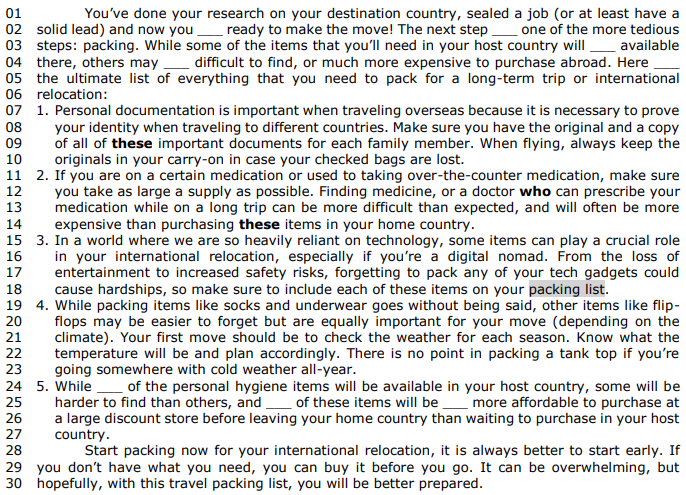

(Available in: https://www.internationalcitizens.com/moving-abroad/ultimate-packing-list.php – text specially adapted for this test).

The words in bold “these” (l. 09), “who” (l. 12), and “these” (l. 14) are referring to, respectively:
Alternativas
Q4182189 Inglês

Instruction: answer the question based on the following text.


The Ultimate Packing List for Expatriates Moving Abroad


(Available in: https://www.internationalcitizens.com/moving-abroad/ultimate-packing-list.php – text specially adapted for this test).

Annalise the following statements about the blanks in item 5 (l. 24 – 27) and mark T, if true, or F, if false.

( ) Blank 1 should be filled with “much” because it is related to “personal hygiene”, which is uncountable.
( ) Blank 2 should be filled with “many” because it is related to “items”, which is countable.
( ) Blank 3 should be filled with “much” because it is related to “purchase”, which is uncountable.

The correct order of filling the parentheses, from top to bottom, is:
Alternativas
Q4182187 Inglês

Instruction: answer the question based on the following text.


The Ultimate Packing List for Expatriates Moving Abroad


(Available in: https://www.internationalcitizens.com/moving-abroad/ultimate-packing-list.php – text specially adapted for this test).

Which of the statements below is true according to the article?
Alternativas
Q4182186 Inglês

Instruction: answer the question based on the following text.


The Ultimate Packing List for Expatriates Moving Abroad


(Available in: https://www.internationalcitizens.com/moving-abroad/ultimate-packing-list.php – text specially adapted for this test).

Match each topic 1 to 5 from the text to a heading:

( ) Electronics.
( ) Important Documents for Your International Relocation.
( ) Toiletries.
( ) Stock up on Your Prescriptions.
( ) What to Wear When You Get There.

The correct order of filling the parentheses, from top to bottom, is:
Alternativas
Q4182184 Inglês
The “Currículo do Espírito Santo” also suggests how to approach the English Language in the classroom: “(...) precisamos aproximar nossos alunos desta língua (Língua Inglesa) e concebêla agregada tanto à nossa língua materna quanto a demais línguas faladas em nossa sociedade, partindo do local para o global (FINARDI, 2014), possibilitando inclusão social (FINARDI, 2013) ao promover acesso a informações e também a produção de informação por meio da língua. Nesse sentido, busca-se contribuir com a formação de um cidadão social e autônomo que intervenha no seu espaço local e, indo além, no mundo globalizado”. Currículo do Espírito Santo, 2018. Consider the following statements about the citation:

I. English teaching should not ignore the native language of the students, but use it as a base on which learners can build their knowledge.
II. Learning English can promote social inclusion because it allows people to access a broader range of information available in the world and produce content about it, being active global citizens.
III. Students must be independent learners, searching the globalized world for knowledge in an autonomous way.

Which statements are correct?
Alternativas
Q3984537 Inglês

Read text 4 and answer the question.


Text 4


The World Health Organization (WHO) has published a booklet entitled “Getting your workforce ready for Covid-19”. The eight-page document is organized by topics and in one of them, it is possible to read as follows:


Promote regular and thorough hand-washing by employees, contractors and customers:


a. Put sanitizing hand rub dispensers in prominent places around the workplace;


b. Make sure these dispensers are regularly refilled;


c. Display posters promoting hand-washing– ask your local public health authority for these or look on www.WHO.int;


d. Combine this with other communication measures such as offering guidance from occupational health and safety officers, briefings at meetings and information on the intranet to promote hand-washing;


e. Make sure that staff, contractors and customers have access to places where they can wash their hands with soap and water;


f. Why? Because washing kills the virus on your hands and prevents the spread of Covid-19.


(Retrived from: <https://www.who.int/docs/default-source/coronaviruse/getting-workplace-ready-for-covid-19.pdf>.)

The statement letter “f” has the following purpose:
Alternativas
Q3984534 Inglês

Read text 3 and answer the question.


Text 3

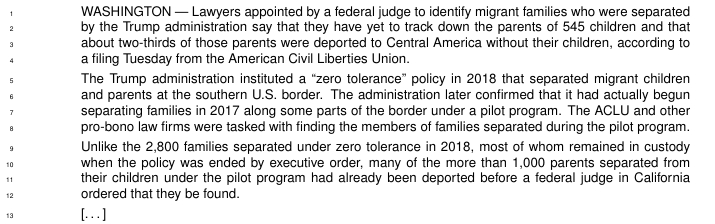
Lawyers say they can’t find the parents of 545 migrant children separated by Trump administration By Julia Ainsley and Jacob Soboroff


(Retrived from: <https://www.nbcnews.com/politics/immigration/lawyers-say-they-can-t-find-parents-545-migrant-children-n1244066>.)

Considering the information from text 3, the “zero tolerance” policy can be described as:
Alternativas
Q3984532 Inglês

Read text 2 and answer the question. 


Text 2



(Retrived from: <https://www.usnews.com/cartoons/immigration-cartoons>.)

In multimodal texts, the meanings are created by the use of both written and visual language. Regarding the ideas created on text 2, consider the following statements.

I. The former US President says a declarative statement.

II. The young migrant boy is positioned as a passive character both by his visual representation and by his non-verbal statement.

III. By visual language, it is possible to infer the discursive effect of the former US President’s statement on the young migrant boy.

IV. The visual language contradicts the written one.

Choose the correct alternative.
Alternativas
Q3984531 Inglês

Read text 2 and answer the question. 


Text 2


(Retrived from: <https://www.usnews.com/cartoons/immigration-cartoons>.)

On text 2, the former US President is addressing to a young migrant boy and creates a controversy in his speech. What is the meaning conveyed?
Alternativas
Q3984530 Inglês

Read text 1 and answer the question.


Text 1

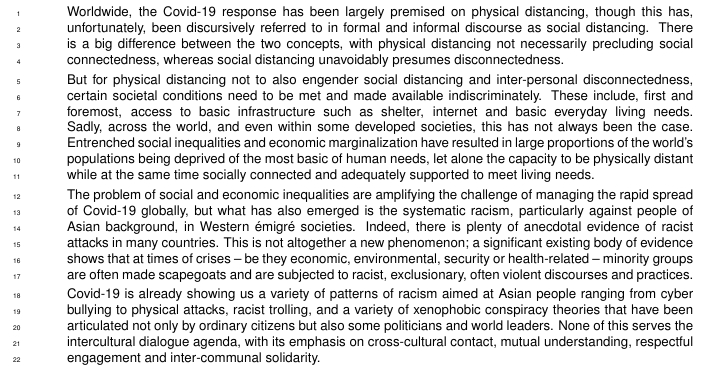
The socio-cultural implications of Covid-19

By Professor Fethi Mansouri


(Retrived from:<https://en.unesco.org/news/socio-cultural-implications-covid-19>)

The author employed the terms “social inequalities” and “economic marginalization” to state that the pandemic
Alternativas
Respostas
5741: E
5742: E
5743: C
5744: E
5745: B
5746: C
5747: B
5748: D
5749: B
5750: D
5751: B
5752: D
5753: C
5754: A
5755: D
5756: A
5757: E
5758: C
5759: C
5760: D