Questões de Concurso Sobre interpretação de texto | reading comprehension em inglês

Foram encontradas 12.992 questões

Q3012911 Inglês
A total solar eclipse passed over North America on Monday, putting on a dramatic show that was visible to millions of people.

A total solar eclipse occurs when the moon passes between Earth and the sun, completely blocking the sun's face. Those within the path of totality, including 32 million people in the United States, saw the eclipse in its full splendor. People outside the path were still able to see a partial solar eclipse, where the moon blocks only part of the sun's face.

Many people traveled to the path of totality to attend special viewing parties. Those along the very center line of the path saw an eclipse that lasted between 3 and half and 4 minutes, according to NASA.

For many Americans, this was the last chance to see a total solar eclipse for 20 years. The next one won't be visible across the contiguous United States until August 2044.

The Solar Eclipse. CNN. 08 April 2024. Adapted.
According to the text, what defines a total solar eclipse?
Alternativas
Q3009836 Inglês
Read and mark the option which fills in the blanks accordingly.
On Friday, a major tech failure ________ services worldwide and highlighted the vulnerability of interconnected technologies.
Cybersecurity firm CrowdStrike apologized after an update to its antivirus software, which protects Microsoft Windows devices from attacks, caused a global ________ . This led to thousands of flight cancellations and delays and affected banking, healthcare, and payment systems. Although the software bug has been fixed, experts warn that manually ________ each affected computer will take significant time and effort. Microsoft estimated that 8.5 million computers globally were impacted by the ________ , making it the worst cyber event in history. The UK’s National Cyber Security Centre and Germany’s IT security agency have warned that ________ might exploit the situation. Despite the fix, it will take time to resolve all issues and clear backlogs. It is important to be prepared for such disruptions in the future and have resilient systems.
Available at: https://www.newsinlevels.com/products/global-it-outage-level-3/. Accessed: July 25, 2024. 
Alternativas
Q3008322 Inglês

Leia a tirinha a seguir e responda a questão.
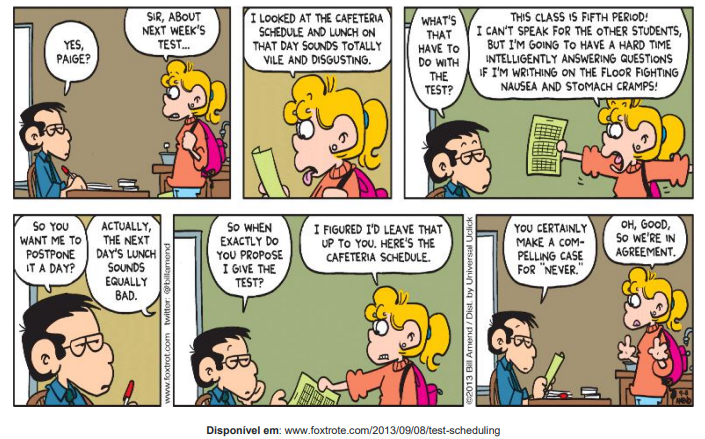


Assinale a alternativa que indica um significado para o verbo em destaque na sentença “I’m writhing on the floor”.
Alternativas
Q3008318 Inglês

Leia o fragmento de texto a seguir e responda a questão.


    Cultural stereotypes are fixed ideas that people have about what specific social groups or individuals are like, especially an idea that is wrong. Other terms that are associated with the term stereotype are prejudice and cliché. The term has a Greek origin: stereos means solid or firm and typos mean blow, impression, engraved, or mark. The term was first used in the printing business. The first modern English use of the term was in 1850, meaning “image perpetuated without change.”

    Because stereotypes are standardized and simplified ideas of groups based on some prejudices, they are not derived from objective facts but rather from subjective and often unverifiable ideas. As Sociologist Charles E. Hurst states, “one reason for stereotypes is the lack of personal, concrete familiarity that individuals have with persons in other racial or ethnic groups. Lack of familiarity encourages the lumping together of unknown individuals”.

    The existence of stereotypes may be explained by the need for groups of people to view themselves as more normal or superior to other groups. Consequently, stereotypes may be used to justify ill-founded prejudices or ignorance and prevent people of stereotyped groups from entering or succeeding in various activities or fields. The stereotyping group is, generally, reluctant to reconsider their attitudes and behavior towards the stereotyped group.

    Stereotypes may affect people negatively. This includes forming inaccurate and distorted images and opinions of people. Stereotypes may also be used for scapegoating or for making general erroneous judgments about people. Some stereotyping people may feel comfortable when they prevent themselves from emotional identification with the stereotyped group, which leads to xenophobic or racist behavior. Finally, another serious consequence of stereotypes is the feeling of inferiority that the stereotyped people may have, which may impair their performance.


Fonte: HURST, Charles. Social Inequality: Forms, Causes and Consequences. Boston: Pearson Education, 2007.

Analise as afirmativas a seguir:
I. Estereótipos são ideias padronizadas e derivadas de fatos objetivos sobre grupos ou indivíduos que se comportam de maneira errada na sociedade. II. Vem do grego a origem do termo estereótipo, sendo que o uso do termo teve início no contexto do ramo gráfico. III. O sentimento de inferioridade é uma das consequências que as pessoas que sofrem por estereótipos podem vir a sentir. IV. Há pessoas que são estereotipadas porque, por vezes, aparentam se mostrar superiores a outras pessoas. V. Segundo o sociólogo Charles E. Hurst, a falta de familiaridade com indivíduos de outros grupos étnicos e raciais é uma causa para a construção de estereótipos.
Assinale a alternativa CORRETA
Alternativas
Q3008311 Inglês
Para se ler um texto em língua estrangeira, podemos aplicar diferentes estratégias de leitura. Em relação às estratégias, analise as afirmativas abaixo.
I. Consists of having an idea about the content and goals of a reading text before starting to read. To do so, readers look at the title, subtitles, a picture or read the first sentence of each paragraph. II. Reading a text quickly to locate a specific fact or piece of information. This may be a date, a name or a figure. III. Readers relate the content of the passage to self, to other texts or to the world. IV. Making meaning of the text by reading between the lines and using personal knowledge. The aim is to construct meaning beyond what is literally expressed. V. Reading a text quickly to get its general idea of the content.
Fonte: https://www.myenglishpages.com (adaptado).
Assinale a alternativa que representa a ordem CORRETA das estratégias apresentadas nas afirmativas.
Alternativas
Q2847473 Inglês

Read the following text to answer the question.


By Leo Selivan


In this article, informed by the Lexical Approach, I reflect on grammar instruction in the classroom […]. I consider the problems with ‘traditional’ grammar teaching before arguing that what we actually need is more grammar input as well as showing how lexis can provide necessary ‘crutches’ for the learner.


Lexis = vocabulary + grammar


The shift in ELT from grammar to lexis mirrors a similar change in the attitude of linguists. In the past linguists were preoccupied with the grammar of language; however the advances in corpus linguistics have pushed lexis to the forefront. The term ‘lexis’, which was traditionally used by linguists, is a common word these days and frequently used even in textbooks.


Why use a technical term borrowed from the realm of linguistics instead of the word ‘vocabulary’? Quite simply because vocabulary is typically seen as individual words (often presented in lists) whereas lexis is a somewhat wider concept and consists of collocations, chunks and formulaic expressions. It also includes certain patterns that were traditionally associated with the grammar of a language, e.g. If I were you…, I haven’t seen you for ages etc.


Recognising certain grammar structures as lexical items means that they can be introduced much earlier, without structural analysis or elaboration. Indeed, since the concept of notions and functions made its way into language teaching, particularly as Communicative Language Teaching (CLT) gained prominence, some structures associated with grammar started to be taught lexically (or functionally). I’d like to is not taught as ‹the conditional› but as a chunk expressing desire. Similarly many other ‹traditional› grammar items can be introduced lexically relatively early on.


Less grammar or more grammar?


You are, no doubt, all familiar with students who on one hand seem to know the ‘rules’ of grammar but still fail to produce grammatically correct sentences when speaking or, on the other, sound unnatural and foreign-like even when their sentences are grammatically correct. Michael Lewis, who might be considered the founder of the Lexical Approach, once claimed that there was no direct relationship between the knowledge of grammar and speaking. In contrast, the knowledge of formulaic language has been shown by research to have a significant bearing on the natural language production.


Furthermore, certain grammar rules are practically impossible to learn. Dave Willis cites the grammar of orientation (which includes the notoriously difficult present perfect and the uses of certain modal verbs) as particularly resistant to teaching. The only way to grasp their meaning is through continuous exposure and use.


Finally, even the most authoritative English grammars never claim to provide a comprehensive description of all the grammar, hence the word ‘introduction’ often used in their titles (for instance, Huddleston & Pullum’s A Student’s Introduction to English Grammar or Halliday’s An Introduction to Functional Grammar).


If grammarians do not even attempt to address all areas of grammar, how can we, practitioners, cover all the aspects of grammar in our teaching, especially if all we seem to focus on is a limited selection of discrete items, comprised mostly of tenses and a handful of modal verbs? It would seem that we need to expose our students to a lot of naturally occurring language and frequently draw their attention to various grammar points as they arise.


For example, while teaching the expression fall asleep / be asleep you can ask your students:


• Don’t make any noise – she’s fallen asleep.

• Don’t make any noise – she’s asleep.


What does’s stand for in each of these cases (is or has)?


One of the fathers of the Communicative Language Teaching Henry Widdowson advocated using lexical items as a starting point and then ‘showing how they need to be grammatically modified to be communicatively effective’ (1990:95). For example, when exploring a text with your students, you may come across a sentence like this:


They’ve been married for seven years.


You can ask your students: When did they get married? How should you change the sentence if the couple you are talking about is no longer married?


The above demonstrates how the teacher should be constantly on the ball and take every opportunity to draw students’ attention to grammar. Such short but frequent ‘grammar spots’ will help to slowly raise students’ awareness and build their understanding of the English grammar system.

[…]


Conclusion


So is there room for grammar instruction in the classroom? Certainly yes. But the grammar practice should always start with the exploitation of lexical items. Exposing students to a lot of natural and contextualised examples will offer a lexical way into the grammar of the language.


To sum up, grammar should play some role in language teaching but should not occupy a big part of class time. Instead grammar should be delivered in small but frequent portions. Students should be encouraged to collect a lot of examples of a particular structure before being invited to analyse it. Hence, analysis should be preceded by synthesis.


Lastly, language practitioners should bear in mind that grammar acquisition is an incremental process which requires frequent focus and refocus on the items already studied.


Available at: https://www.teachingenglish.org.uk/professionaldevelopment/teachers/knowing-subject/articles/grammar-vs-lexisor-grammar-through. Accessed on: April 29, 2024.

Which sentence does not refer to lexis
Alternativas
Q2847471 Inglês

Read the following text to answer the question.


By Leo Selivan


In this article, informed by the Lexical Approach, I reflect on grammar instruction in the classroom […]. I consider the problems with ‘traditional’ grammar teaching before arguing that what we actually need is more grammar input as well as showing how lexis can provide necessary ‘crutches’ for the learner.


Lexis = vocabulary + grammar


The shift in ELT from grammar to lexis mirrors a similar change in the attitude of linguists. In the past linguists were preoccupied with the grammar of language; however the advances in corpus linguistics have pushed lexis to the forefront. The term ‘lexis’, which was traditionally used by linguists, is a common word these days and frequently used even in textbooks.


Why use a technical term borrowed from the realm of linguistics instead of the word ‘vocabulary’? Quite simply because vocabulary is typically seen as individual words (often presented in lists) whereas lexis is a somewhat wider concept and consists of collocations, chunks and formulaic expressions. It also includes certain patterns that were traditionally associated with the grammar of a language, e.g. If I were you…, I haven’t seen you for ages etc.


Recognising certain grammar structures as lexical items means that they can be introduced much earlier, without structural analysis or elaboration. Indeed, since the concept of notions and functions made its way into language teaching, particularly as Communicative Language Teaching (CLT) gained prominence, some structures associated with grammar started to be taught lexically (or functionally). I’d like to is not taught as ‹the conditional› but as a chunk expressing desire. Similarly many other ‹traditional› grammar items can be introduced lexically relatively early on.


Less grammar or more grammar?


You are, no doubt, all familiar with students who on one hand seem to know the ‘rules’ of grammar but still fail to produce grammatically correct sentences when speaking or, on the other, sound unnatural and foreign-like even when their sentences are grammatically correct. Michael Lewis, who might be considered the founder of the Lexical Approach, once claimed that there was no direct relationship between the knowledge of grammar and speaking. In contrast, the knowledge of formulaic language has been shown by research to have a significant bearing on the natural language production.


Furthermore, certain grammar rules are practically impossible to learn. Dave Willis cites the grammar of orientation (which includes the notoriously difficult present perfect and the uses of certain modal verbs) as particularly resistant to teaching. The only way to grasp their meaning is through continuous exposure and use.


Finally, even the most authoritative English grammars never claim to provide a comprehensive description of all the grammar, hence the word ‘introduction’ often used in their titles (for instance, Huddleston & Pullum’s A Student’s Introduction to English Grammar or Halliday’s An Introduction to Functional Grammar).


If grammarians do not even attempt to address all areas of grammar, how can we, practitioners, cover all the aspects of grammar in our teaching, especially if all we seem to focus on is a limited selection of discrete items, comprised mostly of tenses and a handful of modal verbs? It would seem that we need to expose our students to a lot of naturally occurring language and frequently draw their attention to various grammar points as they arise.


For example, while teaching the expression fall asleep / be asleep you can ask your students:


• Don’t make any noise – she’s fallen asleep.

• Don’t make any noise – she’s asleep.


What does’s stand for in each of these cases (is or has)?


One of the fathers of the Communicative Language Teaching Henry Widdowson advocated using lexical items as a starting point and then ‘showing how they need to be grammatically modified to be communicatively effective’ (1990:95). For example, when exploring a text with your students, you may come across a sentence like this:


They’ve been married for seven years.


You can ask your students: When did they get married? How should you change the sentence if the couple you are talking about is no longer married?


The above demonstrates how the teacher should be constantly on the ball and take every opportunity to draw students’ attention to grammar. Such short but frequent ‘grammar spots’ will help to slowly raise students’ awareness and build their understanding of the English grammar system.

[…]


Conclusion


So is there room for grammar instruction in the classroom? Certainly yes. But the grammar practice should always start with the exploitation of lexical items. Exposing students to a lot of natural and contextualised examples will offer a lexical way into the grammar of the language.


To sum up, grammar should play some role in language teaching but should not occupy a big part of class time. Instead grammar should be delivered in small but frequent portions. Students should be encouraged to collect a lot of examples of a particular structure before being invited to analyse it. Hence, analysis should be preceded by synthesis.


Lastly, language practitioners should bear in mind that grammar acquisition is an incremental process which requires frequent focus and refocus on the items already studied.


Available at: https://www.teachingenglish.org.uk/professionaldevelopment/teachers/knowing-subject/articles/grammar-vs-lexisor-grammar-through. Accessed on: April 29, 2024.

The author states that research findings have demonstrated that 
Alternativas
Q2847470 Inglês

Read the following text to answer the question.


By Leo Selivan


In this article, informed by the Lexical Approach, I reflect on grammar instruction in the classroom […]. I consider the problems with ‘traditional’ grammar teaching before arguing that what we actually need is more grammar input as well as showing how lexis can provide necessary ‘crutches’ for the learner.


Lexis = vocabulary + grammar


The shift in ELT from grammar to lexis mirrors a similar change in the attitude of linguists. In the past linguists were preoccupied with the grammar of language; however the advances in corpus linguistics have pushed lexis to the forefront. The term ‘lexis’, which was traditionally used by linguists, is a common word these days and frequently used even in textbooks.


Why use a technical term borrowed from the realm of linguistics instead of the word ‘vocabulary’? Quite simply because vocabulary is typically seen as individual words (often presented in lists) whereas lexis is a somewhat wider concept and consists of collocations, chunks and formulaic expressions. It also includes certain patterns that were traditionally associated with the grammar of a language, e.g. If I were you…, I haven’t seen you for ages etc.


Recognising certain grammar structures as lexical items means that they can be introduced much earlier, without structural analysis or elaboration. Indeed, since the concept of notions and functions made its way into language teaching, particularly as Communicative Language Teaching (CLT) gained prominence, some structures associated with grammar started to be taught lexically (or functionally). I’d like to is not taught as ‹the conditional› but as a chunk expressing desire. Similarly many other ‹traditional› grammar items can be introduced lexically relatively early on.


Less grammar or more grammar?


You are, no doubt, all familiar with students who on one hand seem to know the ‘rules’ of grammar but still fail to produce grammatically correct sentences when speaking or, on the other, sound unnatural and foreign-like even when their sentences are grammatically correct. Michael Lewis, who might be considered the founder of the Lexical Approach, once claimed that there was no direct relationship between the knowledge of grammar and speaking. In contrast, the knowledge of formulaic language has been shown by research to have a significant bearing on the natural language production.


Furthermore, certain grammar rules are practically impossible to learn. Dave Willis cites the grammar of orientation (which includes the notoriously difficult present perfect and the uses of certain modal verbs) as particularly resistant to teaching. The only way to grasp their meaning is through continuous exposure and use.


Finally, even the most authoritative English grammars never claim to provide a comprehensive description of all the grammar, hence the word ‘introduction’ often used in their titles (for instance, Huddleston & Pullum’s A Student’s Introduction to English Grammar or Halliday’s An Introduction to Functional Grammar).


If grammarians do not even attempt to address all areas of grammar, how can we, practitioners, cover all the aspects of grammar in our teaching, especially if all we seem to focus on is a limited selection of discrete items, comprised mostly of tenses and a handful of modal verbs? It would seem that we need to expose our students to a lot of naturally occurring language and frequently draw their attention to various grammar points as they arise.


For example, while teaching the expression fall asleep / be asleep you can ask your students:


• Don’t make any noise – she’s fallen asleep.

• Don’t make any noise – she’s asleep.


What does’s stand for in each of these cases (is or has)?


One of the fathers of the Communicative Language Teaching Henry Widdowson advocated using lexical items as a starting point and then ‘showing how they need to be grammatically modified to be communicatively effective’ (1990:95). For example, when exploring a text with your students, you may come across a sentence like this:


They’ve been married for seven years.


You can ask your students: When did they get married? How should you change the sentence if the couple you are talking about is no longer married?


The above demonstrates how the teacher should be constantly on the ball and take every opportunity to draw students’ attention to grammar. Such short but frequent ‘grammar spots’ will help to slowly raise students’ awareness and build their understanding of the English grammar system.

[…]


Conclusion


So is there room for grammar instruction in the classroom? Certainly yes. But the grammar practice should always start with the exploitation of lexical items. Exposing students to a lot of natural and contextualised examples will offer a lexical way into the grammar of the language.


To sum up, grammar should play some role in language teaching but should not occupy a big part of class time. Instead grammar should be delivered in small but frequent portions. Students should be encouraged to collect a lot of examples of a particular structure before being invited to analyse it. Hence, analysis should be preceded by synthesis.


Lastly, language practitioners should bear in mind that grammar acquisition is an incremental process which requires frequent focus and refocus on the items already studied.


Available at: https://www.teachingenglish.org.uk/professionaldevelopment/teachers/knowing-subject/articles/grammar-vs-lexisor-grammar-through. Accessed on: April 29, 2024.

As far as grammar instruction is considered, the author of this text, who is a teacher, contends that 
Alternativas
Q2847466 Inglês

Empowering language learning through assessment 

By Liying Cheng & Janna Fox


 Introduction

Like you, we are teachers. We both began our careers teaching English to students ______ first languages were not English. We taught many of these students in Asia, the Middle East, Africa, and North America, navigating our way through the teaching, learning, and assessment of our students with little guidance from theory or resources. Over the years, we became increasingly sensitive to the negative influence and consequences of ill-considered assessment and testing practices. Although we could increasingly find resources on language teaching methods, strategies, and techniques, very few of these resources provided systematic and coherent support for our day-to-day assessment practices. There were no ready answers to our questions in the research literature either – researchers tended to write for other researchers, and their findings, although interesting, were not readily applicable in our classrooms. Years later, our long-term interest in assessment led us to teaching courses to pre-service and in-service teachers: helping them to support their students’ learning through sound assessment practices. This thread has centrally run through our work. Again, we searched for resources that could answer the questions and address the issues arising in the classroom; we realised that the narrow scope of resources on classroom assessment rarely moved beyond test design and test analysis, and was more appropriate for large-scale testing than for on-going classroom assessment.

In the present educational climate, we are continually faced with complex assessment issues. For example, there is a great deal of discussion now about alignment as a guiding principle for high quality assessment: that is, the degree of agreement amongst standards, curriculum, learning outcomes, assessment tasks (including tests), and instruction. Alignment, validity, reliability, fairness, consequences, and practicality are viewed as central aspects of assessment practice that supports learning.

The alignment of learning goals, assessment, and classroom activity 


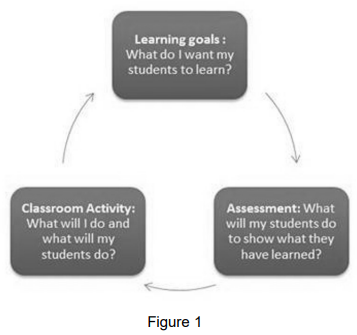
Figure 1 depicts assessment practices three-dimensionally and asks us as teachers to revisit our own classroom practices. Think about what it means to us in achieving instructional goals through teaching and assessment. In the center of this triangle is our students’ learning. The first question we need to ask relates to the learning goals we have for our students: What do I want my students to learn? What do I want them to know, value, and / or be able to do as an outcome of my teaching? Moving to the next question in Figure 1, on assessment, we need to ask how we will monitor and evaluate learning – or what information is essential in order to determine whether our students have met or exceeded the required expectations: What will my students do to show what they have learned? Given the evidence that we plan to collect during a course, we then need to identify the actual classroom activities that will support our students’ learning and development: What will I do as a teacher, and what will my students do as learners?

Assessment serves as the key to check on learning, providing essential information to teachers. This is an on-going, iterative, and cyclical way of supporting learners through assessment and teaching. In this sense, teaching and assessment are one integral and interconnected process. Teachers need to constantly ask themselves: Have my students learned? And how well have they progressed as a result of my assessment practices?


Assessment ofas, and for learning 

For teachers to support student learning through assessment, teachers need to engage themselves as well as their students in the discussion of assessment of learning, assessment for learning, and assessment as learning. We argue that it is inaccurate to view assessment only as judgments on learner progress at the conclusion of a unit of teaching and learning. Rather, it should also be viewed as a way of obtaining evidence for where students are in reaching their learning goals and what they need in order to progress towards these goals. Assessment as learning puts the focus on the students themselves taking responsibility for their own learning through self and peer-assessment, monitoring their own progress toward their goals and employing strategies for achieving them. We know that alignment and assessment of, for, and as learning ultimately empower our students’ language development.


Available at: https://www.onestopenglish.com/methodology-theworld-of-elt/applied-linguistics-empowering-language-learningthrough-assessment/555928.article. Accessed on: April 29, 2024.  
According to the authors, ensuring that students’ learning is effectively supported mainly involves 
Alternativas
Q2847465 Inglês

Empowering language learning through assessment 


By Liying Cheng & Janna Fox


 Introduction

Like you, we are teachers. We both began our careers teaching English to students ______ first languages were not English. We taught many of these students in Asia, the Middle East, Africa, and North America, navigating our way through the teaching, learning, and assessment of our students with little guidance from theory or resources. Over the years, we became increasingly sensitive to the negative influence and consequences of ill-considered assessment and testing practices. Although we could increasingly find resources on language teaching methods, strategies, and techniques, very few of these resources provided systematic and coherent support for our day-to-day assessment practices. There were no ready answers to our questions in the research literature either – researchers tended to write for other researchers, and their findings, although interesting, were not readily applicable in our classrooms. Years later, our long-term interest in assessment led us to teaching courses to pre-service and in-service teachers: helping them to support their students’ learning through sound assessment practices. This thread has centrally run through our work. Again, we searched for resources that could answer the questions and address the issues arising in the classroom; we realised that the narrow scope of resources on classroom assessment rarely moved beyond test design and test analysis, and was more appropriate for large-scale testing than for on-going classroom assessment.

In the present educational climate, we are continually faced with complex assessment issues. For example, there is a great deal of discussion now about alignment as a guiding principle for high quality assessment: that is, the degree of agreement amongst standards, curriculum, learning outcomes, assessment tasks (including tests), and instruction. Alignment, validity, reliability, fairness, consequences, and practicality are viewed as central aspects of assessment practice that supports learning.

The alignment of learning goals, assessment, and classroom activity 


Figure 1 depicts assessment practices three-dimensionally and asks us as teachers to revisit our own classroom practices. Think about what it means to us in achieving instructional goals through teaching and assessment. In the center of this triangle is our students’ learning. The first question we need to ask relates to the learning goals we have for our students: What do I want my students to learn? What do I want them to know, value, and / or be able to do as an outcome of my teaching? Moving to the next question in Figure 1, on assessment, we need to ask how we will monitor and evaluate learning – or what information is essential in order to determine whether our students have met or exceeded the required expectations: What will my students do to show what they have learned? Given the evidence that we plan to collect during a course, we then need to identify the actual classroom activities that will support our students’ learning and development: What will I do as a teacher, and what will my students do as learners?

Assessment serves as the key to check on learning, providing essential information to teachers. This is an on-going, iterative, and cyclical way of supporting learners through assessment and teaching. In this sense, teaching and assessment are one integral and interconnected process. Teachers need to constantly ask themselves: Have my students learned? And how well have they progressed as a result of my assessment practices?


Assessment ofas, and for learning 

For teachers to support student learning through assessment, teachers need to engage themselves as well as their students in the discussion of assessment of learning, assessment for learning, and assessment as learning. We argue that it is inaccurate to view assessment only as judgments on learner progress at the conclusion of a unit of teaching and learning. Rather, it should also be viewed as a way of obtaining evidence for where students are in reaching their learning goals and what they need in order to progress towards these goals. Assessment as learning puts the focus on the students themselves taking responsibility for their own learning through self and peer-assessment, monitoring their own progress toward their goals and employing strategies for achieving them. We know that alignment and assessment of, for, and as learning ultimately empower our students’ language development.


Available at: https://www.onestopenglish.com/methodology-theworld-of-elt/applied-linguistics-empowering-language-learningthrough-assessment/555928.article. Accessed on: April 29, 2024.  
The authors of the text claim that assessment serves as a fundamental tool for 
Alternativas
Q2764794 Inglês
Text II


A river in flux

     MANAUS, BRAZIL—Jochen Schöngart darts back and forth along an escarpment just above the Amazon River, a short water taxi ride from downtown Manaus, Brazil. It’s still early this October morning in 2023, but it’s already hot and his face is beaded with sweat. “Look, there’s a piece of ceramic!” he says, nodding to a worn shard lodged between boulders, likely a relic of an earlier civilization. It’s not the only one.


       Schöngart, a forest scientist at the National Institute of Amazon Research (INPA), stoops and stares at the bedrock at his feet. Well below the river’s normal level for this time of year, the rock bears a gallery of life-size faces, perhaps carved during a megadrought 1000 years ago. Now, they have been exposed again by a new drought, the worst in the region’s modern history.


        In the previous 4 months, only a few millimeters of rain have fallen in this city of 2 million at the confluence of the Negro and Amazon rivers. Normally it gets close to a half a meter during the same period. The Amazon sank steadily beginning in June, as it does most years during the dry season. But by mid-October, the port’s river gauge reached the lowest level observed since the record began in 1902. Freighters coming up from the Atlantic Ocean—the city’s primary supply line—were blocked by shoals. Factories furloughed workers.


     Making matters worse, the drought coincided with a series of week-long heat waves. In September and October, withering conditions persisted across the Amazon, and temperatures here peaked at 39°C, 6°C above normal. Desiccated jungle set ablaze by farmers enveloped the city in choking smoke. Then, in the season’s most freakish episode, a sandstorm blotted out the Sun.


       Drought and heat are only half of the story of the changes unfolding in the heart of the world’s largest rainforest. Schöngart and collaborators’ research on the river here has shown that for decades, while dry-season low water has been plummeting, rainyseason high water has been rising. The city has experienced frequent major flooding in recent years because of heavy rains across much of the Amazon Basin, forcing the officials to erect temporary wooden walkways above streets of the historic waterfront.

    Schöngart and other researchers expect such changes to intensify as global climate warms. The current drought provided a grim preview, killing river dolphins and fish, and threatening livelihoods for communities along the river. If the combination of higher highs and lower lows becomes the new norm, the ramifications could extend throughout the Amazon Basin and even beyond, threatening the very existence of the forest—which harbors much of the planet’s biodiversity, has a far-reaching influence over regional and global climate, and sustains millions of people.


    “We are undergoing massive changes in the hydrological cycle” of the Amazon Basin, Schöngart says. The question now, he says, is whether its ecosystems and people can adapt.


Adapted from: https://www.science.org/content/article/amazon-river-may-alteredforever-climate-change
The situation described in the 5th paragraph is:
Alternativas
Q2764793 Inglês
Text II


A river in flux

     MANAUS, BRAZIL—Jochen Schöngart darts back and forth along an escarpment just above the Amazon River, a short water taxi ride from downtown Manaus, Brazil. It’s still early this October morning in 2023, but it’s already hot and his face is beaded with sweat. “Look, there’s a piece of ceramic!” he says, nodding to a worn shard lodged between boulders, likely a relic of an earlier civilization. It’s not the only one.


       Schöngart, a forest scientist at the National Institute of Amazon Research (INPA), stoops and stares at the bedrock at his feet. Well below the river’s normal level for this time of year, the rock bears a gallery of life-size faces, perhaps carved during a megadrought 1000 years ago. Now, they have been exposed again by a new drought, the worst in the region’s modern history.


        In the previous 4 months, only a few millimeters of rain have fallen in this city of 2 million at the confluence of the Negro and Amazon rivers. Normally it gets close to a half a meter during the same period. The Amazon sank steadily beginning in June, as it does most years during the dry season. But by mid-October, the port’s river gauge reached the lowest level observed since the record began in 1902. Freighters coming up from the Atlantic Ocean—the city’s primary supply line—were blocked by shoals. Factories furloughed workers.


     Making matters worse, the drought coincided with a series of week-long heat waves. In September and October, withering conditions persisted across the Amazon, and temperatures here peaked at 39°C, 6°C above normal. Desiccated jungle set ablaze by farmers enveloped the city in choking smoke. Then, in the season’s most freakish episode, a sandstorm blotted out the Sun.


       Drought and heat are only half of the story of the changes unfolding in the heart of the world’s largest rainforest. Schöngart and collaborators’ research on the river here has shown that for decades, while dry-season low water has been plummeting, rainyseason high water has been rising. The city has experienced frequent major flooding in recent years because of heavy rains across much of the Amazon Basin, forcing the officials to erect temporary wooden walkways above streets of the historic waterfront.

    Schöngart and other researchers expect such changes to intensify as global climate warms. The current drought provided a grim preview, killing river dolphins and fish, and threatening livelihoods for communities along the river. If the combination of higher highs and lower lows becomes the new norm, the ramifications could extend throughout the Amazon Basin and even beyond, threatening the very existence of the forest—which harbors much of the planet’s biodiversity, has a far-reaching influence over regional and global climate, and sustains millions of people.


    “We are undergoing massive changes in the hydrological cycle” of the Amazon Basin, Schöngart says. The question now, he says, is whether its ecosystems and people can adapt.


Adapted from: https://www.science.org/content/article/amazon-river-may-alteredforever-climate-change
Due to global warming, experts believe the changes described will tend to
Alternativas
Q2764792 Inglês
Text II


A river in flux

     MANAUS, BRAZIL—Jochen Schöngart darts back and forth along an escarpment just above the Amazon River, a short water taxi ride from downtown Manaus, Brazil. It’s still early this October morning in 2023, but it’s already hot and his face is beaded with sweat. “Look, there’s a piece of ceramic!” he says, nodding to a worn shard lodged between boulders, likely a relic of an earlier civilization. It’s not the only one.


       Schöngart, a forest scientist at the National Institute of Amazon Research (INPA), stoops and stares at the bedrock at his feet. Well below the river’s normal level for this time of year, the rock bears a gallery of life-size faces, perhaps carved during a megadrought 1000 years ago. Now, they have been exposed again by a new drought, the worst in the region’s modern history.


        In the previous 4 months, only a few millimeters of rain have fallen in this city of 2 million at the confluence of the Negro and Amazon rivers. Normally it gets close to a half a meter during the same period. The Amazon sank steadily beginning in June, as it does most years during the dry season. But by mid-October, the port’s river gauge reached the lowest level observed since the record began in 1902. Freighters coming up from the Atlantic Ocean—the city’s primary supply line—were blocked by shoals. Factories furloughed workers.


     Making matters worse, the drought coincided with a series of week-long heat waves. In September and October, withering conditions persisted across the Amazon, and temperatures here peaked at 39°C, 6°C above normal. Desiccated jungle set ablaze by farmers enveloped the city in choking smoke. Then, in the season’s most freakish episode, a sandstorm blotted out the Sun.


       Drought and heat are only half of the story of the changes unfolding in the heart of the world’s largest rainforest. Schöngart and collaborators’ research on the river here has shown that for decades, while dry-season low water has been plummeting, rainyseason high water has been rising. The city has experienced frequent major flooding in recent years because of heavy rains across much of the Amazon Basin, forcing the officials to erect temporary wooden walkways above streets of the historic waterfront.

    Schöngart and other researchers expect such changes to intensify as global climate warms. The current drought provided a grim preview, killing river dolphins and fish, and threatening livelihoods for communities along the river. If the combination of higher highs and lower lows becomes the new norm, the ramifications could extend throughout the Amazon Basin and even beyond, threatening the very existence of the forest—which harbors much of the planet’s biodiversity, has a far-reaching influence over regional and global climate, and sustains millions of people.


    “We are undergoing massive changes in the hydrological cycle” of the Amazon Basin, Schöngart says. The question now, he says, is whether its ecosystems and people can adapt.


Adapted from: https://www.science.org/content/article/amazon-river-may-alteredforever-climate-change
In the opening sentence, the forest scientist is described as moving 
Alternativas
Q2764791 Inglês
Text II


A river in flux

     MANAUS, BRAZIL—Jochen Schöngart darts back and forth along an escarpment just above the Amazon River, a short water taxi ride from downtown Manaus, Brazil. It’s still early this October morning in 2023, but it’s already hot and his face is beaded with sweat. “Look, there’s a piece of ceramic!” he says, nodding to a worn shard lodged between boulders, likely a relic of an earlier civilization. It’s not the only one.


       Schöngart, a forest scientist at the National Institute of Amazon Research (INPA), stoops and stares at the bedrock at his feet. Well below the river’s normal level for this time of year, the rock bears a gallery of life-size faces, perhaps carved during a megadrought 1000 years ago. Now, they have been exposed again by a new drought, the worst in the region’s modern history.


        In the previous 4 months, only a few millimeters of rain have fallen in this city of 2 million at the confluence of the Negro and Amazon rivers. Normally it gets close to a half a meter during the same period. The Amazon sank steadily beginning in June, as it does most years during the dry season. But by mid-October, the port’s river gauge reached the lowest level observed since the record began in 1902. Freighters coming up from the Atlantic Ocean—the city’s primary supply line—were blocked by shoals. Factories furloughed workers.


     Making matters worse, the drought coincided with a series of week-long heat waves. In September and October, withering conditions persisted across the Amazon, and temperatures here peaked at 39°C, 6°C above normal. Desiccated jungle set ablaze by farmers enveloped the city in choking smoke. Then, in the season’s most freakish episode, a sandstorm blotted out the Sun.


       Drought and heat are only half of the story of the changes unfolding in the heart of the world’s largest rainforest. Schöngart and collaborators’ research on the river here has shown that for decades, while dry-season low water has been plummeting, rainyseason high water has been rising. The city has experienced frequent major flooding in recent years because of heavy rains across much of the Amazon Basin, forcing the officials to erect temporary wooden walkways above streets of the historic waterfront.

    Schöngart and other researchers expect such changes to intensify as global climate warms. The current drought provided a grim preview, killing river dolphins and fish, and threatening livelihoods for communities along the river. If the combination of higher highs and lower lows becomes the new norm, the ramifications could extend throughout the Amazon Basin and even beyond, threatening the very existence of the forest—which harbors much of the planet’s biodiversity, has a far-reaching influence over regional and global climate, and sustains millions of people.


    “We are undergoing massive changes in the hydrological cycle” of the Amazon Basin, Schöngart says. The question now, he says, is whether its ecosystems and people can adapt.


Adapted from: https://www.science.org/content/article/amazon-river-may-alteredforever-climate-change
Based on the text, mark the statements below as true (T) or false (F).

( ) To find the piece of ceramic, the scientist had to dig into the hot soil.
( ) Due to the drought, factories found themselves having to hire workers to unblock the long and narrow ridges.
( ) Thus far, the control over climate change has not been considered a given.

The statements are, respectively,
Alternativas
Q2764790 Inglês
Text I


Office Culture


Companies are clawing to bring back pre-pandemic perks and that 'family' feeling – but employees want something more tangible.


      Many employers are calling employees back into offices, trying to restore the workplace of pre-pandemic days. Along with filling seats, they're also looking to bring back another relic: office culture.


       Pre-2020, office culture was synonymous with the 'cool' office: think places to lounge, stocked pantries and in-office happy hours that went all out; or luxe retreats and team-building exercises meant to foster the feeling of 'family'. In past years, these perks drew many workers to the office – in some cases, entire companies defined themselves by their office cultures.


        The world of work looks and feels entirely different than just a few years ago – yet many companies are still intent on recreating the office cultures workers left behind as they abandoned their desks in 2020. While these companies are making some gestures to adapt – for instance, redesigning spaces to accommodate new preferences and hybrid-work habits – many are still set on bringing back what lured in workers before the pandemic.


         Yet swaths of employees simply aren't interested in going backward. Instead of trust-falls and cold brew on tap, employees are demanding flexible work, equitable pay and a focus on humanity in the workplace that transcends the perks they sought years earlier.

       Workers' shifting priorities are a natural consequence of the Covid-19 pandemic, says Georgina Fraser, head of human capital for global commercial real-estate firm CBRE. "The pandemic gave us autonomy in a way that we haven't had previously," she says. "It gave us the opportunity to choose how we structured our working days."


         And now that workers have experienced that level of work-life balance, they won't settle for less. Fraser adds: "Post-pandemic, we saw a resurgence of people being very vocal about what they wanted and needed, not just from office culture, but from the wider world."


        Now, she says, workers aren't shy about "wanting to be seen as a whole human – and that filters down to their physical location, how [employers] manage them, what support they receive and how [employers] integrate technologies between home and office in order to support them".


      One major factor in this changing attitude is that many employees feel office culture simply isn't applicable in a remoteand hybrid-first world, where the physical office can feel superfluous. Now that the workplace doesn't serve as the culture hub it once did, "companies have really struggled to redefine the role of the office", says Lewis Beck, CBRE's head of workplace for Europe. Office culture that was once meant to get employees excited doesn't have the same pull when workplaces are only onethird full.


Adapted from: https://www.bbc.com/worklife/article/20240229-office-culture-isdead
When it is argued that workers aren't shy (7th paragraph), the author means they are
Alternativas
Q2764789 Inglês
Text I


Office Culture


Companies are clawing to bring back pre-pandemic perks and that 'family' feeling – but employees want something more tangible.


      Many employers are calling employees back into offices, trying to restore the workplace of pre-pandemic days. Along with filling seats, they're also looking to bring back another relic: office culture.


       Pre-2020, office culture was synonymous with the 'cool' office: think places to lounge, stocked pantries and in-office happy hours that went all out; or luxe retreats and team-building exercises meant to foster the feeling of 'family'. In past years, these perks drew many workers to the office – in some cases, entire companies defined themselves by their office cultures.


        The world of work looks and feels entirely different than just a few years ago – yet many companies are still intent on recreating the office cultures workers left behind as they abandoned their desks in 2020. While these companies are making some gestures to adapt – for instance, redesigning spaces to accommodate new preferences and hybrid-work habits – many are still set on bringing back what lured in workers before the pandemic.


         Yet swaths of employees simply aren't interested in going backward. Instead of trust-falls and cold brew on tap, employees are demanding flexible work, equitable pay and a focus on humanity in the workplace that transcends the perks they sought years earlier.

       Workers' shifting priorities are a natural consequence of the Covid-19 pandemic, says Georgina Fraser, head of human capital for global commercial real-estate firm CBRE. "The pandemic gave us autonomy in a way that we haven't had previously," she says. "It gave us the opportunity to choose how we structured our working days."


         And now that workers have experienced that level of work-life balance, they won't settle for less. Fraser adds: "Post-pandemic, we saw a resurgence of people being very vocal about what they wanted and needed, not just from office culture, but from the wider world."


        Now, she says, workers aren't shy about "wanting to be seen as a whole human – and that filters down to their physical location, how [employers] manage them, what support they receive and how [employers] integrate technologies between home and office in order to support them".


      One major factor in this changing attitude is that many employees feel office culture simply isn't applicable in a remoteand hybrid-first world, where the physical office can feel superfluous. Now that the workplace doesn't serve as the culture hub it once did, "companies have really struggled to redefine the role of the office", says Lewis Beck, CBRE's head of workplace for Europe. Office culture that was once meant to get employees excited doesn't have the same pull when workplaces are only onethird full.


Adapted from: https://www.bbc.com/worklife/article/20240229-office-culture-isdead
Trust-falls (4th paragraph) are group activities aimed at
Alternativas
Q2764788 Inglês
Text I


Office Culture


Companies are clawing to bring back pre-pandemic perks and that 'family' feeling – but employees want something more tangible.


      Many employers are calling employees back into offices, trying to restore the workplace of pre-pandemic days. Along with filling seats, they're also looking to bring back another relic: office culture.


       Pre-2020, office culture was synonymous with the 'cool' office: think places to lounge, stocked pantries and in-office happy hours that went all out; or luxe retreats and team-building exercises meant to foster the feeling of 'family'. In past years, these perks drew many workers to the office – in some cases, entire companies defined themselves by their office cultures.


        The world of work looks and feels entirely different than just a few years ago – yet many companies are still intent on recreating the office cultures workers left behind as they abandoned their desks in 2020. While these companies are making some gestures to adapt – for instance, redesigning spaces to accommodate new preferences and hybrid-work habits – many are still set on bringing back what lured in workers before the pandemic.


         Yet swaths of employees simply aren't interested in going backward. Instead of trust-falls and cold brew on tap, employees are demanding flexible work, equitable pay and a focus on humanity in the workplace that transcends the perks they sought years earlier.

       Workers' shifting priorities are a natural consequence of the Covid-19 pandemic, says Georgina Fraser, head of human capital for global commercial real-estate firm CBRE. "The pandemic gave us autonomy in a way that we haven't had previously," she says. "It gave us the opportunity to choose how we structured our working days."


         And now that workers have experienced that level of work-life balance, they won't settle for less. Fraser adds: "Post-pandemic, we saw a resurgence of people being very vocal about what they wanted and needed, not just from office culture, but from the wider world."


        Now, she says, workers aren't shy about "wanting to be seen as a whole human – and that filters down to their physical location, how [employers] manage them, what support they receive and how [employers] integrate technologies between home and office in order to support them".


      One major factor in this changing attitude is that many employees feel office culture simply isn't applicable in a remoteand hybrid-first world, where the physical office can feel superfluous. Now that the workplace doesn't serve as the culture hub it once did, "companies have really struggled to redefine the role of the office", says Lewis Beck, CBRE's head of workplace for Europe. Office culture that was once meant to get employees excited doesn't have the same pull when workplaces are only onethird full.


Adapted from: https://www.bbc.com/worklife/article/20240229-office-culture-isdead
The extract what lured in workers (3rd paragraph) implies that workers were
Alternativas
Q2764787 Inglês
Text I


Office Culture


Companies are clawing to bring back pre-pandemic perks and that 'family' feeling – but employees want something more tangible.


      Many employers are calling employees back into offices, trying to restore the workplace of pre-pandemic days. Along with filling seats, they're also looking to bring back another relic: office culture.


       Pre-2020, office culture was synonymous with the 'cool' office: think places to lounge, stocked pantries and in-office happy hours that went all out; or luxe retreats and team-building exercises meant to foster the feeling of 'family'. In past years, these perks drew many workers to the office – in some cases, entire companies defined themselves by their office cultures.


        The world of work looks and feels entirely different than just a few years ago – yet many companies are still intent on recreating the office cultures workers left behind as they abandoned their desks in 2020. While these companies are making some gestures to adapt – for instance, redesigning spaces to accommodate new preferences and hybrid-work habits – many are still set on bringing back what lured in workers before the pandemic.


         Yet swaths of employees simply aren't interested in going backward. Instead of trust-falls and cold brew on tap, employees are demanding flexible work, equitable pay and a focus on humanity in the workplace that transcends the perks they sought years earlier.

       Workers' shifting priorities are a natural consequence of the Covid-19 pandemic, says Georgina Fraser, head of human capital for global commercial real-estate firm CBRE. "The pandemic gave us autonomy in a way that we haven't had previously," she says. "It gave us the opportunity to choose how we structured our working days."


         And now that workers have experienced that level of work-life balance, they won't settle for less. Fraser adds: "Post-pandemic, we saw a resurgence of people being very vocal about what they wanted and needed, not just from office culture, but from the wider world."


        Now, she says, workers aren't shy about "wanting to be seen as a whole human – and that filters down to their physical location, how [employers] manage them, what support they receive and how [employers] integrate technologies between home and office in order to support them".


      One major factor in this changing attitude is that many employees feel office culture simply isn't applicable in a remoteand hybrid-first world, where the physical office can feel superfluous. Now that the workplace doesn't serve as the culture hub it once did, "companies have really struggled to redefine the role of the office", says Lewis Beck, CBRE's head of workplace for Europe. Office culture that was once meant to get employees excited doesn't have the same pull when workplaces are only onethird full.


Adapted from: https://www.bbc.com/worklife/article/20240229-office-culture-isdead
If stocked pantries (2nd paragraph) are available in the office, peckish employees will have a place where they can grab a(n) 
Alternativas
Q2764786 Inglês
Text I


Office Culture


Companies are clawing to bring back pre-pandemic perks and that 'family' feeling – but employees want something more tangible.


      Many employers are calling employees back into offices, trying to restore the workplace of pre-pandemic days. Along with filling seats, they're also looking to bring back another relic: office culture.


       Pre-2020, office culture was synonymous with the 'cool' office: think places to lounge, stocked pantries and in-office happy hours that went all out; or luxe retreats and team-building exercises meant to foster the feeling of 'family'. In past years, these perks drew many workers to the office – in some cases, entire companies defined themselves by their office cultures.


        The world of work looks and feels entirely different than just a few years ago – yet many companies are still intent on recreating the office cultures workers left behind as they abandoned their desks in 2020. While these companies are making some gestures to adapt – for instance, redesigning spaces to accommodate new preferences and hybrid-work habits – many are still set on bringing back what lured in workers before the pandemic.


         Yet swaths of employees simply aren't interested in going backward. Instead of trust-falls and cold brew on tap, employees are demanding flexible work, equitable pay and a focus on humanity in the workplace that transcends the perks they sought years earlier.

       Workers' shifting priorities are a natural consequence of the Covid-19 pandemic, says Georgina Fraser, head of human capital for global commercial real-estate firm CBRE. "The pandemic gave us autonomy in a way that we haven't had previously," she says. "It gave us the opportunity to choose how we structured our working days."


         And now that workers have experienced that level of work-life balance, they won't settle for less. Fraser adds: "Post-pandemic, we saw a resurgence of people being very vocal about what they wanted and needed, not just from office culture, but from the wider world."


        Now, she says, workers aren't shy about "wanting to be seen as a whole human – and that filters down to their physical location, how [employers] manage them, what support they receive and how [employers] integrate technologies between home and office in order to support them".


      One major factor in this changing attitude is that many employees feel office culture simply isn't applicable in a remoteand hybrid-first world, where the physical office can feel superfluous. Now that the workplace doesn't serve as the culture hub it once did, "companies have really struggled to redefine the role of the office", says Lewis Beck, CBRE's head of workplace for Europe. Office culture that was once meant to get employees excited doesn't have the same pull when workplaces are only onethird full.


Adapted from: https://www.bbc.com/worklife/article/20240229-office-culture-isdead
The extract Companies are clawing (in the subtitle) suggests that the effort expended by the companies is
Alternativas
Q2764785 Inglês
Text I


Office Culture


Companies are clawing to bring back pre-pandemic perks and that 'family' feeling – but employees want something more tangible.


      Many employers are calling employees back into offices, trying to restore the workplace of pre-pandemic days. Along with filling seats, they're also looking to bring back another relic: office culture.


       Pre-2020, office culture was synonymous with the 'cool' office: think places to lounge, stocked pantries and in-office happy hours that went all out; or luxe retreats and team-building exercises meant to foster the feeling of 'family'. In past years, these perks drew many workers to the office – in some cases, entire companies defined themselves by their office cultures.


        The world of work looks and feels entirely different than just a few years ago – yet many companies are still intent on recreating the office cultures workers left behind as they abandoned their desks in 2020. While these companies are making some gestures to adapt – for instance, redesigning spaces to accommodate new preferences and hybrid-work habits – many are still set on bringing back what lured in workers before the pandemic.


         Yet swaths of employees simply aren't interested in going backward. Instead of trust-falls and cold brew on tap, employees are demanding flexible work, equitable pay and a focus on humanity in the workplace that transcends the perks they sought years earlier.

       Workers' shifting priorities are a natural consequence of the Covid-19 pandemic, says Georgina Fraser, head of human capital for global commercial real-estate firm CBRE. "The pandemic gave us autonomy in a way that we haven't had previously," she says. "It gave us the opportunity to choose how we structured our working days."


         And now that workers have experienced that level of work-life balance, they won't settle for less. Fraser adds: "Post-pandemic, we saw a resurgence of people being very vocal about what they wanted and needed, not just from office culture, but from the wider world."


        Now, she says, workers aren't shy about "wanting to be seen as a whole human – and that filters down to their physical location, how [employers] manage them, what support they receive and how [employers] integrate technologies between home and office in order to support them".


      One major factor in this changing attitude is that many employees feel office culture simply isn't applicable in a remoteand hybrid-first world, where the physical office can feel superfluous. Now that the workplace doesn't serve as the culture hub it once did, "companies have really struggled to redefine the role of the office", says Lewis Beck, CBRE's head of workplace for Europe. Office culture that was once meant to get employees excited doesn't have the same pull when workplaces are only onethird full.


Adapted from: https://www.bbc.com/worklife/article/20240229-office-culture-isdead
Analyse the statements below based on Text I.

I. Before the Covid-19 pandemic, office culture was understood as a concept requiring state-of-the-art technological skills from workers.
II. In the past, employees loathed going to fancy resorts.

III. Post pandemic workers have priorities other than office perks.

Choose the correct answer:

Alternativas
Respostas
3321: B
3322: B
3323: B
3324: D
3325: C
3326: D
3327: A
3328: B
3329: A
3330: B
3331: B
3332: E
3333: A
3334: C
3335: B
3336: E
3337: E
3338: A
3339: D
3340: C