Questões de Concurso
Sobre interpretação de texto | reading comprehension em inglês
Foram encontradas 12.687 questões


( ) The concept of translanguaging holds that students need to be exposed to languages one at a time.
( ) Translanguaging exercises are meant solely for group activities.
( ) Studies on how translanguaging can help measure student performance are under way.
The statements are, respectively,
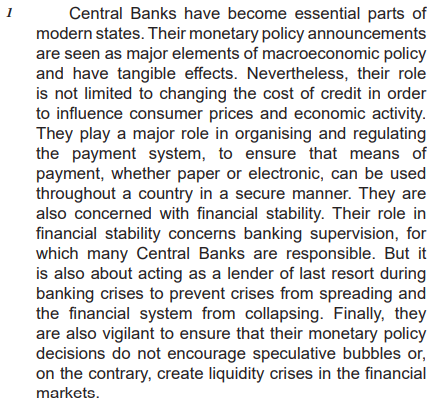
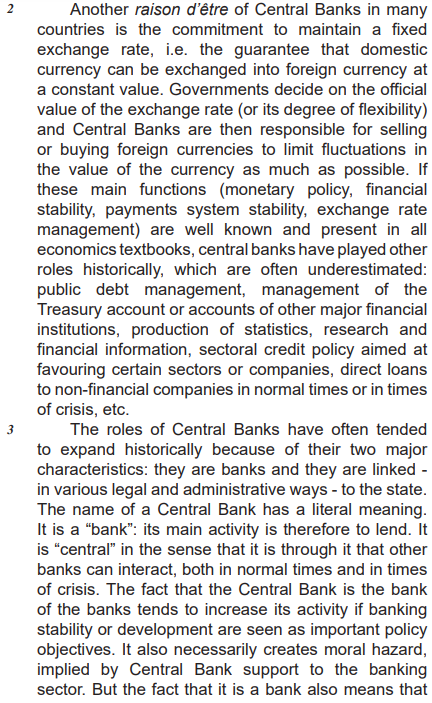
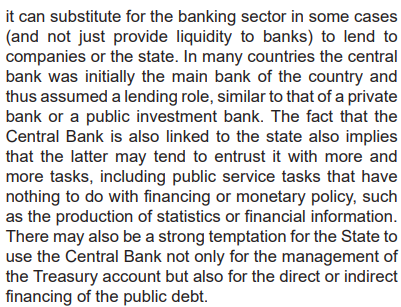
Available at: https://www.parisschoolofeconomics.eu/docs/monnet-eric/history-of-central-banks_oxford.pdf. Retrieved on: May 13, 2024. Adapted.
Available at: https://www.parisschoolofeconomics.eu/docs/monnet-eric/history-of-central-banks_oxford.pdf. Retrieved on: May 13, 2024. Adapted.
Available at: https://www.parisschoolofeconomics.eu/docs/monnet-eric/history-of-central-banks_oxford.pdf. Retrieved on: May 13, 2024. Adapted.
Available at: https://www.parisschoolofeconomics.eu/docs/monnet-eric/history-of-central-banks_oxford.pdf. Retrieved on: May 13, 2024. Adapted.
Available at: https://www.parisschoolofeconomics.eu/docs/monnet-eric/history-of-central-banks_oxford.pdf. Retrieved on: May 13, 2024. Adapted.
McDonald’s and Wendy’s investors group demands fixes to franchisee child labor issues
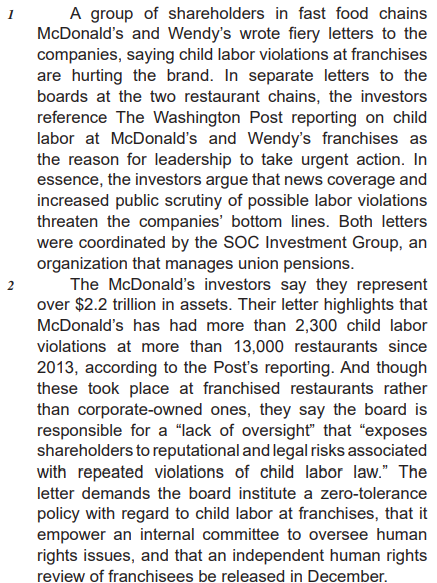
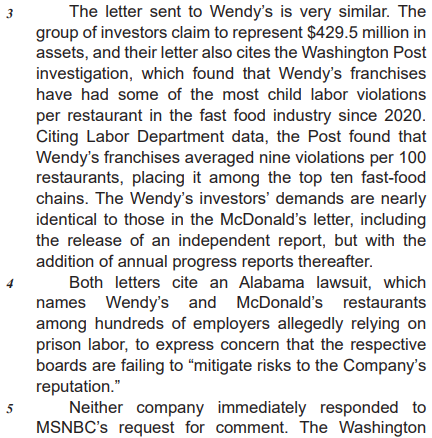
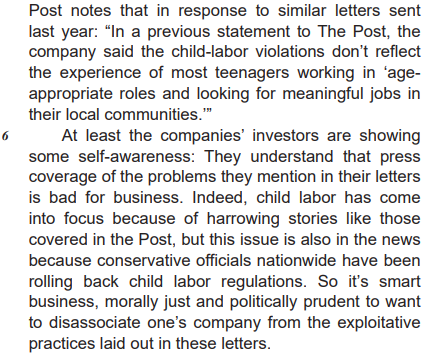
Available at: https://www.msnbc.com/the-reidout/reidout-blog/ mcdonalds-wendys-investors-child-labor-rcna151722. Retrieved on: May 14, 2024. Adapted.
McDonald’s and Wendy’s investors group demands fixes to franchisee child labor issues
Available at: https://www.msnbc.com/the-reidout/reidout-blog/ mcdonalds-wendys-investors-child-labor-rcna151722. Retrieved on: May 14, 2024. Adapted.
McDonald’s and Wendy’s investors group demands fixes to franchisee child labor issues
Available at: https://www.msnbc.com/the-reidout/reidout-blog/ mcdonalds-wendys-investors-child-labor-rcna151722. Retrieved on: May 14, 2024. Adapted.
McDonald’s and Wendy’s investors group demands fixes to franchisee child labor issues
Available at: https://www.msnbc.com/the-reidout/reidout-blog/ mcdonalds-wendys-investors-child-labor-rcna151722. Retrieved on: May 14, 2024. Adapted.
McDonald’s and Wendy’s investors group demands fixes to franchisee child labor issues
Available at: https://www.msnbc.com/the-reidout/reidout-blog/ mcdonalds-wendys-investors-child-labor-rcna151722. Retrieved on: May 14, 2024. Adapted.
The role of technology in language and literacy education
As Dourish and Bell (2011) have pointed out, “The technologically mediated world does not stand apart from the physical one within which it is embedded; rather, it provides a new set of ways for that physical world to be understood and appropriated” (p. 132). But those new ways of understanding and appropriating are not likely to be developed automatically. A favorable disposition of mind is a prerequisite. And that disposition is probably best fostered in educational settings. Young people today learn digitally mediated modes of expression largely outside of school, and those out of school uses of digital technologies are often more varied and more sophisticated than those they encounter at school (Jenkins, Purushotma, Weigel, Clinton, & Robison, 2009; Lundby, 2008). This raises the question of what the function of schools should be with respect to digital technologies and literacy. If literacy is the know-how needed to deal with the technology of writing in a given culture, and if globalization and its attendant social and technological changes have simultaneously increased individuals’ control of and control by technologies of communication, then I would suggest that the answer to the question above is that schools need to foster literacy that includes a dimension of critical semiotic awareness.
KERN, Richard. Language, literacy, and technology. Cambridge University Press, 2019.
According to the text, the technologically mediated world influences the understanding and appropriation of the physical world, therefore what role should educational settings play in this context to improve students’ awareness?
Genres, according to what is being appointed above, are defined according to their

 Conheça nossos planos