Questões de Concurso
Comentadas sobre interpretação de texto | reading comprehension em inglês
Foram encontradas 8.877 questões


Q203358
Inglês
Texto associado
Paulo César Nóbrega is one of 40 milion people living with HIV/AIDS. This is story:
Like most young people of my generation, I started using drugs as an adolescent. By the time I was 16, I was taking cannabis, hallucinogens and injecting drugs. Soon, my addiction led me to drug trafficking. Between 1985 and 1993, I was imprisoned in the city of São Paulo, Brazil, where I was diagnosed HIV-positive.
Initially, I was shocked. But I didn't really know what HIV or AIDS were, which is why I continued using drugs and sharing needles with other inmates. We received no guidance or preventive care.
In prison, AIDS first manifested itself through tuberculosis, an illness I suffered from three times. Although I was eventually given anti-retroviral medicines, I continued taking drugs and only restarted the treatment in earnest after abandoning drugs for good in 1999.
At that time, I was a member of a support group in my hometown, the coastal city of São Vicente, and was close to other HIV-positive people. We soon decided to establish the Hipupiara NGO to promote a sense of unity among people living with HIV and to improve their quality of life.
Unfortunately, I suffered a lot of prejudice for being HIV-positive, including from members of my family. I was also denied jobs. Then, in 2001, I started working as a fisherman, a job I retired from in 2005, at 50, due to poor health.
Today, I am free of drugs and am sticking to the treatment. I work as a volunteer for Hipupiara, contacting drug users in the city and referring them to treatment and assistance services.
Thanks to all the information I have accumulated about HIV/AIDS, I can now face and beat prejudice. People infected with HIV and drug users should not close up or avoid talking about their problems; we should help each other so that we can all lead a better life.
Like most young people of my generation, I started using drugs as an adolescent. By the time I was 16, I was taking cannabis, hallucinogens and injecting drugs. Soon, my addiction led me to drug trafficking. Between 1985 and 1993, I was imprisoned in the city of São Paulo, Brazil, where I was diagnosed HIV-positive.
Initially, I was shocked. But I didn't really know what HIV or AIDS were, which is why I continued using drugs and sharing needles with other inmates. We received no guidance or preventive care.
In prison, AIDS first manifested itself through tuberculosis, an illness I suffered from three times. Although I was eventually given anti-retroviral medicines, I continued taking drugs and only restarted the treatment in earnest after abandoning drugs for good in 1999.
At that time, I was a member of a support group in my hometown, the coastal city of São Vicente, and was close to other HIV-positive people. We soon decided to establish the Hipupiara NGO to promote a sense of unity among people living with HIV and to improve their quality of life.
Unfortunately, I suffered a lot of prejudice for being HIV-positive, including from members of my family. I was also denied jobs. Then, in 2001, I started working as a fisherman, a job I retired from in 2005, at 50, due to poor health.
Today, I am free of drugs and am sticking to the treatment. I work as a volunteer for Hipupiara, contacting drug users in the city and referring them to treatment and assistance services.
Thanks to all the information I have accumulated about HIV/AIDS, I can now face and beat prejudice. People infected with HIV and drug users should not close up or avoid talking about their problems; we should help each other so that we can all lead a better life.
(Available in: <
http://www.unodc.org/newsletter/200601/page005.htm...>; Acess in: Mar. 6, 2006.)
Mr. Nóbrega “was denied jobs” because:
Q203357
Inglês
Texto associado
Paulo César Nóbrega is one of 40 milion people living with HIV/AIDS. This is story:
Like most young people of my generation, I started using drugs as an adolescent. By the time I was 16, I was taking cannabis, hallucinogens and injecting drugs. Soon, my addiction led me to drug trafficking. Between 1985 and 1993, I was imprisoned in the city of São Paulo, Brazil, where I was diagnosed HIV-positive.
Initially, I was shocked. But I didn't really know what HIV or AIDS were, which is why I continued using drugs and sharing needles with other inmates. We received no guidance or preventive care.
In prison, AIDS first manifested itself through tuberculosis, an illness I suffered from three times. Although I was eventually given anti-retroviral medicines, I continued taking drugs and only restarted the treatment in earnest after abandoning drugs for good in 1999.
At that time, I was a member of a support group in my hometown, the coastal city of São Vicente, and was close to other HIV-positive people. We soon decided to establish the Hipupiara NGO to promote a sense of unity among people living with HIV and to improve their quality of life.
Unfortunately, I suffered a lot of prejudice for being HIV-positive, including from members of my family. I was also denied jobs. Then, in 2001, I started working as a fisherman, a job I retired from in 2005, at 50, due to poor health.
Today, I am free of drugs and am sticking to the treatment. I work as a volunteer for Hipupiara, contacting drug users in the city and referring them to treatment and assistance services.
Thanks to all the information I have accumulated about HIV/AIDS, I can now face and beat prejudice. People infected with HIV and drug users should not close up or avoid talking about their problems; we should help each other so that we can all lead a better life.
Like most young people of my generation, I started using drugs as an adolescent. By the time I was 16, I was taking cannabis, hallucinogens and injecting drugs. Soon, my addiction led me to drug trafficking. Between 1985 and 1993, I was imprisoned in the city of São Paulo, Brazil, where I was diagnosed HIV-positive.
Initially, I was shocked. But I didn't really know what HIV or AIDS were, which is why I continued using drugs and sharing needles with other inmates. We received no guidance or preventive care.
In prison, AIDS first manifested itself through tuberculosis, an illness I suffered from three times. Although I was eventually given anti-retroviral medicines, I continued taking drugs and only restarted the treatment in earnest after abandoning drugs for good in 1999.
At that time, I was a member of a support group in my hometown, the coastal city of São Vicente, and was close to other HIV-positive people. We soon decided to establish the Hipupiara NGO to promote a sense of unity among people living with HIV and to improve their quality of life.
Unfortunately, I suffered a lot of prejudice for being HIV-positive, including from members of my family. I was also denied jobs. Then, in 2001, I started working as a fisherman, a job I retired from in 2005, at 50, due to poor health.
Today, I am free of drugs and am sticking to the treatment. I work as a volunteer for Hipupiara, contacting drug users in the city and referring them to treatment and assistance services.
Thanks to all the information I have accumulated about HIV/AIDS, I can now face and beat prejudice. People infected with HIV and drug users should not close up or avoid talking about their problems; we should help each other so that we can all lead a better life.
(Available in: <
http://www.unodc.org/newsletter/200601/page005.htm...>; Acess in: Mar. 6, 2006.)
During the time Mr. Nóbrega spent in prison he:
Q203356
Inglês
Texto associado
Paulo César Nóbrega is one of 40 milion people living with HIV/AIDS. This is story:
Like most young people of my generation, I started using drugs as an adolescent. By the time I was 16, I was taking cannabis, hallucinogens and injecting drugs. Soon, my addiction led me to drug trafficking. Between 1985 and 1993, I was imprisoned in the city of São Paulo, Brazil, where I was diagnosed HIV-positive.
Initially, I was shocked. But I didn't really know what HIV or AIDS were, which is why I continued using drugs and sharing needles with other inmates. We received no guidance or preventive care.
In prison, AIDS first manifested itself through tuberculosis, an illness I suffered from three times. Although I was eventually given anti-retroviral medicines, I continued taking drugs and only restarted the treatment in earnest after abandoning drugs for good in 1999.
At that time, I was a member of a support group in my hometown, the coastal city of São Vicente, and was close to other HIV-positive people. We soon decided to establish the Hipupiara NGO to promote a sense of unity among people living with HIV and to improve their quality of life.
Unfortunately, I suffered a lot of prejudice for being HIV-positive, including from members of my family. I was also denied jobs. Then, in 2001, I started working as a fisherman, a job I retired from in 2005, at 50, due to poor health.
Today, I am free of drugs and am sticking to the treatment. I work as a volunteer for Hipupiara, contacting drug users in the city and referring them to treatment and assistance services.
Thanks to all the information I have accumulated about HIV/AIDS, I can now face and beat prejudice. People infected with HIV and drug users should not close up or avoid talking about their problems; we should help each other so that we can all lead a better life.
Like most young people of my generation, I started using drugs as an adolescent. By the time I was 16, I was taking cannabis, hallucinogens and injecting drugs. Soon, my addiction led me to drug trafficking. Between 1985 and 1993, I was imprisoned in the city of São Paulo, Brazil, where I was diagnosed HIV-positive.
Initially, I was shocked. But I didn't really know what HIV or AIDS were, which is why I continued using drugs and sharing needles with other inmates. We received no guidance or preventive care.
In prison, AIDS first manifested itself through tuberculosis, an illness I suffered from three times. Although I was eventually given anti-retroviral medicines, I continued taking drugs and only restarted the treatment in earnest after abandoning drugs for good in 1999.
At that time, I was a member of a support group in my hometown, the coastal city of São Vicente, and was close to other HIV-positive people. We soon decided to establish the Hipupiara NGO to promote a sense of unity among people living with HIV and to improve their quality of life.
Unfortunately, I suffered a lot of prejudice for being HIV-positive, including from members of my family. I was also denied jobs. Then, in 2001, I started working as a fisherman, a job I retired from in 2005, at 50, due to poor health.
Today, I am free of drugs and am sticking to the treatment. I work as a volunteer for Hipupiara, contacting drug users in the city and referring them to treatment and assistance services.
Thanks to all the information I have accumulated about HIV/AIDS, I can now face and beat prejudice. People infected with HIV and drug users should not close up or avoid talking about their problems; we should help each other so that we can all lead a better life.
(Available in: <
http://www.unodc.org/newsletter/200601/page005.htm...>; Acess in: Mar. 6, 2006.)
Mr. Nóbrega started dealing drugs:
Q203355
Inglês
Texto associado
Paulo César Nóbrega is one of 40 milion people living with HIV/AIDS. This is story:
Like most young people of my generation, I started using drugs as an adolescent. By the time I was 16, I was taking cannabis, hallucinogens and injecting drugs. Soon, my addiction led me to drug trafficking. Between 1985 and 1993, I was imprisoned in the city of São Paulo, Brazil, where I was diagnosed HIV-positive.
Initially, I was shocked. But I didn't really know what HIV or AIDS were, which is why I continued using drugs and sharing needles with other inmates. We received no guidance or preventive care.
In prison, AIDS first manifested itself through tuberculosis, an illness I suffered from three times. Although I was eventually given anti-retroviral medicines, I continued taking drugs and only restarted the treatment in earnest after abandoning drugs for good in 1999.
At that time, I was a member of a support group in my hometown, the coastal city of São Vicente, and was close to other HIV-positive people. We soon decided to establish the Hipupiara NGO to promote a sense of unity among people living with HIV and to improve their quality of life.
Unfortunately, I suffered a lot of prejudice for being HIV-positive, including from members of my family. I was also denied jobs. Then, in 2001, I started working as a fisherman, a job I retired from in 2005, at 50, due to poor health.
Today, I am free of drugs and am sticking to the treatment. I work as a volunteer for Hipupiara, contacting drug users in the city and referring them to treatment and assistance services.
Thanks to all the information I have accumulated about HIV/AIDS, I can now face and beat prejudice. People infected with HIV and drug users should not close up or avoid talking about their problems; we should help each other so that we can all lead a better life.
Like most young people of my generation, I started using drugs as an adolescent. By the time I was 16, I was taking cannabis, hallucinogens and injecting drugs. Soon, my addiction led me to drug trafficking. Between 1985 and 1993, I was imprisoned in the city of São Paulo, Brazil, where I was diagnosed HIV-positive.
Initially, I was shocked. But I didn't really know what HIV or AIDS were, which is why I continued using drugs and sharing needles with other inmates. We received no guidance or preventive care.
In prison, AIDS first manifested itself through tuberculosis, an illness I suffered from three times. Although I was eventually given anti-retroviral medicines, I continued taking drugs and only restarted the treatment in earnest after abandoning drugs for good in 1999.
At that time, I was a member of a support group in my hometown, the coastal city of São Vicente, and was close to other HIV-positive people. We soon decided to establish the Hipupiara NGO to promote a sense of unity among people living with HIV and to improve their quality of life.
Unfortunately, I suffered a lot of prejudice for being HIV-positive, including from members of my family. I was also denied jobs. Then, in 2001, I started working as a fisherman, a job I retired from in 2005, at 50, due to poor health.
Today, I am free of drugs and am sticking to the treatment. I work as a volunteer for Hipupiara, contacting drug users in the city and referring them to treatment and assistance services.
Thanks to all the information I have accumulated about HIV/AIDS, I can now face and beat prejudice. People infected with HIV and drug users should not close up or avoid talking about their problems; we should help each other so that we can all lead a better life.
(Available in: <
http://www.unodc.org/newsletter/200601/page005.htm...>; Acess in: Mar. 6, 2006.)
The text is about the story:
Ano: 2007
Banca:
CESPE / CEBRASPE
Órgão:
Petrobras
Provas:
CESPE - 2007 - Petrobras - Administrador Júnior
|
CESPE - 2007 - Petrobrás - Engenheiro de Equipamento Júnior - Elétrica |
CESPE - 2007 - Petrobrás - Analista de Sistemas Júnior - Engenharia de Software |
CESPE - 2007 - Petrobrás - Analista de Sistemas Júnior - Infra-Estrutura |
CESPE - 2007 - Petrobrás - Analista de Sistemas Júnior - Processos de Negócios |
Q167272
Inglês
Texto associado
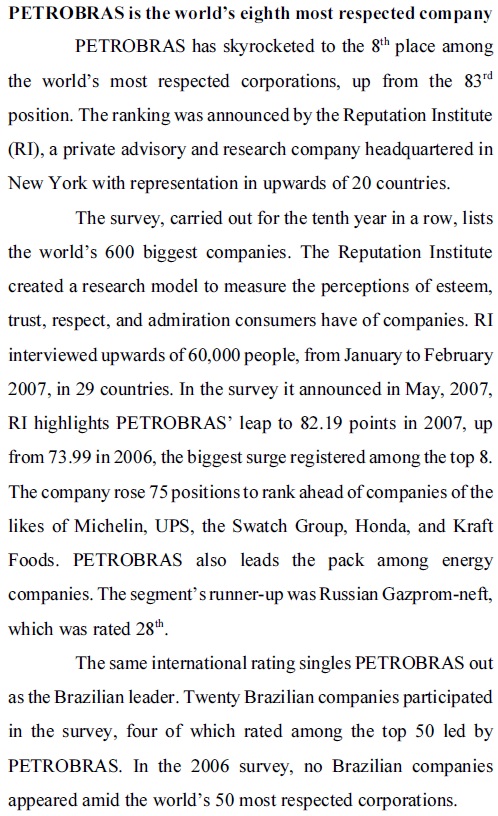
Internet: www.petrobras.com.br (adapted).
Based on the text above, judge the following items.
Internet: www.petrobras.com.br (adapted).
Based on the text above, judge the following items.
It is possible that the perception factor mentioned in the text helped PETROBRAS reach an outstanding ranking.
Ano: 2007
Banca:
CESPE / CEBRASPE
Órgão:
Petrobras
Provas:
CESPE - 2007 - Petrobras - Administrador Júnior
|
CESPE - 2007 - Petrobrás - Analista de Sistemas Júnior - Processos de Negócios |
Q167263
Inglês
Texto associado
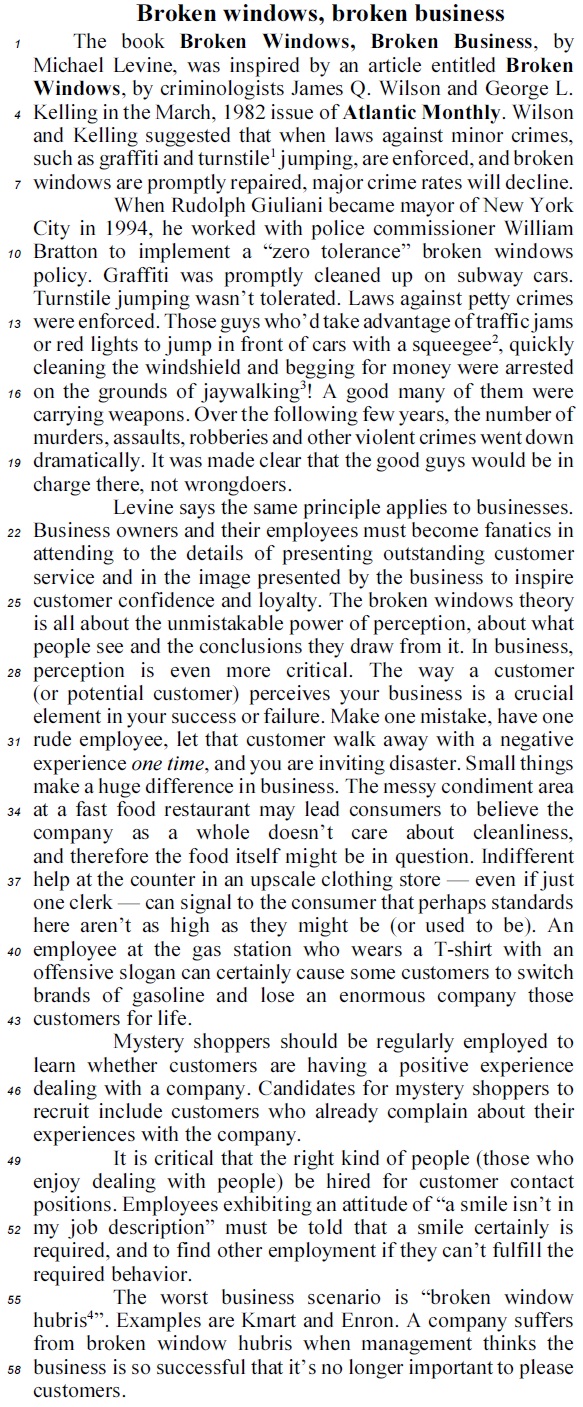
Internet: www.profitadvisors.com (adapted).
1turnstile – a narrow gate at the entrance of something, with metal bars that move in a circle so that only one person at a time can go through.
2squeegee – an object used for cleaning windows, consisting of a short handle with a rubber blade.
3jaywalking – a dangerous or illegal way of crossing a street at a place where cars do not usually stop.
4hubris – a very proud way of talking or behaving that offends people.
According to the text,
Internet: www.profitadvisors.com (adapted).
1turnstile – a narrow gate at the entrance of something, with metal bars that move in a circle so that only one person at a time can go through.
2squeegee – an object used for cleaning windows, consisting of a short handle with a rubber blade.
3jaywalking – a dangerous or illegal way of crossing a street at a place where cars do not usually stop.
4hubris – a very proud way of talking or behaving that offends people.
According to the text,
for customer contact positions, the candidate’s educational background is the decisive factor.
Ano: 2007
Banca:
CESPE / CEBRASPE
Órgão:
Petrobras
Prova:
CESPE - 2007 - Petrobras - Administrador Júnior |
Q167261
Inglês
Texto associado
Internet: www.profitadvisors.com (adapted).
1turnstile – a narrow gate at the entrance of something, with metal bars that move in a circle so that only one person at a time can go through.
2squeegee – an object used for cleaning windows, consisting of a short handle with a rubber blade.
3jaywalking – a dangerous or illegal way of crossing a street at a place where cars do not usually stop.
4hubris – a very proud way of talking or behaving that offends people.
According to the text,
Internet: www.profitadvisors.com (adapted).
1turnstile – a narrow gate at the entrance of something, with metal bars that move in a circle so that only one person at a time can go through.
2squeegee – an object used for cleaning windows, consisting of a short handle with a rubber blade.
3jaywalking – a dangerous or illegal way of crossing a street at a place where cars do not usually stop.
4hubris – a very proud way of talking or behaving that offends people.
According to the text,
customer service and the image presented by the business is a concern solely of the business owner.
Ano: 2007
Banca:
CESPE / CEBRASPE
Órgão:
Petrobras
Prova:
CESPE - 2007 - Petrobras - Administrador Júnior |
Q167259
Inglês
Texto associado
Internet: www.profitadvisors.com (adapted).
1turnstile – a narrow gate at the entrance of something, with metal bars that move in a circle so that only one person at a time can go through.
2squeegee – an object used for cleaning windows, consisting of a short handle with a rubber blade.
3jaywalking – a dangerous or illegal way of crossing a street at a place where cars do not usually stop.
4hubris – a very proud way of talking or behaving that offends people.
It can be inferred from the text that
Internet: www.profitadvisors.com (adapted).
1turnstile – a narrow gate at the entrance of something, with metal bars that move in a circle so that only one person at a time can go through.
2squeegee – an object used for cleaning windows, consisting of a short handle with a rubber blade.
3jaywalking – a dangerous or illegal way of crossing a street at a place where cars do not usually stop.
4hubris – a very proud way of talking or behaving that offends people.
It can be inferred from the text that
time and money spent training employees on how to deal with people really pays off.
Q29506
Inglês
Texto associado

According to the text,
According to the text,
the more successful a company is, the more satisfied its customers are.
Ano: 2007
Banca:
CESGRANRIO
Órgão:
REFAP SA
Prova:
CESGRANRIO - 2007 - REFAP SA - Programador de computador |
Q9417
Inglês
Texto associado
Good Stuff? - A Consumption Manifesto:
The Top Ten Principles of Good Consumption
Consumption is one of life's great pleasures. Buying
things we desire, traveling to beautiful places, eating
delectable food: icing on the cake of life. But too often the
effects of our blissful consumption make for a sad story.
Giant cars exhaling dangerous exhaust, hog farms pumping
out harmful pollutants, toxic trash pestering poor
neighborhoods - none of this if there weren't something
to sell.
But there's no need to trade pleasure for guilt. With
thoughtfulness and commitment, consumption can be a force
for good. Through buying what we need, produced the way
we want, we can create the world we'd like to live in.
To that end and for the future, a Consumption Manifesto:
Principle One. Reduce, Reuse, Recycle. This brilliant triad
says it all. Reduce: Avoid buying what you don't need-
and when you do get that dishwasher/lawnmower/toilet,
spend the money up front for an efficient model. Re-use:
Buy used stuff, and wring the last drop of usefulness out of
most everything you own. Recycle: Do it, but know that
it's the last and least effective leg of the triad. (Ultimately,
recycling simply results in the manufacture of more things.)
Principle Two. Stay close to home. Work close to home
to shorten your commute; eat food grown nearby; support
local businesses; join local organizations. All of these will
improve the look, shape, smell, and feel of your community.
Principle Three. Internal combustion engines are polluting,
and their use should be minimized. Period.
Principle Four. Watch what you eat. Whenever possible,
avoid food grown with pesticides, in feedlots, or by
agribusiness. It's an easy way to use your dollars to vote
against the spread of toxins in our bodies, land, and water.
Principle Five. Private industries have very little incentive
to improve their environmental practices. Our consumption
choices must encourage and support good behavior; our
political choices must support government regulation.
Principle Six. Support thoughtful innovations in
manufacturing and production. Hint: Drilling for oil is no
longer an innovation.
Principle Seven. Prioritize. Think hardest when buying
large objects; don't drive yourself mad fretting over the small
ones. It's easy to be distracted by the paper bag puzzle,
but an energy-sucking refrigerator is much more worthy of
your attention. (Small electronics are an exception.)
Principle Eight. Vote. Political engagement enables the
spread of environmentally conscious policies. Without
public action, thoughtful individuals are swimming
upstream.
Principle Nine. Don't feel guilty. It only makes you sad.
Principle Ten. Enjoy what you have-the things that are
yours alone, and the things that belong to none of us. Both
are nice, but the latter are precious. Those things that we
cannot manufacture and should never own-water, air, birds,
trees-are the foundation of life's pleasures. Without them,
we're nothing. With us, there may be nothing left. It's our
choice.
Umbra Fisk, Grist Magazine.
Slightly adapted from: http://www.worldwatch.org/node/1470
Access on June 1, 2007.
The Top Ten Principles of Good Consumption
Consumption is one of life's great pleasures. Buying
things we desire, traveling to beautiful places, eating
delectable food: icing on the cake of life. But too often the
effects of our blissful consumption make for a sad story.
Giant cars exhaling dangerous exhaust, hog farms pumping
out harmful pollutants, toxic trash pestering poor
neighborhoods - none of this if there weren't something
to sell.
But there's no need to trade pleasure for guilt. With
thoughtfulness and commitment, consumption can be a force
for good. Through buying what we need, produced the way
we want, we can create the world we'd like to live in.
To that end and for the future, a Consumption Manifesto:
Principle One. Reduce, Reuse, Recycle. This brilliant triad
says it all. Reduce: Avoid buying what you don't need-
and when you do get that dishwasher/lawnmower/toilet,
spend the money up front for an efficient model. Re-use:
Buy used stuff, and wring the last drop of usefulness out of
most everything you own. Recycle: Do it, but know that
it's the last and least effective leg of the triad. (Ultimately,
recycling simply results in the manufacture of more things.)
Principle Two. Stay close to home. Work close to home
to shorten your commute; eat food grown nearby; support
local businesses; join local organizations. All of these will
improve the look, shape, smell, and feel of your community.
Principle Three. Internal combustion engines are polluting,
and their use should be minimized. Period.
Principle Four. Watch what you eat. Whenever possible,
avoid food grown with pesticides, in feedlots, or by
agribusiness. It's an easy way to use your dollars to vote
against the spread of toxins in our bodies, land, and water.
Principle Five. Private industries have very little incentive
to improve their environmental practices. Our consumption
choices must encourage and support good behavior; our
political choices must support government regulation.
Principle Six. Support thoughtful innovations in
manufacturing and production. Hint: Drilling for oil is no
longer an innovation.
Principle Seven. Prioritize. Think hardest when buying
large objects; don't drive yourself mad fretting over the small
ones. It's easy to be distracted by the paper bag puzzle,
but an energy-sucking refrigerator is much more worthy of
your attention. (Small electronics are an exception.)
Principle Eight. Vote. Political engagement enables the
spread of environmentally conscious policies. Without
public action, thoughtful individuals are swimming
upstream.
Principle Nine. Don't feel guilty. It only makes you sad.
Principle Ten. Enjoy what you have-the things that are
yours alone, and the things that belong to none of us. Both
are nice, but the latter are precious. Those things that we
cannot manufacture and should never own-water, air, birds,
trees-are the foundation of life's pleasures. Without them,
we're nothing. With us, there may be nothing left. It's our
choice.
Umbra Fisk, Grist Magazine.
Slightly adapted from: http://www.worldwatch.org/node/1470
Access on June 1, 2007.
Check the only alternative that is NOT correct according to the principles listed in the manifesto.
Ano: 2007
Banca:
CESGRANRIO
Órgão:
REFAP SA
Prova:
CESGRANRIO - 2007 - REFAP SA - Programador de computador |
Q9416
Inglês
Texto associado
Good Stuff? - A Consumption Manifesto:
The Top Ten Principles of Good Consumption
Consumption is one of life's great pleasures. Buying
things we desire, traveling to beautiful places, eating
delectable food: icing on the cake of life. But too often the
effects of our blissful consumption make for a sad story.
Giant cars exhaling dangerous exhaust, hog farms pumping
out harmful pollutants, toxic trash pestering poor
neighborhoods - none of this if there weren't something
to sell.
But there's no need to trade pleasure for guilt. With
thoughtfulness and commitment, consumption can be a force
for good. Through buying what we need, produced the way
we want, we can create the world we'd like to live in.
To that end and for the future, a Consumption Manifesto:
Principle One. Reduce, Reuse, Recycle. This brilliant triad
says it all. Reduce: Avoid buying what you don't need-
and when you do get that dishwasher/lawnmower/toilet,
spend the money up front for an efficient model. Re-use:
Buy used stuff, and wring the last drop of usefulness out of
most everything you own. Recycle: Do it, but know that
it's the last and least effective leg of the triad. (Ultimately,
recycling simply results in the manufacture of more things.)
Principle Two. Stay close to home. Work close to home
to shorten your commute; eat food grown nearby; support
local businesses; join local organizations. All of these will
improve the look, shape, smell, and feel of your community.
Principle Three. Internal combustion engines are polluting,
and their use should be minimized. Period.
Principle Four. Watch what you eat. Whenever possible,
avoid food grown with pesticides, in feedlots, or by
agribusiness. It's an easy way to use your dollars to vote
against the spread of toxins in our bodies, land, and water.
Principle Five. Private industries have very little incentive
to improve their environmental practices. Our consumption
choices must encourage and support good behavior; our
political choices must support government regulation.
Principle Six. Support thoughtful innovations in
manufacturing and production. Hint: Drilling for oil is no
longer an innovation.
Principle Seven. Prioritize. Think hardest when buying
large objects; don't drive yourself mad fretting over the small
ones. It's easy to be distracted by the paper bag puzzle,
but an energy-sucking refrigerator is much more worthy of
your attention. (Small electronics are an exception.)
Principle Eight. Vote. Political engagement enables the
spread of environmentally conscious policies. Without
public action, thoughtful individuals are swimming
upstream.
Principle Nine. Don't feel guilty. It only makes you sad.
Principle Ten. Enjoy what you have-the things that are
yours alone, and the things that belong to none of us. Both
are nice, but the latter are precious. Those things that we
cannot manufacture and should never own-water, air, birds,
trees-are the foundation of life's pleasures. Without them,
we're nothing. With us, there may be nothing left. It's our
choice.
Umbra Fisk, Grist Magazine.
Slightly adapted from: http://www.worldwatch.org/node/1470
Access on June 1, 2007.
The Top Ten Principles of Good Consumption
Consumption is one of life's great pleasures. Buying
things we desire, traveling to beautiful places, eating
delectable food: icing on the cake of life. But too often the
effects of our blissful consumption make for a sad story.
Giant cars exhaling dangerous exhaust, hog farms pumping
out harmful pollutants, toxic trash pestering poor
neighborhoods - none of this if there weren't something
to sell.
But there's no need to trade pleasure for guilt. With
thoughtfulness and commitment, consumption can be a force
for good. Through buying what we need, produced the way
we want, we can create the world we'd like to live in.
To that end and for the future, a Consumption Manifesto:
Principle One. Reduce, Reuse, Recycle. This brilliant triad
says it all. Reduce: Avoid buying what you don't need-
and when you do get that dishwasher/lawnmower/toilet,
spend the money up front for an efficient model. Re-use:
Buy used stuff, and wring the last drop of usefulness out of
most everything you own. Recycle: Do it, but know that
it's the last and least effective leg of the triad. (Ultimately,
recycling simply results in the manufacture of more things.)
Principle Two. Stay close to home. Work close to home
to shorten your commute; eat food grown nearby; support
local businesses; join local organizations. All of these will
improve the look, shape, smell, and feel of your community.
Principle Three. Internal combustion engines are polluting,
and their use should be minimized. Period.
Principle Four. Watch what you eat. Whenever possible,
avoid food grown with pesticides, in feedlots, or by
agribusiness. It's an easy way to use your dollars to vote
against the spread of toxins in our bodies, land, and water.
Principle Five. Private industries have very little incentive
to improve their environmental practices. Our consumption
choices must encourage and support good behavior; our
political choices must support government regulation.
Principle Six. Support thoughtful innovations in
manufacturing and production. Hint: Drilling for oil is no
longer an innovation.
Principle Seven. Prioritize. Think hardest when buying
large objects; don't drive yourself mad fretting over the small
ones. It's easy to be distracted by the paper bag puzzle,
but an energy-sucking refrigerator is much more worthy of
your attention. (Small electronics are an exception.)
Principle Eight. Vote. Political engagement enables the
spread of environmentally conscious policies. Without
public action, thoughtful individuals are swimming
upstream.
Principle Nine. Don't feel guilty. It only makes you sad.
Principle Ten. Enjoy what you have-the things that are
yours alone, and the things that belong to none of us. Both
are nice, but the latter are precious. Those things that we
cannot manufacture and should never own-water, air, birds,
trees-are the foundation of life's pleasures. Without them,
we're nothing. With us, there may be nothing left. It's our
choice.
Umbra Fisk, Grist Magazine.
Slightly adapted from: http://www.worldwatch.org/node/1470
Access on June 1, 2007.
The sentence "Our consumption choices must encourage and support good behavior" (line 33-34), means that:
Ano: 2007
Banca:
CESGRANRIO
Órgão:
REFAP SA
Prova:
CESGRANRIO - 2007 - REFAP SA - Programador de computador |
Q9415
Inglês
Texto associado
Good Stuff? - A Consumption Manifesto:
The Top Ten Principles of Good Consumption
Consumption is one of life's great pleasures. Buying
things we desire, traveling to beautiful places, eating
delectable food: icing on the cake of life. But too often the
effects of our blissful consumption make for a sad story.
Giant cars exhaling dangerous exhaust, hog farms pumping
out harmful pollutants, toxic trash pestering poor
neighborhoods - none of this if there weren't something
to sell.
But there's no need to trade pleasure for guilt. With
thoughtfulness and commitment, consumption can be a force
for good. Through buying what we need, produced the way
we want, we can create the world we'd like to live in.
To that end and for the future, a Consumption Manifesto:
Principle One. Reduce, Reuse, Recycle. This brilliant triad
says it all. Reduce: Avoid buying what you don't need-
and when you do get that dishwasher/lawnmower/toilet,
spend the money up front for an efficient model. Re-use:
Buy used stuff, and wring the last drop of usefulness out of
most everything you own. Recycle: Do it, but know that
it's the last and least effective leg of the triad. (Ultimately,
recycling simply results in the manufacture of more things.)
Principle Two. Stay close to home. Work close to home
to shorten your commute; eat food grown nearby; support
local businesses; join local organizations. All of these will
improve the look, shape, smell, and feel of your community.
Principle Three. Internal combustion engines are polluting,
and their use should be minimized. Period.
Principle Four. Watch what you eat. Whenever possible,
avoid food grown with pesticides, in feedlots, or by
agribusiness. It's an easy way to use your dollars to vote
against the spread of toxins in our bodies, land, and water.
Principle Five. Private industries have very little incentive
to improve their environmental practices. Our consumption
choices must encourage and support good behavior; our
political choices must support government regulation.
Principle Six. Support thoughtful innovations in
manufacturing and production. Hint: Drilling for oil is no
longer an innovation.
Principle Seven. Prioritize. Think hardest when buying
large objects; don't drive yourself mad fretting over the small
ones. It's easy to be distracted by the paper bag puzzle,
but an energy-sucking refrigerator is much more worthy of
your attention. (Small electronics are an exception.)
Principle Eight. Vote. Political engagement enables the
spread of environmentally conscious policies. Without
public action, thoughtful individuals are swimming
upstream.
Principle Nine. Don't feel guilty. It only makes you sad.
Principle Ten. Enjoy what you have-the things that are
yours alone, and the things that belong to none of us. Both
are nice, but the latter are precious. Those things that we
cannot manufacture and should never own-water, air, birds,
trees-are the foundation of life's pleasures. Without them,
we're nothing. With us, there may be nothing left. It's our
choice.
Umbra Fisk, Grist Magazine.
Slightly adapted from: http://www.worldwatch.org/node/1470
Access on June 1, 2007.
The Top Ten Principles of Good Consumption
Consumption is one of life's great pleasures. Buying
things we desire, traveling to beautiful places, eating
delectable food: icing on the cake of life. But too often the
effects of our blissful consumption make for a sad story.
Giant cars exhaling dangerous exhaust, hog farms pumping
out harmful pollutants, toxic trash pestering poor
neighborhoods - none of this if there weren't something
to sell.
But there's no need to trade pleasure for guilt. With
thoughtfulness and commitment, consumption can be a force
for good. Through buying what we need, produced the way
we want, we can create the world we'd like to live in.
To that end and for the future, a Consumption Manifesto:
Principle One. Reduce, Reuse, Recycle. This brilliant triad
says it all. Reduce: Avoid buying what you don't need-
and when you do get that dishwasher/lawnmower/toilet,
spend the money up front for an efficient model. Re-use:
Buy used stuff, and wring the last drop of usefulness out of
most everything you own. Recycle: Do it, but know that
it's the last and least effective leg of the triad. (Ultimately,
recycling simply results in the manufacture of more things.)
Principle Two. Stay close to home. Work close to home
to shorten your commute; eat food grown nearby; support
local businesses; join local organizations. All of these will
improve the look, shape, smell, and feel of your community.
Principle Three. Internal combustion engines are polluting,
and their use should be minimized. Period.
Principle Four. Watch what you eat. Whenever possible,
avoid food grown with pesticides, in feedlots, or by
agribusiness. It's an easy way to use your dollars to vote
against the spread of toxins in our bodies, land, and water.
Principle Five. Private industries have very little incentive
to improve their environmental practices. Our consumption
choices must encourage and support good behavior; our
political choices must support government regulation.
Principle Six. Support thoughtful innovations in
manufacturing and production. Hint: Drilling for oil is no
longer an innovation.
Principle Seven. Prioritize. Think hardest when buying
large objects; don't drive yourself mad fretting over the small
ones. It's easy to be distracted by the paper bag puzzle,
but an energy-sucking refrigerator is much more worthy of
your attention. (Small electronics are an exception.)
Principle Eight. Vote. Political engagement enables the
spread of environmentally conscious policies. Without
public action, thoughtful individuals are swimming
upstream.
Principle Nine. Don't feel guilty. It only makes you sad.
Principle Ten. Enjoy what you have-the things that are
yours alone, and the things that belong to none of us. Both
are nice, but the latter are precious. Those things that we
cannot manufacture and should never own-water, air, birds,
trees-are the foundation of life's pleasures. Without them,
we're nothing. With us, there may be nothing left. It's our
choice.
Umbra Fisk, Grist Magazine.
Slightly adapted from: http://www.worldwatch.org/node/1470
Access on June 1, 2007.
What does the author state about recycling?
Ano: 2007
Banca:
CESGRANRIO
Órgão:
REFAP SA
Prova:
CESGRANRIO - 2007 - REFAP SA - Programador de computador |
Q9414
Inglês
Texto associado
Good Stuff? - A Consumption Manifesto:
The Top Ten Principles of Good Consumption
Consumption is one of life's great pleasures. Buying
things we desire, traveling to beautiful places, eating
delectable food: icing on the cake of life. But too often the
effects of our blissful consumption make for a sad story.
Giant cars exhaling dangerous exhaust, hog farms pumping
out harmful pollutants, toxic trash pestering poor
neighborhoods - none of this if there weren't something
to sell.
But there's no need to trade pleasure for guilt. With
thoughtfulness and commitment, consumption can be a force
for good. Through buying what we need, produced the way
we want, we can create the world we'd like to live in.
To that end and for the future, a Consumption Manifesto:
Principle One. Reduce, Reuse, Recycle. This brilliant triad
says it all. Reduce: Avoid buying what you don't need-
and when you do get that dishwasher/lawnmower/toilet,
spend the money up front for an efficient model. Re-use:
Buy used stuff, and wring the last drop of usefulness out of
most everything you own. Recycle: Do it, but know that
it's the last and least effective leg of the triad. (Ultimately,
recycling simply results in the manufacture of more things.)
Principle Two. Stay close to home. Work close to home
to shorten your commute; eat food grown nearby; support
local businesses; join local organizations. All of these will
improve the look, shape, smell, and feel of your community.
Principle Three. Internal combustion engines are polluting,
and their use should be minimized. Period.
Principle Four. Watch what you eat. Whenever possible,
avoid food grown with pesticides, in feedlots, or by
agribusiness. It's an easy way to use your dollars to vote
against the spread of toxins in our bodies, land, and water.
Principle Five. Private industries have very little incentive
to improve their environmental practices. Our consumption
choices must encourage and support good behavior; our
political choices must support government regulation.
Principle Six. Support thoughtful innovations in
manufacturing and production. Hint: Drilling for oil is no
longer an innovation.
Principle Seven. Prioritize. Think hardest when buying
large objects; don't drive yourself mad fretting over the small
ones. It's easy to be distracted by the paper bag puzzle,
but an energy-sucking refrigerator is much more worthy of
your attention. (Small electronics are an exception.)
Principle Eight. Vote. Political engagement enables the
spread of environmentally conscious policies. Without
public action, thoughtful individuals are swimming
upstream.
Principle Nine. Don't feel guilty. It only makes you sad.
Principle Ten. Enjoy what you have-the things that are
yours alone, and the things that belong to none of us. Both
are nice, but the latter are precious. Those things that we
cannot manufacture and should never own-water, air, birds,
trees-are the foundation of life's pleasures. Without them,
we're nothing. With us, there may be nothing left. It's our
choice.
Umbra Fisk, Grist Magazine.
Slightly adapted from: http://www.worldwatch.org/node/1470
Access on June 1, 2007.
The Top Ten Principles of Good Consumption
Consumption is one of life's great pleasures. Buying
things we desire, traveling to beautiful places, eating
delectable food: icing on the cake of life. But too often the
effects of our blissful consumption make for a sad story.
Giant cars exhaling dangerous exhaust, hog farms pumping
out harmful pollutants, toxic trash pestering poor
neighborhoods - none of this if there weren't something
to sell.
But there's no need to trade pleasure for guilt. With
thoughtfulness and commitment, consumption can be a force
for good. Through buying what we need, produced the way
we want, we can create the world we'd like to live in.
To that end and for the future, a Consumption Manifesto:
Principle One. Reduce, Reuse, Recycle. This brilliant triad
says it all. Reduce: Avoid buying what you don't need-
and when you do get that dishwasher/lawnmower/toilet,
spend the money up front for an efficient model. Re-use:
Buy used stuff, and wring the last drop of usefulness out of
most everything you own. Recycle: Do it, but know that
it's the last and least effective leg of the triad. (Ultimately,
recycling simply results in the manufacture of more things.)
Principle Two. Stay close to home. Work close to home
to shorten your commute; eat food grown nearby; support
local businesses; join local organizations. All of these will
improve the look, shape, smell, and feel of your community.
Principle Three. Internal combustion engines are polluting,
and their use should be minimized. Period.
Principle Four. Watch what you eat. Whenever possible,
avoid food grown with pesticides, in feedlots, or by
agribusiness. It's an easy way to use your dollars to vote
against the spread of toxins in our bodies, land, and water.
Principle Five. Private industries have very little incentive
to improve their environmental practices. Our consumption
choices must encourage and support good behavior; our
political choices must support government regulation.
Principle Six. Support thoughtful innovations in
manufacturing and production. Hint: Drilling for oil is no
longer an innovation.
Principle Seven. Prioritize. Think hardest when buying
large objects; don't drive yourself mad fretting over the small
ones. It's easy to be distracted by the paper bag puzzle,
but an energy-sucking refrigerator is much more worthy of
your attention. (Small electronics are an exception.)
Principle Eight. Vote. Political engagement enables the
spread of environmentally conscious policies. Without
public action, thoughtful individuals are swimming
upstream.
Principle Nine. Don't feel guilty. It only makes you sad.
Principle Ten. Enjoy what you have-the things that are
yours alone, and the things that belong to none of us. Both
are nice, but the latter are precious. Those things that we
cannot manufacture and should never own-water, air, birds,
trees-are the foundation of life's pleasures. Without them,
we're nothing. With us, there may be nothing left. It's our
choice.
Umbra Fisk, Grist Magazine.
Slightly adapted from: http://www.worldwatch.org/node/1470
Access on June 1, 2007.
The main purpose of this text is to:
Ano: 2007
Banca:
FCC
Órgão:
TRE-SE
Prova:
FCC - 2007 - TRE-SE - Analista Judiciário - Tecnologia da Informação |
Q9115
Inglês
Texto associado
Atenção: Para responder às questões de números 53 a 60,
considere o texto abaixo.
Brian Krebs on Computer Security
Three of the most aggressive buyers of online advertising
space today agreed to ...53... fines and reform their advertising
practices as part of a landmark anti-spyware settlement.
Mobile phone giant Cingular Wireless LLC, and travel
sites Priceline.com and Travelocity.com agreed to settle their
part in an ongoing investigation by the New York State Attorney
General's office, which last year sued adware/spyware purveyor
DirectRevenue for deceptively and fraudulently installing its popup
ad serving and Web tracking software on millions of PCs
...54... approval or consent of consumers.
This is an important settlement on a number of levels.
Online help forums are awash in desperate messages from
consumers ...55... machines were besieged by pop-up ads after
visiting a Web site that used slimy drive-by tactics to install
DirectRevenue's software, which is notoriously difficult to
remove from a host machine.
Perhaps more significantly, these advertisers were just
as culpable for supporting DirectRevenue's sleazy business
practices long after anti-spyware activists like Ben Edelman,
Suzi Turner and others published evidence of the illegal
distribution methods of DirectRevenue and the Webmasters it
paid to install its software. Experts consistently documented
adware bundles like the ones distributed by DirectRevenue
being installed on computers that contract distributors had
already infected with computer viruses and worms.
Ari Schwartz, deputy director for the Center for
Democracy & Technology, a consumer policy group in
Washington, D.C., said today's settlement was important
because it recognizes the oft-overlooked role that advertisers
continue to play in supporting the adware and spyware industry.
"The dirty secret about unwanted adware is that many
legitimate companies - knowingly or not - fund its proliferation
with their advertising dollars. Until we cut off that funding, there
will always be a financial incentive for companies to bombard
users with adware that they neither want nor need," Schwartz
said in a written statement.
While the settlement is a welcome and important one, the
terms and fines could have been a bit stiffer. Under the terms of
the agreement, all three companies will have to pay between
$30,000 and $35,000 each to New York state. In addition, "prior
to contracting with a company to deliver their ads, and quarterly
thereafter, the companies must investigate how their online ads
are delivered. The companies must immediately cease using
adware programs that violate the settlement agreements or their
own adware policies."
By Brian Krebs ? January 29, 2007
(Adapted from:
http://blog.washingtonpost.com/securityfix/2007/01/web_advertisers
_settle_ny_spyw.html)
considere o texto abaixo.
Brian Krebs on Computer Security
Three of the most aggressive buyers of online advertising
space today agreed to ...53... fines and reform their advertising
practices as part of a landmark anti-spyware settlement.
Mobile phone giant Cingular Wireless LLC, and travel
sites Priceline.com and Travelocity.com agreed to settle their
part in an ongoing investigation by the New York State Attorney
General's office, which last year sued adware/spyware purveyor
DirectRevenue for deceptively and fraudulently installing its popup
ad serving and Web tracking software on millions of PCs
...54... approval or consent of consumers.
This is an important settlement on a number of levels.
Online help forums are awash in desperate messages from
consumers ...55... machines were besieged by pop-up ads after
visiting a Web site that used slimy drive-by tactics to install
DirectRevenue's software, which is notoriously difficult to
remove from a host machine.
Perhaps more significantly, these advertisers were just
as culpable for supporting DirectRevenue's sleazy business
practices long after anti-spyware activists like Ben Edelman,
Suzi Turner and others published evidence of the illegal
distribution methods of DirectRevenue and the Webmasters it
paid to install its software. Experts consistently documented
adware bundles like the ones distributed by DirectRevenue
being installed on computers that contract distributors had
already infected with computer viruses and worms.
Ari Schwartz, deputy director for the Center for
Democracy & Technology, a consumer policy group in
Washington, D.C., said today's settlement was important
because it recognizes the oft-overlooked role that advertisers
continue to play in supporting the adware and spyware industry.
"The dirty secret about unwanted adware is that many
legitimate companies - knowingly or not - fund its proliferation
with their advertising dollars. Until we cut off that funding, there
will always be a financial incentive for companies to bombard
users with adware that they neither want nor need," Schwartz
said in a written statement.
While the settlement is a welcome and important one, the
terms and fines could have been a bit stiffer. Under the terms of
the agreement, all three companies will have to pay between
$30,000 and $35,000 each to New York state. In addition, "prior
to contracting with a company to deliver their ads, and quarterly
thereafter, the companies must investigate how their online ads
are delivered. The companies must immediately cease using
adware programs that violate the settlement agreements or their
own adware policies."
By Brian Krebs ? January 29, 2007
(Adapted from:
http://blog.washingtonpost.com/securityfix/2007/01/web_advertisers
_settle_ny_spyw.html)
Segundo o texto,
Ano: 2007
Banca:
FCC
Órgão:
TRE-SE
Prova:
FCC - 2007 - TRE-SE - Analista Judiciário - Tecnologia da Informação |
Q9114
Inglês
Texto associado
Atenção: Para responder às questões de números 53 a 60,
considere o texto abaixo.
Brian Krebs on Computer Security
Three of the most aggressive buyers of online advertising
space today agreed to ...53... fines and reform their advertising
practices as part of a landmark anti-spyware settlement.
Mobile phone giant Cingular Wireless LLC, and travel
sites Priceline.com and Travelocity.com agreed to settle their
part in an ongoing investigation by the New York State Attorney
General's office, which last year sued adware/spyware purveyor
DirectRevenue for deceptively and fraudulently installing its popup
ad serving and Web tracking software on millions of PCs
...54... approval or consent of consumers.
This is an important settlement on a number of levels.
Online help forums are awash in desperate messages from
consumers ...55... machines were besieged by pop-up ads after
visiting a Web site that used slimy drive-by tactics to install
DirectRevenue's software, which is notoriously difficult to
remove from a host machine.
Perhaps more significantly, these advertisers were just
as culpable for supporting DirectRevenue's sleazy business
practices long after anti-spyware activists like Ben Edelman,
Suzi Turner and others published evidence of the illegal
distribution methods of DirectRevenue and the Webmasters it
paid to install its software. Experts consistently documented
adware bundles like the ones distributed by DirectRevenue
being installed on computers that contract distributors had
already infected with computer viruses and worms.
Ari Schwartz, deputy director for the Center for
Democracy & Technology, a consumer policy group in
Washington, D.C., said today's settlement was important
because it recognizes the oft-overlooked role that advertisers
continue to play in supporting the adware and spyware industry.
"The dirty secret about unwanted adware is that many
legitimate companies - knowingly or not - fund its proliferation
with their advertising dollars. Until we cut off that funding, there
will always be a financial incentive for companies to bombard
users with adware that they neither want nor need," Schwartz
said in a written statement.
While the settlement is a welcome and important one, the
terms and fines could have been a bit stiffer. Under the terms of
the agreement, all three companies will have to pay between
$30,000 and $35,000 each to New York state. In addition, "prior
to contracting with a company to deliver their ads, and quarterly
thereafter, the companies must investigate how their online ads
are delivered. The companies must immediately cease using
adware programs that violate the settlement agreements or their
own adware policies."
By Brian Krebs ? January 29, 2007
(Adapted from:
http://blog.washingtonpost.com/securityfix/2007/01/web_advertisers
_settle_ny_spyw.html)
considere o texto abaixo.
Brian Krebs on Computer Security
Three of the most aggressive buyers of online advertising
space today agreed to ...53... fines and reform their advertising
practices as part of a landmark anti-spyware settlement.
Mobile phone giant Cingular Wireless LLC, and travel
sites Priceline.com and Travelocity.com agreed to settle their
part in an ongoing investigation by the New York State Attorney
General's office, which last year sued adware/spyware purveyor
DirectRevenue for deceptively and fraudulently installing its popup
ad serving and Web tracking software on millions of PCs
...54... approval or consent of consumers.
This is an important settlement on a number of levels.
Online help forums are awash in desperate messages from
consumers ...55... machines were besieged by pop-up ads after
visiting a Web site that used slimy drive-by tactics to install
DirectRevenue's software, which is notoriously difficult to
remove from a host machine.
Perhaps more significantly, these advertisers were just
as culpable for supporting DirectRevenue's sleazy business
practices long after anti-spyware activists like Ben Edelman,
Suzi Turner and others published evidence of the illegal
distribution methods of DirectRevenue and the Webmasters it
paid to install its software. Experts consistently documented
adware bundles like the ones distributed by DirectRevenue
being installed on computers that contract distributors had
already infected with computer viruses and worms.
Ari Schwartz, deputy director for the Center for
Democracy & Technology, a consumer policy group in
Washington, D.C., said today's settlement was important
because it recognizes the oft-overlooked role that advertisers
continue to play in supporting the adware and spyware industry.
"The dirty secret about unwanted adware is that many
legitimate companies - knowingly or not - fund its proliferation
with their advertising dollars. Until we cut off that funding, there
will always be a financial incentive for companies to bombard
users with adware that they neither want nor need," Schwartz
said in a written statement.
While the settlement is a welcome and important one, the
terms and fines could have been a bit stiffer. Under the terms of
the agreement, all three companies will have to pay between
$30,000 and $35,000 each to New York state. In addition, "prior
to contracting with a company to deliver their ads, and quarterly
thereafter, the companies must investigate how their online ads
are delivered. The companies must immediately cease using
adware programs that violate the settlement agreements or their
own adware policies."
By Brian Krebs ? January 29, 2007
(Adapted from:
http://blog.washingtonpost.com/securityfix/2007/01/web_advertisers
_settle_ny_spyw.html)
According to the text,
Ano: 2007
Banca:
FCC
Órgão:
TRE-SE
Prova:
FCC - 2007 - TRE-SE - Analista Judiciário - Tecnologia da Informação |
Q9113
Inglês
Texto associado
Atenção: Para responder às questões de números 53 a 60,
considere o texto abaixo.
Brian Krebs on Computer Security
Three of the most aggressive buyers of online advertising
space today agreed to ...53... fines and reform their advertising
practices as part of a landmark anti-spyware settlement.
Mobile phone giant Cingular Wireless LLC, and travel
sites Priceline.com and Travelocity.com agreed to settle their
part in an ongoing investigation by the New York State Attorney
General's office, which last year sued adware/spyware purveyor
DirectRevenue for deceptively and fraudulently installing its popup
ad serving and Web tracking software on millions of PCs
...54... approval or consent of consumers.
This is an important settlement on a number of levels.
Online help forums are awash in desperate messages from
consumers ...55... machines were besieged by pop-up ads after
visiting a Web site that used slimy drive-by tactics to install
DirectRevenue's software, which is notoriously difficult to
remove from a host machine.
Perhaps more significantly, these advertisers were just
as culpable for supporting DirectRevenue's sleazy business
practices long after anti-spyware activists like Ben Edelman,
Suzi Turner and others published evidence of the illegal
distribution methods of DirectRevenue and the Webmasters it
paid to install its software. Experts consistently documented
adware bundles like the ones distributed by DirectRevenue
being installed on computers that contract distributors had
already infected with computer viruses and worms.
Ari Schwartz, deputy director for the Center for
Democracy & Technology, a consumer policy group in
Washington, D.C., said today's settlement was important
because it recognizes the oft-overlooked role that advertisers
continue to play in supporting the adware and spyware industry.
"The dirty secret about unwanted adware is that many
legitimate companies - knowingly or not - fund its proliferation
with their advertising dollars. Until we cut off that funding, there
will always be a financial incentive for companies to bombard
users with adware that they neither want nor need," Schwartz
said in a written statement.
While the settlement is a welcome and important one, the
terms and fines could have been a bit stiffer. Under the terms of
the agreement, all three companies will have to pay between
$30,000 and $35,000 each to New York state. In addition, "prior
to contracting with a company to deliver their ads, and quarterly
thereafter, the companies must investigate how their online ads
are delivered. The companies must immediately cease using
adware programs that violate the settlement agreements or their
own adware policies."
By Brian Krebs ? January 29, 2007
(Adapted from:
http://blog.washingtonpost.com/securityfix/2007/01/web_advertisers
_settle_ny_spyw.html)
considere o texto abaixo.
Brian Krebs on Computer Security
Three of the most aggressive buyers of online advertising
space today agreed to ...53... fines and reform their advertising
practices as part of a landmark anti-spyware settlement.
Mobile phone giant Cingular Wireless LLC, and travel
sites Priceline.com and Travelocity.com agreed to settle their
part in an ongoing investigation by the New York State Attorney
General's office, which last year sued adware/spyware purveyor
DirectRevenue for deceptively and fraudulently installing its popup
ad serving and Web tracking software on millions of PCs
...54... approval or consent of consumers.
This is an important settlement on a number of levels.
Online help forums are awash in desperate messages from
consumers ...55... machines were besieged by pop-up ads after
visiting a Web site that used slimy drive-by tactics to install
DirectRevenue's software, which is notoriously difficult to
remove from a host machine.
Perhaps more significantly, these advertisers were just
as culpable for supporting DirectRevenue's sleazy business
practices long after anti-spyware activists like Ben Edelman,
Suzi Turner and others published evidence of the illegal
distribution methods of DirectRevenue and the Webmasters it
paid to install its software. Experts consistently documented
adware bundles like the ones distributed by DirectRevenue
being installed on computers that contract distributors had
already infected with computer viruses and worms.
Ari Schwartz, deputy director for the Center for
Democracy & Technology, a consumer policy group in
Washington, D.C., said today's settlement was important
because it recognizes the oft-overlooked role that advertisers
continue to play in supporting the adware and spyware industry.
"The dirty secret about unwanted adware is that many
legitimate companies - knowingly or not - fund its proliferation
with their advertising dollars. Until we cut off that funding, there
will always be a financial incentive for companies to bombard
users with adware that they neither want nor need," Schwartz
said in a written statement.
While the settlement is a welcome and important one, the
terms and fines could have been a bit stiffer. Under the terms of
the agreement, all three companies will have to pay between
$30,000 and $35,000 each to New York state. In addition, "prior
to contracting with a company to deliver their ads, and quarterly
thereafter, the companies must investigate how their online ads
are delivered. The companies must immediately cease using
adware programs that violate the settlement agreements or their
own adware policies."
By Brian Krebs ? January 29, 2007
(Adapted from:
http://blog.washingtonpost.com/securityfix/2007/01/web_advertisers
_settle_ny_spyw.html)
The above text is about
Ano: 2007
Banca:
FCC
Órgão:
TRE-SE
Prova:
FCC - 2007 - TRE-SE - Analista Judiciário - Tecnologia da Informação |
Q9112
Inglês
Texto associado
Atenção: Para responder às questões de números 53 a 60,
considere o texto abaixo.
Brian Krebs on Computer Security
Three of the most aggressive buyers of online advertising
space today agreed to ...53... fines and reform their advertising
practices as part of a landmark anti-spyware settlement.
Mobile phone giant Cingular Wireless LLC, and travel
sites Priceline.com and Travelocity.com agreed to settle their
part in an ongoing investigation by the New York State Attorney
General's office, which last year sued adware/spyware purveyor
DirectRevenue for deceptively and fraudulently installing its popup
ad serving and Web tracking software on millions of PCs
...54... approval or consent of consumers.
This is an important settlement on a number of levels.
Online help forums are awash in desperate messages from
consumers ...55... machines were besieged by pop-up ads after
visiting a Web site that used slimy drive-by tactics to install
DirectRevenue's software, which is notoriously difficult to
remove from a host machine.
Perhaps more significantly, these advertisers were just
as culpable for supporting DirectRevenue's sleazy business
practices long after anti-spyware activists like Ben Edelman,
Suzi Turner and others published evidence of the illegal
distribution methods of DirectRevenue and the Webmasters it
paid to install its software. Experts consistently documented
adware bundles like the ones distributed by DirectRevenue
being installed on computers that contract distributors had
already infected with computer viruses and worms.
Ari Schwartz, deputy director for the Center for
Democracy & Technology, a consumer policy group in
Washington, D.C., said today's settlement was important
because it recognizes the oft-overlooked role that advertisers
continue to play in supporting the adware and spyware industry.
"The dirty secret about unwanted adware is that many
legitimate companies - knowingly or not - fund its proliferation
with their advertising dollars. Until we cut off that funding, there
will always be a financial incentive for companies to bombard
users with adware that they neither want nor need," Schwartz
said in a written statement.
While the settlement is a welcome and important one, the
terms and fines could have been a bit stiffer. Under the terms of
the agreement, all three companies will have to pay between
$30,000 and $35,000 each to New York state. In addition, "prior
to contracting with a company to deliver their ads, and quarterly
thereafter, the companies must investigate how their online ads
are delivered. The companies must immediately cease using
adware programs that violate the settlement agreements or their
own adware policies."
By Brian Krebs ? January 29, 2007
(Adapted from:
http://blog.washingtonpost.com/securityfix/2007/01/web_advertisers
_settle_ny_spyw.html)
considere o texto abaixo.
Brian Krebs on Computer Security
Three of the most aggressive buyers of online advertising
space today agreed to ...53... fines and reform their advertising
practices as part of a landmark anti-spyware settlement.
Mobile phone giant Cingular Wireless LLC, and travel
sites Priceline.com and Travelocity.com agreed to settle their
part in an ongoing investigation by the New York State Attorney
General's office, which last year sued adware/spyware purveyor
DirectRevenue for deceptively and fraudulently installing its popup
ad serving and Web tracking software on millions of PCs
...54... approval or consent of consumers.
This is an important settlement on a number of levels.
Online help forums are awash in desperate messages from
consumers ...55... machines were besieged by pop-up ads after
visiting a Web site that used slimy drive-by tactics to install
DirectRevenue's software, which is notoriously difficult to
remove from a host machine.
Perhaps more significantly, these advertisers were just
as culpable for supporting DirectRevenue's sleazy business
practices long after anti-spyware activists like Ben Edelman,
Suzi Turner and others published evidence of the illegal
distribution methods of DirectRevenue and the Webmasters it
paid to install its software. Experts consistently documented
adware bundles like the ones distributed by DirectRevenue
being installed on computers that contract distributors had
already infected with computer viruses and worms.
Ari Schwartz, deputy director for the Center for
Democracy & Technology, a consumer policy group in
Washington, D.C., said today's settlement was important
because it recognizes the oft-overlooked role that advertisers
continue to play in supporting the adware and spyware industry.
"The dirty secret about unwanted adware is that many
legitimate companies - knowingly or not - fund its proliferation
with their advertising dollars. Until we cut off that funding, there
will always be a financial incentive for companies to bombard
users with adware that they neither want nor need," Schwartz
said in a written statement.
While the settlement is a welcome and important one, the
terms and fines could have been a bit stiffer. Under the terms of
the agreement, all three companies will have to pay between
$30,000 and $35,000 each to New York state. In addition, "prior
to contracting with a company to deliver their ads, and quarterly
thereafter, the companies must investigate how their online ads
are delivered. The companies must immediately cease using
adware programs that violate the settlement agreements or their
own adware policies."
By Brian Krebs ? January 29, 2007
(Adapted from:
http://blog.washingtonpost.com/securityfix/2007/01/web_advertisers
_settle_ny_spyw.html)
Qual das palavras abaixo, conforme usadas no texto, NÃO se refere a práticas condenáveis?
Ano: 2007
Banca:
FCC
Órgão:
TRE-SE
Prova:
FCC - 2007 - TRE-SE - Analista Judiciário - Tecnologia da Informação |
Q9111
Inglês
Texto associado
Atenção: Para responder às questões de números 53 a 60,
considere o texto abaixo.
Brian Krebs on Computer Security
Three of the most aggressive buyers of online advertising
space today agreed to ...53... fines and reform their advertising
practices as part of a landmark anti-spyware settlement.
Mobile phone giant Cingular Wireless LLC, and travel
sites Priceline.com and Travelocity.com agreed to settle their
part in an ongoing investigation by the New York State Attorney
General's office, which last year sued adware/spyware purveyor
DirectRevenue for deceptively and fraudulently installing its popup
ad serving and Web tracking software on millions of PCs
...54... approval or consent of consumers.
This is an important settlement on a number of levels.
Online help forums are awash in desperate messages from
consumers ...55... machines were besieged by pop-up ads after
visiting a Web site that used slimy drive-by tactics to install
DirectRevenue's software, which is notoriously difficult to
remove from a host machine.
Perhaps more significantly, these advertisers were just
as culpable for supporting DirectRevenue's sleazy business
practices long after anti-spyware activists like Ben Edelman,
Suzi Turner and others published evidence of the illegal
distribution methods of DirectRevenue and the Webmasters it
paid to install its software. Experts consistently documented
adware bundles like the ones distributed by DirectRevenue
being installed on computers that contract distributors had
already infected with computer viruses and worms.
Ari Schwartz, deputy director for the Center for
Democracy & Technology, a consumer policy group in
Washington, D.C., said today's settlement was important
because it recognizes the oft-overlooked role that advertisers
continue to play in supporting the adware and spyware industry.
"The dirty secret about unwanted adware is that many
legitimate companies - knowingly or not - fund its proliferation
with their advertising dollars. Until we cut off that funding, there
will always be a financial incentive for companies to bombard
users with adware that they neither want nor need," Schwartz
said in a written statement.
While the settlement is a welcome and important one, the
terms and fines could have been a bit stiffer. Under the terms of
the agreement, all three companies will have to pay between
$30,000 and $35,000 each to New York state. In addition, "prior
to contracting with a company to deliver their ads, and quarterly
thereafter, the companies must investigate how their online ads
are delivered. The companies must immediately cease using
adware programs that violate the settlement agreements or their
own adware policies."
By Brian Krebs ? January 29, 2007
(Adapted from:
http://blog.washingtonpost.com/securityfix/2007/01/web_advertisers
_settle_ny_spyw.html)
considere o texto abaixo.
Brian Krebs on Computer Security
Three of the most aggressive buyers of online advertising
space today agreed to ...53... fines and reform their advertising
practices as part of a landmark anti-spyware settlement.
Mobile phone giant Cingular Wireless LLC, and travel
sites Priceline.com and Travelocity.com agreed to settle their
part in an ongoing investigation by the New York State Attorney
General's office, which last year sued adware/spyware purveyor
DirectRevenue for deceptively and fraudulently installing its popup
ad serving and Web tracking software on millions of PCs
...54... approval or consent of consumers.
This is an important settlement on a number of levels.
Online help forums are awash in desperate messages from
consumers ...55... machines were besieged by pop-up ads after
visiting a Web site that used slimy drive-by tactics to install
DirectRevenue's software, which is notoriously difficult to
remove from a host machine.
Perhaps more significantly, these advertisers were just
as culpable for supporting DirectRevenue's sleazy business
practices long after anti-spyware activists like Ben Edelman,
Suzi Turner and others published evidence of the illegal
distribution methods of DirectRevenue and the Webmasters it
paid to install its software. Experts consistently documented
adware bundles like the ones distributed by DirectRevenue
being installed on computers that contract distributors had
already infected with computer viruses and worms.
Ari Schwartz, deputy director for the Center for
Democracy & Technology, a consumer policy group in
Washington, D.C., said today's settlement was important
because it recognizes the oft-overlooked role that advertisers
continue to play in supporting the adware and spyware industry.
"The dirty secret about unwanted adware is that many
legitimate companies - knowingly or not - fund its proliferation
with their advertising dollars. Until we cut off that funding, there
will always be a financial incentive for companies to bombard
users with adware that they neither want nor need," Schwartz
said in a written statement.
While the settlement is a welcome and important one, the
terms and fines could have been a bit stiffer. Under the terms of
the agreement, all three companies will have to pay between
$30,000 and $35,000 each to New York state. In addition, "prior
to contracting with a company to deliver their ads, and quarterly
thereafter, the companies must investigate how their online ads
are delivered. The companies must immediately cease using
adware programs that violate the settlement agreements or their
own adware policies."
By Brian Krebs ? January 29, 2007
(Adapted from:
http://blog.washingtonpost.com/securityfix/2007/01/web_advertisers
_settle_ny_spyw.html)
Em quais dos trechos abaixo landmark tem o mesmo sentido do que tem no texto?
I. Max Steiner's score is a true landmark in Hollywood film music. The music virtually.
II. East Berlin's most striking landmark, the television tower, along with the East.
III. Since 1985, following the publication of a landmark study showing that less extensive.
IV. This victory was a double landmark, completing Winterbottom's record of beating.
V. One of the City's landmark buildings, the home of Lloyd's of London, .
I. Max Steiner's score is a true landmark in Hollywood film music. The music virtually.
II. East Berlin's most striking landmark, the television tower, along with the East.
III. Since 1985, following the publication of a landmark study showing that less extensive.
IV. This victory was a double landmark, completing Winterbottom's record of beating.
V. One of the City's landmark buildings, the home of Lloyd's of London, .
Ano: 2007
Banca:
CESGRANRIO
Órgão:
REFAP SA
Prova:
CESGRANRIO - 2007 - REFAP SA - Analista de Sistemas Júnior |
Q1733
Inglês
Texto associado
REPORT: BIOFUELS POISED TO DISPLACE OIL
Biofuels such as ethanol and biodiesel can
significantly reduce global dependence on oil, according
to a new report by the Worldwatch Institute.
Last year, world biofuel production surpassed 670,000
barrels per day, the equivalent of about 1 percent of the
global transport fuel market. Although oil still accounts for
more than 96 percent of transport fuel use, biofuel
production has doubled since 2001 and is poised for even
stronger growth as the industry responds to higher fuel
prices and supportive government policies. "Coordinated
action to expand biofuel markets and advance new
technologies could relieve pressure on oil prices while
strengthening agricultural economies and reducing climatealtering
emissions," says Worldwatch Institute President
Christopher Flavin.
Brazil is the world's biofuel leader, with half of its
sugar cane crop providing more than 40 percent of its nondiesel
transport fuel. In the United States, where 15 percent
of the corn crop provides about 2 percent of the non-diesel
transport fuel, ethanol production is growing even more
rapidly. This surging growth may allow the U.S. to overtake
Brazil as the world's biofuel leader this year. Both countries
are now estimated to be producing ethanol at less than
the current cost of gasoline.
Figures cited in the report reveal that biofuels could
provide 37 percent of U.S. transport fuel within the next 25
years, and up to 75 percent if automobile fuel economy
doubles. Biofuels could replace 20-30 percent of the oil
used in European Union countries during the same time
frame.
As the first-ever global assessment of the potential
social and environmental impacts of biofuels, Biofuels for
Transportation warns that the large-scale use of biofuels
carries significant agricultural and ecological risks. "It is
essential that government incentives be used to minimize
competition between food and fuel crops and to discourage
expansion onto ecologically valuable lands," says
Worldwatch Biofuels Project Manager Suzanne Hunt.
However, the report also finds that biofuels have the potential
to increase energy security, create new economic
opportunities in rural areas, and reduce local pollution and
emissions of greenhouse gases.
The long-term potential of biofuels is in the use of
non-food feedstock that include agricultural, municipal, and
forestry wastes as well as fast-growing, cellulose-rich
energy crops such as switchgrass. It is expected that the
combination of cellulosic biomass resources and "nextgeneration"
biofuel conversion technologies will compete
with conventional gasoline and diesel fuel without subsidies
in the medium term.
The report recommends policies to accelerate the
development of biofuels, while maximizing the benefits and
minimizing the risks. Recommendations include:
strengthening the market (i.e. focusing on market
development, infrastructure development, and the building
of transportation fleets that are able to use the new fuels),
speeding the transition to next-generation
technologies allowing for dramatically increased
production at lower cost, and facilitating sustainable
international biofuel trade, developing a true
international market unimpeded by the trade restrictions
in place today.
Biofuels such as ethanol and biodiesel can
significantly reduce global dependence on oil, according
to a new report by the Worldwatch Institute.
Last year, world biofuel production surpassed 670,000
barrels per day, the equivalent of about 1 percent of the
global transport fuel market. Although oil still accounts for
more than 96 percent of transport fuel use, biofuel
production has doubled since 2001 and is poised for even
stronger growth as the industry responds to higher fuel
prices and supportive government policies. "Coordinated
action to expand biofuel markets and advance new
technologies could relieve pressure on oil prices while
strengthening agricultural economies and reducing climatealtering
emissions," says Worldwatch Institute President
Christopher Flavin.
Brazil is the world's biofuel leader, with half of its
sugar cane crop providing more than 40 percent of its nondiesel
transport fuel. In the United States, where 15 percent
of the corn crop provides about 2 percent of the non-diesel
transport fuel, ethanol production is growing even more
rapidly. This surging growth may allow the U.S. to overtake
Brazil as the world's biofuel leader this year. Both countries
are now estimated to be producing ethanol at less than
the current cost of gasoline.
Figures cited in the report reveal that biofuels could
provide 37 percent of U.S. transport fuel within the next 25
years, and up to 75 percent if automobile fuel economy
doubles. Biofuels could replace 20-30 percent of the oil
used in European Union countries during the same time
frame.
As the first-ever global assessment of the potential
social and environmental impacts of biofuels, Biofuels for
Transportation warns that the large-scale use of biofuels
carries significant agricultural and ecological risks. "It is
essential that government incentives be used to minimize
competition between food and fuel crops and to discourage
expansion onto ecologically valuable lands," says
Worldwatch Biofuels Project Manager Suzanne Hunt.
However, the report also finds that biofuels have the potential
to increase energy security, create new economic
opportunities in rural areas, and reduce local pollution and
emissions of greenhouse gases.
The long-term potential of biofuels is in the use of
non-food feedstock that include agricultural, municipal, and
forestry wastes as well as fast-growing, cellulose-rich
energy crops such as switchgrass. It is expected that the
combination of cellulosic biomass resources and "nextgeneration"
biofuel conversion technologies will compete
with conventional gasoline and diesel fuel without subsidies
in the medium term.
The report recommends policies to accelerate the
development of biofuels, while maximizing the benefits and
minimizing the risks. Recommendations include:
strengthening the market (i.e. focusing on market
development, infrastructure development, and the building
of transportation fleets that are able to use the new fuels),
speeding the transition to next-generation
technologies allowing for dramatically increased
production at lower cost, and facilitating sustainable
international biofuel trade, developing a true
international market unimpeded by the trade restrictions
in place today.
Worldwatch Institute - June 7, 2006.
Adapted from: http://www.worldwatch.org/node/4079
Adapted from: http://www.worldwatch.org/node/4079
Mark the option that contains a recommendation included in the report.
Ano: 2007
Banca:
CESGRANRIO
Órgão:
REFAP SA
Provas:
CESGRANRIO - 2007 - REFAP SA - Analista de Sistemas Júnior
|
CESGRANRIO - 2007 - REFAP SA - Advogado Júnior |
Q1732
Inglês
Texto associado
REPORT: BIOFUELS POISED TO DISPLACE OIL
Biofuels such as ethanol and biodiesel can
significantly reduce global dependence on oil, according
to a new report by the Worldwatch Institute.
Last year, world biofuel production surpassed 670,000
barrels per day, the equivalent of about 1 percent of the
global transport fuel market. Although oil still accounts for
more than 96 percent of transport fuel use, biofuel
production has doubled since 2001 and is poised for even
stronger growth as the industry responds to higher fuel
prices and supportive government policies. "Coordinated
action to expand biofuel markets and advance new
technologies could relieve pressure on oil prices while
strengthening agricultural economies and reducing climatealtering
emissions," says Worldwatch Institute President
Christopher Flavin.
Brazil is the world's biofuel leader, with half of its
sugar cane crop providing more than 40 percent of its nondiesel
transport fuel. In the United States, where 15 percent
of the corn crop provides about 2 percent of the non-diesel
transport fuel, ethanol production is growing even more
rapidly. This surging growth may allow the U.S. to overtake
Brazil as the world's biofuel leader this year. Both countries
are now estimated to be producing ethanol at less than
the current cost of gasoline.
Figures cited in the report reveal that biofuels could
provide 37 percent of U.S. transport fuel within the next 25
years, and up to 75 percent if automobile fuel economy
doubles. Biofuels could replace 20-30 percent of the oil
used in European Union countries during the same time
frame.
As the first-ever global assessment of the potential
social and environmental impacts of biofuels, Biofuels for
Transportation warns that the large-scale use of biofuels
carries significant agricultural and ecological risks. "It is
essential that government incentives be used to minimize
competition between food and fuel crops and to discourage
expansion onto ecologically valuable lands," says
Worldwatch Biofuels Project Manager Suzanne Hunt.
However, the report also finds that biofuels have the potential
to increase energy security, create new economic
opportunities in rural areas, and reduce local pollution and
emissions of greenhouse gases.
The long-term potential of biofuels is in the use of
non-food feedstock that include agricultural, municipal, and
forestry wastes as well as fast-growing, cellulose-rich
energy crops such as switchgrass. It is expected that the
combination of cellulosic biomass resources and "nextgeneration"
biofuel conversion technologies will compete
with conventional gasoline and diesel fuel without subsidies
in the medium term.
The report recommends policies to accelerate the
development of biofuels, while maximizing the benefits and
minimizing the risks. Recommendations include:
strengthening the market (i.e. focusing on market
development, infrastructure development, and the building
of transportation fleets that are able to use the new fuels),
speeding the transition to next-generation
technologies allowing for dramatically increased
production at lower cost, and facilitating sustainable
international biofuel trade, developing a true
international market unimpeded by the trade restrictions
in place today.
Biofuels such as ethanol and biodiesel can
significantly reduce global dependence on oil, according
to a new report by the Worldwatch Institute.
Last year, world biofuel production surpassed 670,000
barrels per day, the equivalent of about 1 percent of the
global transport fuel market. Although oil still accounts for
more than 96 percent of transport fuel use, biofuel
production has doubled since 2001 and is poised for even
stronger growth as the industry responds to higher fuel
prices and supportive government policies. "Coordinated
action to expand biofuel markets and advance new
technologies could relieve pressure on oil prices while
strengthening agricultural economies and reducing climatealtering
emissions," says Worldwatch Institute President
Christopher Flavin.
Brazil is the world's biofuel leader, with half of its
sugar cane crop providing more than 40 percent of its nondiesel
transport fuel. In the United States, where 15 percent
of the corn crop provides about 2 percent of the non-diesel
transport fuel, ethanol production is growing even more
rapidly. This surging growth may allow the U.S. to overtake
Brazil as the world's biofuel leader this year. Both countries
are now estimated to be producing ethanol at less than
the current cost of gasoline.
Figures cited in the report reveal that biofuels could
provide 37 percent of U.S. transport fuel within the next 25
years, and up to 75 percent if automobile fuel economy
doubles. Biofuels could replace 20-30 percent of the oil
used in European Union countries during the same time
frame.
As the first-ever global assessment of the potential
social and environmental impacts of biofuels, Biofuels for
Transportation warns that the large-scale use of biofuels
carries significant agricultural and ecological risks. "It is
essential that government incentives be used to minimize
competition between food and fuel crops and to discourage
expansion onto ecologically valuable lands," says
Worldwatch Biofuels Project Manager Suzanne Hunt.
However, the report also finds that biofuels have the potential
to increase energy security, create new economic
opportunities in rural areas, and reduce local pollution and
emissions of greenhouse gases.
The long-term potential of biofuels is in the use of
non-food feedstock that include agricultural, municipal, and
forestry wastes as well as fast-growing, cellulose-rich
energy crops such as switchgrass. It is expected that the
combination of cellulosic biomass resources and "nextgeneration"
biofuel conversion technologies will compete
with conventional gasoline and diesel fuel without subsidies
in the medium term.
The report recommends policies to accelerate the
development of biofuels, while maximizing the benefits and
minimizing the risks. Recommendations include:
strengthening the market (i.e. focusing on market
development, infrastructure development, and the building
of transportation fleets that are able to use the new fuels),
speeding the transition to next-generation
technologies allowing for dramatically increased
production at lower cost, and facilitating sustainable
international biofuel trade, developing a true
international market unimpeded by the trade restrictions
in place today.
Worldwatch Institute - June 7, 2006.
Adapted from: http://www.worldwatch.org/node/4079
Adapted from: http://www.worldwatch.org/node/4079
Some of the benefits of the increase in biofuel production listed by the author are:

 Conheça nossos planos