Questões de Concurso
Comentadas sobre interpretação de texto | reading comprehension em inglês
Foram encontradas 8.877 questões


It was once considered the ‘port of death’ in the 19th century. Ships tended to avoid docking at the wood plank port, fearing the yellow fever. The floods in the city’s area provoked illnesses and once the bubonic plague almost decimated the population.
In the early 20th century, major urbanization created the port’s modern structure seen today, eliminating the risk of diseases and providing the port with modern, industrial-age infrastructure.
The first railway link from the port to the state capital São Paulo City, 79 km away, and the state’s interior, was completed in 1864. This allowed for an easier transportation of the vast masses of migrant workers who headed to São Paulo and the state’s numerous coffee farms.
Millions of immigrants reached Brazil via the port of Santos in the late 19th and early 20th centuries, proceeding to the country’s interior by railway. Santos was for a few decades the true gateway to Brazil for millions of immigrants.
(Adapted from http://en.wikipedia.org/wiki/Port_of_Santos – acesso em 21.01.2011)
Identifique as afirmativas verdadeiras ( V ) e falsas ( F ), de acordo com o texto.
( ) If you’re not in the room the use of timers to turn of the lights helps to save energy.
( ) Living in a warm region one shouldn’t have curtains at home.
( ) The color that your curtains must be is white, because they reflect the heat.
( ) A car releases the same amount of carbon dioxide into the air than a household generates.
( ) Anybody can preserve and help the Earth’s natural resources.
Assinale a alternativa que indica a sequência correta, de cima para baixo.
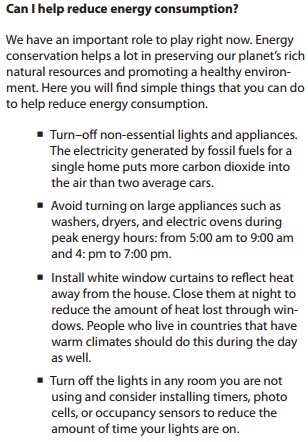
Can I help reduce energy consumption?
We have an important role to play right now. Energy conservation helps a lot in preserving our planet’s rich natural resources and promoting a healthy environment. Here you will find simple things that you can do to help reduce energy consumption.
· Turn–off non-essential lights and appliances. The electricity generated by fossil fuels for a single home puts more carbon dioxide into the air than two average cars.
· Avoid turning on large appliances such as washers, dryers, and electric ovens during peak energy hours: from 5:00 am to 9:00 am and 4: pm to 7:00 pm.
· Install white window curtains to reflect heat away from the house. Close them at night to reduce the amount of heat lost through windows. People who live in countries that have warm climates should do this during the day as well.
· Turn off the lights in any room you are not using and consider installing timers, photo cells, or occupancy sensors to reduce the amount of time your lights are on.
( ) If you’re not in the room the use of timers to turn of the lights helps to save energy.
( ) Living in a warm region one shouldn’t have curtains at home.
( ) The color that your curtains must be is white, because they refect the heat.
( ) A car releases the same amount of car- bon dioxide into the air than a household generates.
( ) Anybody can preserve and help the Earth’s natural resources.
Assinale a alternativa que indica a sequência correta, de cima para baixo.

Considering translation and some of the notions it envolves, judge
the following items.
Translation should be understood as communication and the search for an exact equivalence between the languages involved in the process.


Based on the text above, judge the following items.
Based on the text above, judge the following items.


Based on the text above, judge the following items.
Apps include everything from games to specialized word processors and even instruments. Generally, apps make use of a tablet's touchscreen to deliver an experience that a user couldn't get from a typical computer.
Sobre o texto acima, é INCORRETO afirmar:
By Kim Painter, USA TODAY, April 7th, 2011
Remember the lunch hour? In a more relaxed, less plugged-in era, office workers would rise up midday to eat food at tables, gossip with co-workers, enjoy a book on a park bench or take a walk in the sun. Can it still be done, without invoking the scorn of desk-bound colleagues or enduring constant electronic interruptions? It can and should. Here are five ways to break free: 1. Give yourself permission. As the hair-color ads say, “You're worth it." Taking a break in the workday is more than an indulgence, though: It's a way of taking care of your body and mind, says Laura Stack, a time-management expert and author who blogs at theproductivitypro.com. “You have to eliminate the guilt and remind yourself that the more you take care of yourself, the better you are able to take care of others," she says. “We have to recharge our batteries. We have to refresh. It's OK." 2. Get a posse. “Indeed, many people are wishing they could just peel themselves away, but they don't have the discipline," Stack says. Thus, invite a co-worker to take daily walks with you or a group to gather for Friday lunches. Pretty soon, you'll be working in a happier place (and feeling less like a shirker and more like a leader). 3. Schedule it. Put it on your calendar and on any electronic schedule visible to co-workers. “Code yourself as 'unavailable.' Nobody has to know why," says Laura Vanderkam, author of 168 Hours: You Have More Time Than You Think. And, if a daily hour of “me time" seems impossible right now, then commit to just one or two big breaks a week. Or schedule several 15-minute leg-stretching, mind-freeing breaks each day. Keep those appointments, and spend them in “a cone of silence," without electronic devices, Vanderkam says. 4. Apply deadline pressure. The promise of a lunch break could make for a more productive morning: “Treat it as a deadline or a game," Stack says. Pick a meaty task or two that must be finished before lunch and dive in. Plan what you'll finish in the afternoon, too. That will free your mind to enjoy the break, Vanderkam says. 5. Eat at your desk. That's right: If you can't beat them, seem to join them. If you really don't care about eating elsewhere, “pack your lunch and eat it at your desk, and save the time for something you'd rather do," whether it's going to the gym or sneaking out to your car to read, Vanderkam says. (But remember, you still have to schedule this break.) While most co-workers care less about your habits than you think they do, she says, “this has the extra advantage that you can be seen eating at your desk." . Access on April 7th, 2011. Adapted.
By Kim Painter, USA TODAY, April 7th, 2011
Remember the lunch hour? In a more relaxed, less plugged-in era, office workers would rise up midday to eat food at tables, gossip with co-workers, enjoy a book on a park bench or take a walk in the sun. Can it still be done, without invoking the scorn of desk-bound colleagues or enduring constant electronic interruptions? It can and should. Here are five ways to break free: 1. Give yourself permission. As the hair-color ads say, “You're worth it." Taking a break in the workday is more than an indulgence, though: It's a way of taking care of your body and mind, says Laura Stack, a time-management expert and author who blogs at theproductivitypro.com. “You have to eliminate the guilt and remind yourself that the more you take care of yourself, the better you are able to take care of others," she says. “We have to recharge our batteries. We have to refresh. It's OK." 2. Get a posse. “Indeed, many people are wishing they could just peel themselves away, but they don't have the discipline," Stack says. Thus, invite a co-worker to take daily walks with you or a group to gather for Friday lunches. Pretty soon, you'll be working in a happier place (and feeling less like a shirker and more like a leader). 3. Schedule it. Put it on your calendar and on any electronic schedule visible to co-workers. “Code yourself as 'unavailable.' Nobody has to know why," says Laura Vanderkam, author of 168 Hours: You Have More Time Than You Think. And, if a daily hour of “me time" seems impossible right now, then commit to just one or two big breaks a week. Or schedule several 15-minute leg-stretching, mind-freeing breaks each day. Keep those appointments, and spend them in “a cone of silence," without electronic devices, Vanderkam says. 4. Apply deadline pressure. The promise of a lunch break could make for a more productive morning: “Treat it as a deadline or a game," Stack says. Pick a meaty task or two that must be finished before lunch and dive in. Plan what you'll finish in the afternoon, too. That will free your mind to enjoy the break, Vanderkam says. 5. Eat at your desk. That's right: If you can't beat them, seem to join them. If you really don't care about eating elsewhere, “pack your lunch and eat it at your desk, and save the time for something you'd rather do," whether it's going to the gym or sneaking out to your car to read, Vanderkam says. (But remember, you still have to schedule this break.) While most co-workers care less about your habits than you think they do, she says, “this has the extra advantage that you can be seen eating at your desk." . Access on April 7th, 2011. Adapted.
Gerald Herbert
With crude still hemorrhaging into the Gulf of Mexico, deep-water drilling might seem taboo just now. In fact, extreme oil will likely be the new normal. Despite the gulf tragedy, the quest for oil and gas in the most difficult places on the planet is just getting underway. Prospecting proceeds apace in the ultradeepwater reserves off the coasts of Ghana and Nigeria, the sulfur-laden depths of the Black Sea, and the tar sands of Venezuela’s Orinoco Basin. Brazil’s Petrobras, which already controls a quarter of global deepwater operations, is just starting to plumb its 9 to 15 billion barrels of proven reserves buried some four miles below the Atlantic. The reason is simple: after a century and a half of breakneck oil prospecting, the easy stuff is history. Blistering growth in emerging nations has turned the power grid upside down. India and China will consume 28 percent of global energy by 2030, triple the juice they required in 1990. China is set to overtake the U.S. in energy consumption by 2014. And now that the Great Recession is easing, the earth’s hoard of conventional oil is waning even faster. The International Energy Agency reckons the world will need to find 65 million additional barrels a day by 2030. If the U.S. offshore-drilling moratorium drags on, look for idled rigs heading to other shores. Available in: Retrieved on: June 19, 2011.
Gerald Herbert
With crude still hemorrhaging into the Gulf of Mexico, deep-water drilling might seem taboo just now. In fact, extreme oil will likely be the new normal. Despite the gulf tragedy, the quest for oil and gas in the most difficult places on the planet is just getting underway. Prospecting proceeds apace in the ultradeepwater reserves off the coasts of Ghana and Nigeria, the sulfur-laden depths of the Black Sea, and the tar sands of Venezuela’s Orinoco Basin. Brazil’s Petrobras, which already controls a quarter of global deepwater operations, is just starting to plumb its 9 to 15 billion barrels of proven reserves buried some four miles below the Atlantic. The reason is simple: after a century and a half of breakneck oil prospecting, the easy stuff is history. Blistering growth in emerging nations has turned the power grid upside down. India and China will consume 28 percent of global energy by 2030, triple the juice they required in 1990. China is set to overtake the U.S. in energy consumption by 2014. And now that the Great Recession is easing, the earth’s hoard of conventional oil is waning even faster. The International Energy Agency reckons the world will need to find 65 million additional barrels a day by 2030. If the U.S. offshore-drilling moratorium drags on, look for idled rigs heading to other shores. Available in: Retrieved on: June 19, 2011.
Gerald Herbert
With crude still hemorrhaging into the Gulf of Mexico, deep-water drilling might seem taboo just now. In fact, extreme oil will likely be the new normal. Despite the gulf tragedy, the quest for oil and gas in the most difficult places on the planet is just getting underway. Prospecting proceeds apace in the ultradeepwater reserves off the coasts of Ghana and Nigeria, the sulfur-laden depths of the Black Sea, and the tar sands of Venezuela’s Orinoco Basin. Brazil’s Petrobras, which already controls a quarter of global deepwater operations, is just starting to plumb its 9 to 15 billion barrels of proven reserves buried some four miles below the Atlantic. The reason is simple: after a century and a half of breakneck oil prospecting, the easy stuff is history. Blistering growth in emerging nations has turned the power grid upside down. India and China will consume 28 percent of global energy by 2030, triple the juice they required in 1990. China is set to overtake the U.S. in energy consumption by 2014. And now that the Great Recession is easing, the earth’s hoard of conventional oil is waning even faster. The International Energy Agency reckons the world will need to find 65 million additional barrels a day by 2030. If the U.S. offshore-drilling moratorium drags on, look for idled rigs heading to other shores. Available in: Retrieved on: June 19, 2011.
Comparing Texts I and II,

Notorious specialists will take part in field events.


Based on the text above, judge the items below.

A placa acima objetiva
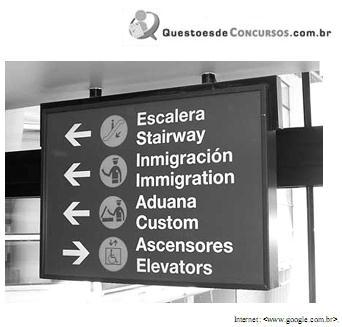
Um turista que esteja em frente à placa ilustrada acima deve observar que

 Conheça nossos planos