Questões de Concurso
Comentadas sobre interpretação de texto | reading comprehension em inglês
Foram encontradas 8.877 questões


Leia o texto para responder à questão.
The Research Assignment
Students today have access to so much information that they need to weigh the reliability of sources. Any resource – print, human, or electronic – used to support your research inquiry has to be evaluated for its credibility and reliability. In other words, you have to exercise some quality control over what you use. When you use the print and multimedia materials found in your college library, your evaluation task is not so complicated because librarians have already established the credibility and appropriateness of those materials for academic research. The marketplace forces publishers to be discriminating as well.
Data collected in interviews of persons whose reliability is not always clearly established should be carefully screened, especially if you present this material as expert opinion or as based on knowledge of your topic. And you may have even more difficulty establishing trustworthiness for electronic sources, especially Web and Internet sources.
Because the Internet and World Wide Web are easy to use and accessible, Web material is volatile – it changes, becomes outdated, or is deleted. Its lack of consistency and sometimes crude form make Web information suspect for people who use it for research. Because there is frequently no quality control over Web information, you must critically evaluate all the material you find there, text and graphics alike.
(http://www.umuc.edu/writingcenter/onlineguide/
chapter4-07.cfm-27.10.2013. Adaptado)
Leia o texto para responder à questão.
The Research Assignment
Students today have access to so much information that they need to weigh the reliability of sources. Any resource – print, human, or electronic – used to support your research inquiry has to be evaluated for its credibility and reliability. In other words, you have to exercise some quality control over what you use. When you use the print and multimedia materials found in your college library, your evaluation task is not so complicated because librarians have already established the credibility and appropriateness of those materials for academic research. The marketplace forces publishers to be discriminating as well.
Data collected in interviews of persons whose reliability is not always clearly established should be carefully screened, especially if you present this material as expert opinion or as based on knowledge of your topic. And you may have even more difficulty establishing trustworthiness for electronic sources, especially Web and Internet sources.
Because the Internet and World Wide Web are easy to use and accessible, Web material is volatile – it changes, becomes outdated, or is deleted. Its lack of consistency and sometimes crude form make Web information suspect for people who use it for research. Because there is frequently no quality control over Web information, you must critically evaluate all the material you find there, text and graphics alike.
(http://www.umuc.edu/writingcenter/onlineguide/
chapter4-07.cfm-27.10.2013. Adaptado)
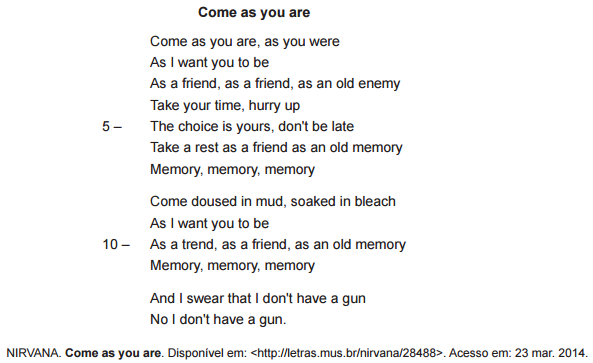
Marque C,se a proposição é verdadeira; E,se a proposição é falsa.
O autor dessa canção dirige-se às pessoas em geral, enfatizando que elas se apresentem e sejam aceitas como realmente são, sem quaisquer restrições.
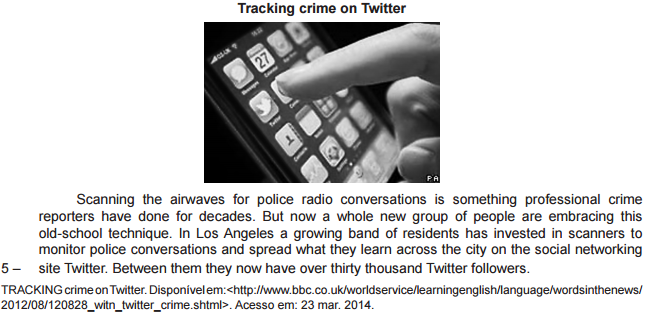
Repórteres profissionais da área criminal, após os relatos dos moradores, começaram a fazer o rastreamento de crimes através da escuta de conversas de rádio entre os policiais.
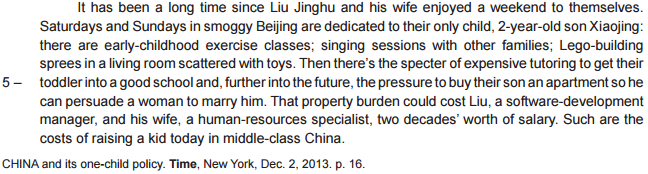
Marque C,se a proposição é verdadeira; E,se a proposição é falsa.
Liu Jinghu e sua esposa costumam divertir-se apenas nos fins de semana, quando seu único filho, Xiaojing, fica aos cuidados de amigos.
How Telecommuting Works
Telecommuting, which is growing in popularity, allows
employees to avoid long commutes.
“Brring,” the alarm startles you out of a deep sleep. It’s
8 a.m. on Monday morning. Time to head to the office.
You roll out of bed, brush your teeth and stumble your
way to the kitchen to grab some coffee.
Moments later, you head to the office, still wearing
your pajamas and fluffy slippers. Luckily for you, you
don’t have to go far – you work at home.
Telecommuting, or working at home, has grown in
popularity over the last 20 years.
On an increasing basis, workers are saying “no” to
long commutes and opting to work at home. In fact,
the U.S. Census Bureau reports that the number of
employees working from home grew by 23 percent
from 1990 to 2000.
Telecommuting workers revel in making their own
schedule – allowing them to schedule work around
family and personal commitments. With the ready
availability of technology tools, like the Internet and
home computers, companies are more willing to let
employees work from home.
( Adaptedfrom : < http: //home.howstuffworks.com/telecommuting.htm>Access on 18th January, 2014)
Everyone keeps data. Big organizations spend millions to look after their payroll, customer and transaction data. The penalties for getting it wrong are severe: businesses may collapse, shareholders and customers lose money, and for many organizations (airlines, health boards, energy companies), it is not exaggerating to say that even personal safety may be put at risk. And then there are the lawsuits. The problems in successfully designing, installing, and maintaining such large databases are the subject of numerous books on data management and software engineering. However, many small databases are used within large organizations and also for small businesses, clubs, and private concerns. When these go wrong, it doesn't make the front page of the papers; but the costs, often hidden, can be just as serious.
Where do we find these smaller electronic databases? Sports clubs will have membership information and match results; small businesses might maintain their own customer data. Within large organizations, there will also be a number of small projects to maintain data information that isn't easily or conveniently managed by the large system-wide databases. Researchers may keep their own experiment and survey results; groups will want to manage their own rosters or keep track of equipment; departments may keep their own detailed accounts and submit just a summary to the organization's financial software.
Most of these small databases are set up by end users. These are people whose main job is something other than that of a Computer professional. They will typically be scientists, administrators, technicians, accountants, or teachers, and many will have only modest skills when it comes to spreadsheet or database software.
The resulting databases often do not live up to expectations. Time and energy is expended to set up a few tables in a database product such as Microsoft Access, or in setting up a spreadsheet in a product such as Excel. Even more time is spent collecting and keying in data. But invariably (often within a short time frame) there is a problem producing what seems to be a quite simple report or query. Often this is because the way the tables have been set up makes the required result very awkward, if not impossible, to achieve.
A database that does not fulfill expectations becomes a
costly exercise in more ways than one. We clearly have the
cost of the time and effort expended on setting up an
unsatisfactory application. However, a much more serious
problem is the unability to make the best use of valuable
data. This is especially so for research data. Scientific and
social researchers may spend considerable money and many
years designing experiments, hiring assistants and collecting
and analyzing data, but often very little thought goes into
storing it in an appropriately designed database.
Unfortunately, some quite simple mistakes in design can mean that much of the potential information is lost. The
immediate objective may be satisfied, but unforeseen uses
of the data may be seriously compromised. Next year's grant
opportunities are lost.
Read text III and answer the question:
Text III
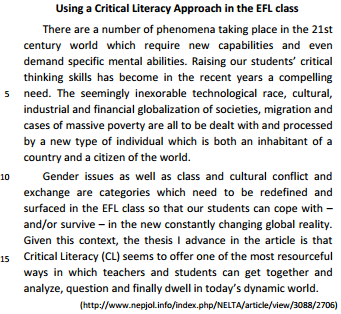
I. Discussing gender issues.
II. Emphasizing oral drilling.
III. Translating famous poets.
IV. Practicing critical literacy.
According to Text III, the strategies in line with the Brazilian National Parameters are
Read text III and answer the question:
Text III
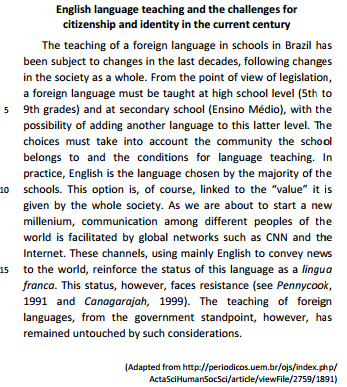
Read text I and answer the question.
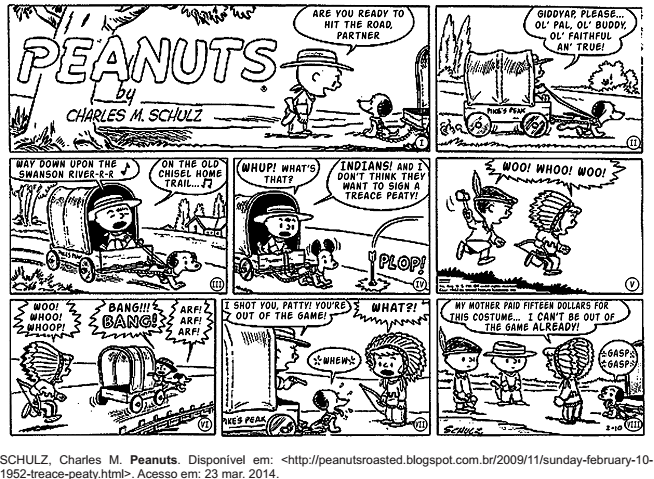
Com base no texto, julgue o item.
Nessa história em quadrinhos, o garoto, dirigindo a carroça, argumenta com Patty que ela foi baleada e que, portanto, está eliminada da brincadeira.
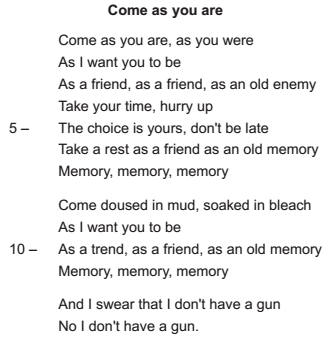
NIRVANA. Come as you are. Disponível em:<http://letras.mus.br/nirvana/28488> . Acesso em: 23 mar. 2014.
Com base no texto, julgue o item.
Nos dois últimos versos da canção – “And I swear that I don’t have a gun / No I don’t have a gun”–, o
autor lamenta o fato de não possuir uma arma.
text VII

Government of Montenegro launched first round
for offshore production concession contracts
on 7 August 2013.
The Ministry of Economy of Montenegro launched its first bid round for a production concession contract. A total of 3,191 square kilometres of offshore area is Offered, comprising of 13 blocks in the Adriatic Sea.
More information about the Round, data availability, and
overall procedure can be obtained either by contacting
[email protected] or at
www.petroleum.me
(The Economist, September 4th, 2013. Page 86.)
Self-repairing software tackles malware
University of Utah computer scientists have developed software that not only detects and eradicates never-before-seen viruses and other malware, but also automatically repairs damage caused by them. The software then prevents the invader from ever infecting the computer
again.
A3 is a software suite that works with a virtual machine - a virtual computer that emulates the operations of a computer without dedicated hardware. The A3 software is designed to watch over the virtual machine's operating system and applications, says Eric Eide, University of Utah research assistant professor of computer science leading the university's A3 team with U computer science associate professor John Regehr. A3 is designed to protect servers or similar business-grade computers that run on the Linux operating system. It also has been demonstrated to protect military applications.
The new software called A3, or Advanced Adaptive Applications, was co-developed by Massachusetts-based defense contractor, Raytheon BBN. The four-year project was completed in late September.
There are no plans to adapt A3 for home computers or laptops, but Eide says this could be possible in the future.
"A3 technologies could find their way into consumer products someday, which would help consumer devices protect themselves against fast-spreading malware or internal corruption of software components. But we haven't tried those experiments yet," he says.
Unlike a normal virus scanner on consumer PCs that compares a catalog of known viruses to something that has infected the computer, A3 can detect new, unknown viruses or malware automatically by sensing that something is occurring in the computer's operation that is not correct. It then can stop the virus, approximate a repair for the damaged software code, and then learn to never let that bug enter the machine gain.
While the military has an interest in A3 to enhance cybersecurity for its mission-critical systems, A3 also potentially could be used in the consumer space, such as in web services like Amazon. If a virus or attack stops the service, A3 could repair it in minutes without having to take the servers down.
Source: http://www.sciencedaily.com
I. A3 works exactly the same way as a normal virus scanner on consumer PCs.
II. The A3 software already found their way into consumer products and cloud-computing.
III. The software is designed to protect military servers that run on the Linux operating system.
IV. A3 only stops the virus and repairs the damaged software code.
According to the text:
Self-repairing software tackles malware
University of Utah computer scientists have developed software that not only detects and eradicates never-before-seen viruses and other malware, but also automatically repairs damage caused by them. The software then prevents the invader from ever infecting the computer
again.
A3 is a software suite that works with a virtual machine - a virtual computer that emulates the operations of a computer without dedicated hardware. The A3 software is designed to watch over the virtual machine's operating system and applications, says Eric Eide, University of Utah research assistant professor of computer science leading the university's A3 team with U computer science associate professor John Regehr. A3 is designed to protect servers or similar business-grade computers that run on the Linux operating system. It also has been demonstrated to protect military applications.
The new software called A3, or Advanced Adaptive Applications, was co-developed by Massachusetts-based defense contractor, Raytheon BBN. The four-year project was completed in late September.
There are no plans to adapt A3 for home computers or laptops, but Eide says this could be possible in the future.
"A3 technologies could find their way into consumer products someday, which would help consumer devices protect themselves against fast-spreading malware or internal corruption of software components. But we haven't tried those experiments yet," he says.
Unlike a normal virus scanner on consumer PCs that compares a catalog of known viruses to something that has infected the computer, A3 can detect new, unknown viruses or malware automatically by sensing that something is occurring in the computer's operation that is not correct. It then can stop the virus, approximate a repair for the damaged software code, and then learn to never let that bug enter the machine gain.
While the military has an interest in A3 to enhance cybersecurity for its mission-critical systems, A3 also potentially could be used in the consumer space, such as in web services like Amazon. If a virus or attack stops the service, A3 could repair it in minutes without having to take the servers down.
Source: http://www.sciencedaily.com
“A World Health Organization panel is convening Monday to discuss the ethics of using experimental medicine to fight the Ebola outbreak in West Africa. Since its onset this year, the virus is believed to have infected 1,779 people and killed 961, according to WHO's latest figures. Their conditions are said to be improving. ZMapp is also being given to Miguel Pajares, a Spanish priest infected with Ebola while working in Liberia, Spain's Ministry of Heath announced Saturday. The drug was sent from Geneva, Switzerland, to Madrid, where Pajares is being treated in a special isolation unit at Hospital Carlos III.
The patients' treatment has raised questions about the use of unproven and unlicensed drugs to treat Ebola and why these three have received the serum when so many others in West Africa also have the virus. Medical ethicists, scientific experts and lay people from the countries affected by the Ebola outbreak will discuss the use of unlicensed medicines to combat the virus during the WHO teleconference Monday. The panel will look at issues including whether it is ethical to use "unregistered interventions with unknown adverse effects," and, if so, who should receive them. The WHO last week declared the Ebola outbreak a "public health emergency of international concern." Since an Ebola epidemic was declared in Guinea in March, the disease has spread to Sierra Leone, Liberia and Nigeria. On Sunday, Ivory Coast banned flights to and from those countries affected by Ebola. Emirates this month become the first major international airline to suspend flights from Guinea, followed by pan-African airline ASKY and smaller regional carrier Arik Air. British Airways stopped its flights to Sierra Leone and Liberia last Tuesday, because of the "deteriorating public health situation."
The Ebola virus causes hemorrhagic fever that affects multiple organ systems in the body. It can kill up to 90% of those infected. Early symptoms include weakness, muscle pain, headaches and a sore throat. They later progress to vomiting, diarrhea, impaired kidney and liver function -- and sometimes internal and external bleeding. Ebola spreads through contact with organs and bodily fluids such as blood, saliva, urine and other secretions of infected people. The most common treatment requires supporting organ functions and maintaining bodily fluids such as blood and water long enough for the body to fight off the infection.
Disponível em: http://edition.cnn.com. Acesso em: 11 ago 2014. (Adaptado).
De acordo com o texto acima, o painel convocado pela Organização Mundial de Saúde tem por objetivo discutir sobre
Party girls don't get hurt
Can't feel anything, when will I learn
I push it down, push it down
I'm the one "for a good time call"
Phone's blowin' up, they're ringin' my
doorbell
I feel the love, feel the love
1, 2, 3 1, 2, 3 drink
1, 2, 3 1, 2, 3 drink
1, 2, 3 1, 2, 3 drink
Throw ‘em back, till I lose count
I'm gonna swing from the chandelier,
from the chandelier
I'm gonna live like tomorrow doesn't
exist
Like it doesn't exist
I'm gonna fly like a bird through the night
Feel my tears as they dry
I'm gonna swing from the chandelier,
from the chandelier
And I'm holding on for dear life
Won't look down, won't open my eyes
Keep my glass full until morning light
'Cause I'm just holding on for tonight
Help me, I'm holding on for dear life
Won't look down won't open my eyes
Keep my glass full until morning light
'Cause I'm just holding on for tonight
On for tonigh
Sun is up, I'm a mess
Gotta get out now, gotta run from this
Here comes the shame, here comes the
shame
[...]
Furler, Sia. Chandelier, Sia. In: 1000 Forms of Fear. Monkey Puzzle Records e RCA Records, 2014.
Starring Sandra Bullock and George Clooney as astronauts adrift in
space, Alfonso Cuarón’s astonishing thriller is one of the films of
the year, says Robbie Collin
Watch an astronaut drifting through space for long enough and eventually you notice how much they look like a newborn baby. The oxygen helmet makes their head bigger, rounder and cuter; their hands grasp eagerly at whatever happens to be passing; their limbs are made fat and their movements simple by the spacesuit’s cuddly bulk. They tumble head-over-heels like tripping toddlers or simply bob there in amniotic suspension. Even the lifeline that keeps them tethered to their ship has a pulsing, umbilical aspect.
Gravity, the new Alfonso Cuarón picture, is a heart- achingly tender film about the miracle of motherhood, and the billion-to-one odds against any of us being here, astronauts or not. It’s also a totally absorbing, often overpowering spectacle - a $100 million 3D action movie in which Sandra Bullock and George Clooney play two Hollywood-handsome spacefarers, fighting for their lives 375 miles above the Earth’s crust.
A series of captions over the opening titles reminds us that this is a dead zone: no oxygen or air pressure, and nothing to carry sound. “Life in space is impossible,” the final message tells us, as the cinema shakes with Steven Price’s resonant score, and then suddenly falls quiet.
For Dr. Ryan Stone (Bullock), a mission specialist in orbit for the first time, the lack of noise is welcome. She’s a medical engineer called up by NASA to install new software on to the Hubble Telescope, but also a mother in mourning for her four- year-old daughter, whom she lost in a senseless accident, and the silence enfolds her like a comfort blanket.
Available in: http://www.telegraph.co.uk
“It’s also a totally absorbing, often overpowering spectacle – a $100 million 3D action movie in which Sandra Bullock and George Clooney play two Hollywood-handsome spacefarers, fighting for their lives 375 miles above the Earth’s crust.”
According to the context and considering the text, it is correct to affirm that the underlined word refers to
This is not a great time to be a recent college graduate.
Average student-loan debt is $29,400. The underemployment rate is 44 percent for graduates ages 22 to 27, meaning they are holding jobs that don’t require bachelor’s degrees. And the average age of financial independence for college graduate these days is 30.
Such statistics have given rise to the narrative that a college degree is no longer worth it, although volumes of economic studies on lifetime earnings prove otherwise. Even so, given the number of college graduates struggling to launch their careers, a wide gap has emerged between what the workforce needs in employees and what colleges are producing in graduates.
Part of the problem is that we have high expectations for the bachelor’s degree today. Thirty years ago, when fewer people required a higher education to get ahead in life, the bachelor’s degree was seen as a vehicle for broad learning. The training part came later by going to graduate school or getting a job where the new employer trained you.
Now we demand that skills training move in tandem with broad learning, and expect both to be completed in the four years of an undergraduate education. For too many students, however, the bachelor’s degree is not providing that dual experience - high-impact, in-classroom learning and out-of-the- classroom, experiential, and hands-on learning necessary for success in today’s economy.
Because of student loan debt, graduate or professional school is no longer an option for many recent college graduates. They’re searching for quick and cheap add- on boot camps that give them what they’re missing. And a whole new set of providers are emerging outside of the traditional higher-education ecosystem to provide that lift.
Last year, General Assembly, which offers courses of a few hours to a few weeks in everything from digital marketing to web development, expanded to Washington, DC, where it is selling out of nearly all of its offerings. Its average student is in his mid-20s and just a few years out of college.
I. colleges are not producing in graduates what the workforce needs in employees.
II. nowadays, the bachelor’s degree is seen only as a vehicle for broad learning.
III. nearly 44% of graduates ages 22 to 27 hold jobs that require bachelor’s degree.
IV. colleges are expected to give students not only skills training, but also broad learning.
V. economic studies on lifetime earnings prove a college degree is no longer worth it.
The correct assumption(s) is(are)
The 2014 World Cup has seen innovations such as goal-line technology and vanishing spray introduced to football’s showpiece global event for the first time.
France benefited from the use of goal-line technology in their opening win over Honduras.
With language barriers no longer a problem, red and yellow cards were introduced at the 1970 World Cup and have been adopted worldwide since, with variants appearing in many other sports.

 Conheça nossos planos