Questões de Concurso
Comentadas sobre interpretação de texto | reading comprehension em inglês
Foram encontradas 8.877 questões


Principies for an effective informatics curriculum
The committee performed a comprehensive review of the considerabie existing material on building informatics curricula, including among many others the (UK) Royal Society report, the CSPrinciples site, the Computing at Schools Initiative, and the work of the CSTA. Two major conclusions follow from that review.
The first is the sheer number of existing experiences demonstrating that it is indeed possible to teach informatics successfully in primary and secondary education. The second conclusion is in the form of two core principies for such curricula. Existing experiences use a wide variety of approaches; there is no standard curriculum yet, and it was not part of the Committee's mission to define such a standard informatics curriculum for the whole of Europe. The committee has found, however, that while views diverge on the details, a remarkable consensus exists among experts on the basics of what a school informatics curriculum should (and should not) include. On the basis of that existing work, the Committee has identified two principies: leverage students' creativity, emphasize quality.
Leverage student creativity
A powerful aid for informatics teaching is the topic's potential for stimulating students; creativity. The barriers to innovation are often lower than in other disciplines; the technical equipment (computers) is ubiquitous and considerably less expensive. Opportunities exist even for a beginner: with proper guidance, a Creative student can quickly start writing a program or a Web Service, see the results right away, and make them available to numerous other people. Informatics education should draw on this phenomenon and channel the creativity into useful directions, while warning students away from nefarious directions such as destructive "hacking". The example of HFOSS (Humanitarian Free and Open Software Systems) shows the way towards constructive societal contributions based on informatics.
Informatics education must not just dwell on imparting information to students. It must draw attention to aspects of informatics that immediately appeal to young students, to encourage interaction, to bring abstract concepts to life through visualization and animation; a typical application of this idea is the careful use of (non- violent) games.
Foster quality
Curious students are always going to learn some IT and in particular some programming outside of informatics education through games scripting, Web site development, or adding software components to social networks. Informatics education must emphasize quality, in particular software quality, including the need for correctness (proper functioning of software), for good user interfaces, for taking the needs of users into consideration including psychological and social concerns. The role of informatics education here is:
• To convey the distinction between mere "coding" and software development as a constructive activity based on scientific and engineering principies.
• To dispel the wrong image of programming as an activity for "nerds" and emphasize its human, user-centered aspects, a focus that helps attract students of both genders.
Breaking the teacher availability deadlock
An obstacle to generalizing informatics education is the lack of teachers. It follows from a chicken-and-egg problem: as long as informatics is not in the curriculum, there is Iittle incentive to educate teachers in the subject; as long as there are no teachers, there is Iittle incentive to introduce the subject.
To bring informatics education to the levei that their schools deserve, European countries will have to take both long-term and short-term initiatives:
• Universities, in particular through their informatics departments, must put in place comprehensive programs to train informatics teachers, able to teach digital literacy and informatics under the same intellectual standards as in mathematics, physics and other Sciences.
• The current chicken-and-egg situation is not an excuse for deferring the start of urgently needed efforts. Existing experiences conclusively show that it is possible to break the deadlock. For example, a recent New York Times article explains how IT companies such as Microsoft and Google, conscious of the need to improve the state of education, allow some of their most committed engineers and researchers in the US to pair up with high school teachers to teach computational thinking. In Russia, it is common for academics who graduated from the best high schools to go back to these schools, also on a volunteer basis, and help teachers introduce the concepts of modern informatics. Ali these efforts respect the principie that outsiders must always be paired with current high-school teachers.
(Excerpt of ' Report ofthe joint Informatics Europe & ACM Europe Working Group on Informatics Education April 2013')
According to the text, it is correct to say that:
Brazilian exports have tripled in the last ten years and now the country requires huge investments in port infrastructure. Investment projects in the coming years are likely to exceed R$19 billion.
The Brazilian infrastructure sector is gearing up to sup- port the strong growth of the country’s foreign trade. In the last 10 years exports have more than tripled, while imports have more than doubled. In order to handle the trade boom Brazilian ports – which handle 95% of the country’s trade by volume and 85% by value – have been receiving significant public and private investments.
At the same time, large-scale projects in transportation logistics (railroads, highways, waterways and airports) are now underway or will be starting in the short or medium term and will promote greater integration with the country’s ports system.
For its part the federal government has made the rules _______________ the ports sector more flexible _______________ the recent publication of Decree 6,620, which allows Brazilian and international private companies ________________ build and operate new public ports under concession. Ports Minister Pedro Brito said he hopes Brazilian ports will receive investments totaling R$19 billion through the coming years.
Investments are needed to expand and modernize Brazilian ports to handle the growth of foreign trade. From 1998 to 2008 Brazil’s total trade flow, counting imports and exports, jumped from US$108 billion to an estimated US$400 billion, of US$281 billion in 2007.
Brazil is also expanding the number of countries with which it trades. From January to September of 2008 Brazil exported to 224 countries and imported from 109. While Brazilian exports still include a strong element of commodities (petroleum, iron ore, soy, grains, coffee and sugar as well as newcomers such as ethanol and bio-diesel) they now also include high-value- added items such as airplanes, vehicles, engines, auto parts, processed meat and steel products.
The sentence:
“The Brazilian infrastructure sector is gearing up to support the strong growth of the country’s foreign trade.” can be correctly translated as:
According to the text:
Building a Practical College Degree for the New Economy
This is not a great time to be a recent college graduate.
Average student-loan debt is $29,400. The underemployment rate is 44 percent for graduates ages 22 to 27, meaning they are holding jobs that don’t require bachelor’s degrees. And the average age of financial independence for college graduate these days is 30.
Such statistics have given rise to the narrative that a college degree is no longer worth it, although volumes of economic studies on lifetime earnings prove otherwise. Even so, given the number of college graduates struggling to launch their careers, a wide gap has emerged between what the workforce needs in employees and what colleges are producing in graduates.
Part of the problem is that we have high expectations for the bachelor’s degree today. Thirty years ago, when fewer people required a higher education to get ahead in life, the bachelor’s degree was seen as a vehicle for broad learning. The training part came later by going to graduate school or getting a job where the new employer trained you.
Now we demand that skills training move in tandem with broad learning, and expect both to be completed in the four years of an undergraduate education. For too many students, however, the bachelor’s degree is not providing that dual experience – high-impact, in-classroom learning and out-of-theclassroom, experiential, and hands-on learning necessary for success in today’s economy.
Because of student loan debt, graduate or professional school is no longer an option for many recent college graduates. They’re searching for quick and cheap addon boot camps that give them what they’re missing. And a whole new set of providers are emerging outside of the traditional higher-education ecosystem to provide that lift.
Last year, General Assembly, which offers courses of a few hours to a few weeks in everything from digital marketing to web development, expanded to Washington, DC, where it is selling out of nearly all of its offerings. Its average student is in his mid-20s and just a few years out of college.
According to the text,
I. colleges are not producing in graduates what the workforce needs in employees.
II. nowadays, the bachelor’s degree is seen only as a vehicle for broad learning.
III. nearly 44% of graduates ages 22 to 27 hold jobs that require bachelor’s degree.
IV. colleges are expected to give students not only skills training, but also broad learning.
V. economic studies on lifetime earnings prove a college degree is no longer worth it.
The correct assumption(s) is(are)

De acordo com o texto, assinale com V (verdadeiro) ou F (falso) as afirmativas abaixo.
( ) Ganhos financeiros não são os únicos objetivos do crime cibernético.
( ) Os Cavalos de Troia são o único programa que não pode destruir toda uma rede de computadores.
( ) Desde início dos anos 90, o compartilhamento de sítios de músicas já se fazia violando a lei.
( ) A disseminação de material sujeito a direitos autorais, sem autorização do proprietário, é considerada pirataria.
A sequência correta do preenchimento dos parênteses, de cima para baixo, é
Leia as frases abaixo:
I - Conseguir informações valiosas.
II - Burlar as medidas de segurança do governo ou corporações.
III - Gastar dinheiro.
De acordo com o texto, qual/quais se refere(m) aos principais objetivos do crime cibernético?

Leia as afirmativas abaixo de acordo com as linhas 42 a 50.
I - Nos Estados Unidos, uma grande porção do lixo eletrônico é processada nas prisões.
II - Nas prisões, os trabalhadores tem mais direitos do que no setor privado.
III - O trabalho de reciclagem feito nas prisões prejudica o desenvolvimento de uma infraestrutura de reciclagem responsável.
Quais estão corretas?
Leia as seguintes afirmativas de acordo com o trecho entre as linhas 21 e 33.
I - Mesmo quando enviamos o lixo eletrônico aos centros de reciclagem, não há garantia de que serão reciclados.
II - Nos Estados Unidos se recicla apenas uma percentagem de 11 a 14% do lixo eletrônico.
III - Quanto ao resto, fica por conta de outros métodos de descarte que são os mais seguros possíveis.
Quais estão corretas?
Complete, de acordo com as linhas 09-14.
Materiais eletrônicos tóxicos podem causar danos à saúde se:
Read the cartoon.
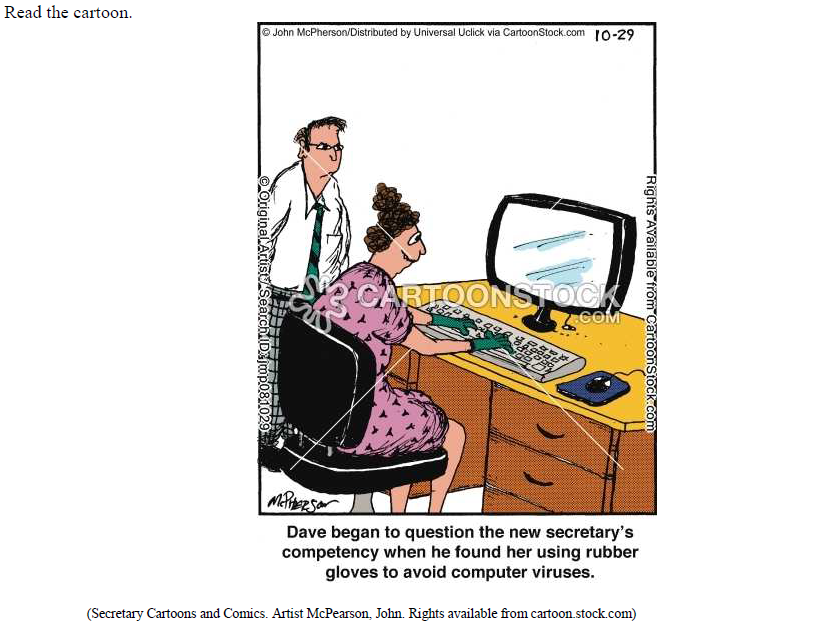
It can be inferred from the text that
Leia o texto para responder à questão.
The Research Assignment
Students today have access to so much information that they need to weigh the reliability of sources. Any resource – print, human, or electronic – used to support your research inquiry has to be evaluated for its credibility and reliability. In other words, you have to exercise some quality control over what you use. When you use the print and multimedia materials found in your college library, your evaluation task is not so complicated because librarians have already established the credibility and appropriateness of those materials for academic research. The marketplace forces publishers to be discriminating as well.
Data collected in interviews of persons whose reliability is not always clearly established should be carefully screened, especially if you present this material as expert opinion or as based on knowledge of your topic. And you may have even more difficulty establishing trustworthiness for electronic sources, especially Web and Internet sources.
Because the Internet and World Wide Web are easy to use and accessible, Web material is volatile – it changes, becomes outdated, or is deleted. Its lack of consistency and sometimes crude form make Web information suspect for people who use it for research. Because there is frequently no quality control over Web information, you must critically evaluate all the material you find there, text and graphics alike.
(http://www.umuc.edu/writingcenter/onlineguide/
chapter4-07.cfm-27.10.2013. Adaptado)

 Conheça nossos planos