Questões de Concurso
Comentadas sobre interpretação de texto | reading comprehension em inglês
Foram encontradas 8.877 questões


TEXT 1 below, retrieved and adapted from https://chroniclingamerica. loc.gov/lccn/sn83035487/1851-06-21/ed-1/seq-4/ on July 9th, 2018.
Text 1
Women’s rights convention – Sojourner Truth
One of the most unique and interesting speeches of the convention was made by Sojourner Truth, an emancipated slave. It is impossible to transfer it to paper or convey any adequate idea of the effect it produced upon the audience. Those only can appreciate it who saw her powerful form, her whole-souled, earnest gesture, and listened to her strong and truthful tones. She came forward to the platform and addressing the President said with great simplicity:
"May I say a few words?" Receiving an affirmative answer, she proceeded: I want to say a few words about this matter. I am a woman's rights. I have as much muscle as any man and can do as much work as any man. I have plowed and reaped and husked and chopped and mowed, and can any man do more than that? I have heard much about the sexes being equal. I can carry as much as any man, and can eat as much too, if I can get it. I am as strong as any man that is now. As for intellect, all I can say is, if a woman has a pint, and a man a quart -- why can't she have her little pint full? You need not be afraid to give us our rights for fear we will take too much; -- for we can't take more than our pint will hold. The poor men seem to be all in confusion, and don't know what to do. Why children, if you have woman's rights, give it to her and you will feel better. You will have your own rights, and they won't be so much trouble. I can't read, but I can hear. I have heard the bible and have learned that Eve caused man to sin. Well, if a woman upset the world, do give her a chance to set it right side up again. The Lady has spoken about Jesus, how he never spurned woman from him, and she was right. When Lazarus died, Mary and Martha came to him with faith and love and besought him to raise their brother. And Jesus wept and Lazarus came forth. And how came Jesus into the world? Through God who created him and the woman who bore him. Man, where was your part? But the women are coming up blessed be God and a few of the men are coming up with them. But man is in a tight place, the poor slave is on him, woman is coming on him, he is surely between a hawk and a buzzard.
Reference: Robinson, M. (1851, June 21). Women’s
rights convention: Sojourner Truth. Anti-slavery Bugle, vol. 6
no. 41, Page 160.
Question must be answered by looking at the following sentence from Text 1:
I have plowed and reaped and husked and chopped and mowed, and can any man do more than that?
When Sojourner chooses to use “can” in “and can any man do more than that?”, she does it because:
TEXT 1 below, retrieved and adapted from https://chroniclingamerica. loc.gov/lccn/sn83035487/1851-06-21/ed-1/seq-4/ on July 9th, 2018.
Text 1
Women’s rights convention – Sojourner Truth
One of the most unique and interesting speeches of the convention was made by Sojourner Truth, an emancipated slave. It is impossible to transfer it to paper or convey any adequate idea of the effect it produced upon the audience. Those only can appreciate it who saw her powerful form, her whole-souled, earnest gesture, and listened to her strong and truthful tones. She came forward to the platform and addressing the President said with great simplicity:
"May I say a few words?" Receiving an affirmative answer, she proceeded: I want to say a few words about this matter. I am a woman's rights. I have as much muscle as any man and can do as much work as any man. I have plowed and reaped and husked and chopped and mowed, and can any man do more than that? I have heard much about the sexes being equal. I can carry as much as any man, and can eat as much too, if I can get it. I am as strong as any man that is now. As for intellect, all I can say is, if a woman has a pint, and a man a quart -- why can't she have her little pint full? You need not be afraid to give us our rights for fear we will take too much; -- for we can't take more than our pint will hold. The poor men seem to be all in confusion, and don't know what to do. Why children, if you have woman's rights, give it to her and you will feel better. You will have your own rights, and they won't be so much trouble. I can't read, but I can hear. I have heard the bible and have learned that Eve caused man to sin. Well, if a woman upset the world, do give her a chance to set it right side up again. The Lady has spoken about Jesus, how he never spurned woman from him, and she was right. When Lazarus died, Mary and Martha came to him with faith and love and besought him to raise their brother. And Jesus wept and Lazarus came forth. And how came Jesus into the world? Through God who created him and the woman who bore him. Man, where was your part? But the women are coming up blessed be God and a few of the men are coming up with them. But man is in a tight place, the poor slave is on him, woman is coming on him, he is surely between a hawk and a buzzard.
Reference: Robinson, M. (1851, June 21). Women’s
rights convention: Sojourner Truth. Anti-slavery Bugle, vol. 6
no. 41, Page 160.
Question must be answered by looking at the following sentence from Text 1:
I have plowed and reaped and husked and chopped and mowed, and can any man do more than that?
About the use of -ed made by Sojourner, identify the correct and incorrect items:
( ) she uses –ed arbitrarily.
( ) she uses –ed to indicate the completeness of the actions.
( ) these words finish in –ed because they mark the perfective aspect of the verbs.
( ) these words finish in –ed because they’re adjectives.
The alternative that best represents the appropriate
sequence, top-down, is:
TEXT 1 below, retrieved and adapted from https://chroniclingamerica. loc.gov/lccn/sn83035487/1851-06-21/ed-1/seq-4/ on July 9th, 2018.
Text 1
Women’s rights convention – Sojourner Truth
One of the most unique and interesting speeches of the convention was made by Sojourner Truth, an emancipated slave. It is impossible to transfer it to paper or convey any adequate idea of the effect it produced upon the audience. Those only can appreciate it who saw her powerful form, her whole-souled, earnest gesture, and listened to her strong and truthful tones. She came forward to the platform and addressing the President said with great simplicity:
"May I say a few words?" Receiving an affirmative answer, she proceeded: I want to say a few words about this matter. I am a woman's rights. I have as much muscle as any man and can do as much work as any man. I have plowed and reaped and husked and chopped and mowed, and can any man do more than that? I have heard much about the sexes being equal. I can carry as much as any man, and can eat as much too, if I can get it. I am as strong as any man that is now. As for intellect, all I can say is, if a woman has a pint, and a man a quart -- why can't she have her little pint full? You need not be afraid to give us our rights for fear we will take too much; -- for we can't take more than our pint will hold. The poor men seem to be all in confusion, and don't know what to do. Why children, if you have woman's rights, give it to her and you will feel better. You will have your own rights, and they won't be so much trouble. I can't read, but I can hear. I have heard the bible and have learned that Eve caused man to sin. Well, if a woman upset the world, do give her a chance to set it right side up again. The Lady has spoken about Jesus, how he never spurned woman from him, and she was right. When Lazarus died, Mary and Martha came to him with faith and love and besought him to raise their brother. And Jesus wept and Lazarus came forth. And how came Jesus into the world? Through God who created him and the woman who bore him. Man, where was your part? But the women are coming up blessed be God and a few of the men are coming up with them. But man is in a tight place, the poor slave is on him, woman is coming on him, he is surely between a hawk and a buzzard.
Reference: Robinson, M. (1851, June 21). Women’s
rights convention: Sojourner Truth. Anti-slavery Bugle, vol. 6
no. 41, Page 160.
Question must be answered by looking at the following sentence from Text 1:
I have plowed and reaped and husked and chopped and mowed, and can any man do more than that?
We may say that the verbs Sojourner uses are:
TEXT 1 below, retrieved and adapted from https://chroniclingamerica. loc.gov/lccn/sn83035487/1851-06-21/ed-1/seq-4/ on July 9th, 2018.
Text 1
Women’s rights convention – Sojourner Truth
One of the most unique and interesting speeches of the convention was made by Sojourner Truth, an emancipated slave. It is impossible to transfer it to paper or convey any adequate idea of the effect it produced upon the audience. Those only can appreciate it who saw her powerful form, her whole-souled, earnest gesture, and listened to her strong and truthful tones. She came forward to the platform and addressing the President said with great simplicity:
"May I say a few words?" Receiving an affirmative answer, she proceeded: I want to say a few words about this matter. I am a woman's rights. I have as much muscle as any man and can do as much work as any man. I have plowed and reaped and husked and chopped and mowed, and can any man do more than that? I have heard much about the sexes being equal. I can carry as much as any man, and can eat as much too, if I can get it. I am as strong as any man that is now. As for intellect, all I can say is, if a woman has a pint, and a man a quart -- why can't she have her little pint full? You need not be afraid to give us our rights for fear we will take too much; -- for we can't take more than our pint will hold. The poor men seem to be all in confusion, and don't know what to do. Why children, if you have woman's rights, give it to her and you will feel better. You will have your own rights, and they won't be so much trouble. I can't read, but I can hear. I have heard the bible and have learned that Eve caused man to sin. Well, if a woman upset the world, do give her a chance to set it right side up again. The Lady has spoken about Jesus, how he never spurned woman from him, and she was right. When Lazarus died, Mary and Martha came to him with faith and love and besought him to raise their brother. And Jesus wept and Lazarus came forth. And how came Jesus into the world? Through God who created him and the woman who bore him. Man, where was your part? But the women are coming up blessed be God and a few of the men are coming up with them. But man is in a tight place, the poor slave is on him, woman is coming on him, he is surely between a hawk and a buzzard.
Reference: Robinson, M. (1851, June 21). Women’s
rights convention: Sojourner Truth. Anti-slavery Bugle, vol. 6
no. 41, Page 160.
TEXT 1 below, retrieved and adapted from https://chroniclingamerica. loc.gov/lccn/sn83035487/1851-06-21/ed-1/seq-4/ on July 9th, 2018.
Text 1
Women’s rights convention – Sojourner Truth
One of the most unique and interesting speeches of the convention was made by Sojourner Truth, an emancipated slave. It is impossible to transfer it to paper or convey any adequate idea of the effect it produced upon the audience. Those only can appreciate it who saw her powerful form, her whole-souled, earnest gesture, and listened to her strong and truthful tones. She came forward to the platform and addressing the President said with great simplicity:
"May I say a few words?" Receiving an affirmative answer, she proceeded: I want to say a few words about this matter. I am a woman's rights. I have as much muscle as any man and can do as much work as any man. I have plowed and reaped and husked and chopped and mowed, and can any man do more than that? I have heard much about the sexes being equal. I can carry as much as any man, and can eat as much too, if I can get it. I am as strong as any man that is now. As for intellect, all I can say is, if a woman has a pint, and a man a quart -- why can't she have her little pint full? You need not be afraid to give us our rights for fear we will take too much; -- for we can't take more than our pint will hold. The poor men seem to be all in confusion, and don't know what to do. Why children, if you have woman's rights, give it to her and you will feel better. You will have your own rights, and they won't be so much trouble. I can't read, but I can hear. I have heard the bible and have learned that Eve caused man to sin. Well, if a woman upset the world, do give her a chance to set it right side up again. The Lady has spoken about Jesus, how he never spurned woman from him, and she was right. When Lazarus died, Mary and Martha came to him with faith and love and besought him to raise their brother. And Jesus wept and Lazarus came forth. And how came Jesus into the world? Through God who created him and the woman who bore him. Man, where was your part? But the women are coming up blessed be God and a few of the men are coming up with them. But man is in a tight place, the poor slave is on him, woman is coming on him, he is surely between a hawk and a buzzard.
Reference: Robinson, M. (1851, June 21). Women’s
rights convention: Sojourner Truth. Anti-slavery Bugle, vol. 6
no. 41, Page 160.
Consider the assertions:
I Sojourner’s speech was easily transcribed by the author.
II The author agreed with the words Sojourner had put forward.
III Sojourner believed men and women should not have equal rights.
IV Sojourner used a few analogies to sustain her argument.
According to the text, the only correct ones are:
TEXT 1 below, retrieved and adapted from https://chroniclingamerica. loc.gov/lccn/sn83035487/1851-06-21/ed-1/seq-4/ on July 9th, 2018.
Text 1
Women’s rights convention – Sojourner Truth
One of the most unique and interesting speeches of the convention was made by Sojourner Truth, an emancipated slave. It is impossible to transfer it to paper or convey any adequate idea of the effect it produced upon the audience. Those only can appreciate it who saw her powerful form, her whole-souled, earnest gesture, and listened to her strong and truthful tones. She came forward to the platform and addressing the President said with great simplicity:
"May I say a few words?" Receiving an affirmative answer, she proceeded: I want to say a few words about this matter. I am a woman's rights. I have as much muscle as any man and can do as much work as any man. I have plowed and reaped and husked and chopped and mowed, and can any man do more than that? I have heard much about the sexes being equal. I can carry as much as any man, and can eat as much too, if I can get it. I am as strong as any man that is now. As for intellect, all I can say is, if a woman has a pint, and a man a quart -- why can't she have her little pint full? You need not be afraid to give us our rights for fear we will take too much; -- for we can't take more than our pint will hold. The poor men seem to be all in confusion, and don't know what to do. Why children, if you have woman's rights, give it to her and you will feel better. You will have your own rights, and they won't be so much trouble. I can't read, but I can hear. I have heard the bible and have learned that Eve caused man to sin. Well, if a woman upset the world, do give her a chance to set it right side up again. The Lady has spoken about Jesus, how he never spurned woman from him, and she was right. When Lazarus died, Mary and Martha came to him with faith and love and besought him to raise their brother. And Jesus wept and Lazarus came forth. And how came Jesus into the world? Through God who created him and the woman who bore him. Man, where was your part? But the women are coming up blessed be God and a few of the men are coming up with them. But man is in a tight place, the poor slave is on him, woman is coming on him, he is surely between a hawk and a buzzard.
Reference: Robinson, M. (1851, June 21). Women’s
rights convention: Sojourner Truth. Anti-slavery Bugle, vol. 6
no. 41, Page 160.
Hutchinson and Waters (1987) use the analogy of a tree to get to a definition of what ESP is. However, they approach this definition by showing not what ESP is, but rather by showing what ESP isn’t.
Choose the statement that is true according to their definition:
Tomlinson ( 2011, p. 9-10 ) postulates that “materials should help learners to develop confidence”.
Which of the following alternatives present the author’s statement about this subject?
Brown ( 2007, p.15-17 ) explains the differences among methodology, approach, method, curriculum/syllabus and technique.
Choose the alternative in which the definition of METHOD is according to Brown’s (2007) explanation.
An autonomous learner is someone who is able to learn on their own. In a sense, every learner is autonomous to some extent because each student in the classroom has to learn for themselves. Teachers try to help students learn by exposing them to English and providing opportunities for them to practice the new language in class as well as revise and learn at home, but they cannot learn for their students.
Students who are successful are those who take some responsibility for their learning. We can promote this by encouraging and fostering students’ ability to remember, learn, extrapolate and achieve on their own. Think about something you learned to do. Someone probably showed you what to do and how to do it, but in the end it was up to you to try for yourself. The moment that you did this was the moment you really began to learn.
(LOWES, Ricky. Helping Students to Learn. A Guide to Learner Autonomy. Richmond : 1998, p.5)
What Teaching Approach is best described by the passage above?
“Different learners have different preferred learning styles. This means that activities should be variable and should cater for all learning styles” (TOMLINSON, 2011, p. 17) Tomlinson (2011) presents the styles of learning which need to be catered for in language learning material.
Choose the alternative in which the exemplification of the learning style is correct:
Brown (2007, p. 62-79) proposes an approach to language teaching based on cognitive, socioaffective and linguistic principles.
Choose the alternative in which the SOCIOAFFECTIVE PRINCIPLES are presented.
A “method” is not a relevant issue in such a connection between approach and technique. As your teacher-trainees develop and carry out classroom techniques, they can benefit by grounding everything they do in well-established principles of language learning and teaching. In so doing, they will be less likely to bring a pre-packaged and possibly ineffective method to bear, and more likely to be directly responsive to their students’ purposes and goals.
(BROWN, H. Douglas. Beyond Method: Toward a principled approach to language learning and teaching. Anais do XIII ENPULI. 1995 p.45)
Which statement is correct according to Brown?
After analyzing the cartoons, answer the question:
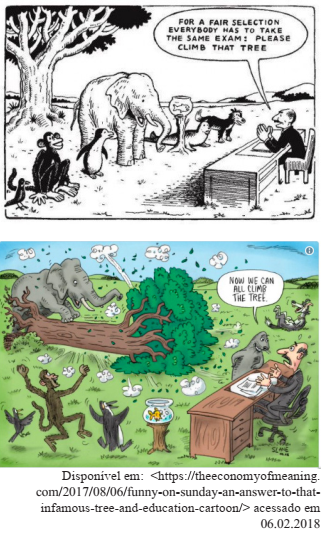
What can be stated about students’ learning
autonomy?
On the other hand, one may wonder what role English for Specific Purposes (ESP) plays in Brazil? The answer is: ESP has also its place in the Brazilian educational c ontext. It is now a well-established area field of language teaching and learning in the country. As already attested elsewhere (Ramos, 2005) ESP is a part of innumerable new textbooks that were put on the market in the last 10 years. It is part of the content indicated for the tertiary level entrance exams (maned Vestibular) in the country. It is the name of many courses that are offered in Brazilian universities.
(RAMOS, R. C. G. ESP in Brazil: history, new trends and challenges. In: KRZANOWSKI, M. (Ed.). ESP and EAP in Developing and in Least Developing Countries. IATEFL, 2008. p. 68-83.)
Which of the following are characteristics of English for Specific Purposes?
1. Meets specific needs of learners.
2. Makes use of underlying methodology and activities of the discipline it serves.
3. Is centered on the language appropriate to these activities in terms of grammar, lexis, syntax, study skills, discourse and genre.
4. Is designed for business purposes only.
5. Follows a specific methodology.
Tomlinson (2011, p.7) states that materials should achieve impact. “Impact is achieved when materials have a noticeable effect on learners, that is when the learners’ curiosity, interest and attention are attracted. If this is achieved there is a better chance that some of the language in the materials will be taken in for processing”. According to the author, materials can achieve impact through some aspects.
Choose the alternative that is approached by Tomlinson (2006):
“Our concern is with language learning. We cannot simply assume that describing and exemplifying what people do with language will enable someone to learn it. If that were so, we would need to do more than read a grammar book and a dictionary in order to learn a language. A truly valid approach to ESP must be based on an understanding of the processes of language learning”
(HUTCHINSON & WATERS, 1987, p.14)
According to Hutchinson and Waters (1987), the subject of their book is:
TEXTO II
It has become more or less a cliché these days to refer to English as a world language. At the 1984 conference to celebrate the SOth anniversary of the British Council there was a debate between Sir Randolph Quirk and Professor Braj Kachru on the (literally) million dollar question of 'who owns English’, and hence whose English must be adopted as the model for teaching the language worldwide (Quirk and Widdowson 198S). Since then, much has been written on the role of English as a language of international communication, and the desirability or otherwise of adopting one of the Inner Circle varieties of English (to all intents and purposes, either British or American) as the canonical model for teaching it as a second or foreign language. The position vigorously defended by Quirk in that debate— succinctly captured in the phrase 'a single monochrome standard’ (Quirk 198S: 6)— no longer appeals to the majority of those who are involved in the ELT enterprise in one way or another. Instead, Kachru’s equally spirited insistence that 'the native speakers [of English] seem to have lost the exclusive prerogative to control its standardisation’ (Kachru 198S: 3O), and his plea for a paradigm shift in linguistic and pedagogical research so as to bring it more in tune with the changing landscape, have continued to strike a favourable chord with most ELT professionals. And the idea that English belongs to everyone who speaks it has been steadily gaining ground.
Though still resisted in some quarters, the very idea of World English (henceforward, W E) makes the whole question of the 'ownership’ of English problematic, not to say completely anachronistic. Widdowson expressed the idea in a very telling manner when he wrote 'It is a matter of considerable pride and satisfaction for native speakers of English that their language is an international means of communication. But the point is that it is only international to the extent that it is not their language.’ (italics mine) (Widdowson 1994: 38S).
(...)
Lest I should be misunderstood here, please note what it is that I am not claiming. I am not saying that there are no native speakers of English any more— if by native speakers we mean persons who were born and brought up in monolingual households with no contact with other languages. Indeed, that would be an absurd thing to say. As with every other language, there will— for the immediately foreseeable future at least— continue to be children born into monolingual English-speaking households who will, under the familiar criteria established for the purpose (Davies 1991), qualify as native speakers of English. But what we are interested in at the moment is W E, not the English language as it is spoken in Englishspeaking households, or the Houses of Parliament in Britain. W E is a language (for want of a better term, that is) spoken across the world— routinely at the check-in desks and in the corridors and departure lounges of some of the world’s busiest airports, typically during multinational business encounters, periodically during the Olympics or World Cup Football seasons, international trade fairs, academic conferences, and so on [...].
RAJAGOPALAN, K. The concept of ‘World English’ and its
implications for ELT. ELT Journal Volume S8I2 April 2004.
TEXTO II
It has become more or less a cliché these days to refer to English as a world language. At the 1984 conference to celebrate the SOth anniversary of the British Council there was a debate between Sir Randolph Quirk and Professor Braj Kachru on the (literally) million dollar question of 'who owns English’, and hence whose English must be adopted as the model for teaching the language worldwide (Quirk and Widdowson 198S). Since then, much has been written on the role of English as a language of international communication, and the desirability or otherwise of adopting one of the Inner Circle varieties of English (to all intents and purposes, either British or American) as the canonical model for teaching it as a second or foreign language. The position vigorously defended by Quirk in that debate— succinctly captured in the phrase 'a single monochrome standard’ (Quirk 198S: 6)— no longer appeals to the majority of those who are involved in the ELT enterprise in one way or another. Instead, Kachru’s equally spirited insistence that 'the native speakers [of English] seem to have lost the exclusive prerogative to control its standardisation’ (Kachru 198S: 3O), and his plea for a paradigm shift in linguistic and pedagogical research so as to bring it more in tune with the changing landscape, have continued to strike a favourable chord with most ELT professionals. And the idea that English belongs to everyone who speaks it has been steadily gaining ground.
Though still resisted in some quarters, the very idea of World English (henceforward, W E) makes the whole question of the 'ownership’ of English problematic, not to say completely anachronistic. Widdowson expressed the idea in a very telling manner when he wrote 'It is a matter of considerable pride and satisfaction for native speakers of English that their language is an international means of communication. But the point is that it is only international to the extent that it is not their language.’ (italics mine) (Widdowson 1994: 38S).
(...)
Lest I should be misunderstood here, please note what it is that I am not claiming. I am not saying that there are no native speakers of English any more— if by native speakers we mean persons who were born and brought up in monolingual households with no contact with other languages. Indeed, that would be an absurd thing to say. As with every other language, there will— for the immediately foreseeable future at least— continue to be children born into monolingual English-speaking households who will, under the familiar criteria established for the purpose (Davies 1991), qualify as native speakers of English. But what we are interested in at the moment is W E, not the English language as it is spoken in Englishspeaking households, or the Houses of Parliament in Britain. W E is a language (for want of a better term, that is) spoken across the world— routinely at the check-in desks and in the corridors and departure lounges of some of the world’s busiest airports, typically during multinational business encounters, periodically during the Olympics or World Cup Football seasons, international trade fairs, academic conferences, and so on [...].
RAJAGOPALAN, K. The concept of ‘World English’ and its
implications for ELT. ELT Journal Volume S8I2 April 2004.

 Conheça nossos planos