Questões de Concurso
Comentadas sobre interpretação de texto | reading comprehension em inglês
Foram encontradas 8.877 questões


The Disappearing Honeybee
- Honeybees do more than just make honey. They fly around and pollinate flowers, plants, and trees. Our fruits, nuts, and vegetables rely.....................these pollinators. One third.....................America’s food supply is pollinated.....................the honeybee.
Have you seen or heard a honeybee lately? Bees are mysteriously disappearing in many parts of the world. Most people don’t know about this problem. It is called “colony collapse disorder” (CCD). Some North American beekeepers lost 80% of their hives from 2006-2008. Bees in Italy and Australia are disappearing too.
The disappearance of the honeybee is a serious problem. Can you imagine never eating another blueberry? What about almonds and cherries? Without honeybees food prices will skyrocket. The poorest people always suffer the worst when there is a lack of food.
This problem affects other foods besides fresh produce. Imagine losing your favourite ice cream! Haagen Daaz is a famous ice cream company. Many of their flavours rely on the hard working honeybee. In 2008, Haagen Daaz began raising money for CCD. They also funded a garden at the University of California called The Haven. This garden helps raise awareness about the disappearing honeybee and teaches visitors how to plant for pollinators.
Donating money to research is the most important thing humans can do to save the honeybee. Some scientists blame CCD on climate change. Others think pesticides are killing the bees. Commercial bee migration may also cause CCD. Beekeepers transport their hives from place to place in order to pollinate plants year round.
https://www.englishclub.com/reading/environment/honeybee.htm
Match the words on column 1 with their meanings on the column 2:
Column 1 Words
1. pollinate
2. lack
3. rely
4. disorder
5. supply
Column 2 Meanings
( ) to have confidence based on experience
( ) to add as a supplement
( ) convey pollen to
( ) lack of order
( ) the fact or state of being wanting or deficient
Assinale a alternativa que indica todas as afirmativas corretas.
The Disappearing Honeybee
- Honeybees do more than just make honey. They fly around and pollinate flowers, plants, and trees. Our fruits, nuts, and vegetables rely.....................these pollinators. One third.....................America’s food supply is pollinated.....................the honeybee.
Have you seen or heard a honeybee lately? Bees are mysteriously disappearing in many parts of the world. Most people don’t know about this problem. It is called “colony collapse disorder” (CCD). Some North American beekeepers lost 80% of their hives from 2006-2008. Bees in Italy and Australia are disappearing too.
The disappearance of the honeybee is a serious problem. Can you imagine never eating another blueberry? What about almonds and cherries? Without honeybees food prices will skyrocket. The poorest people always suffer the worst when there is a lack of food.
This problem affects other foods besides fresh produce. Imagine losing your favourite ice cream! Haagen Daaz is a famous ice cream company. Many of their flavours rely on the hard working honeybee. In 2008, Haagen Daaz began raising money for CCD. They also funded a garden at the University of California called The Haven. This garden helps raise awareness about the disappearing honeybee and teaches visitors how to plant for pollinators.
Donating money to research is the most important thing humans can do to save the honeybee. Some scientists blame CCD on climate change. Others think pesticides are killing the bees. Commercial bee migration may also cause CCD. Beekeepers transport their hives from place to place in order to pollinate plants year round.
https://www.englishclub.com/reading/environment/honeybee.htm
The Disappearing Honeybee
- Honeybees do more than just make honey. They fly around and pollinate flowers, plants, and trees. Our fruits, nuts, and vegetables rely.....................these pollinators. One third.....................America’s food supply is pollinated.....................the honeybee.
Have you seen or heard a honeybee lately? Bees are mysteriously disappearing in many parts of the world. Most people don’t know about this problem. It is called “colony collapse disorder” (CCD). Some North American beekeepers lost 80% of their hives from 2006-2008. Bees in Italy and Australia are disappearing too.
The disappearance of the honeybee is a serious problem. Can you imagine never eating another blueberry? What about almonds and cherries? Without honeybees food prices will skyrocket. The poorest people always suffer the worst when there is a lack of food.
This problem affects other foods besides fresh produce. Imagine losing your favourite ice cream! Haagen Daaz is a famous ice cream company. Many of their flavours rely on the hard working honeybee. In 2008, Haagen Daaz began raising money for CCD. They also funded a garden at the University of California called The Haven. This garden helps raise awareness about the disappearing honeybee and teaches visitors how to plant for pollinators.
Donating money to research is the most important thing humans can do to save the honeybee. Some scientists blame CCD on climate change. Others think pesticides are killing the bees. Commercial bee migration may also cause CCD. Beekeepers transport their hives from place to place in order to pollinate plants year round.
https://www.englishclub.com/reading/environment/honeybee.htm
The Disappearing Honeybee
- Honeybees do more than just make honey. They fly around and pollinate flowers, plants, and trees. Our fruits, nuts, and vegetables rely.....................these pollinators. One third.....................America’s food supply is pollinated.....................the honeybee.
Have you seen or heard a honeybee lately? Bees are mysteriously disappearing in many parts of the world. Most people don’t know about this problem. It is called “colony collapse disorder” (CCD). Some North American beekeepers lost 80% of their hives from 2006-2008. Bees in Italy and Australia are disappearing too.
The disappearance of the honeybee is a serious problem. Can you imagine never eating another blueberry? What about almonds and cherries? Without honeybees food prices will skyrocket. The poorest people always suffer the worst when there is a lack of food.
This problem affects other foods besides fresh produce. Imagine losing your favourite ice cream! Haagen Daaz is a famous ice cream company. Many of their flavours rely on the hard working honeybee. In 2008, Haagen Daaz began raising money for CCD. They also funded a garden at the University of California called The Haven. This garden helps raise awareness about the disappearing honeybee and teaches visitors how to plant for pollinators.
Donating money to research is the most important thing humans can do to save the honeybee. Some scientists blame CCD on climate change. Others think pesticides are killing the bees. Commercial bee migration may also cause CCD. Beekeepers transport their hives from place to place in order to pollinate plants year round.
https://www.englishclub.com/reading/environment/honeybee.htm
The Disappearing Honeybee
- Honeybees do more than just make honey. They fly around and pollinate flowers, plants, and trees. Our fruits, nuts, and vegetables rely.....................these pollinators. One third.....................America’s food supply is pollinated.....................the honeybee.
Have you seen or heard a honeybee lately? Bees are mysteriously disappearing in many parts of the world. Most people don’t know about this problem. It is called “colony collapse disorder” (CCD). Some North American beekeepers lost 80% of their hives from 2006-2008. Bees in Italy and Australia are disappearing too.
The disappearance of the honeybee is a serious problem. Can you imagine never eating another blueberry? What about almonds and cherries? Without honeybees food prices will skyrocket. The poorest people always suffer the worst when there is a lack of food.
This problem affects other foods besides fresh produce. Imagine losing your favourite ice cream! Haagen Daaz is a famous ice cream company. Many of their flavours rely on the hard working honeybee. In 2008, Haagen Daaz began raising money for CCD. They also funded a garden at the University of California called The Haven. This garden helps raise awareness about the disappearing honeybee and teaches visitors how to plant for pollinators.
Donating money to research is the most important thing humans can do to save the honeybee. Some scientists blame CCD on climate change. Others think pesticides are killing the bees. Commercial bee migration may also cause CCD. Beekeepers transport their hives from place to place in order to pollinate plants year round.
https://www.englishclub.com/reading/environment/honeybee.htm
The Disappearing Honeybee
- Honeybees do more than just make honey. They fly around and pollinate flowers, plants, and trees. Our fruits, nuts, and vegetables rely.....................these pollinators. One third.....................America’s food supply is pollinated.....................the honeybee.
Have you seen or heard a honeybee lately? Bees are mysteriously disappearing in many parts of the world. Most people don’t know about this problem. It is called “colony collapse disorder” (CCD). Some North American beekeepers lost 80% of their hives from 2006-2008. Bees in Italy and Australia are disappearing too.
The disappearance of the honeybee is a serious problem. Can you imagine never eating another blueberry? What about almonds and cherries? Without honeybees food prices will skyrocket. The poorest people always suffer the worst when there is a lack of food.
This problem affects other foods besides fresh produce. Imagine losing your favourite ice cream! Haagen Daaz is a famous ice cream company. Many of their flavours rely on the hard working honeybee. In 2008, Haagen Daaz began raising money for CCD. They also funded a garden at the University of California called The Haven. This garden helps raise awareness about the disappearing honeybee and teaches visitors how to plant for pollinators.
Donating money to research is the most important thing humans can do to save the honeybee. Some scientists blame CCD on climate change. Others think pesticides are killing the bees. Commercial bee migration may also cause CCD. Beekeepers transport their hives from place to place in order to pollinate plants year round.
https://www.englishclub.com/reading/environment/honeybee.htm
Analyze the sentences below about ‘Reading Comprehension Strategies’.
1. Skimming is one of the strategies that you have to make inferences about the text to find the correct answers.
2. Making predictions is a reading comprehension strategy in which the reader uses information from a text (including titles, headings, pictures, and diagrams) and his/her own personal experience to anticipate what the text is about .
3. If you want to read a text rapidly in order to find specific facts, you are using the Scanning Strategy.
Choose the alternative which contains all the correct affirmatives:
In order for collection of sentences and utterances to succed effectively, the discourse needs to be organised or conducted in such a way that it will be successful. In written English this calls for both coherence and cohesion. For a text to be coherent, it needs to be in the right order. (…)
No matter how coherent a text is, however, it will not work unless it has internal cohesion. The elements in that text must cohere or stick to each other successfully to help us navigate our way around the stretch of discourse. One way of achieving this is through lexical cohesion, and a way of ensuring lexical cohesion is through the repetition of words and phrases. (…) We can also use interrelated words and meanings to bind a text together (…)
Another similar cohesive technique is that of substitution, using a phrase to refer to something we have already written. (…) Writers also use linkers such as and, also, moreover (…)
These features are also present in spoken language, which also shows many examples of ellipsis (where words from a written-grammar version of an utterance are left out without compromising the meaning of what is said). (…)
(Harmer, J. The practice of English language teaching. 2007. Adapted)
There is a danger in paying too much attention to learners’ errors. While errors indeed reveal a system at work, the classroom language teacher can become so preoccupied ________ noticing errors that the correct utterances in the second language go unnoticed. In our observation and analysis of errors – for all that they do reveal about the learner – we must beware of placing too much attention on errors and not lose sight of the value of positive reinforcement of clearly expressed language that is a product of the learner’s progress of development. While the diminishing of errors is an important criterion ______ increasing language proficiency, the ultimate goal of second language learning is the attainment of communicative fluency.
Another inadequacy in error analysis is an overemphasis on production data. Language is speaking and listening, writing and reading. The comprehension of language is as important as production. It so happens that production lends itself to analysis and thus becomes the prey of researchers, __________ comprehension data is equally important in developing an understanding of the process of SLA.
(Brown, D. H. Principles of language learning and teaching. 2000. Adapted)
In the first paragraph, the author argues in favor of the error treatment that is used in which of these language teaching-learning methods/approaches?
Classes which are arranged in a circle make quite a strong statement about what the teacher and the students believe in. With all the people in the room sitting in a circle, there is a far greater feeling of equality than when the teacher stays out at the front. This may not be quite so true of the horseshoe shape, where the teacher is often located in a commanding position, but, even here, the rigidity that comes with orderly rows, for example, is lessened.
With the horseshoe and circle seating, the classroom is a more intimate place and the potential for students to share feelings and information through talking, eye contact or expressive body movements (eyebrow-raising, shouldershrugging, etc.) is far greater than when they are sitting in rows.
(Harmer, J. The practice of English language teaching. 2007)
Which picture shows one of the movements that students can use to communicate with each other in the classroom according to the text?
1. What is an analog-digital converter?
An Analog-Digital Converter (ADC) is a widely used electronic component that converts an analog electric signal (usually a voltage) into a digital representation. The ADCs are at the front-end of any digital circuit that needs to process signals coming from the exterior world. Its schematic symbol is:

The output of a microphone, the voltage at a photodiode or the signal of an accelerometer are examples of analog values that need to be converted so that a microprocessor can work with them.
2. How does the ADC convert a signal?
Many ways have been developed to convert an analog signal, each with its strengths and weaknesses. The choice of the ADC for a given application is usually defined by the requirements you have: if you need speed, use a fast ADC; if you need precision, use an accurate ADC; if you are constrained in space, use a compact ADC.
All ADCs work under the same principle: they need to convert a signal to a certain number of bits N. The sequence of bits represents the number and each bit has the double of the weight of the next, starting from the Most Significant Bit (MSB) up to the Least Significant Bit (LSB). In a nutshell, we want to find the sequence of bits bN−1, bN−2, ..., b0 that represents the analog value Vin as Vin=∑n=0N−1bn2nVref2N.
(www.onmyphd.com/?p=analog.digital.converter. Adaptado)
1. What is an analog-digital converter?
An Analog-Digital Converter (ADC) is a widely used electronic component that converts an analog electric signal (usually a voltage) into a digital representation. The ADCs are at the front-end of any digital circuit that needs to process signals coming from the exterior world. Its schematic symbol is:
The output of a microphone, the voltage at a photodiode or the signal of an accelerometer are examples of analog values that need to be converted so that a microprocessor can work with them.
2. How does the ADC convert a signal?
Many ways have been developed to convert an analog signal, each with its strengths and weaknesses. The choice of the ADC for a given application is usually defined by the requirements you have: if you need speed, use a fast ADC; if you need precision, use an accurate ADC; if you are constrained in space, use a compact ADC.
All ADCs work under the same principle: they need to convert a signal to a certain number of bits N. The sequence of bits represents the number and each bit has the double of the weight of the next, starting from the Most Significant Bit (MSB) up to the Least Significant Bit (LSB). In a nutshell, we want to find the sequence of bits bN−1, bN−2, ..., b0 that represents the analog value Vin as Vin=∑n=0N−1bn2nVref2N.
(www.onmyphd.com/?p=analog.digital.converter. Adaptado)
Knowledge and the library
It was not until the development of monastic libraries in Europe around 1200 that humanity amassed in a single place what approached the collective wisdom and knowledge of the age. Libraries may be exchanges of information and market places for ideas but they are also the buildings which contain the bulk of human knowledge. Or, at least they were until the electronic digitally stored information revolution of the 1980s.
Now knowledge is virtually everywhere; it has broken free of the constraint of buildings. Today if you were today to destroy all the world’s libraries, it is unlikely that more than 20% of human knowledge would be lost. Certainly, a large amount of archival material would disappear forever, but a substantial volume of knowledge would survive. If a library is a repository of knowledge, this is now just one of its functions. The library’s prime function is now making that knowledge available and encouraging exchange and reflection upon it.
Electronic knowledge is nowadays available to everybody – in the home, workplace, airport terminal, school, and so on. The Internet has liberated the library; nevertheless, it has not removed the justification for library facilities.
(www.sciencedirect.com/science/article/pii/B978185617619410017X. Adaptado)
Knowledge and the library
It was not until the development of monastic libraries in Europe around 1200 that humanity amassed in a single place what approached the collective wisdom and knowledge of the age. Libraries may be exchanges of information and market places for ideas but they are also the buildings which contain the bulk of human knowledge. Or, at least they were until the electronic digitally stored information revolution of the 1980s.
Now knowledge is virtually everywhere; it has broken free of the constraint of buildings. Today if you were today to destroy all the world’s libraries, it is unlikely that more than 20% of human knowledge would be lost. Certainly, a large amount of archival material would disappear forever, but a substantial volume of knowledge would survive. If a library is a repository of knowledge, this is now just one of its functions. The library’s prime function is now making that knowledge available and encouraging exchange and reflection upon it.
Electronic knowledge is nowadays available to everybody – in the home, workplace, airport terminal, school, and so on. The Internet has liberated the library; nevertheless, it has not removed the justification for library facilities.
(www.sciencedirect.com/science/article/pii/B978185617619410017X. Adaptado)
Knowledge and the library
It was not until the development of monastic libraries in Europe around 1200 that humanity amassed in a single place what approached the collective wisdom and knowledge of the age. Libraries may be exchanges of information and market places for ideas but they are also the buildings which contain the bulk of human knowledge. Or, at least they were until the electronic digitally stored information revolution of the 1980s.
Now knowledge is virtually everywhere; it has broken free of the constraint of buildings. Today if you were today to destroy all the world’s libraries, it is unlikely that more than 20% of human knowledge would be lost. Certainly, a large amount of archival material would disappear forever, but a substantial volume of knowledge would survive. If a library is a repository of knowledge, this is now just one of its functions. The library’s prime function is now making that knowledge available and encouraging exchange and reflection upon it.
Electronic knowledge is nowadays available to everybody – in the home, workplace, airport terminal, school, and so on. The Internet has liberated the library; nevertheless, it has not removed the justification for library facilities.
(www.sciencedirect.com/science/article/pii/B978185617619410017X. Adaptado)
Knowledge and the library
It was not until the development of monastic libraries in Europe around 1200 that humanity amassed in a single place what approached the collective wisdom and knowledge of the age. Libraries may be exchanges of information and market places for ideas but they are also the buildings which contain the bulk of human knowledge. Or, at least they were until the electronic digitally stored information revolution of the 1980s.
Now knowledge is virtually everywhere; it has broken free of the constraint of buildings. Today if you were today to destroy all the world’s libraries, it is unlikely that more than 20% of human knowledge would be lost. Certainly, a large amount of archival material would disappear forever, but a substantial volume of knowledge would survive. If a library is a repository of knowledge, this is now just one of its functions. The library’s prime function is now making that knowledge available and encouraging exchange and reflection upon it.
Electronic knowledge is nowadays available to everybody – in the home, workplace, airport terminal, school, and so on. The Internet has liberated the library; nevertheless, it has not removed the justification for library facilities.
(www.sciencedirect.com/science/article/pii/B978185617619410017X. Adaptado)
The real reason Apple and Google want you to use your phone less
NIR EYAL MAY 19, 2019
If tech is “hijacking your brain” with their “irresistible” products, as some tech critics claim, why are these companies now acting against their own interests?
This week Apple follows Google by announcing features to help people cut back on their tech use. Why would the companies that make your phone want you to use it less? If tech is “hijacking your brain” with their “irresistible” products, as some tech critics claim, why are these companies now acting against their own interests? Perhaps the tech giants have had a change of heart or have been persuaded by public pressure to change their ways? Hardly. I studied the sophisticated psychology these companies deploy to keep people hooked and wrote a book about how they do it. At first glance, it appears their business model would benefit from addiction. The more you use your phone, the more money they make through the apps you buy and the ads you view.
However, the addiction story falls short when considering the long-term interests of these companies. Apple and Google are making it easier for consumers to cut back on phone use because it is in their interest to do so. In this case, what’s good for the user is also good for these companies’ bottom lines. Apple and Google don’t want you to get addicted. Addiction is a compulsive harmful behavior. Rather, they’d prefer you form healthy habits with your digital devices.
Consider why you wear a seatbelt. In 1968, the Federal Government mandated that seat belts come equipped in all cars. However, nineteen years before any such regulation, American car makers started offering seat belts as a feature. The laws came well after car makers started offering seatbelts because that’s what consumers wanted. Car makers who sold safer cars sold more.
Similarly, thousands of third-party apps have given smartphone owners ways to moderate tech use with tools to help them monitor how much time they spend online, turn off access to certain sites, and reduce digital distraction — tools very similar to what Apple and Google recently announced. I started writing about this burgeoning trend, in what I called “attention retention” devices, back in early 2015 and today there are more digital wellness products than ever.
As they often do with successful apps built on their platforms, Apple and Google took note of what consumers wanted and decided to incorporate these features as standard — just as car makers did with seat belts in the 1950s. They also went beyond what app makers can do by adding features only the operating system makers can offer, like batch notifications to reduce the frequency of intraday interruptions and the ability to put the phone in “shush” mode by flipping it over.
The history of innovation is littered with examples of new technologies causing unintended harm. As cultural theorist Paul Virilio said, “When you invent the ship, you also invent the shipwreck.” Although the devices these modern shipbuilders make certainly have potential negative consequences, like overuse, it’s also in their interests to make their products less harmful.
With few exceptions, when a product harms people, consumers tend to use it less often or find better alternatives. The feature fight between these two tech rivals benefits everyone. The move to help users create healthy habits with their devices is an example of competition making products better.
Although they are certainly designed to be persuasive and user-friendly, we aren’t slaves to our technologies and it behooves us to stop thinking we’re powerless. The tech companies are taking steps to help users rein in device overuse. Now it’s our turn to put these features to use, buckle down, and buckle up
(Available in: https://www.theladders.com/career-advice/the-reason-apple-and-google-want-you-to-use-your-phone-less. Accessed on May 19th, 2019. Adapted.)
The real reason Apple and Google want you to use your phone less
NIR EYAL MAY 19, 2019
If tech is “hijacking your brain” with their “irresistible” products, as some tech critics claim, why are these companies now acting against their own interests?
This week Apple follows Google by announcing features to help people cut back on their tech use. Why would the companies that make your phone want you to use it less? If tech is “hijacking your brain” with their “irresistible” products, as some tech critics claim, why are these companies now acting against their own interests? Perhaps the tech giants have had a change of heart or have been persuaded by public pressure to change their ways? Hardly. I studied the sophisticated psychology these companies deploy to keep people hooked and wrote a book about how they do it. At first glance, it appears their business model would benefit from addiction. The more you use your phone, the more money they make through the apps you buy and the ads you view.
However, the addiction story falls short when considering the long-term interests of these companies. Apple and Google are making it easier for consumers to cut back on phone use because it is in their interest to do so. In this case, what’s good for the user is also good for these companies’ bottom lines. Apple and Google don’t want you to get addicted. Addiction is a compulsive harmful behavior. Rather, they’d prefer you form healthy habits with your digital devices.
Consider why you wear a seatbelt. In 1968, the Federal Government mandated that seat belts come equipped in all cars. However, nineteen years before any such regulation, American car makers started offering seat belts as a feature. The laws came well after car makers started offering seatbelts because that’s what consumers wanted. Car makers who sold safer cars sold more.
Similarly, thousands of third-party apps have given smartphone owners ways to moderate tech use with tools to help them monitor how much time they spend online, turn off access to certain sites, and reduce digital distraction — tools very similar to what Apple and Google recently announced. I started writing about this burgeoning trend, in what I called “attention retention” devices, back in early 2015 and today there are more digital wellness products than ever.
As they often do with successful apps built on their platforms, Apple and Google took note of what consumers wanted and decided to incorporate these features as standard — just as car makers did with seat belts in the 1950s. They also went beyond what app makers can do by adding features only the operating system makers can offer, like batch notifications to reduce the frequency of intraday interruptions and the ability to put the phone in “shush” mode by flipping it over.
The history of innovation is littered with examples of new technologies causing unintended harm. As cultural theorist Paul Virilio said, “When you invent the ship, you also invent the shipwreck.” Although the devices these modern shipbuilders make certainly have potential negative consequences, like overuse, it’s also in their interests to make their products less harmful.
With few exceptions, when a product harms people, consumers tend to use it less often or find better alternatives. The feature fight between these two tech rivals benefits everyone. The move to help users create healthy habits with their devices is an example of competition making products better.
Although they are certainly designed to be persuasive and user-friendly, we aren’t slaves to our technologies and it behooves us to stop thinking we’re powerless. The tech companies are taking steps to help users rein in device overuse. Now it’s our turn to put these features to use, buckle down, and buckle up
(Available in: https://www.theladders.com/career-advice/the-reason-apple-and-google-want-you-to-use-your-phone-less. Accessed on May 19th, 2019. Adapted.)
The real reason Apple and Google want you to use your phone less
NIR EYAL MAY 19, 2019
If tech is “hijacking your brain” with their “irresistible” products, as some tech critics claim, why are these companies now acting against their own interests?
This week Apple follows Google by announcing features to help people cut back on their tech use. Why would the companies that make your phone want you to use it less? If tech is “hijacking your brain” with their “irresistible” products, as some tech critics claim, why are these companies now acting against their own interests? Perhaps the tech giants have had a change of heart or have been persuaded by public pressure to change their ways? Hardly. I studied the sophisticated psychology these companies deploy to keep people hooked and wrote a book about how they do it. At first glance, it appears their business model would benefit from addiction. The more you use your phone, the more money they make through the apps you buy and the ads you view.
However, the addiction story falls short when considering the long-term interests of these companies. Apple and Google are making it easier for consumers to cut back on phone use because it is in their interest to do so. In this case, what’s good for the user is also good for these companies’ bottom lines. Apple and Google don’t want you to get addicted. Addiction is a compulsive harmful behavior. Rather, they’d prefer you form healthy habits with your digital devices.
Consider why you wear a seatbelt. In 1968, the Federal Government mandated that seat belts come equipped in all cars. However, nineteen years before any such regulation, American car makers started offering seat belts as a feature. The laws came well after car makers started offering seatbelts because that’s what consumers wanted. Car makers who sold safer cars sold more.
Similarly, thousands of third-party apps have given smartphone owners ways to moderate tech use with tools to help them monitor how much time they spend online, turn off access to certain sites, and reduce digital distraction — tools very similar to what Apple and Google recently announced. I started writing about this burgeoning trend, in what I called “attention retention” devices, back in early 2015 and today there are more digital wellness products than ever.
As they often do with successful apps built on their platforms, Apple and Google took note of what consumers wanted and decided to incorporate these features as standard — just as car makers did with seat belts in the 1950s. They also went beyond what app makers can do by adding features only the operating system makers can offer, like batch notifications to reduce the frequency of intraday interruptions and the ability to put the phone in “shush” mode by flipping it over.
The history of innovation is littered with examples of new technologies causing unintended harm. As cultural theorist Paul Virilio said, “When you invent the ship, you also invent the shipwreck.” Although the devices these modern shipbuilders make certainly have potential negative consequences, like overuse, it’s also in their interests to make their products less harmful.
With few exceptions, when a product harms people, consumers tend to use it less often or find better alternatives. The feature fight between these two tech rivals benefits everyone. The move to help users create healthy habits with their devices is an example of competition making products better.
Although they are certainly designed to be persuasive and user-friendly, we aren’t slaves to our technologies and it behooves us to stop thinking we’re powerless. The tech companies are taking steps to help users rein in device overuse. Now it’s our turn to put these features to use, buckle down, and buckle up
(Available in: https://www.theladders.com/career-advice/the-reason-apple-and-google-want-you-to-use-your-phone-less. Accessed on May 19th, 2019. Adapted.)
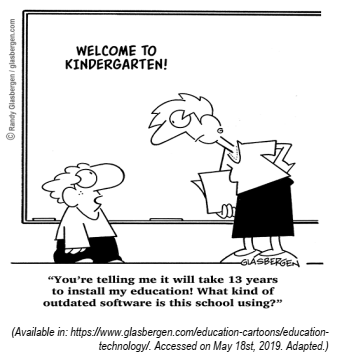
What is the main idea of the comic strip?
Technology in schools: Future changes in classrooms
Technology has the power to transform how people learn - but walk into some classrooms and you could be forgiven for thinking you were entering a time warp. There will probably be a whiteboard instead of the traditional blackboard, and the children may be using laptops or tablets, but plenty of textbooks, pens and photocopied sheets are still likely.
The curriculum and theory have changed little since Victorian times, according to the educationalist and author Marc Prensky. "The world needs a new curriculum," he said at the recent Bett show, a conference dedicated to technology in education. Most of the education products on the market are just aids to teach the existing curriculum, he says, based on the false assumption "we need to teach better what we teach today". He feels a whole new core of subjects is needed, focusing on the skills that will equip today's learners for tomorrow's world of work. These include problem-solving, creative thinking and collaboration.
'Flipped' classrooms
One of the biggest problems with radically changing centuries-old pedagogical methods is that no generation of parents wants their children to be the guinea pigs. Mr Prensky he thinks we have little choice, however: "We are living in an age of accelerating change. We have to experiment and figure out what works."
"We are at the ground floor of a new world full of imagination, creativity, innovation and digital wisdom. We are going to have to create the education of the future because it doesn't exist anywhere today." He might be wrong there. Change is already afoot to disrupt the traditional classroom. The "flipped" classroom - the idea of inverting traditional teaching methods by delivering instructions online outside of the classroom and using the time in school as the place to do homework - has gained in popularity in US schools. The teacher's role becomes one of a guide, while students watch lectures at home at their own pace, communicating with classmates and teachers online.
(Available in:https://www.bbc.com/news/technology-30814302. Accessed on May 18st, 2019. Adapted. Author: Jane Wakefield.)

 Conheça nossos planos