Questões de Concurso
Comentadas sobre interpretação de texto | reading comprehension em inglês
Foram encontradas 9.238 questões


Ano: 2019
Banca:
Unesc
Órgão:
Prefeitura de Maracajá - SC
Prova:
Unesc - 2019 - Prefeitura de Maracajá - SC - Professor - Inglês |
Q1819130
Inglês
Assinale a alternativa que apresenta somente gêneros textuais.
Ano: 2019
Banca:
Unesc
Órgão:
Prefeitura de Maracajá - SC
Prova:
Unesc - 2019 - Prefeitura de Maracajá - SC - Professor - Inglês |
Q1819125
Inglês
Dentre as estratégias de leitura mais utilizadas no ensino de língua inglesa estão os
processos de skimming e scanning. Assinale a alternativa verdadeira em relação a estes
processos.
Ano: 2019
Banca:
Unesc
Órgão:
Prefeitura de Maracajá - SC
Prova:
Unesc - 2019 - Prefeitura de Maracajá - SC - Professor - Inglês |
Q1819124
Inglês
Qual ação a seguir descreve melhor a técnica de leitura scanning?
Ano: 2019
Banca:
Unesc
Órgão:
Prefeitura de Maracajá - SC
Prova:
Unesc - 2019 - Prefeitura de Maracajá - SC - Professor - Inglês |
Q1819122
Inglês
Leia o excerto: “I used to work in a factory in Ohio, but next week I am singing at Carnegie
Hall in front of an audience of almost 3,000 people! I didn't like school, so I dropped out
when I was 16, and I lived with my parents for two years. When I turned 18, I decided to get
a job. I started working at a chicken factory.”
Qual das perguntas abaixo não pode ser respondida com a leitura do trecho anterior?
Qual das perguntas abaixo não pode ser respondida com a leitura do trecho anterior?
Ano: 2019
Banca:
Unesc
Órgão:
Prefeitura de Maracajá - SC
Prova:
Unesc - 2019 - Prefeitura de Maracajá - SC - Professor - Inglês |
Q1819121
Inglês
“Her disease is the worst I have ever seen.” Which word is the best to replace the one in
bold?
Ano: 2019
Banca:
Unesc
Órgão:
Prefeitura de Maracajá - SC
Prova:
Unesc - 2019 - Prefeitura de Maracajá - SC - Professor - Inglês |
Q1819120
Inglês
“Jordan is a very ||boy.” He always gets good grades at school. Qual palavra preenche
corretamente a lacuna?
Ano: 2019
Banca:
Unesc
Órgão:
Prefeitura de Maracajá - SC
Prova:
Unesc - 2019 - Prefeitura de Maracajá - SC - Professor - Inglês |
Q1819119
Inglês
“Will it be a vote for Europe, or, as I fear, a nationalist rebuke to governments?” Mr.
McLuhan asked. O pronome 'I', em destaque, se refere a:
Ano: 2019
Banca:
Unesc
Órgão:
Prefeitura de Maracajá - SC
Prova:
Unesc - 2019 - Prefeitura de Maracajá - SC - Professor - Inglês |
Q1819118
Inglês
“In that year, the Centers for Disease Control and Prevention estimates, 34 million
Americans got the flu, 710,000 were hospitalized and about 56,000 died. 'We'll expect
something around those numbers’ Dr. Daniel said.”
Qual a afirmação correta em relação aos números do excerto?
Qual a afirmação correta em relação aos números do excerto?
Ano: 2019
Banca:
Unesc
Órgão:
Prefeitura de Maracajá - SC
Prova:
Unesc - 2019 - Prefeitura de Maracajá - SC - Professor - Inglês |
Q1819115
Inglês
Assinale a única alternativa errada em relação à leitura do texto abaixo.
“Peace and Love! To warm your heart this holiday season. Merry Christmas!"
“Peace and Love! To warm your heart this holiday season. Merry Christmas!"
Ano: 2019
Banca:
Unesc
Órgão:
Prefeitura de Maracajá - SC
Prova:
Unesc - 2019 - Prefeitura de Maracajá - SC - Professor - Inglês |
Q1819112
Inglês
Leia o trecho retirado da canção ‘Perfect’ de Ed Sheeran.
“Cause we were just kids when we fell in love Not knowing what it was I will not give you up this time But darling, just kiss me slow” De acordo com o excerto, é correto afirmar que:
“Cause we were just kids when we fell in love Not knowing what it was I will not give you up this time But darling, just kiss me slow” De acordo com o excerto, é correto afirmar que:
Ano: 2019
Banca:
Unesc
Órgão:
Prefeitura de Maracajá - SC
Prova:
Unesc - 2019 - Prefeitura de Maracajá - SC - Professor - Inglês |
Q1819111
Inglês
Leia a seguir a descrição de um parque: “Outside there are beautiful large gardens and a
lake. There is a Himalayan garden with a Buddhist temple and a bird garden too. We can
feed the penguins! Sometimes they have concerts - there is so much to do there.”
Qual informação não está explícita no trecho?
Qual informação não está explícita no trecho?
Ano: 2019
Banca:
Unesc
Órgão:
Prefeitura de Maracajá - SC
Prova:
Unesc - 2019 - Prefeitura de Maracajá - SC - Professor - Inglês |
Q1819110
Inglês
Leia o trecho abaixo e assinale a alternativa que melhor descreve o assunto tratado.
“What can we do about the problem of water? Clean drinking water is a basic need for all people, but not everyone can get it easily. In some dry places, like deserts, it is expensive to transport water, difficult to store it, and if a water system stops working, an engineer is needed to repair it but sometimes the nearest engineer is miles away.”
“What can we do about the problem of water? Clean drinking water is a basic need for all people, but not everyone can get it easily. In some dry places, like deserts, it is expensive to transport water, difficult to store it, and if a water system stops working, an engineer is needed to repair it but sometimes the nearest engineer is miles away.”
Ano: 2019
Banca:
Unesc
Órgão:
Prefeitura de Maracajá - SC
Prova:
Unesc - 2019 - Prefeitura de Maracajá - SC - Professor - Inglês |
Q1819106
Inglês
O seguinte trecho poderia ser provavelmente encontrado em qual gênero textual?
“J.K. Rowling prepared the first Harry Potter book in the Nicolson's Café in Edinburgh. Then J.K. Rowling tried to find a publisher. She offered her first book to twelve publishers in England but they didn't like it.”
“J.K. Rowling prepared the first Harry Potter book in the Nicolson's Café in Edinburgh. Then J.K. Rowling tried to find a publisher. She offered her first book to twelve publishers in England but they didn't like it.”
Q1788908
Inglês
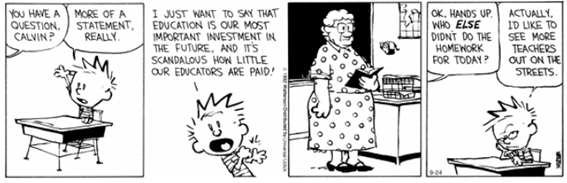
In the comic strip above, Calvin becomes upset because:
Q1788907
Inglês
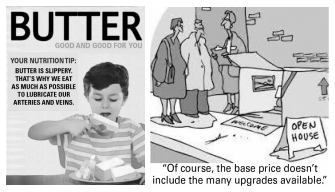
The following advertisements are examples
of which deceptive practices, respectively?
Ano: 2019
Banca:
Instituto Consulplan
Órgão:
Prefeitura de Pitangueiras - SP
Prova:
Instituto Consulplan - 2019 - Prefeitura de Pitangueiras - SP - Professor Educação Básica II - Inglês |
Q1787977
Inglês
“After the acquisition of their vernacular variety has started,
people often also go on to acquire various non-vernacular
specialist varieties of language used for special purposes and
activities. For example, they may acquire a way of talking
(and writing) about fundamentalist Christian theology,
video games, or bird-watching. Specialist varieties of
language are different—sometimes in small ways, sometimes
in large ways—from people’s vernacular varieties of
language. One category of specialist varieties of language is
what we can call academic varieties of language: that is, the
varieties of language connected to learning and using
information from academic or school-based content areas
(Gee 2002; Schleppegrell 2004; Schleppegrell and Cecilia
Colombi 2002). The varieties of language used in (different
branches) of biology, physics, law, or literary criticism fall
into this category.” (GEE, James Paul. Situated Language and Learning: a critique of
traditional schooling. London, Routdlege, 2004.)
Segundo o texto, é correto afirmar que:
Segundo o texto, é correto afirmar que:
Ano: 2019
Banca:
Instituto Consulplan
Órgão:
Prefeitura de Pitangueiras - SP
Prova:
Instituto Consulplan - 2019 - Prefeitura de Pitangueiras - SP - Professor Educação Básica II - Inglês |
Q1787976
Inglês
“Do poor children have less ‘language ability’ than rich
ones? The way the term is being used above certainly
makes it sound as if they do. But no, they don’t. Linguists
have known for years that all children—including poor
children—have impressive language ability. The vast
majority of children enter school with vocabularies fully fit
for everyday life, with complex grammar and with deep
understandings of experiences and stories. It has been
decades since anyone believed that poor and minority
children entered school with ‘no language’ (Labov, 1972;
Gee, 1996). Every human being, barring those with very
serious disorders, acquires a complex native language early
in life, a language fully fit for the task of leading daily life in
a human culture.” (GEE, James Paul. Situated Language and
Learning: a critique of traditional schooling. London, Routdlege, 2004.)
Assinale a afirmativa coerente com o texto.
Assinale a afirmativa coerente com o texto.
Ano: 2019
Banca:
Instituto Consulplan
Órgão:
Prefeitura de Pitangueiras - SP
Prova:
Instituto Consulplan - 2019 - Prefeitura de Pitangueiras - SP - Professor Educação Básica II - Inglês |
Q1787975
Inglês
“The ‘fourth-grade slump’ (Chall et al. 1990) is the
phenomenon where some children seem to acquire reading
(i.e. pass reading tests) fine in the early grades, but fail to
be able to use reading to learn school content in the later
grades, when the language demands of that content (e.g.
science) get more and more complex. The fourth-grade
slump is made up of kids who can ‘read,’ in the sense of
decode and assign superficial literal meanings to texts, but
can’t ‘read’ in the sense of understanding, in any deep way,
informational texts written in fairly complex language.
From remarks like the one quoted above, it would certainly
seem that the problems poor and minority children have
with learning to read must lie, for the most part, some place
else than a lack of early phonemic awareness training or
other early ‘basic skills’ training. The fourth-grade slump
tells us this much (because here we see kids who have
mastered early reading skills of the sorts traditionalists
stress, but still can’t read to learn in the later grades).” (GEE, James Paul. Situated Language and Learning: a critique of
traditional schooling. London, Routdlege, 2004.)
Quando o aprendiz apenas decodifica um texto, podemos afirmar que:
Quando o aprendiz apenas decodifica um texto, podemos afirmar que:
Ano: 2019
Banca:
Instituto Consulplan
Órgão:
FADIP
Prova:
Instituto Consulplan - 2019 - FADIP - Vestibular de Medicina - Edital nº 02/2019 |
Q1785876
Inglês
Texto associado
Common Side Effects of Chemo and Radiation on kids
Chemo and radiation cause similar side effects.
Chemo's side effects depend on the type of drug used, the
dosage, and a child's overall health. These effects are more
likely to affect the whole body. Radiation's side effects, on
the other hand, tend to affect the area being treated. But
they do still depend on the dose of radiation given, the
location on the body, and whether the radiation was internal
or external. Some of them are: fatigue, flu-like symptoms,
pain, gastrointestinal problems, skin and weight changes,
hair loss, kidney and bladder problems, anemia, blood
clotting problems, neutropenia, infection. Besides that both
chemo and radiation — specifically to the head and neck —
can lead to mouth sores, sensitive gums, an irritated throat,
and an increased risk of tooth decay.
Kids with neutropenia need to take special precautions
against germs. Like all kids, they should wash their hands
well and often, especially before eating, after using the
bathroom, and after touching animals. They also need to
avoid crowded indoor places or visiting with friends or family
members who have contagious illnesses such as a cold, the
flu, or chickenpox.
Cells that help blood to clot, called platelets, are
another type of blood cell that can be affected during cancer
treatment, especially chemo. Low platelets,
orthrombocytopenia, can lead to bleeding. This may cause
small red spots on the skin, bloody or black bowel
movements, vomit, or bleeding from the nose, gums, or line
site (the area where fluids and medicines are given to people
with cancer). Kids with a low platelet count have to take it
easy to reduce the risk of bleeding. That means avoiding
rough play and contact sports (like football), and brushing
with a soft toothbrush and flossing very gently. In very
serious cases of thrombocytopenia, a child might need a
blood transfusion.
Most side effects start to go away after cancer
treatment ends and the healthy cells have a chance to grow
again. Sometimes, though, cancer treatment can cause
changes to a growing body. These long-term side effects can
include permanent damage to the heart, lungs, brain,
nerves, kidneys, thyroid gland, or reproductive organs. In
some cases, kids and teens who’ve had some types of
chemotherapy have a higher risk of developing a second
type of cancer later in life. Cancer treatment has come a long
way. But it can be hard for kids and teens to cope with the
sometimes painful or uncomfortable side effects of
treatment. Fortunately, doctors have many ways to make
treatments easier to manage.
(Available: https://kidshealth.org. Adapted.)
One of the possible lasting side effects of cancer treatment
could be:
Ano: 2019
Banca:
Instituto Consulplan
Órgão:
FADIP
Prova:
Instituto Consulplan - 2019 - FADIP - Vestibular de Medicina - Edital nº 02/2019 |
Q1785875
Inglês
Texto associado
Common Side Effects of Chemo and Radiation on kids
Chemo and radiation cause similar side effects.
Chemo's side effects depend on the type of drug used, the
dosage, and a child's overall health. These effects are more
likely to affect the whole body. Radiation's side effects, on
the other hand, tend to affect the area being treated. But
they do still depend on the dose of radiation given, the
location on the body, and whether the radiation was internal
or external. Some of them are: fatigue, flu-like symptoms,
pain, gastrointestinal problems, skin and weight changes,
hair loss, kidney and bladder problems, anemia, blood
clotting problems, neutropenia, infection. Besides that both
chemo and radiation — specifically to the head and neck —
can lead to mouth sores, sensitive gums, an irritated throat,
and an increased risk of tooth decay.
Kids with neutropenia need to take special precautions
against germs. Like all kids, they should wash their hands
well and often, especially before eating, after using the
bathroom, and after touching animals. They also need to
avoid crowded indoor places or visiting with friends or family
members who have contagious illnesses such as a cold, the
flu, or chickenpox.
Cells that help blood to clot, called platelets, are
another type of blood cell that can be affected during cancer
treatment, especially chemo. Low platelets,
orthrombocytopenia, can lead to bleeding. This may cause
small red spots on the skin, bloody or black bowel
movements, vomit, or bleeding from the nose, gums, or line
site (the area where fluids and medicines are given to people
with cancer). Kids with a low platelet count have to take it
easy to reduce the risk of bleeding. That means avoiding
rough play and contact sports (like football), and brushing
with a soft toothbrush and flossing very gently. In very
serious cases of thrombocytopenia, a child might need a
blood transfusion.
Most side effects start to go away after cancer
treatment ends and the healthy cells have a chance to grow
again. Sometimes, though, cancer treatment can cause
changes to a growing body. These long-term side effects can
include permanent damage to the heart, lungs, brain,
nerves, kidneys, thyroid gland, or reproductive organs. In
some cases, kids and teens who’ve had some types of
chemotherapy have a higher risk of developing a second
type of cancer later in life. Cancer treatment has come a long
way. But it can be hard for kids and teens to cope with the
sometimes painful or uncomfortable side effects of
treatment. Fortunately, doctors have many ways to make
treatments easier to manage.
(Available: https://kidshealth.org. Adapted.)
Mark the item which might NOT be considered a cancer
treatment side effect.

 Conheça nossos planos