Questões de Concurso Comentadas sobre interpretação de texto | reading comprehension em inglês

Foram encontradas 8.877 questões

Q1768268 Inglês

English in Brazil: Insights from the Analysis of Language Policies, Internationalization Programs and the CLIL Approach


Abstract: The paper proposes a reflection on the role of English in the globalized world and its teaching/learning in Brazil. With that aim, the study reviews language policies and internationalization programs in Brazil regarding the role of foreign languages in general and of English in particular. The theoretical framework includes a review of an English language teaching (ELT) approach used mainly in Europe, as a result of globalization and internationalization, the Content and Language Integrated Approach (CLIL). In order to support this reflection, a case study was carried out to examine pre-service English teachers’ beliefs on the use of CLIL in Brazil. The results of study show that pre-service English teachers understand the importance of the CLIL approach though they are aware of the various obstacles to its implementation in that context. The study suggests a review of language policies in Brazil so as to ensure a convergence between them and internationalization policies and approaches, at all levels of education. Regarding the ELT approach analyzed, the study concludes that despite the difficulties associated with the implementation of CLIL in Brazil, it represents a relevant alternative in that context.


Keywords: English language teaching (ELT), Content and Language Integrated Learning (CLIL), Language policies, Internationalization, Brazil


Source:

FINARDI, Kyria; LEÃO, Roberta; PINHEIRO, Livia Melina. English in Brazil: Insights from the Analysis of Language Policies, Internationalization Programs and the CLILApproach. In: Education and Linguistics Research, 2016, Vol. 2, No. 1. Available at:

https://www.researchgate.net/profile/Kyria_Finardi/publication/297653683_English_in_Brazil_Insights_from_the_Analysis_of_Language_Policies_Internationaliz ation_Programs_and_the_CLIL_Approach/links/5814871508aeffbed6bdf5ba/English-in-Brazil-Insights-from-the-Analysis-of-Language-Policiesth Internationalization-Programs-and-the-CLIL-Approach.pdf . Accessed on September 29th , 2020.

In line with the abstract, we may infer that
Alternativas
Q1765217 Inglês

Text II


Pollution


Pollution is the introduction of harmful materials into the environment. These harmful materials are called pollutants. Pollutants can be natural, such as volcanic ash. They can also be created by human activity, such as trash or runoff produced by factories. Pollutants damage the quality of air, water, and land.

Many things that are useful to people produce pollution. Cars spew pollutants from their exhaust pipes. Burning coal to create electricity pollutes the air. Industries and homes generate garbage and sewage that can pollute the land and water. Pesticides – chemical poisons used to kill weeds and insects – seep into waterways and harm wildlife. 

All living things – from one-celled microbes to blue whales – depend on Earth's supply of air and water. When these resources are polluted, all forms of life are threatened.

Pollution is a global problem. Although urban areas are usually more polluted than the countryside, pollution can spread to remote places where no people live. For example, pesticides and other chemicals have been found in the Antarctic ice sheet. In the middle of the northern Pacific Ocean, a huge collection of microscopic plastic particles forms what is known as the Great Pacific Garbage Patch.

Air and water currents carry pollution. Ocean currents and migrating fish carry marine pollutants far and wide. Winds can pick up radioactive material accidentally released from a nuclear reactor and scatter it around the world. Smoke from a factory in one country drifts into another country. 

Adapted from: https://www.nationalgeographic.org/encyclopedia/pollution. Accessed on March 27, 2021.

According to the text II, it is not correct to infer that:
Alternativas
Q1765215 Inglês

Text I


While viruses do not respect borders, their spread and their chances of survival have long depended greatly on the laws, policies and acts of states. However, not all states are up to the job, writes Adam Roberts. 


A.J.P. Taylor often observed that great events can have very small causes. The 2020 COVID-19 pandemic is fresh evidence for this proposition. The cause is in all likelihood tiny and accidental: a genetic mutation in a virus, which then spreads into the human population. Like earlier epidemics throughout history, it could have happened with no human intentionality. Its consequences are already momentous and will be even more so before it is over.


The novel coronavirus can easily be seen as a profoundly anti-democratic force. In its first eight months, from early January to mid-August, it produced over 20 million cases of the COVID-19 disease. That disease has killed over 800,000 people and counting; put millions out of work; drastically curtailed travel; precipitated states of emergency; and caused citizens to be placed under detailed and intrusive administrative control, demonstrations to be banned, and elections to be rescheduled or postponed. Bitter disagreements have arisen about when and how to ease restrictions on movement. COVID-19 has generated a revival of conspiracy theories and unjustified recriminations, and prompted absurd denials of medical reality by certain political leaders. Among states, the pandemic has actually heightened some long-existing disputes, most notably those on trade and other matters between China and the United States. The capacity of the United Nations system to address epidemics has been called into question, not least in harsh American criticisms of the World Health Organization (WHO).


It is too simple to cast the pandemic crisis merely as a narrative of rampant authoritarianism versus embattled democracy. The long history of pandemics, earthquakes and other disasters reminds us of the enduring complexity of disaster management, and of the many controversies surrounding it, including the causes of and responses to plagues. States respond in different ways, raising questions regarding the relative effectiveness of democratic versus authoritarian states. International health organisations, especially the WHO, have important roles in dealing with epidemics, whether regional or global. Yet their formal powers are limited and their effectiveness depends on state cooperation. Epidemics, and action to control them, do sometimes play a part in increased authoritarianism, but they can also give rise to more positive initiatives of various kinds.


Adapted from: https://www.iiss.org/. Accessed on March 20, 2021.
Choose the correct alternative according to the text:
Alternativas
Q1765214 Inglês

Text I


While viruses do not respect borders, their spread and their chances of survival have long depended greatly on the laws, policies and acts of states. However, not all states are up to the job, writes Adam Roberts. 


A.J.P. Taylor often observed that great events can have very small causes. The 2020 COVID-19 pandemic is fresh evidence for this proposition. The cause is in all likelihood tiny and accidental: a genetic mutation in a virus, which then spreads into the human population. Like earlier epidemics throughout history, it could have happened with no human intentionality. Its consequences are already momentous and will be even more so before it is over.


The novel coronavirus can easily be seen as a profoundly anti-democratic force. In its first eight months, from early January to mid-August, it produced over 20 million cases of the COVID-19 disease. That disease has killed over 800,000 people and counting; put millions out of work; drastically curtailed travel; precipitated states of emergency; and caused citizens to be placed under detailed and intrusive administrative control, demonstrations to be banned, and elections to be rescheduled or postponed. Bitter disagreements have arisen about when and how to ease restrictions on movement. COVID-19 has generated a revival of conspiracy theories and unjustified recriminations, and prompted absurd denials of medical reality by certain political leaders. Among states, the pandemic has actually heightened some long-existing disputes, most notably those on trade and other matters between China and the United States. The capacity of the United Nations system to address epidemics has been called into question, not least in harsh American criticisms of the World Health Organization (WHO).


It is too simple to cast the pandemic crisis merely as a narrative of rampant authoritarianism versus embattled democracy. The long history of pandemics, earthquakes and other disasters reminds us of the enduring complexity of disaster management, and of the many controversies surrounding it, including the causes of and responses to plagues. States respond in different ways, raising questions regarding the relative effectiveness of democratic versus authoritarian states. International health organisations, especially the WHO, have important roles in dealing with epidemics, whether regional or global. Yet their formal powers are limited and their effectiveness depends on state cooperation. Epidemics, and action to control them, do sometimes play a part in increased authoritarianism, but they can also give rise to more positive initiatives of various kinds.


Adapted from: https://www.iiss.org/. Accessed on March 20, 2021.

According to the text I, COVID-19 can be understood as a/an:
Alternativas
Q1755093 Inglês
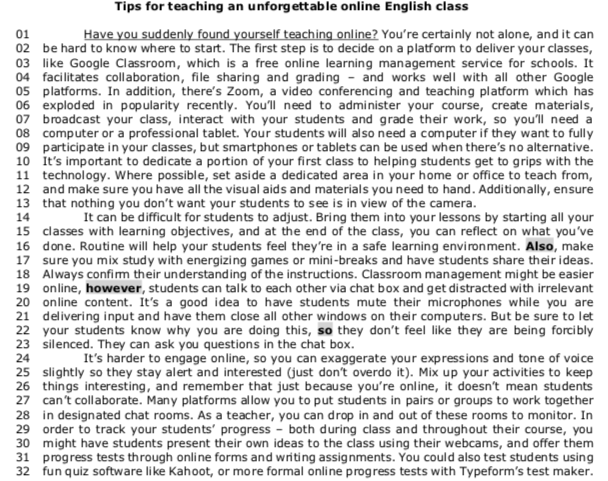
Instruction: answer question based on the following text.


  1. (Avaliable in: https://www.cambridgeenglish.org/blog/12-tips-for-teaching-an-online-english-class/ – text adapted specially for this test).


Which topic is NOT mentioned in the text?
Alternativas
Q1753960 Inglês
    The pandemic has exposed a contradiction in modern society. We are more connected than ever – proven by the speed and truly global spread of the virus; nevertheless, we are also deeply divided.
    Today’s connectedness, enforced by social distancing, has pushed the role of technology in every aspect of our lives to a new level. The tech industry is now in a challenging space: trapped between the increasing politicization of technology, the still superficial social debate around its impact and the slow adaptation of appropriate legislation. Right now, the industry needs to enable and push forward this ethical debate, recognizing its responsibility in this historic moment.
    The first step is to end the myth of tech neutrality. We need to acknowledge that technology is caught between private economic interests and its social value. Some tech business models, for example, prioritize commodification of data or advertising revenue over the social value of their services — the sharing of knowledge, connecting people, etc.
    The social impact of tech is deeper than we usually perceive and most of the time invisible to us. Digital architecture determines, increasingly, social interactions in our digital society. An example of this is the invisible influence of search engine and social media algorithms, the results of which shape our understanding of the world.
    In this moment of crisis, technology can play a fundamental role in overcoming the economic recession and reducing the systemic injustices that have been exposed.
Social exclusion - the next pandemic.
Internet: <www.thoughtworks.com> (adapted)

Concerning the ideas stated in the text and the words used in it, judge the following items.
The words “trapped” (in the second sentence of the second paragraph) and “caught” (in the second sentence of the third paragraph) can be considered synonyms and are used with similar meanings in the text.
Alternativas
Q1753959 Inglês
    The pandemic has exposed a contradiction in modern society. We are more connected than ever – proven by the speed and truly global spread of the virus; nevertheless, we are also deeply divided.
    Today’s connectedness, enforced by social distancing, has pushed the role of technology in every aspect of our lives to a new level. The tech industry is now in a challenging space: trapped between the increasing politicization of technology, the still superficial social debate around its impact and the slow adaptation of appropriate legislation. Right now, the industry needs to enable and push forward this ethical debate, recognizing its responsibility in this historic moment.
    The first step is to end the myth of tech neutrality. We need to acknowledge that technology is caught between private economic interests and its social value. Some tech business models, for example, prioritize commodification of data or advertising revenue over the social value of their services — the sharing of knowledge, connecting people, etc.
    The social impact of tech is deeper than we usually perceive and most of the time invisible to us. Digital architecture determines, increasingly, social interactions in our digital society. An example of this is the invisible influence of search engine and social media algorithms, the results of which shape our understanding of the world.
    In this moment of crisis, technology can play a fundamental role in overcoming the economic recession and reducing the systemic injustices that have been exposed.
Social exclusion - the next pandemic.
Internet: <www.thoughtworks.com> (adapted)

Concerning the ideas stated in the text and the words used in it, judge the following items.
Understanding that digital technology does not play an impartial role in the tense dynamics between private and social spheres is an important stage in the debate in the text.
Alternativas
Q1750587 Inglês
Let’s keep the lights on when she’s your age. What sort of world will this little girl grow up in? Many experts agree that it will be a considerably more energyhungry one. There are already seven billion people on our planet. And the forecast is that there will be around two billion more by 2050. So if we’re going to keep the lights on for her, we will need to look at every possible energy source. At Shell we’re exploring a broad mix of energies. We’re making our fuels and lubricants more advanced and more efficient than before. With our partner in Brazil, we’re also producing ethanol, a biofuel made from renewable sugar cane. And we’re delivering natural gas to more countries than any other energy company. When used to generate electricity, natural gas emits around half the CO2 of coal. Let’s broaden the world’s energy mix. (Newsweek. June 25, 2012. Cover. Adapted.)
In “Let’s keep the lights on when she’s your age. ” the underlined words mean that
Alternativas
Q1750586 Inglês
Let’s keep the lights on when she’s your age. What sort of world will this little girl grow up in? Many experts agree that it will be a considerably more energyhungry one. There are already seven billion people on our planet. And the forecast is that there will be around two billion more by 2050. So if we’re going to keep the lights on for her, we will need to look at every possible energy source. At Shell we’re exploring a broad mix of energies. We’re making our fuels and lubricants more advanced and more efficient than before. With our partner in Brazil, we’re also producing ethanol, a biofuel made from renewable sugar cane. And we’re delivering natural gas to more countries than any other energy company. When used to generate electricity, natural gas emits around half the CO2 of coal. Let’s broaden the world’s energy mix. (Newsweek. June 25, 2012. Cover. Adapted.)
The sentence “Let’s broaden the world’s energy mix.” means that
Alternativas
Q1750354 Inglês
   A Brazilian company has agreed to pay nearly $ 7 billion in compensation after a dam collapsed at one of its mines in Brazil two years ago, killing 270 people and causing huge damage to the local environment.
  The settlement with the Brazilian state of Minas Gerais, which was announced on Thursday, is the largest in the country’s history, according to local media. The Court of Justice of Minas Gerais mediated the agreement, which will provide funds for affected communities, emergency aid and resources for urban mobility.
  In January 2019, a dam holding waste water from the company’s iron ore mine in the town of Brumadinho burst, burying the workers’ cafeteria and dozens of homes under a toxic wave of sludge. It also polluted local rivers.
   Minas Gerais, a state whose name translates to “general mines”, is a mining hub in the southeast of Brazil. The 2019 disaster came after another mining dam in the state burst in November 2015, inundating the small village of Mariana and killing 19 people.
   “Our company is committed to fully repair and compensate the damage caused by the tragedy in Brumadinho and to increasingly contribute to the improvement and development of the communities in which we operate,” the company’s CEO said in a statement.
   In 2016, a mining company reached a deal with the Brazilian government to pay up to 24 billion reais ($ 6,2 billion) over the Mariana dam collapse.
   The disasters, which left thousands of families in mourning, have renewed scrutiny of the company’s practices and of environmental regulations in Minas Gerais.
   The company involved in the Brumadinho disaster has said that since the latest breach two years ago, it has tried to work with “the impacted families, providing assistance to restore their dignity, well-being and livelihoods.”
   “In addition to meeting the most immediate needs of the affected people and regions, it is also working to deliver projects that promote lasting change to recover communities and benefit the population effectively,” the company said in its statement.

Internet: <edition.cnn.com> (adapted).

According to the previous text, judge the following item.
The company mentioned in the first paragraph was waiting for the Justice resolutions so that they could start helping the impacted families.
Alternativas
Q1750353 Inglês
   A Brazilian company has agreed to pay nearly $ 7 billion in compensation after a dam collapsed at one of its mines in Brazil two years ago, killing 270 people and causing huge damage to the local environment.
  The settlement with the Brazilian state of Minas Gerais, which was announced on Thursday, is the largest in the country’s history, according to local media. The Court of Justice of Minas Gerais mediated the agreement, which will provide funds for affected communities, emergency aid and resources for urban mobility.
  In January 2019, a dam holding waste water from the company’s iron ore mine in the town of Brumadinho burst, burying the workers’ cafeteria and dozens of homes under a toxic wave of sludge. It also polluted local rivers.
   Minas Gerais, a state whose name translates to “general mines”, is a mining hub in the southeast of Brazil. The 2019 disaster came after another mining dam in the state burst in November 2015, inundating the small village of Mariana and killing 19 people.
   “Our company is committed to fully repair and compensate the damage caused by the tragedy in Brumadinho and to increasingly contribute to the improvement and development of the communities in which we operate,” the company’s CEO said in a statement.
   In 2016, a mining company reached a deal with the Brazilian government to pay up to 24 billion reais ($ 6,2 billion) over the Mariana dam collapse.
   The disasters, which left thousands of families in mourning, have renewed scrutiny of the company’s practices and of environmental regulations in Minas Gerais.
   The company involved in the Brumadinho disaster has said that since the latest breach two years ago, it has tried to work with “the impacted families, providing assistance to restore their dignity, well-being and livelihoods.”
   “In addition to meeting the most immediate needs of the affected people and regions, it is also working to deliver projects that promote lasting change to recover communities and benefit the population effectively,” the company said in its statement.

Internet: <edition.cnn.com> (adapted).

According to the previous text, judge the following item.
The disasters in mining dams around Brazil have helped the companies to rethink the way they inspect their practices in the state of Minas Gerais.
Alternativas
Q1750351 Inglês
   A Brazilian company has agreed to pay nearly $ 7 billion in compensation after a dam collapsed at one of its mines in Brazil two years ago, killing 270 people and causing huge damage to the local environment.
  The settlement with the Brazilian state of Minas Gerais, which was announced on Thursday, is the largest in the country’s history, according to local media. The Court of Justice of Minas Gerais mediated the agreement, which will provide funds for affected communities, emergency aid and resources for urban mobility.
  In January 2019, a dam holding waste water from the company’s iron ore mine in the town of Brumadinho burst, burying the workers’ cafeteria and dozens of homes under a toxic wave of sludge. It also polluted local rivers.
   Minas Gerais, a state whose name translates to “general mines”, is a mining hub in the southeast of Brazil. The 2019 disaster came after another mining dam in the state burst in November 2015, inundating the small village of Mariana and killing 19 people.
   “Our company is committed to fully repair and compensate the damage caused by the tragedy in Brumadinho and to increasingly contribute to the improvement and development of the communities in which we operate,” the company’s CEO said in a statement.
   In 2016, a mining company reached a deal with the Brazilian government to pay up to 24 billion reais ($ 6,2 billion) over the Mariana dam collapse.
   The disasters, which left thousands of families in mourning, have renewed scrutiny of the company’s practices and of environmental regulations in Minas Gerais.
   The company involved in the Brumadinho disaster has said that since the latest breach two years ago, it has tried to work with “the impacted families, providing assistance to restore their dignity, well-being and livelihoods.”
   “In addition to meeting the most immediate needs of the affected people and regions, it is also working to deliver projects that promote lasting change to recover communities and benefit the population effectively,” the company said in its statement.

Internet: <edition.cnn.com> (adapted).

According to the previous text, judge the following item.
There was another disaster involving a mining dam in the state of Minas Gerais which killed up to 18 people.
Alternativas
Q1750350 Inglês
   A Brazilian company has agreed to pay nearly $ 7 billion in compensation after a dam collapsed at one of its mines in Brazil two years ago, killing 270 people and causing huge damage to the local environment.
  The settlement with the Brazilian state of Minas Gerais, which was announced on Thursday, is the largest in the country’s history, according to local media. The Court of Justice of Minas Gerais mediated the agreement, which will provide funds for affected communities, emergency aid and resources for urban mobility.
  In January 2019, a dam holding waste water from the company’s iron ore mine in the town of Brumadinho burst, burying the workers’ cafeteria and dozens of homes under a toxic wave of sludge. It also polluted local rivers.
   Minas Gerais, a state whose name translates to “general mines”, is a mining hub in the southeast of Brazil. The 2019 disaster came after another mining dam in the state burst in November 2015, inundating the small village of Mariana and killing 19 people.
   “Our company is committed to fully repair and compensate the damage caused by the tragedy in Brumadinho and to increasingly contribute to the improvement and development of the communities in which we operate,” the company’s CEO said in a statement.
   In 2016, a mining company reached a deal with the Brazilian government to pay up to 24 billion reais ($ 6,2 billion) over the Mariana dam collapse.
   The disasters, which left thousands of families in mourning, have renewed scrutiny of the company’s practices and of environmental regulations in Minas Gerais.
   The company involved in the Brumadinho disaster has said that since the latest breach two years ago, it has tried to work with “the impacted families, providing assistance to restore their dignity, well-being and livelihoods.”
   “In addition to meeting the most immediate needs of the affected people and regions, it is also working to deliver projects that promote lasting change to recover communities and benefit the population effectively,” the company said in its statement.

Internet: <edition.cnn.com> (adapted).

According to the previous text, judge the following item.
There has never been such a large compensation agreement before in Brazil like the one mentioned in the text.
Alternativas
Q1742669 Inglês
    A deep freeze this week in the Lone Star state, which relies on electricity to heat many homes, is causing power demand to skyrocket. At the same time, natural gas, coal, wind and nuclear facilities in Texas have been knocked offline by the unthinkably low temperatures.
    “The extreme cold is causing the entire system to freeze up,” said Jason Bordoff, director of Columbia University’s Center on Global Energy Policy. “All sources of energy are underperforming in the extreme cold because they’re not designed to handle these unusual conditions.”
     The ripple effects are being felt around the nation as Texas’ prolific oil-and-gas industry stumbles.
     It’s striking that these power outages are happening in a state with abundant energy resources. Texas produces more electricity than any other US state — generating almost twice as much as Florida, the next-closest, according to federal statistics.
     Wind power is also booming in Texas, which produced about 28% of all the US wind-powered electricity in 2019, the EIA said. But the problem is that not only is Texas an energy superpower, it tends to be an above-average temperature state. That means its infrastructure is ill-prepared for the cold spell currently wreaking havoc. And the consequences are being felt by millions.
     Critics of renewable energy have pointed out that wind turbines have frozen or needed to be shut down due to the extreme weather.
     Even though other places with colder weather (like Iowa and Denmark) rely on wind for even larger shares of power, experts said the turbines in Texas were not winterized for the unexpected freeze.
     But this is not just about wind turbines going down. Natural gas and coal-fired power plants need water to stay online. Yet those water facilities froze in the cold temperatures and others lost access to the electricity they require to operate.
     It’s too early to definitively say what went wrong in Texas and how to prevent similar outages. More information will need to be released by state authorities. Still, some experts say the criticism of wind power appears overdone already. “In terms of the blame game, the focus on wind is a red herring. It’s more of a political issue than what is causing the power problems on the grid,” said Dan Cohan, associate professor of environmental engineering at Rice University.
     The energy crisis in Texas raises also questions about the nature of the state’s deregulated and decentralized electric grid. Unlike other states, Texas has made a conscious decision to isolate its grid from the rest of the country.
     That means that when things are running smoothly, Texas can’t export excess power to neighboring states. And in the current crisis, it can’t import power either.

Internet: <www.cnn.com>  (adapted).

About ideas stated in the text above and the words used in it, judge the following item. 


In “Natural gas and coal-fired power plants need water to stay online. Yet those water facilities froze in the cold temperatures and others lost access to the electricity they require to operate”, it is possible to substitute “Yet” for Even so without changing the meaning of the sentence.

Alternativas
Q1742665 Inglês
    A deep freeze this week in the Lone Star state, which relies on electricity to heat many homes, is causing power demand to skyrocket. At the same time, natural gas, coal, wind and nuclear facilities in Texas have been knocked offline by the unthinkably low temperatures.
    “The extreme cold is causing the entire system to freeze up,” said Jason Bordoff, director of Columbia University’s Center on Global Energy Policy. “All sources of energy are underperforming in the extreme cold because they’re not designed to handle these unusual conditions.”
     The ripple effects are being felt around the nation as Texas’ prolific oil-and-gas industry stumbles.
     It’s striking that these power outages are happening in a state with abundant energy resources. Texas produces more electricity than any other US state — generating almost twice as much as Florida, the next-closest, according to federal statistics.
     Wind power is also booming in Texas, which produced about 28% of all the US wind-powered electricity in 2019, the EIA said. But the problem is that not only is Texas an energy superpower, it tends to be an above-average temperature state. That means its infrastructure is ill-prepared for the cold spell currently wreaking havoc. And the consequences are being felt by millions.
     Critics of renewable energy have pointed out that wind turbines have frozen or needed to be shut down due to the extreme weather.
     Even though other places with colder weather (like Iowa and Denmark) rely on wind for even larger shares of power, experts said the turbines in Texas were not winterized for the unexpected freeze.
     But this is not just about wind turbines going down. Natural gas and coal-fired power plants need water to stay online. Yet those water facilities froze in the cold temperatures and others lost access to the electricity they require to operate.
     It’s too early to definitively say what went wrong in Texas and how to prevent similar outages. More information will need to be released by state authorities. Still, some experts say the criticism of wind power appears overdone already. “In terms of the blame game, the focus on wind is a red herring. It’s more of a political issue than what is causing the power problems on the grid,” said Dan Cohan, associate professor of environmental engineering at Rice University.
     The energy crisis in Texas raises also questions about the nature of the state’s deregulated and decentralized electric grid. Unlike other states, Texas has made a conscious decision to isolate its grid from the rest of the country.
     That means that when things are running smoothly, Texas can’t export excess power to neighboring states. And in the current crisis, it can’t import power either.

Internet: <www.cnn.com>  (adapted).

About ideas stated in the text above and the words used in it, judge the following item.


Despite the cold temperatures, energy production in Texas continued unimpeded.

Alternativas
Q1742664 Inglês
    A deep freeze this week in the Lone Star state, which relies on electricity to heat many homes, is causing power demand to skyrocket. At the same time, natural gas, coal, wind and nuclear facilities in Texas have been knocked offline by the unthinkably low temperatures.
    “The extreme cold is causing the entire system to freeze up,” said Jason Bordoff, director of Columbia University’s Center on Global Energy Policy. “All sources of energy are underperforming in the extreme cold because they’re not designed to handle these unusual conditions.”
     The ripple effects are being felt around the nation as Texas’ prolific oil-and-gas industry stumbles.
     It’s striking that these power outages are happening in a state with abundant energy resources. Texas produces more electricity than any other US state — generating almost twice as much as Florida, the next-closest, according to federal statistics.
     Wind power is also booming in Texas, which produced about 28% of all the US wind-powered electricity in 2019, the EIA said. But the problem is that not only is Texas an energy superpower, it tends to be an above-average temperature state. That means its infrastructure is ill-prepared for the cold spell currently wreaking havoc. And the consequences are being felt by millions.
     Critics of renewable energy have pointed out that wind turbines have frozen or needed to be shut down due to the extreme weather.
     Even though other places with colder weather (like Iowa and Denmark) rely on wind for even larger shares of power, experts said the turbines in Texas were not winterized for the unexpected freeze.
     But this is not just about wind turbines going down. Natural gas and coal-fired power plants need water to stay online. Yet those water facilities froze in the cold temperatures and others lost access to the electricity they require to operate.
     It’s too early to definitively say what went wrong in Texas and how to prevent similar outages. More information will need to be released by state authorities. Still, some experts say the criticism of wind power appears overdone already. “In terms of the blame game, the focus on wind is a red herring. It’s more of a political issue than what is causing the power problems on the grid,” said Dan Cohan, associate professor of environmental engineering at Rice University.
     The energy crisis in Texas raises also questions about the nature of the state’s deregulated and decentralized electric grid. Unlike other states, Texas has made a conscious decision to isolate its grid from the rest of the country.
     That means that when things are running smoothly, Texas can’t export excess power to neighboring states. And in the current crisis, it can’t import power either.

Internet: <www.cnn.com>  (adapted).

About ideas stated in the text above and the words used in it, judge the following item.


In the last paragraph of the text, “That” refers to the decision by Texas to isolate its energy grid from the rest of the country.

Alternativas
Q1739917 Inglês

Leia o texto para responder à questão.


Suez Canal reopens after giant stranded ship is freed Traffic has resumed in Egypt's Suez Canal after a stranded container ship blocking it for nearly a week was finally freed by salvage crews.

Tug boats honked their horns in celebration as the 400m-long (1,300ft) Ever Given was dislodged on Monday with the help of dredgers.

Hundreds of ships are waiting to pass through the canal which links the Mediterranean to the Red Sea.

It is one of the world's busiest trade routes.

Peter Berdowski, CEO of Dutch salvage company Boskalis, said the Ever Given had been refloated at 15:05 (13:05 GMT) on Monday, "thereby making free passage through the Suez Canal possible again".

Egyptian officials say the backlog of ships waiting to transit through should be cleared in around three days, but experts believe the knock-on effect on global shipping could take weeks or even months to resolve.

A marine source told Reuters news agency on Monday evening that ships were travelling southwards towards the Red Sea while canal services provider Leth Agencies said vessels had resumed transit from the Great Bitter Lake.

Some ships have already left the region, preferring to take an alternative, longer route around the southern tip of Africa. 

Inevitably, cargoes will be reaching their destination much later than planned. There may be congestion when they arrive in port, while future sailing schedules have been thrown into disarray,

The cost of shipping goods to Europe is expected to rise as a result, BBC Business Correspondent Theo Leggett reports.

Adaptado de: BBC. 2021. Disponível em: https://www.bbc.com/news/world-middle-east56567985. Acesso em 30 mar. 2021.

Mark the alternative which better fits the main objective of this text genre. 

Alternativas
Q1739916 Inglês

Leia o texto e responda à questão.


Brazil Becomes the Second Nation After the U.S. to Top

300,000 COVID-19 Deaths


Brazil topped 300,000 confirmed COVID-19 deaths on Wednesday, becoming the second country to do so amid a spike in infections that has seen the South American country report record death tolls in recent days.

The United States reached the grim milestone on Dec. 14, but has a larger population than Brazil.

On Wednesday, Brazil’s health ministry reported 2,009 daily COVID-19 deaths, bringing its pandemic total to 300,685. On Tuesday, the country saw a single-day record of 3,251 deaths.

According to local media reports, the latest coronavirus figures might be affected by changes in the government’s counting system. Newly appointed Health Minister Marcelo Queiroga said in a press conference that he was going to check whether the numbers had been artificially reduced.

With daily death tolls at pandemic highs, state governors and mayors in Brazil have expressed fears that April could be as bad as March for the country’s overwhelmed hospitals.

Just in the past 75 days, Brazil has registered 100,000 confirmed coronavirus deaths, a spike health experts blame on a lack of political coordination in fighting the virus, new variants that spread more easily and a disregard for health protocols. 

President Jair Bolsonaro on Wednesday held a meeting with the heads of other government branches to coordinate anti-virus efforts. But he didn’t propose any policies to deal with the pandemic.

Bolsonaro has consistently downplayed the severity of the pandemic, insisting the economy must be kept humming to prevent worse hardship, and he has criticized health measures imposed by local leaders.

Adaptado de: SAVARESE, Mauricio. 2021. Disponível em: https://time.com/5949897/brazil-300000-covid-19- deaths/. Acesso em 26 mar. 2021.

Mark the correct alternative according to the text.
Alternativas
Q1739913 Inglês

Leia o texto para responder à questão.


BOOK REVIEW: HOW TO TEACH ENGLISH BY

JEREMY HARMER


Right at the top of the recommended reading list for Eton Institute’s TESOL (Teaching English to Speakers of Other Languages) program is “How to Teach English” by Jeremy Harmer. Alisa W., TESOL graduate from Eton Institute, shares with us a review of the book and how it helped her own personal TESOL journey.

Prior to the training course I took to learn how to be an EFL teacher, I had no formal teacher training, I had a limited exposure to different styles of teaching, and I had never even done basic self-reflection about why I preferred some instructors over others (I always assumed it was their personality that I enjoyed). If the CEFR gave teacher ratings, I would be at the A1.1 level. I read ‘How to Teach English’ by Jeremy Harmer as part of my TESOL training course, and it was perfect for my level. It is by no means a replacement to a full teaching course, but it is a valuable supplement to those who are learning and a good refresher for those who have been out of practice for a while. It provides contemporary teaching practices and keeps its descriptions pithy and hands-on.

While some of the sections are a bit obvious or too shallow to be useful, the book is so well organized that it is easy to find what you need and skip over what you don’t. Each chapter is divided into main sections (also listed in the table of contents), and subdivided again, bolds important words, and features a list at the end of the chapter that allows you to briefly review what you just read.

As with any well-designed reference book, the glossary, index, and appendices in the back are good sources for extending your self-education as a teacher.

The book comes with a DVD that has clips from real classes so you can observe good teaching practice in the comfort of your pyjamas and the support of a bowl of chips. The DVD wouldn’t play on my MacBook, so I can’t tell you if it is helpful or not. Another feature that is nice-to-have-but-I-didn’t-use is the “Task Files” at the back. After completing a chapter, you can quiz yourself by completing info tables, answering multiple-choice questions, matching definitions, and the like.

Adaptado de: ETON INSTITUTE. Disponível em: https://etoninstitute.com/blog/book-review-how-toteach-english-by-jeremy-harmer. Acesso em 27 mar. 2021.

The textual genre review always points some opinion of the text author. Based on this affirmation, mark the alternative which better describes the opinion of the person who wrote this review.
Alternativas
Q1739716 Inglês

Read and answer.

Lady Gaga's dogs found safe after armed robbery


Lady Gaga's two stolen French bulldogs have been found safe and handed in to police, according to officials.


The two dogs, stolen in an armed robbery, have been "reunited" with the singer's representatives, police said. Lady Gaga's dog walker, Ryan Fischer, was shot by two men who abducted the dogs in Hollywood, Los Angeles, on Wednesday. He is in hospital and his family said on Friday that he was expected to make a full recovery.

Details of how the dogs were recovered are unclear. The Associated Press said a woman had brought them to the Olympic Community Police Station in LA and the singer's representatives had confirmed they were hers. The woman appeared to be "uninvolved and unassociated" with the robbery, a police spokesman said.

Lady Gaga had offered $500,000 for their safe return but it is not clear if the reward has been claimed. The star - whose real name is Stefani Germanotta - is currently in Rome working on a new Ridley Scott film, Gucci. In her first public reaction to the attack, Gaga tweeted on Friday: "My heart is sick. I am praying my family will be whole again with an act of kindness. I will pay $500,000 for their safe return."

Footage has emerged showing one of the suspects firing at Mr. Fischer before making off with the dogs, Koji and Gustav. A third bulldog, named Miss Asia, ran away and was later recovered by police.

The dog walker was shot in the chest, according to reports in US media. His family released a statement on Friday praising the medical staff who had been caring for him and saying they were confident for his full recovery, according to US media: "We cannot possibly say enough to thank all of the first responders, nurses and doctors who have worked so tirelessly to care for Ryan," the statement said. They also said: "Of course, we also want to thank Lady Gaga who has shown nothing but non-stop love and concern for Ryan and our family right from the outset. Ryan loves Gustavo and Koji as much as Lady Gaga does; so we join in her plea for their safe return." 

Police said the attack happened at about 21:40 local time on 24 February, in the area of Sierra Bonita Avenue and Sunset Boulevard: "The suspects approached the victim in a white Nissan Altima four door. Two suspects exited the vehicle and demanded the victim turn over the dogs at gunpoint," the LAPD said in an updated statement on Friday: "The victim struggled with the suspects and was shot once by one of the suspects. The suspects took two of the three dogs and fled the scene in the suspect vehicle."

The statement said "the victim is in stable condition", and the two suspects are described as black males aged 20-25.

It is not clear whether Lady Gaga's dogs were specifically targeted in the attack.

No arrests have been made.


Adaptado de: BBC. 2021. Disponível em: https://www.bbc.com/news/world-us-canada-56218620. Acesso em: 29 mar. 2021.

All the underlined sentences are examples of:

Alternativas
Respostas
4741: A
4742: A
4743: C
4744: A
4745: D
4746: C
4747: C
4748: A
4749: D
4750: E
4751: C
4752: E
4753: C
4754: C
4755: E
4756: C
4757: A
4758: A
4759: C
4760: A