Questões de Concurso Comentadas sobre interpretação de texto | reading comprehension em inglês

Foram encontradas 8.877 questões

Q2121434 Inglês

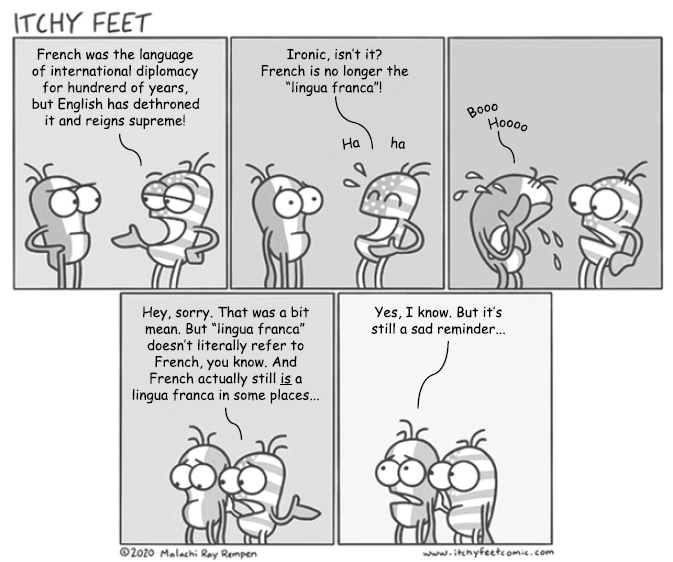
Leia a charge para responder a questão.

(twitter.com. Adaptado)
The expression “Língua Franca” is broadly used to refer to
Alternativas
Q2115839 Inglês
Instruction: answer question based on the following text. The highlights throughout the text are cited in the question.


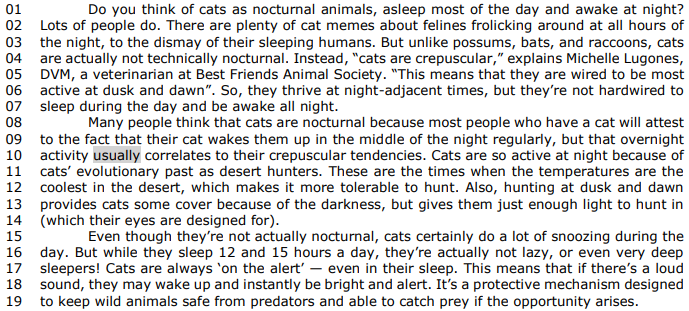
Are Cats Nocturnal? Your Cat’s Overnight Activity, Explained


(Available at: https://www.rd.com/article/are-cats-nocturnal/ – text especially adapted for this test).
The phrase "on the alert" (line 17) in the text means cats are always:
Alternativas
Q2115838 Inglês
Instruction: answer question based on the following text. The highlights throughout the text are cited in the question.


Are Cats Nocturnal? Your Cat’s Overnight Activity, Explained


(Available at: https://www.rd.com/article/are-cats-nocturnal/ – text especially adapted for this test).
According to the text, why are cats active at night?
Alternativas
Q2113345 Inglês
CHANGES


Climate change is one of the biggest threats facing our planet. Rising temperatures and sea levels, more frequent natural disasters, and changes in weather patterns can have devastating effects on ecosystems, economies, and human health. While individual actions like reducing plastic use or driving less can make a difference, larger systemic changes are needed to truly address the problem.

Governments and businesses have a critical role to play in mitigating climate change. This can include investing in renewable energy sources like wind and solar, implementing policies to reduce greenhouse gas emissions, and promoting sustainable practices across industries. The international community has also taken steps to address the issue through agreements like the Paris Agreement, which aims to limit global temperature increases to well below 2 degrees Celsius above preindustrial levels.

It is important for individuals to also stay informed and advocate for action on climate change. This can include supporting political candidates who prioritize the issue, joining grassroots movements, and educating others on the urgency of the problem.
How has the international community addressed climate change? 
Alternativas
Q2113344 Inglês
CHANGES


Climate change is one of the biggest threats facing our planet. Rising temperatures and sea levels, more frequent natural disasters, and changes in weather patterns can have devastating effects on ecosystems, economies, and human health. While individual actions like reducing plastic use or driving less can make a difference, larger systemic changes are needed to truly address the problem.

Governments and businesses have a critical role to play in mitigating climate change. This can include investing in renewable energy sources like wind and solar, implementing policies to reduce greenhouse gas emissions, and promoting sustainable practices across industries. The international community has also taken steps to address the issue through agreements like the Paris Agreement, which aims to limit global temperature increases to well below 2 degrees Celsius above preindustrial levels.

It is important for individuals to also stay informed and advocate for action on climate change. This can include supporting political candidates who prioritize the issue, joining grassroots movements, and educating others on the urgency of the problem.
What role do governments and businesses have in mitigating climate change according to the text?
Alternativas
Q2113343 Inglês
CHANGES


Climate change is one of the biggest threats facing our planet. Rising temperatures and sea levels, more frequent natural disasters, and changes in weather patterns can have devastating effects on ecosystems, economies, and human health. While individual actions like reducing plastic use or driving less can make a difference, larger systemic changes are needed to truly address the problem.

Governments and businesses have a critical role to play in mitigating climate change. This can include investing in renewable energy sources like wind and solar, implementing policies to reduce greenhouse gas emissions, and promoting sustainable practices across industries. The international community has also taken steps to address the issue through agreements like the Paris Agreement, which aims to limit global temperature increases to well below 2 degrees Celsius above preindustrial levels.

It is important for individuals to also stay informed and advocate for action on climate change. This can include supporting political candidates who prioritize the issue, joining grassroots movements, and educating others on the urgency of the problem.
What are some of the devastating effects of climate change mentioned in the text?
Alternativas
Q2113342 Inglês
CHANGES


Climate change is one of the biggest threats facing our planet. Rising temperatures and sea levels, more frequent natural disasters, and changes in weather patterns can have devastating effects on ecosystems, economies, and human health. While individual actions like reducing plastic use or driving less can make a difference, larger systemic changes are needed to truly address the problem.

Governments and businesses have a critical role to play in mitigating climate change. This can include investing in renewable energy sources like wind and solar, implementing policies to reduce greenhouse gas emissions, and promoting sustainable practices across industries. The international community has also taken steps to address the issue through agreements like the Paris Agreement, which aims to limit global temperature increases to well below 2 degrees Celsius above preindustrial levels.

It is important for individuals to also stay informed and advocate for action on climate change. This can include supporting political candidates who prioritize the issue, joining grassroots movements, and educating others on the urgency of the problem.
What is one of the biggest threats facing our planet according to the text?
Alternativas
Q2113013 Inglês
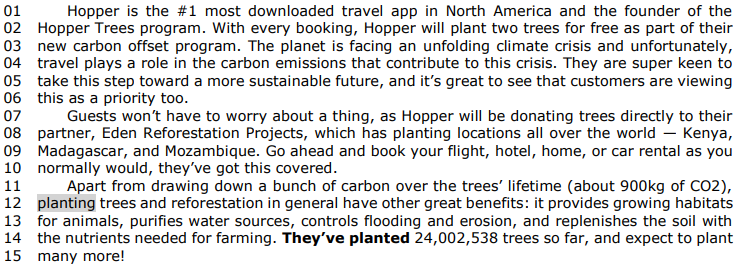
Instruction: answer question based on the following text. The highlights throughout the text are cited in the question.

The buns with green thumbs


(Available at: https://hopper.com/trees?utm_source=web&utm_medium=hp&utm_campaign=nav – text especially adapted for this test). 
Consider the context presented in the article and mark the INCORRECT statement about the use of “They’ve planted” in line 14.
Alternativas
Q2113011 Inglês
Instruction: answer question based on the following text. The highlights throughout the text are cited in the question.

The buns with green thumbs


(Available at: https://hopper.com/trees?utm_source=web&utm_medium=hp&utm_campaign=nav – text especially adapted for this test). 
Which question is NOT answered by the text?
Alternativas
Q2106871 Inglês
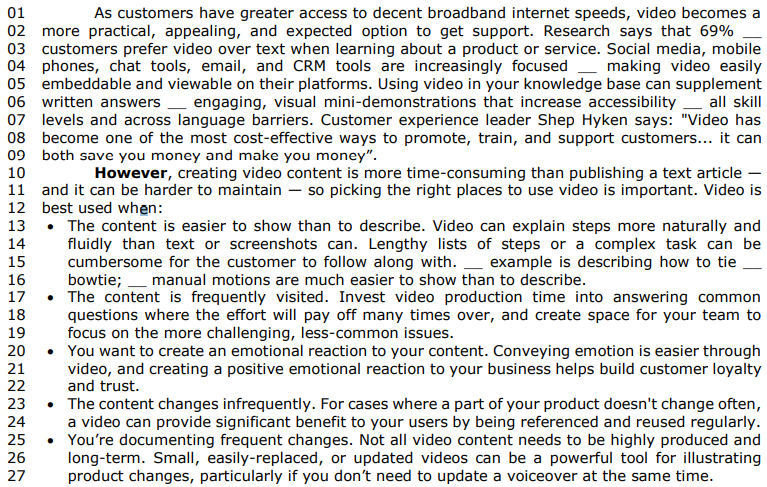
Creating Knowledge Base Videos

texto_13 - 19 .png (767×487)

(Available at: https://www.helpscout.com/blog/video-knowledge-base/ – text especially adapted for this test). 
Consider the following statements about the word “can” in the sentence “Video can explain steps more naturally” (l. 13) in the context presented in the article: 
I. Its past form is “could”. II. It could be replaced by “must” with no significative changes in meaning. III. It expresses permission.
Which statements are correct?
Alternativas
Q2106869 Inglês
Creating Knowledge Base Videos

texto_13 - 19 .png (767×487)

(Available at: https://www.helpscout.com/blog/video-knowledge-base/ – text especially adapted for this test). 
Which of the following questions is NOT answered by the article?
Alternativas
Q2101806 Inglês
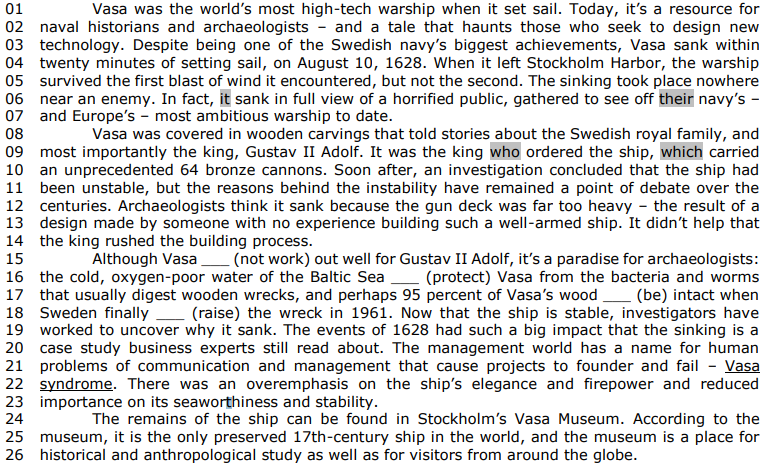
The Bizarre Story of the Swedish Warship “Vasa”

texto_13 - 19 .png (765×465)

(Available at: https://www.smithsonianmag.com/smart-news/bizarre-story-vasa-ship-keeps-giving-180964328/ – text especially adapted for this test). 
Consider the following statements about the “Vasa syndrome” (l. 21-22):
I. It is a condition that makes it difficult for people to communicate well, what can cause trouble when business people need to explain their projects. II. It is a reference to the warship Vasa, making it an example of a situation in which miscommunication can cause the failure of a project. III. It is based on the idea that the people involved in designing and building the ship failed to balance their goals, creating a beautiful ship that could not serve its main purpose: sail.
Which statements are correct? 
Alternativas
Q2101804 Inglês
The Bizarre Story of the Swedish Warship “Vasa”

texto_13 - 19 .png (765×465)

(Available at: https://www.smithsonianmag.com/smart-news/bizarre-story-vasa-ship-keeps-giving-180964328/ – text especially adapted for this test). 
The highlighted words “it” (l. 06), “their” (l. 06), “who” (l. 09), and “which” (l. 09), in the order they are mentioned in the article, refer to:  
Alternativas
Q2101803 Inglês
The Bizarre Story of the Swedish Warship “Vasa”

texto_13 - 19 .png (765×465)

(Available at: https://www.smithsonianmag.com/smart-news/bizarre-story-vasa-ship-keeps-giving-180964328/ – text especially adapted for this test). 
Considering the context presented in the text, the sentence “The sinking took place nowhere near an enemy” (l. 05-06) suggests that the ship’s location in relation to an enemy was: 
Alternativas
Q2101802 Inglês
The Bizarre Story of the Swedish Warship “Vasa”

texto_13 - 19 .png (765×465)

(Available at: https://www.smithsonianmag.com/smart-news/bizarre-story-vasa-ship-keeps-giving-180964328/ – text especially adapted for this test). 
Which of the following topics was NOT mentioned in the text?
Alternativas
Q2096255 Inglês
Text II

Global commerce 

    Driverless vehicles whizz across five new berths at Tuas Mega Port, which sits on a swathe of largely reclaimed land at the western tip of Singapore. Unmanned cranes loom overhead, circled by camera-fitted drones. The berths are the first of 21 due by 2027. When it is completed in 2040, the complex will be the largest container port on Earth, boasts PSA International, its Singaporean owner.
   Tuas is a vision of the future on two fronts. It illustrates how port operators the world over are deploying clever technologies to meet the demand for their services in the face of obstacles to the development of new facilities, from lack of space to environmental concerns. More fundamentally, the city-state’s investment, with construction costs estimated at $15bn, is part of a wave of huge bets by the broader logistics industry on the rising importance of Asia, and South-East Asia in particular. The IMF expects the region’s five largest economies—Indonesia, Malaysia, Singapore, the Philippines and Thailand—to be the fastest-growing bloc in the world by trade volumes between 2022 and 2027. The result is that the map of global commerce and the blueprints for its critical nodes are being simultaneously redrawn.

From: The Economist, January 14, 2023, pp. 57-58
The machines described in the first paragraph
Alternativas
Q2096253 Inglês
Text II

Global commerce 

    Driverless vehicles whizz across five new berths at Tuas Mega Port, which sits on a swathe of largely reclaimed land at the western tip of Singapore. Unmanned cranes loom overhead, circled by camera-fitted drones. The berths are the first of 21 due by 2027. When it is completed in 2040, the complex will be the largest container port on Earth, boasts PSA International, its Singaporean owner.
   Tuas is a vision of the future on two fronts. It illustrates how port operators the world over are deploying clever technologies to meet the demand for their services in the face of obstacles to the development of new facilities, from lack of space to environmental concerns. More fundamentally, the city-state’s investment, with construction costs estimated at $15bn, is part of a wave of huge bets by the broader logistics industry on the rising importance of Asia, and South-East Asia in particular. The IMF expects the region’s five largest economies—Indonesia, Malaysia, Singapore, the Philippines and Thailand—to be the fastest-growing bloc in the world by trade volumes between 2022 and 2027. The result is that the map of global commerce and the blueprints for its critical nodes are being simultaneously redrawn.

From: The Economist, January 14, 2023, pp. 57-58
As regards Text II, analyse the assertions below:
I. The soil on which the port is being built was once parched. II. The industry is quite diffident about the success of the investment. III. From an international viewpoint the project described will have sweeping implications.
Choose the correct answer: 
Alternativas
Q2096252 Inglês

Text I 


Trust and audit


    Trust is what auditors sell. They review the accuracy, adequacy or propriety of other people’s work. Financial statement audits are prepared for the owners of a company and presented publically to provide assurance to the market and the wider public. Public service audits are presented to governing bodies and, in some cases, directly to parliament.

      It is the independent scepticism of the auditor that allows shareholders and the public to be confident that they are being given a true and fair account of the organisation in question. The auditor’s signature pledges his or her reputational capital so that the audited body’s public statements can be trusted. […]

    Given the fundamental importance of trust, should auditors not then feel immensely valuable in the context of declining trust? Not so. Among our interviewees, a consensus emerged that the audit profession is under-producing trust at a critical time. One aspect of the problem is the quietness of audit: it is a profession that literally goes about its work behind the scenes. The face and processes of the auditor are rarely seen in the organisations they scrutinise, and relatively rarely in the outside world. Yet, if we listen to the mounting evidence of the importance of social capital, we know that frequent and reliable contacts between groups are important to strengthening and expanding trust.

     So what can be done? Our research suggests that more frequent dialogue with audit committees and a more ambitious outward facing role for the sector’s leadership would be welcome. But we think more is needed. Audit for the 21st century should be understood and designed as primarily a confidence building process within the audited organisation and across its stakeholders. If the audit is a way of ensuring the client’s accountability, much more needs to be done to make the audit itself exemplary in its openness and inclusiveness.

    Instead of an audit report being a trust-producing product, the audit process could become a trust-producing practice in which the auditor uses his or her position as a trusted intermediary to broker rigorous learning across all dimensions of the organisation and its stakeholders. The views of investors, staff, suppliers and customers could routinely be considered, as could questions from the general public; online technologies offer numerous opportunities to inform, involve and invite.

    From being a service that consists almost exclusively of external investigation by a warranted professional, auditing needs to become more co-productive, with the auditor’s role expanding to include that of an expert convenor who is willing to share the tools of enquiry. Audit could move from ‘black box’ to ‘glass box’.

    But the profession will still struggle to secure trust unless it can stake a stronger claim to supporting improvement. Does it increase the economic, social or environmental value of the organisations it reviews? It is one thing to believe in the accuracy of a financial statement audit, but it is another thing to believe in its utility.


Adapted from: https://auditfutures.net/pdf/AuditFutures-RSA-EnlighteningProfessions.pdf

“Unless” in “unless it can stake a stronger claim to supporting improvement” (7th paragraph) introduces a(n)
Alternativas
Q2096250 Inglês

Text I 


Trust and audit


    Trust is what auditors sell. They review the accuracy, adequacy or propriety of other people’s work. Financial statement audits are prepared for the owners of a company and presented publically to provide assurance to the market and the wider public. Public service audits are presented to governing bodies and, in some cases, directly to parliament.

      It is the independent scepticism of the auditor that allows shareholders and the public to be confident that they are being given a true and fair account of the organisation in question. The auditor’s signature pledges his or her reputational capital so that the audited body’s public statements can be trusted. […]

    Given the fundamental importance of trust, should auditors not then feel immensely valuable in the context of declining trust? Not so. Among our interviewees, a consensus emerged that the audit profession is under-producing trust at a critical time. One aspect of the problem is the quietness of audit: it is a profession that literally goes about its work behind the scenes. The face and processes of the auditor are rarely seen in the organisations they scrutinise, and relatively rarely in the outside world. Yet, if we listen to the mounting evidence of the importance of social capital, we know that frequent and reliable contacts between groups are important to strengthening and expanding trust.

     So what can be done? Our research suggests that more frequent dialogue with audit committees and a more ambitious outward facing role for the sector’s leadership would be welcome. But we think more is needed. Audit for the 21st century should be understood and designed as primarily a confidence building process within the audited organisation and across its stakeholders. If the audit is a way of ensuring the client’s accountability, much more needs to be done to make the audit itself exemplary in its openness and inclusiveness.

    Instead of an audit report being a trust-producing product, the audit process could become a trust-producing practice in which the auditor uses his or her position as a trusted intermediary to broker rigorous learning across all dimensions of the organisation and its stakeholders. The views of investors, staff, suppliers and customers could routinely be considered, as could questions from the general public; online technologies offer numerous opportunities to inform, involve and invite.

    From being a service that consists almost exclusively of external investigation by a warranted professional, auditing needs to become more co-productive, with the auditor’s role expanding to include that of an expert convenor who is willing to share the tools of enquiry. Audit could move from ‘black box’ to ‘glass box’.

    But the profession will still struggle to secure trust unless it can stake a stronger claim to supporting improvement. Does it increase the economic, social or environmental value of the organisations it reviews? It is one thing to believe in the accuracy of a financial statement audit, but it is another thing to believe in its utility.


Adapted from: https://auditfutures.net/pdf/AuditFutures-RSA-EnlighteningProfessions.pdf

Text I suggests auditors should invest in more
Alternativas
Q2096249 Inglês

Text I 


Trust and audit


    Trust is what auditors sell. They review the accuracy, adequacy or propriety of other people’s work. Financial statement audits are prepared for the owners of a company and presented publically to provide assurance to the market and the wider public. Public service audits are presented to governing bodies and, in some cases, directly to parliament.

      It is the independent scepticism of the auditor that allows shareholders and the public to be confident that they are being given a true and fair account of the organisation in question. The auditor’s signature pledges his or her reputational capital so that the audited body’s public statements can be trusted. […]

    Given the fundamental importance of trust, should auditors not then feel immensely valuable in the context of declining trust? Not so. Among our interviewees, a consensus emerged that the audit profession is under-producing trust at a critical time. One aspect of the problem is the quietness of audit: it is a profession that literally goes about its work behind the scenes. The face and processes of the auditor are rarely seen in the organisations they scrutinise, and relatively rarely in the outside world. Yet, if we listen to the mounting evidence of the importance of social capital, we know that frequent and reliable contacts between groups are important to strengthening and expanding trust.

     So what can be done? Our research suggests that more frequent dialogue with audit committees and a more ambitious outward facing role for the sector’s leadership would be welcome. But we think more is needed. Audit for the 21st century should be understood and designed as primarily a confidence building process within the audited organisation and across its stakeholders. If the audit is a way of ensuring the client’s accountability, much more needs to be done to make the audit itself exemplary in its openness and inclusiveness.

    Instead of an audit report being a trust-producing product, the audit process could become a trust-producing practice in which the auditor uses his or her position as a trusted intermediary to broker rigorous learning across all dimensions of the organisation and its stakeholders. The views of investors, staff, suppliers and customers could routinely be considered, as could questions from the general public; online technologies offer numerous opportunities to inform, involve and invite.

    From being a service that consists almost exclusively of external investigation by a warranted professional, auditing needs to become more co-productive, with the auditor’s role expanding to include that of an expert convenor who is willing to share the tools of enquiry. Audit could move from ‘black box’ to ‘glass box’.

    But the profession will still struggle to secure trust unless it can stake a stronger claim to supporting improvement. Does it increase the economic, social or environmental value of the organisations it reviews? It is one thing to believe in the accuracy of a financial statement audit, but it is another thing to believe in its utility.


Adapted from: https://auditfutures.net/pdf/AuditFutures-RSA-EnlighteningProfessions.pdf

Based on Text I, mark the statements below as TRUE (T) or FALSE (F).
I. In auditing, taking heed of what other parties have to say needs to be downplayed. II. Auditors are generally unobtrusive when carrying out their jobs. III. Trust is obtained when auditors eschew straightforward statements.
The statements are, respectively,

Alternativas
Respostas
3761: D
3762: C
3763: D
3764: C
3765: C
3766: D
3767: C
3768: B
3769: D
3770: A
3771: C
3772: D
3773: C
3774: D
3775: E
3776: C
3777: C
3778: E
3779: D
3780: A