Questões de Concurso
Comentadas sobre interpretação de texto | reading comprehension em inglês
Foram encontradas 8.877 questões


After reading the extract from Pertanika J. (2022) about reading, choose the CORRECT item that best summarizes the main ideas about reading strategies.
According to Rodinadze, S., & Zarbazoia, K., 2012, judge the items below as (T) True or (F) False regarding the ADVANTAGES of information technology in teaching the English language.
I. Information technology helps students as well as teachers in studying the course material easily because of fast access. Studying the subjects with the help of online libraries and dictionaries has made grasping and increasing knowledge easy for the students.
II. Information technology may facilitate learning or serve as the actual educational structure allowing learning to occur. It benefits both traditional education institutions and online educational models in fundamental ways. For example, multimedia presentations, knowledge-management softwares, apps, mobile devices such as tablets, personal digital assistants (PDAs), lap tops, video conferencing, cloud computing, and collaborative document editing are notable information technology services benefiting education that can provide teachers with an endless choice to create more exciting and interactive lessons.
III. Students and educators utilizing cloud computing to store their homework can also modify the documents access settings to allow multiple editors and contributors to participate in an assignment. This empowers educators to design work assignments for teams of students working together and, in so doing, cultivate a teamwork ethos preparing them for the workplace. Now information technology has made it easy to study as well as teach in groups or in clusters. At the English lessons with online resources they can be united together to do the desired task.
IV. Teachers can enter grades and assignment updates online, rather than in a paper grade-book. Libraries with a digital database in place of a traditional card catalog make their resources available for students to search anywhere with an Internet connection. Staff members can find and send transcript information and other records quickly by accessing a digital filing system, saving time and paper.
V. Information and communication technology opens the doors for better distance learning programs, allowing those in disadvantaged areas to have access to the same education as the privileged. Because this technology makes information accessible from nearly any location with a mobile device or laptop, courses can be more flexible; meaning those with full schedules who may not have the time or opportunity to further their education can choose to enroll in courses online and complete assignments on their own time.
VI. Interactive audio and video allow real time communication using phones and computers at the English lessons. Voice over Internet Protocol enables a person's voice to be transmitted through an Internet connection. Voice and multimedia presentations can also be delivered to a dispersed class with questions and answers taking place in real time.
Choose the CORRECT sequence.
According to Fiorito (2005), what is INCORRECT to say about English for Specific Purposes (ESP)?
Read the quote and choose the CORRECT statement that completes the given sentence.
“Throughout this paper I have been arguing that we have to go further than finding ways of improving
techniques to create “real life” situations in the classroom. Teachers as decision-makers and agents need to
consider the identities that are being (re)constructed by their pedagogical practices and choices. Considering
that those identities are being shaped anyway, it is important that teachers become aware of the effects
of their actions. One of the possible identities is that of a global citizen: not someone who knows many
languages but someone who deals with the conflicts inherent in communicative events made possible by a
language that has acquired a global dimension” (GIMENEZ, 2007, p. 27).
According to Gimenez, globalization and the spread of English around the world have posed new challenges to
language teachers because:
According to the authors, it is CORRECT to point that:
Judge the items below as (T) True or (F) False about the aims of OCEM (2006).
I. To reflect on the educational function of teaching foreign languages in high school and to emphasize their importance in the curriculum;
II. To reaffirm the notion of citizenship and discuss the practice of this notion in the foreign languages teaching context without considering globalization;
III. To discuss the problem of exclusion in the teaching context in the face of “globalizing” values and the feeling of inclusion often combined with foreign languages knowledge;
IV. To introduce theories about language and new technologies emphasizing globalization and individualism.
V. To give suggestions on the practice of teaching foreign languages through literacies, multiliteracies, multimodality and hypertext.
Choose the statement with the TRUE items.
I. “And studies say that students enjoy ‘watching’ videos and retain information from them well”. II. “A PowerPoint presentation should be ‘basic’, simple and not distracting”. III. “The summary slide serves as the main topic and what students should learn after viewing the presentation. Then, at the end of the PowerPoint presentation, teachers should include another summary slide (…)”.
Text: Paulo Freire and Communication Studies
(Adapted from Tania Ramalho article in Communication
- Oxford University Press.
Paulo Freire, the Brazilian activist educator and philosopher of education, affirmed that communication is at the heart of pedagogy, as teaching, and learning through praxis that involves reflection and action ultimately to address social injustice and dehumanization. Dialogue is at the center of his pedagogical approach, as means to individualization and humanization. Dialogue assumes participants from EJA - young and adult education- to be on an equal level even in the presence of difference. In his literacy work, Freire required teacher-facilitators to co-investigate the most important themes in the lives of students. These themes were codified into pictures and brought to dialogue that animated the re-creation of knowledge of participants’ world in the process of learning how to read, achieving the meaning of the word. The objective of this approach was not to reproduce “banking” education but to promote revolutionary emancipation of individual and society. Freire developed his work in life context at the state of Pernambuco, in the challenging circumstances – socially, historically, and geographically – of the Brazilian Northeast Region. He experienced poverty and hunger and was lucky in his access to education thanks to the efforts of his mother. He rose through the ranks of civil service, serving at state and national levels, addressing the literacy and emancipatory needs of the population, particularly adults in rural areas. Exiled during the military dictatorship in Brazil, Freire lived in Chile, the United States, and Switzerland, where he worked on education projects worldwide.
A questão foi desenvolvida em língua portuguesa oficial do Brasil.
Text: Paulo Freire and Communication Studies
(Adapted from Tania Ramalho article in Communication
- Oxford University Press.
Paulo Freire, the Brazilian activist educator and philosopher of education, affirmed that communication is at the heart of pedagogy, as teaching, and learning through praxis that involves reflection and action ultimately to address social injustice and dehumanization. Dialogue is at the center of his pedagogical approach, as means to individualization and humanization. Dialogue assumes participants from EJA - young and adult education- to be on an equal level even in the presence of difference. In his literacy work, Freire required teacher-facilitators to co-investigate the most important themes in the lives of students. These themes were codified into pictures and brought to dialogue that animated the re-creation of knowledge of participants’ world in the process of learning how to read, achieving the meaning of the word. The objective of this approach was not to reproduce “banking” education but to promote revolutionary emancipation of individual and society. Freire developed his work in life context at the state of Pernambuco, in the challenging circumstances – socially, historically, and geographically – of the Brazilian Northeast Region. He experienced poverty and hunger and was lucky in his access to education thanks to the efforts of his mother. He rose through the ranks of civil service, serving at state and national levels, addressing the literacy and emancipatory needs of the population, particularly adults in rural areas. Exiled during the military dictatorship in Brazil, Freire lived in Chile, the United States, and Switzerland, where he worked on education projects worldwide.
A questão foi desenvolvida em língua portuguesa oficial do Brasil.
Text: Paulo Freire and Communication Studies
(Adapted from Tania Ramalho article in Communication
- Oxford University Press.
Paulo Freire, the Brazilian activist educator and philosopher of education, affirmed that communication is at the heart of pedagogy, as teaching, and learning through praxis that involves reflection and action ultimately to address social injustice and dehumanization. Dialogue is at the center of his pedagogical approach, as means to individualization and humanization. Dialogue assumes participants from EJA - young and adult education- to be on an equal level even in the presence of difference. In his literacy work, Freire required teacher-facilitators to co-investigate the most important themes in the lives of students. These themes were codified into pictures and brought to dialogue that animated the re-creation of knowledge of participants’ world in the process of learning how to read, achieving the meaning of the word. The objective of this approach was not to reproduce “banking” education but to promote revolutionary emancipation of individual and society. Freire developed his work in life context at the state of Pernambuco, in the challenging circumstances – socially, historically, and geographically – of the Brazilian Northeast Region. He experienced poverty and hunger and was lucky in his access to education thanks to the efforts of his mother. He rose through the ranks of civil service, serving at state and national levels, addressing the literacy and emancipatory needs of the population, particularly adults in rural areas. Exiled during the military dictatorship in Brazil, Freire lived in Chile, the United States, and Switzerland, where he worked on education projects worldwide.
A questão foi desenvolvida em língua portuguesa oficial do Brasil.
Text: Paulo Freire and Communication Studies
(Adapted from Tania Ramalho article in Communication
- Oxford University Press.
Paulo Freire, the Brazilian activist educator and philosopher of education, affirmed that communication is at the heart of pedagogy, as teaching, and learning through praxis that involves reflection and action ultimately to address social injustice and dehumanization. Dialogue is at the center of his pedagogical approach, as means to individualization and humanization. Dialogue assumes participants from EJA - young and adult education- to be on an equal level even in the presence of difference. In his literacy work, Freire required teacher-facilitators to co-investigate the most important themes in the lives of students. These themes were codified into pictures and brought to dialogue that animated the re-creation of knowledge of participants’ world in the process of learning how to read, achieving the meaning of the word. The objective of this approach was not to reproduce “banking” education but to promote revolutionary emancipation of individual and society. Freire developed his work in life context at the state of Pernambuco, in the challenging circumstances – socially, historically, and geographically – of the Brazilian Northeast Region. He experienced poverty and hunger and was lucky in his access to education thanks to the efforts of his mother. He rose through the ranks of civil service, serving at state and national levels, addressing the literacy and emancipatory needs of the population, particularly adults in rural areas. Exiled during the military dictatorship in Brazil, Freire lived in Chile, the United States, and Switzerland, where he worked on education projects worldwide.
A questão foi desenvolvida em língua portuguesa oficial do Brasil.
Assinale a alternativa correta em relação ao educador da EJA.
Text: Paulo Freire and Communication Studies
(Adapted from Tania Ramalho article in Communication
- Oxford University Press.
Paulo Freire, the Brazilian activist educator and philosopher of education, affirmed that communication is at the heart of pedagogy, as teaching, and learning through praxis that involves reflection and action ultimately to address social injustice and dehumanization. Dialogue is at the center of his pedagogical approach, as means to individualization and humanization. Dialogue assumes participants from EJA - young and adult education- to be on an equal level even in the presence of difference. In his literacy work, Freire required teacher-facilitators to co-investigate the most important themes in the lives of students. These themes were codified into pictures and brought to dialogue that animated the re-creation of knowledge of participants’ world in the process of learning how to read, achieving the meaning of the word. The objective of this approach was not to reproduce “banking” education but to promote revolutionary emancipation of individual and society. Freire developed his work in life context at the state of Pernambuco, in the challenging circumstances – socially, historically, and geographically – of the Brazilian Northeast Region. He experienced poverty and hunger and was lucky in his access to education thanks to the efforts of his mother. He rose through the ranks of civil service, serving at state and national levels, addressing the literacy and emancipatory needs of the population, particularly adults in rural areas. Exiled during the military dictatorship in Brazil, Freire lived in Chile, the United States, and Switzerland, where he worked on education projects worldwide.
A questão foi desenvolvida em língua portuguesa oficial do Brasil.
The following text refers to question
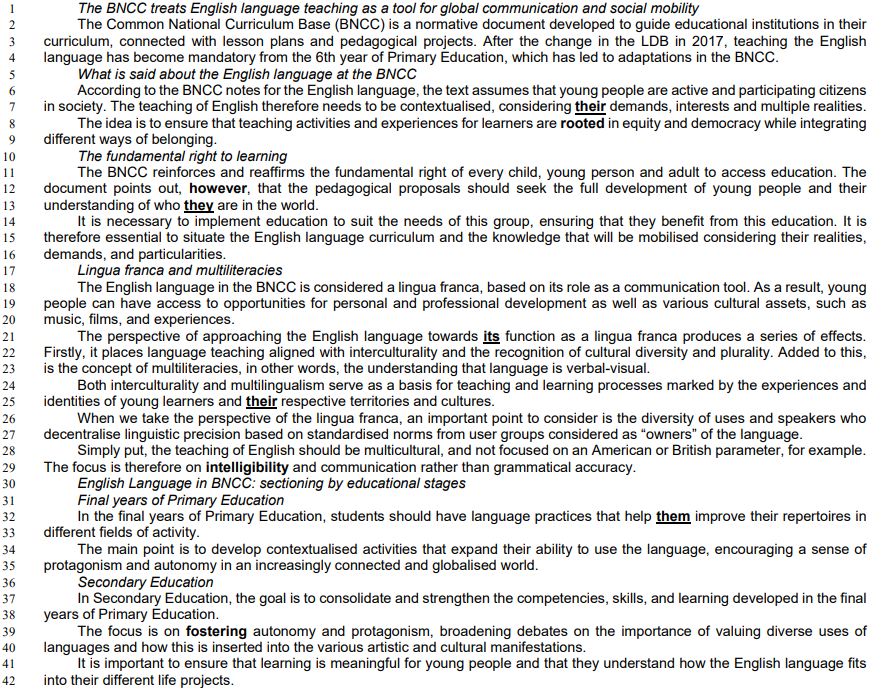
Disponível em: https://www.inglesnasescolas.org/en/headline/english-language-in-bncc/. Adaptado.
When we take the perspective of the lingua franca, an important point to consider is the diversity of uses and speakers who decentralise linguistic precision based on standardised norms from user groups considered as “owners” of the language.
Choose the alternative that conveys the meaning of this excerpt.
The following text refers to question
Disponível em: https://www.inglesnasescolas.org/en/headline/english-language-in-bncc/. Adaptado.
The following text refers to question
Disponível em: https://www.inglesnasescolas.org/en/headline/english-language-in-bncc/. Adaptado.

 Conheça nossos planos