Questões de Concurso Comentadas sobre interpretação de texto | reading comprehension em inglês

Foram encontradas 8.877 questões

Q2214989 Inglês
Text 7A2

         When it comes to the vocabulary of languages, is it true, as some suppose, that the vocabularies of so-called primitive languages are too small and inadequate to account for the nuances of the physical and social universes of their speakers? The answer is somewhat complicated. Because the vocabulary of a language serves only the members of the society who speak it, the question to be asked should be: Is a particular vocabulary sufficient to serve the sociocultural needs of those who use the language? When put like this, it follows that the language associated with a relatively simple culture would have a smaller vocabulary than the language of a complex society. Why, for example, should the Inuit people (often known by the pejorative term “Eskimo”) have words for chlorofluoromethane, dune buggy, or tae kwon do when these substances, objects, and concepts play no part in their culture? By the same token, however, the language of a tribal society would have elaborate lexical domains for prominent aspects of the culture although these do not exist in complex societies. The Agta of the Philippines, for example, are reported to have no fewer than thirty-one verbs referring to types of fishing, while in Munich, the terminology for the local varieties of beer is quite extensive, according to strength, color, fizziness, aging, and clarity, the full list exceeding seventy terms.
        However, even though no language spoken today may be labeled primitive, this does not mean that all languages do all things in the same way, or are equally influential in the modern transnational world. The linguistic anthropologist Dell Hymes claims that languages are not functionally equivalent because the role of speech varies from one society to the next. According to Hymes, though all languages “are potentially equal and hence capable of adaptation to the needs of a complex industrial civilization”, only certain languages have actually done so (Hymes 1961:77). These languages are more successful than others not because they are structurally more advanced, but because they happen to be associated with societies in which language is the basis of literature, education, science, and commerce.

Zdenek SALZMANN, James M. STANLAW and Nobuko ADACHI. Language, culture, and society: an introduction to linguistic anthropology. Boulder (CO): Westview Press, 2012. p. 6-7 (adapted).  

Judge the following item, related to text 7A2 and its subject.


Differences among languages do not allow them to be hierarchically classified according to decontextualized criteria.  

Alternativas
Q2214987 Inglês

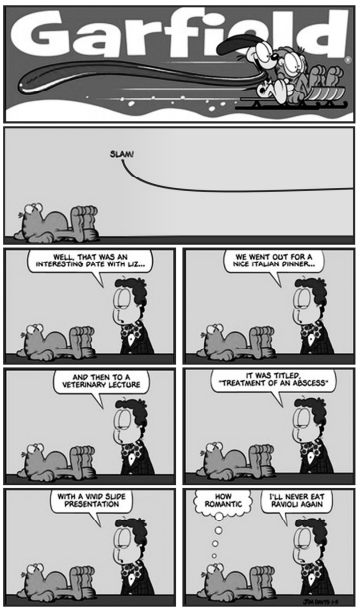
Based on the precedent comic strip, judge the following item.


The cat’s only comment is very sarcastic.


Alternativas
Q2214986 Inglês

Based on the precedent comic strip, judge the following item.


The man wished he had not eaten ravioli.


Alternativas
Q2214985 Inglês

Based on the precedent comic strip, judge the following item.


The slide presentation he watched was too realistic for him.

Alternativas
Q2214973 Inglês
Text 7A1

     Artificial intelligence still has difficulties processing requests in one language, without the additional complications of translation. Michael Housman, chief data science officer at RapportBoost.AI, explained that the ideal scenario for machine learning and artificial intelligence is something with fixed rules and a clear-cut measure of success or failure. He named chess as an obvious example. This happened faster than anyone anticipated because of the game’s very clear rules and limited set of moves. Housman elaborated, “Language is almost the opposite of that. There aren’t as clearly-cut and defined rules.”
      I asked Dr. Jorge Majfud, Associate Professor of Spanish, at Jacksonville University, to explain why consistently accurate language translation has thus far eluded AI. He replied, “The problem is that considering the ‘entire’ sentence is still not enough.” He noted that sarcasm and irony only make sense within this widened context. Similarly, idioms can be problematic for automated translations.
       Dr. Majfud warned, “We should be aware of the fragility of their ‘interpretation.’ Because to translate is basically to interpret, not just an idea but a feeling. Human feelings and ideas that only humans can understand — and sometimes not even we, humans, understand other humans.” He noted that cultures, gender, and even age can pose barriers to this understanding and also contended that an over-reliance on technology is leading to our cultural and political decline. Dr. Majfud mentioned that Argentinean writer Julio Cortázar used to refer to dictionaries as “cemeteries”. He suggested that automatic translators could be called “zombies”.

David Pring-Mill. Why Hasn’t AI Mastered Language Translation? Internet:<singularityhub.com>  (adapted).

Considering information from text 7A1, judge the following item.


Dr. Majfud warns about the excess of reliance on language technology.


Alternativas
Q2214972 Inglês
Text 7A1

     Artificial intelligence still has difficulties processing requests in one language, without the additional complications of translation. Michael Housman, chief data science officer at RapportBoost.AI, explained that the ideal scenario for machine learning and artificial intelligence is something with fixed rules and a clear-cut measure of success or failure. He named chess as an obvious example. This happened faster than anyone anticipated because of the game’s very clear rules and limited set of moves. Housman elaborated, “Language is almost the opposite of that. There aren’t as clearly-cut and defined rules.”
      I asked Dr. Jorge Majfud, Associate Professor of Spanish, at Jacksonville University, to explain why consistently accurate language translation has thus far eluded AI. He replied, “The problem is that considering the ‘entire’ sentence is still not enough.” He noted that sarcasm and irony only make sense within this widened context. Similarly, idioms can be problematic for automated translations.
       Dr. Majfud warned, “We should be aware of the fragility of their ‘interpretation.’ Because to translate is basically to interpret, not just an idea but a feeling. Human feelings and ideas that only humans can understand — and sometimes not even we, humans, understand other humans.” He noted that cultures, gender, and even age can pose barriers to this understanding and also contended that an over-reliance on technology is leading to our cultural and political decline. Dr. Majfud mentioned that Argentinean writer Julio Cortázar used to refer to dictionaries as “cemeteries”. He suggested that automatic translators could be called “zombies”.

David Pring-Mill. Why Hasn’t AI Mastered Language Translation? Internet:<singularityhub.com>  (adapted).

Considering information from text 7A1, judge the following item.


Michael Housman is a chess specialist.


Alternativas
Q2214969 Inglês
Text 7A1

     Artificial intelligence still has difficulties processing requests in one language, without the additional complications of translation. Michael Housman, chief data science officer at RapportBoost.AI, explained that the ideal scenario for machine learning and artificial intelligence is something with fixed rules and a clear-cut measure of success or failure. He named chess as an obvious example. This happened faster than anyone anticipated because of the game’s very clear rules and limited set of moves. Housman elaborated, “Language is almost the opposite of that. There aren’t as clearly-cut and defined rules.”
      I asked Dr. Jorge Majfud, Associate Professor of Spanish, at Jacksonville University, to explain why consistently accurate language translation has thus far eluded AI. He replied, “The problem is that considering the ‘entire’ sentence is still not enough.” He noted that sarcasm and irony only make sense within this widened context. Similarly, idioms can be problematic for automated translations.
       Dr. Majfud warned, “We should be aware of the fragility of their ‘interpretation.’ Because to translate is basically to interpret, not just an idea but a feeling. Human feelings and ideas that only humans can understand — and sometimes not even we, humans, understand other humans.” He noted that cultures, gender, and even age can pose barriers to this understanding and also contended that an over-reliance on technology is leading to our cultural and political decline. Dr. Majfud mentioned that Argentinean writer Julio Cortázar used to refer to dictionaries as “cemeteries”. He suggested that automatic translators could be called “zombies”.

David Pring-Mill. Why Hasn’t AI Mastered Language Translation? Internet:<singularityhub.com>  (adapted).

Based on text 7A1, judge the following item. 


Dr. Majfud considers that AI will soon be able to interpret full sentences.


Alternativas
Q2214967 Inglês
Text 7A1

     Artificial intelligence still has difficulties processing requests in one language, without the additional complications of translation. Michael Housman, chief data science officer at RapportBoost.AI, explained that the ideal scenario for machine learning and artificial intelligence is something with fixed rules and a clear-cut measure of success or failure. He named chess as an obvious example. This happened faster than anyone anticipated because of the game’s very clear rules and limited set of moves. Housman elaborated, “Language is almost the opposite of that. There aren’t as clearly-cut and defined rules.”
      I asked Dr. Jorge Majfud, Associate Professor of Spanish, at Jacksonville University, to explain why consistently accurate language translation has thus far eluded AI. He replied, “The problem is that considering the ‘entire’ sentence is still not enough.” He noted that sarcasm and irony only make sense within this widened context. Similarly, idioms can be problematic for automated translations.
       Dr. Majfud warned, “We should be aware of the fragility of their ‘interpretation.’ Because to translate is basically to interpret, not just an idea but a feeling. Human feelings and ideas that only humans can understand — and sometimes not even we, humans, understand other humans.” He noted that cultures, gender, and even age can pose barriers to this understanding and also contended that an over-reliance on technology is leading to our cultural and political decline. Dr. Majfud mentioned that Argentinean writer Julio Cortázar used to refer to dictionaries as “cemeteries”. He suggested that automatic translators could be called “zombies”.

David Pring-Mill. Why Hasn’t AI Mastered Language Translation? Internet:<singularityhub.com>  (adapted).

Based on text 7A1, judge the following item. 


Even though language is everywhere, its rules are not as exact as in games.


Alternativas
Q2210442 Inglês

In the cartoon below we see an appendix, the body part, saying the following:


1. you don’t have to remove your appendix just because you don’t know what we do!

2. BUT IF YOU DON’T, I WILL KILL YOU IF THE URGE STRIKES ME!

3. but I might help your immune system! 4. MAYBE. 
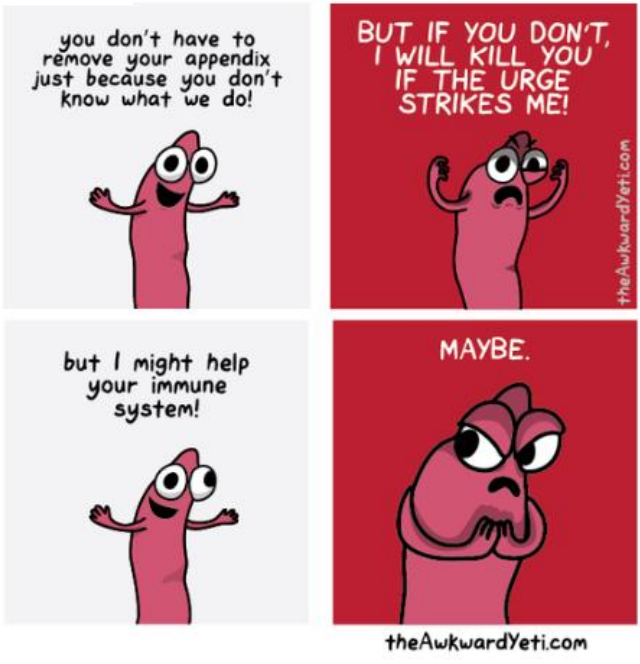

Imagem associada para resolução da questão


Analyze the following statements about the cartoon and mark T, if true, or F, if false.


( ) The second sentence contains a conditional.


( ) Sentence number 3 is a promise.


( ) “Might” in sentence 3 and “maybe” in sentence 4 both express possibilities.


The correct order of filling the parentheses, from top to bottom, is:

Alternativas
Q2210429 Inglês

Stop Wasting Time: A 15-minute Planning Session That Will Save You Hours


(Available at: https://www.classycareergirl.com/5-simple-time-management-tips-for-a-great-week/– textespecially adapted for this test).
Mark the alternative that shows to what the highlighted pronouns are referring to, in the order they appear in the text: “it” (l. 15), “These” (l. 21), and “This” (l. 23). 
Alternativas
Q2210428 Inglês

Stop Wasting Time: A 15-minute Planning Session That Will Save You Hours


(Available at: https://www.classycareergirl.com/5-simple-time-management-tips-for-a-great-week/– textespecially adapted for this test).
Mark the INCORRECT alternative about the excerpt “Every Sunday, I set aside 15 minutes to plan out my upcoming work week”. 
Alternativas
Q2210425 Inglês

Stop Wasting Time: A 15-minute Planning Session That Will Save You Hours


(Available at: https://www.classycareergirl.com/5-simple-time-management-tips-for-a-great-week/– textespecially adapted for this test).
How does setting a time deadline for tasks help the author? 
Alternativas
Q2210424 Inglês

Stop Wasting Time: A 15-minute Planning Session That Will Save You Hours


(Available at: https://www.classycareergirl.com/5-simple-time-management-tips-for-a-great-week/– textespecially adapted for this test).
What technique does the author use to help her identify the most important tasks for the week? 
Alternativas
Q2210423 Inglês

Stop Wasting Time: A 15-minute Planning Session That Will Save You Hours


(Available at: https://www.classycareergirl.com/5-simple-time-management-tips-for-a-great-week/– textespecially adapted for this test).
What is the author’s main goal with the Sunday planning session? 
Alternativas
Q2210093 Inglês
Imagem associada para resolução da questão

Disponível em:<http://www.jaideresbell.com.br/site/2016/07/01/it-was-amazon/>.  . Acesso em: 4 mar. 2023. Tendo em vista o texto acima, analise os itens a seguir.
I. A intenção do texto é denunciar a devastação da floresta e extinção dos animais da maior floresta tropical do mundo.
II. A tradução livre do texto verbal para a Língua Portuguesa é “Isso foi a Amazônia”.
III. A tela pintada faz parte da arte indígena contemporânea aliada aos desígnios da indústria da cultura global e, a ela serve, ao empregar a língua inglesa.
Está correto o que se afirma em
Alternativas
Q2209856 Inglês
Analyze the following text.
Nicknames for coworkers
Kit Kat: always having a break. Justin: Does justinuff not to get fired. Butter knife: not the sharpest tool in the box. Motion light: only works when someone walks past. ET: just wants to go home. Lantern: not very bright and has to be carried. Blister: always shows up when the work is done.
(Available in: https://www.instagram.com/the.language.nerds/?hl=pt – text especially adapted for this text).
When the author says their coworker is "not the sharpest tool in the box" it means this person is: 
Alternativas
Q2209853 Inglês


Try these expert tips for a safer solo trip


(Available at: https://news.airbnb.com/try-these-expert-tips-for-a-safer-solo-trip/ – text especially adapted for this text).

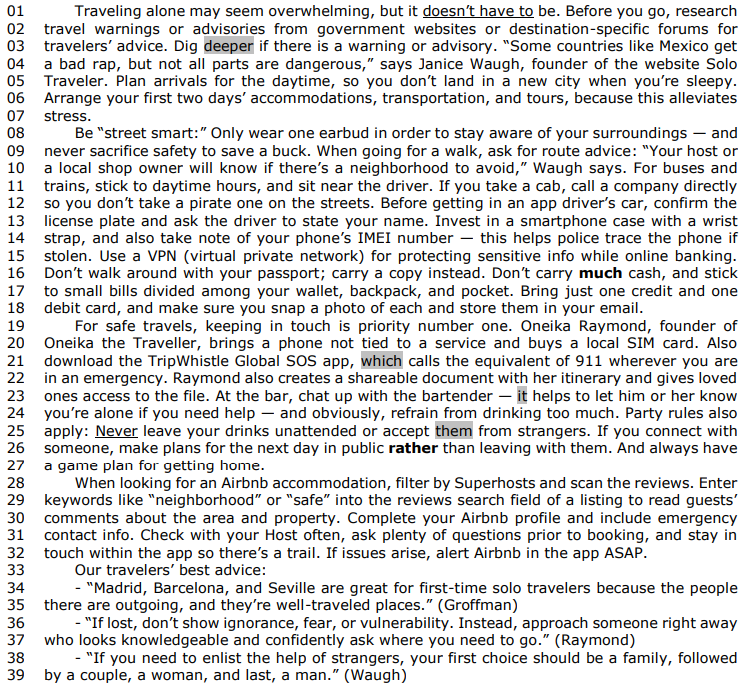
In which of the following sentences is the adjective NOT used with the same comparative structure as the highlighted word “deeper” (l. 03)?
Alternativas
Q2209852 Inglês


Try these expert tips for a safer solo trip


(Available at: https://news.airbnb.com/try-these-expert-tips-for-a-safer-solo-trip/ – text especially adapted for this text).

In which of the sentences below the word “rather” is used with the same meaning as in line 26? 
Alternativas
Q2209851 Inglês


Try these expert tips for a safer solo trip


(Available at: https://news.airbnb.com/try-these-expert-tips-for-a-safer-solo-trip/ – text especially adapted for this text).

In line 01 the author says “Traveling alone may seem overwhelming, but it doesn’t have to be”. Considering the context presented in the article, the underlined structure expresses a (an): 
Alternativas
Q2209850 Inglês


Try these expert tips for a safer solo trip


(Available at: https://news.airbnb.com/try-these-expert-tips-for-a-safer-solo-trip/ – text especially adapted for this text).

Which of the sentences below shows the excerpt “If you connect with someone, make plans for the next day” (l. 25-26) correctly rewritten in the second conditional structure?
Alternativas
Respostas
3521: C
3522: C
3523: E
3524: C
3525: C
3526: E
3527: E
3528: C
3529: B
3530: A
3531: D
3532: B
3533: B
3534: C
3535: B
3536: D
3537: E
3538: C
3539: E
3540: C