Questões de Concurso
Comentadas sobre interpretação de texto | reading comprehension em inglês
Foram encontradas 8.877 questões


Humor is produced with the ability to place an everyday situation in the position for amusement or critical analysis. Humor
construction in the comic image is based on:

Available in: https://br.pinterest.com.)
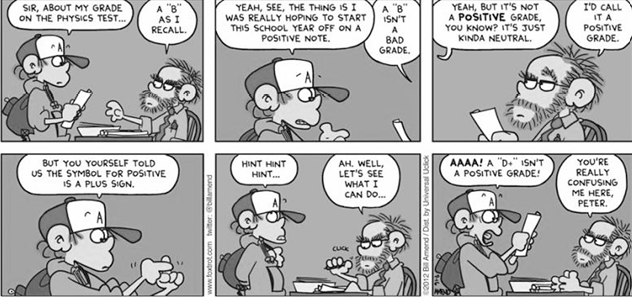
Bill Amend. Foxtrot. Internet: <https://www.gocomics.com/blog/> (adapted).
Judge the following items according to the previous comic strip.
The student is trying to get the teacher to change his grade to A.
Bill Amend. Foxtrot. Internet: <https://www.gocomics.com/blog/> (adapted).
Judge the following items according to the previous comic strip.
Despite his insistence, the student got the opposite result of
what he intended.
Bill Amend. Foxtrot. Internet: <https://www.gocomics.com/blog/> (adapted).
Judge the following items according to the previous comic strip.
Bill Amend. Foxtrot. Internet: <https://www.gocomics.com/blog/> (adapted).
Judge the following items according to the previous comic strip.
It is correct to infer from the comic strip that the teacher has taught mathematical symbols to this student’s class.
The Indian education sector has undergone a significant transformation in recent years, owing to the implementation of innovative technologies and solutions. According to a recent report, the e-learning market in India is estimated to have reached $ 1.96 billion in 2021, up from $ 247 million in 2016. The growth in popularity of mobile learning platforms among students has led to this expansion.
Mobile learning platforms are expected to play a significant role in the growth of the online education market in India. A report by a consultancy company projected that the online education market in India would reach $ 1.96 billion by 2021. Educational apps have seen tremendous success by offering interactive video lessons, quizzes, and personalized learning plans to help students succeed academically.
Personalized learning, tailoring teaching and learning to students’ needs, is also an important trend in the Indian education sector. In addition to technology, the Indian education sector has also witnessed the emergence of new pedagogical approaches such as experiential learning, project-based learning, and collaborative learning. These approaches focus on providing students with hands-on, practical learning experiences that prepare them for the real world.
With the continued adoption of these technologies and approaches, the future of education in India looks bright, offering students new opportunities to learn and grow.
Internet: <https://varthana.com/school> (adapted).
Based on the preceding text, judge the following item.
Based on the text, it is correct to affirm that online education
has proven to be an expanding market in India.
The Indian education sector has undergone a significant transformation in recent years, owing to the implementation of innovative technologies and solutions. According to a recent report, the e-learning market in India is estimated to have reached $ 1.96 billion in 2021, up from $ 247 million in 2016. The growth in popularity of mobile learning platforms among students has led to this expansion.
Mobile learning platforms are expected to play a significant role in the growth of the online education market in India. A report by a consultancy company projected that the online education market in India would reach $ 1.96 billion by 2021. Educational apps have seen tremendous success by offering interactive video lessons, quizzes, and personalized learning plans to help students succeed academically.
Personalized learning, tailoring teaching and learning to students’ needs, is also an important trend in the Indian education sector. In addition to technology, the Indian education sector has also witnessed the emergence of new pedagogical approaches such as experiential learning, project-based learning, and collaborative learning. These approaches focus on providing students with hands-on, practical learning experiences that prepare them for the real world.
With the continued adoption of these technologies and approaches, the future of education in India looks bright, offering students new opportunities to learn and grow.
Internet: <https://varthana.com/school> (adapted).
Based on the preceding text, judge the following item.
The growth of the e-learning market in India has led to the
increase of interest in mobile learning platforms.
According to the previous text, judge the following item.
Dispersing seeds is enough to avoid the issues related to the
process of becoming a completely developed tree.
According to the previous text, judge the following item.
The process put in place by FLS prepares the saplings to be
planted in permanent soil straight after their growth in the
vertical farms.
According to the previous text, judge the following item.
Even if the UK government’s re-forestation goal cannot be
reached, the prospect of renewed forested area is on the
horizon.
Julgue o item subsequente.
The construction of the school curriculum should be
reviewed annually, but once it is established in the school
planning for a year, it cannot be changed.
Julgue o item subsequente.
The Federal Constitution ensures that it is a State duty to
provide access to higher levels of education, research and
arts to students according to each person's capacity.
Julgue o item subsequente.
When reading an illustrated text, a comic strip for
example, there is more to analyze than the verbal
communication as usually the non-verbal communication
is often present and is relevant to the complete
understanding of the message in this type ot text.
Julgue o item subsequente.
Carl Rogers believed that all human beings have an innate
tendency to seek self-realization and personal growth.
This tendency is the motivating force that drives people
toward their maximum potential.
Julgue o item subsequente.
According to Vygotsky's Learning Theory, for learning to
occur, social interaction must take place within the zone
of proximal development, which is the gap between what
the individual already knows, their actual knowledge, and
what the individual has the potential to learn.
Julgue o item subsequente.
It is a rule that adverbial clauses must start with a
subordinating conjunction and connect to an independent
clause in means to make sense.
Julgue o item subsequente.
The social role of school, in addition to providing quality
formal education equally to students is to also be a place
for cultural development, allowing the exposition to the
plurality of ideas, cultures and perspectives to strengthen
them to living on a plural society.
Julgue o item subsequente.
In the sentence: "The children got to play all day, and that
made them happy", the comma provides no change to the
meaning of the phrase.
Julgue o item subsequente.
In Graciliano Ramos work the enviroment usually is really
important to the soty, but the interest is directly focused
on human behavior, attitudes, and conduct, and the
description of the landscape arises from the
psychological characterization of the characters.

 Conheça nossos planos