Questões de Concurso
Comentadas sobre artigos | articles em inglês
Foram encontradas 403 questões
The ___ is the last paragraph of this test's text.
We must use reading strategies ____ text we face.
Bottom-up and top-down are ____ cognitive strategies.
In the utterance "
…) and self-evaluation of learning after the language activity is completed", takenfrom the 2nd paragraph of the text, the underlined word functions as a ____.
In the utterance " (...readers check to see how this information fits ...)", taken from the 5th paragraph of the text, the underlined word can be replaced by ____.
The subject of "if enacted" (l.13) is:
heavily in "when it rains heavily" indicates:
The verb form in "are being taken" is in the same form as in:
The underlined word in " their choice" (l. 11) refers to:
In the title, the verb makes a reference to something that:
The title of this text introduces a:
as much as in "a curse as much as a blessing" signals a:
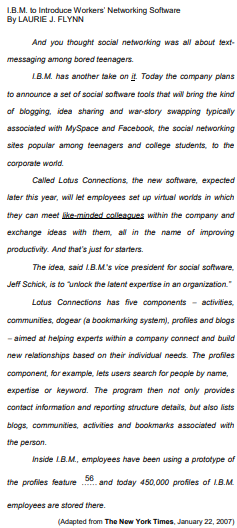
O pronome it, sublinhado no texto, refere-se a
Google as well as Yahoo, Microsoft and AOL among
others are gearing up to keep a much closer eye on all of us,
so that within five years these and other firms will routinely
track our movements, friends, interests, purchases and
5 correspondence – then make money by helping marketers
take advantage of the information.
These companies' brash plans are pushing us toward a
thorny choice that will determine the future of computing.
Google and other Web-oriented, information-service giants are
10 determined to build a breathtaking array of services based on
your personal information, and they're betting you'll be willing
to share it with them in order for you to reap the benefits. But
if we cooperate and let them in on the details of our lives, we'll
lose much of our privacy, and possibly a lot more.
15 A privacy backlash, however, would stifle these potentially
revolutionary services before they get off the ground – and
leave the computer industry's biggest plans for growth in
tatters. That may be just what some people want. The U.S.
Congress is considering four bills that would make it illegal to
20 collect and share information online or through cell phones
about people without clearer warning and permission. These
sorts of restrictions are already in effect throughout much of
Europe, thanks in part to European Union directives on privacy
and electronic communications passed in 2002 and 2003.
25 The good news is that there's no reason to choose
between technology and privacy. New technologies are
emerging that can doctor our data so that companies know
just enough about us to ply us with customized services, while
preventing them from getting a clear picture of our private
lives. The question is again one of trust: in this case, whether
people will come to trust the companies that are trying to build
these new technologies.
(abridged from Next Frontiers in Newsweek, April 3, 2006)
Complete the following passage with the right prepositions in the right order:
Some 25 million surveillance cameras are already _____ place _____ stores and public spaces in the U.S. alone, and new ones are coming online _____ the rate of 2 million a year. _____ fact it's difficult to walk down the street without being photographed _____ several different angles.
(adapted from Next Frontiers in Newsweek, April3, 2006)
Google as well as Yahoo, Microsoft and AOL among
others are gearing up to keep a much closer eye on all of us,
so that within five years these and other firms will routinely
track our movements, friends, interests, purchases and
5 correspondence – then make money by helping marketers
take advantage of the information.
These companies' brash plans are pushing us toward a
thorny choice that will determine the future of computing.
Google and other Web-oriented, information-service giants are
10 determined to build a breathtaking array of services based on
your personal information, and they're betting you'll be willing
to share it with them in order for you to reap the benefits. But
if we cooperate and let them in on the details of our lives, we'll
lose much of our privacy, and possibly a lot more.
15 A privacy backlash, however, would stifle these potentially
revolutionary services before they get off the ground – and
leave the computer industry's biggest plans for growth in
tatters. That may be just what some people want. The U.S.
Congress is considering four bills that would make it illegal to
20 collect and share information online or through cell phones
about people without clearer warning and permission. These
sorts of restrictions are already in effect throughout much of
Europe, thanks in part to European Union directives on privacy
and electronic communications passed in 2002 and 2003.
25 The good news is that there's no reason to choose
between technology and privacy. New technologies are
emerging that can doctor our data so that companies know
just enough about us to ply us with customized services, while
preventing them from getting a clear picture of our private
lives. The question is again one of trust: in this case, whether
people will come to trust the companies that are trying to build
these new technologies.
(abridged from Next Frontiers in Newsweek, April 3, 2006)
Mark the one item which contains the best passive alternative for we'll lose much of our privacy (lines 13-14):
Look at some verbs which describe changes in a market and choose the right alternative for their 'past' and 'past participle' forms.
Increase rise fall

Complete the sentence with one of the words below.
Instead of .................. them orders from above, your administration should support them and try to make their life easier.
Instruções: Considere o texto a seguir para responder às questões de números 37 a 44.
After nearly a decade of trying, Wal-Mart never cracked the country – failing to become the all-in-one shopping destination for Germans that it is for so many millions of Americans. Wal-Mart's problems are not limited to Germany. The retail giant has struggled in countries like South Korea and Japan as it discovered that its formula for success – low prices, zealous inventory control and a large array of merchandise – did not translate to markets with their own discount chains and shoppers with different habits.
Some of Wal-Mart's problems stem from being a uniquely powerful American enterprise trying to impose its values around the world. At Wal-Mart's headquarters in Bentonville, Ark., however, the message from these missteps is now registering loud and clear.
Among other things, Wal-Mart now cares (37) whether its foreign stores carry the name derived from its founder, Sam Walton, as the German Wal-Marts do. Seventy percent of WalMart's international sales come from outlets with names like Asda in Britain, Seiyu in Japan or Bompreço in Brazil. Far from being chastened by its setbacks, Wal-Mart is forging ahead with an aggressive program of foreign acquisitions. In a single week last fall, Wal-Mart completed the purchase of the Sonae chain in Brazil, bought a controlling stake in Seiyu of Japan, and became a partner in the Carcho chain in Central America.
Starting from scratch 14 years ago, Wal-Mart International [TO GROW] into a $63 billion business. It is the fastest-growing part of Wal-Mart, with nearly 30 percent sales growth in June, compared with the same month last year. Even subtracting one-time gains from acquisitions, it grew at nearly 12 percent, about double the rate of Wal-Mart's American stores.
Sustaining that pace is critical for Wal-Mart, because high fuel prices have helped sap the buying power of Americans. In June, store traffic in its home market declined. Wal-Mart estimated that its sales in the United States in stores open at least one year would increase only 1 percent to 3 percent in July.
Another problem that has afflicted Wal-Mart in several countries is its inability to compete with established discounters. The obvious lesson is to try to bulk up. In Brazil, Wal-Mart opened only 25 stores in its first decade there and struggled to compete against bigger local rivals. Then, in 2004, it bought Bompreço, giving it a presence in the country's poor, but fastgrowing, northeast.
Wal-Mart did not change the names of the stores, which range from neighborhood grocers to large American-style hypermarkets. But with 295 stores in Brazil, Wal-Mart now ranks third in the market, after Carrefour of France and the market leader, Companhia Brasileira de Distribução.
(Adapted from an article by Mark Landler and Michael Barbaro published in the New York Times, August 2, 2006)
No 1º parágrafo, a palavra country, sublinhada no texto, refere-se
Instruções: Considere o texto a seguir para responder às questões de números 37 a 44.
After nearly a decade of trying, Wal-Mart never cracked the country – failing to become the all-in-one shopping destination for Germans that it is for so many millions of Americans. Wal-Mart's problems are not limited to Germany. The retail giant has struggled in countries like South Korea and Japan as it discovered that its formula for success – low prices, zealous inventory control and a large array of merchandise – did not translate to markets with their own discount chains and shoppers with different habits.
Some of Wal-Mart's problems stem from being a uniquely powerful American enterprise trying to impose its values around the world. At Wal-Mart's headquarters in Bentonville, Ark., however, the message from these missteps is now registering loud and clear.
Among other things, Wal-Mart now cares (37) whether its foreign stores carry the name derived from its founder, Sam Walton, as the German Wal-Marts do. Seventy percent of WalMart's international sales come from outlets with names like Asda in Britain, Seiyu in Japan or Bompreço in Brazil. Far from being chastened by its setbacks, Wal-Mart is forging ahead with an aggressive program of foreign acquisitions. In a single week last fall, Wal-Mart completed the purchase of the Sonae chain in Brazil, bought a controlling stake in Seiyu of Japan, and became a partner in the Carcho chain in Central America.
Starting from scratch 14 years ago, Wal-Mart International [TO GROW] into a $63 billion business. It is the fastest-growing part of Wal-Mart, with nearly 30 percent sales growth in June, compared with the same month last year. Even subtracting one-time gains from acquisitions, it grew at nearly 12 percent, about double the rate of Wal-Mart's American stores.
Sustaining that pace is critical for Wal-Mart, because high fuel prices have helped sap the buying power of Americans. In June, store traffic in its home market declined. Wal-Mart estimated that its sales in the United States in stores open at least one year would increase only 1 percent to 3 percent in July.
Another problem that has afflicted Wal-Mart in several countries is its inability to compete with established discounters. The obvious lesson is to try to bulk up. In Brazil, Wal-Mart opened only 25 stores in its first decade there and struggled to compete against bigger local rivals. Then, in 2004, it bought Bompreço, giving it a presence in the country's poor, but fastgrowing, northeast.
Wal-Mart did not change the names of the stores, which range from neighborhood grocers to large American-style hypermarkets. But with 295 stores in Brazil, Wal-Mart now ranks third in the market, after Carrefour of France and the market leader, Companhia Brasileira de Distribução.
(Adapted from an article by Mark Landler and Michael Barbaro published in the New York Times, August 2, 2006)
A forma correta de [TO GROW], no 4º parágrafo, é
