Questões de Concurso
Comentadas sobre advérbios de: lugar, modo, tempo e freqüência | adverbs of: place, manner, time and frequency em inglês
Foram encontradas 98 questões


Based on the text, judge the following item.
The word “likely” (line 13) expresses probability.
Based on the text, judge the following item.
The adverb Actually cannot be used instead of “As a matter of fact” (line 7).

Based on the text, judge the following items.
“rarely” (line 20) means seldom.
Based on the text, judge the following items.
The adverb “often” as in “these food fads are often
based” (line 18) is more commonly placed before the
verb to be.

Based on the text, judge the following items.
“all day” (line 8) has the same meaning as every day.
Based on TEXT 2, a fictional blog, answer question
TEXT 2
I do realize that in the world of technology there are early and late adopters. I’m not the earliest of cutting-edge early TESL adopters, but I do like to try out new technology and incorporate it into my teaching. This list is a handful of technologies that are established enough not to be too problematic, user-friendly enough that just about anyone can start using them quickly, and useful enough that you’ll soon wonder how you got along without them. In short, this is a list of tech that just about everyone can (and maybe even should) be using in 2010.
1. Wikipedia – It has become popular to question its accuracy. Wikipedia has become a real knowledge bank on the internet. Once we figure out what it is (a compilation of all referenced knowledge) many of these criticisms fall down. Access to all this information means a reorganization of learning.
2. Google – No, I don’t just mean search, but all the other stuff: maps, docs, calendar, etc. It’s never been so easy to collaborate with other people.
3. Twitter – A year ago, I taught a course through Twitter with mixed results. This microblog is almost exclusively interactive, but my ESL students found it tough to collaborate within Twitter because of its constraints on length. The email by contrast, is very simple – it is equally interactive but it is constraint free. So, you should use it and you should see interesting results !
Can you learn the language by using the above alone? Of course not! But they are a good springboard and I hope they lead you to discover all other media available out there (ebooks, blogs, YouTube videos, music, movies, etc.).
More web in the pipeline. Please post a comment.
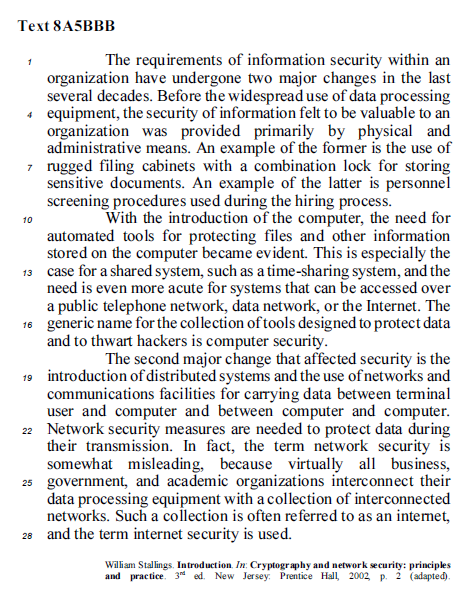
In text 8A5BBB, the word “often” ( .27) can be correctly replaced
by
.27) can be correctly replaced
by

Mining tourism in Ouro Preto
Ouro Preto is surrounded by a rich and varied natural environment with waterfalls, hiking trails and native vegetation partially protected as state parks. Parts of these resources are used for tourism. Paradoxically, this ecosystem contrasts with the human occupation of the region that produced, after centuries, a rich history and a cultural connection to mining, its oldest economic activity which triggered occupation. The region has an unlimited potential for tourism, especially in specific segments such as mining heritage tourism, in association or not with the existing ecotourism market. In fact, in Ouro Preto, tourism, history, geology and mining are often hard to distinguish; such is the inter-relationship between these segments.
For centuries, a major problem of mining has been the reuse of the affected areas. Modern mining projects proposed solutions to this problem right from the initial stages of operation, which did not happen until recently. As a result, most quarries and other old mining areas that do not have an appropriate destination represent serious environmental problems. Mining tourism utilizing exhausted mines is a source of employment and income. Tourism activities may even contribute to the recovery of degraded areas in various ways, such as reforestation for leisure purposes, or their transformation into history museums where aspects of local mining are interpreted.
Minas Gerais, and particularly Ouro Preto, provides the strong and rich cultural and historical content needed for the transformation of mining remnants into attractive tourism products, especially when combined with the existing cultural tourism of the region. Although mining tourism is explored in various parts of the world in extremely different social, economic, cultural and natural contexts, in Brazil it is still not a strategy readily adopted as an alternative for areas affected by mining activities.
(Lohmann, G. M.; Flecha, A. C.; Knupp, M. E. C. G.; Liccardo, A. (2011). Mining tourism in Ouro Preto, Brazil: opportunities and challenges. In: M. V. Conlin; L. Jolliffe (eds).Mining heritage and tourism: a global synthesis. New York: Routledge, pp. 194-202.)
By Jonathan Mahler Sep 27, 2013
So Spain has decided to haul Lionel Messi into court for tax evasion, which strikes me as completely insane on pretty much every level.
You may remember the story from a few months back: The greatest soccer player in the world and his father were accused of setting up
a bunch of shell companies in Belize and Uruguay to avoid paying taxes on royalties and other licensing income.
Messi - who makes an estimated $41 million a year, about half from sponsors - reached a settlement with Spain’s tax authorities earlier
this summer, agreeing to pay the amount he apparently owed, plus interest. The matter was settled, or so it seemed. Messi could go
back to dazzling the world with his athleticism and creativity.
Only it turns out that Spain wasn’t quite done with Messi. His adopted country - Messi is Argentine but became a Spanish citizen in 2005
- is now considering pressing criminal charges against him.
Cracking down on tax-evading footballers has become something of a trend in Europe, where players and clubs have been known to
launder money through “image-rights companies” often set up in tax havens. When you need money - and Europe needs money - go to
the people who have it, or something like that. Over the summer, dozens of Italian soccer clubs were raided as part of an investigation
into a tax-fraud conspiracy. A number of English Premier League clubs were forced last year to pay millions of pounds in back taxes.
No one likes a tax cheat, and there’s little doubt that widespread tax fraud has helped eat away at the social safety net in Spain and
elsewhere, depriving schools, hospitals and other institutions of badly needed funds. But Europe is not going to find the answers to its
financial problems in the pockets of some professional soccer players and clubs.
Messi’s defense, delivered by his father, seems credible enough to me. “He is a footballer and that’s it,” Messi’s father Jorge said of his
soccer-prodigy son. “If there was an error, it was by our financial adviser. He created the company. My mistake was to have trusted the
adviser.” Even if Messi is legally responsible for the intricate tax dodge he is accused of having participated in, it’s pretty hard to believe
that he knew much about it.
More to the point, Lionel Messi is probably Spain’s most valuable global asset. What could possibly motivate the Spanish government to
want to tarnish his reputation, especially after he’s paid off his alleged debt? After four years of Great-Depression level unemployment,
have anxiety and despair curdled into vindictiveness?
Here’s another explanation: Maybe this whole case has less to do with money than it does with history. Maybe it’s no coincidence that
the target of the Spanish government’s weird wrath happens to play for FC Barcelona, which is, after all, "mes que un club." It's a symbol
of Catalan nationalism - and a bitter, longtime rival of Spain’s establishment team, Real Madrid.
Too conspiratorial? Prove it, Spain. Release Cristiano Ronaldo’s tax return.
(Adapted form http://www.bloomberg.com/news/2013-09-27/why-is-spain-really-taking-lionel-messi-to-tax-court-.html)


They _________________ walk along the stream. They frequently do that.
Oil is the largest source of liquid fuel and, in spite of attempts to develop synthetic fuels, world consumption of oil
products in increasing.
The oil industry is not much more than a hundred years old. It began when the first oil well was drilled in 1859. In the
early days, oil was used to light houses because there was no electricity and gas was very scarce. Later, people began to use oil
for heating too.
Most industries use machinery to make things. Every machine needs oil in order to run easily. Even a small clock or watch
needs a little oil from time to time.
The engines of many machines use oil fuels petrol, kerosene or diesel. Cars, buses, trucks, tractors, and small aircraft use
petroleum chemicals: synthetic rubber, plastics, synthetic fiber materials for clothes and for the home, paints, materials which
help to stop rust, photographic materials, soap and cleaning materials (detergents), drugs, fertilizers for farms and gardens, food
containers, and may others.
In 1900 the world’s oil production was less than 2 million tons a year. Today the oil industry is one of the world’s largest
and most important suppliers of raw materials.

In the fragment “All the problems of the now are forever shaped by the experiences of a then” (l.18-19), the words “now” and “then” can be replaced respectively by here and there without effecting changes in the meaning and the grammatical correction of the passage.


Posted on Friday March 27th, 2009 by Jebediah Reed
To give some sense of the pace of public works
construction in China, the city of Guangzhou is planning to open
83 miles of new subway lines by the end of next year.
Meanwhile, New York ? a city of about the same size ? has
been playing around with the 1.7-mile Second Avenue line for
decades now. China also builds subways rather cheaply ? $100
million per mile versus $ 2.4 billion per mile in the Big Apple.
Not surprisingly, projects there are more aggressive in all
respects: there are 60 tunnel boring machines operating in
Guangzhou, while only one is slated for the Second Avenue
project; workers put in five 12-hour shifts a week (and if they
don't like it, they can go pound glacial till); and seizing property
is a breeze.
An article in the Business section of today's NY Times
(Clash of Subways and Car Culture in Chinese Cities by Keith
Bradsher) [VERB] a smart look at the forces at play as China
goes on a transit infrastructure spending spree while it
simultaneously becomes evermore sprawling and car-centric.
Here's one interesting passage, [CONJUNCTION] the
story is worth reading in its entirety:
Western mass transit experts applaud China for investing
billions in systems that will put less stress on the environment
and on cities. But they warn that other Chinese policies, like
allowing real estate developers to build sprawling new suburbs,
undermine the benefits of the mass transit boom.
Mr. Chan Shao Zhang , a 67-year-old engineer in charge
of the works in Guangzhou, defended Guangzhou's combination
of cars and subways, saying that the city built a subway line to a new Toyota assembly plant to help employees and suppliers
reach it.
Subways have been most competitive in cities like New
York that have high prices for parking, and tolls for bridges and
tunnels, discouraging car use. Few Chinese cities have been
willing to follow suit, other than Shanghai, which charges a fee of
several thousand dollars for each license plate.
The cost and physical limitations of subways have
discouraged most cities from building new ones. For instance,
only Tokyo has a subway system that carries more people than
its buses. The buses are cheaper and able to serve far more
streets but move more slowly, pollute more and contribute to
traffic congestion.
China has reason to worry. It surpassed the United
States in total vehicle sales for the first time in January, although
the United States remained slightly ahead in car sales. But in
February, China overtook the United States in both, in part
because the global downturn has hurt auto sales much more in
the United States than in China.
There are many countervaling forces ..X.. China has
passed its own stimulus package and the government is eager
to put people to work, create economic activity, and build
modern infrastructure. The Guangzhou project is part of major
national transit buildout. But the nation's cities are also sprawling
beasts, and in that sense, more suited to cars than trains. Not
shockingly, many Chinese prefer the former.
(Adapted from http://www.infrastructurist.com/2009/03/27/-
building-a-subway-is-96-percent-cheaper-in-china/)

 Conheça nossos planos