Questões de Concurso
Comentadas sobre adjetivos | adjectives em inglês
Foram encontradas 601 questões


Text 2 – Computers
(Text adapted from History of Computing. Retrieved from
https://www.cs.utexas.edu/~mitra/csFall2006/cs 303/lectures/history.html)
When you hear the term computers, it’s difficult to
imagine different devices from a laptop or a small
desktop. Believe it or not, they weren’t always like
they are today. They used to be very large and
heavy, sometimes as big as an entire room. Some
technology professors historically define computers,
as “a device that can help with computations”. The
word computation involves counting, calculating,
adding, subtracting, etc. The modern definition of a
computer is a little wider, because in our day and
age, computers store, compile, analyze and
compute an enormous amount of information.
Ancient computers were very interesting. Actually,
the first computer may have been located in Great
Britain, at Stonehenge. It is a man-made circle of
large stones. Citizens used it to measure the
weather and forecast the change of seasons. Some
specialists say that another ancient computer is the
abacus. It was used by the early Romans, Greeks,
and Egyptians to count and calculate. Even though
they are no longer in use, certainly, these early
devices are fascinating. Computers are embedded
in our history and some people say that we are
completely dependent of them. No matter the
complexity of the task, easy or difficult, some people
can’t do anything without them. Do you contest or
share this opinion?
I. Adjective, as in “His wife is a charming person!”. II. Noun, as in “The building is near the old market”. III. Verb, as in “Paul is developing a new product”.
I. The process of learning how to read, achieving knowledge of the word. II. The objective of this approach was not to reproduce “banking” education. III. The challenging circumstances (…) of the Brazilian Northeast Region. IV. Exiled during the military dictatorship in Brazil.
The following text refers to question
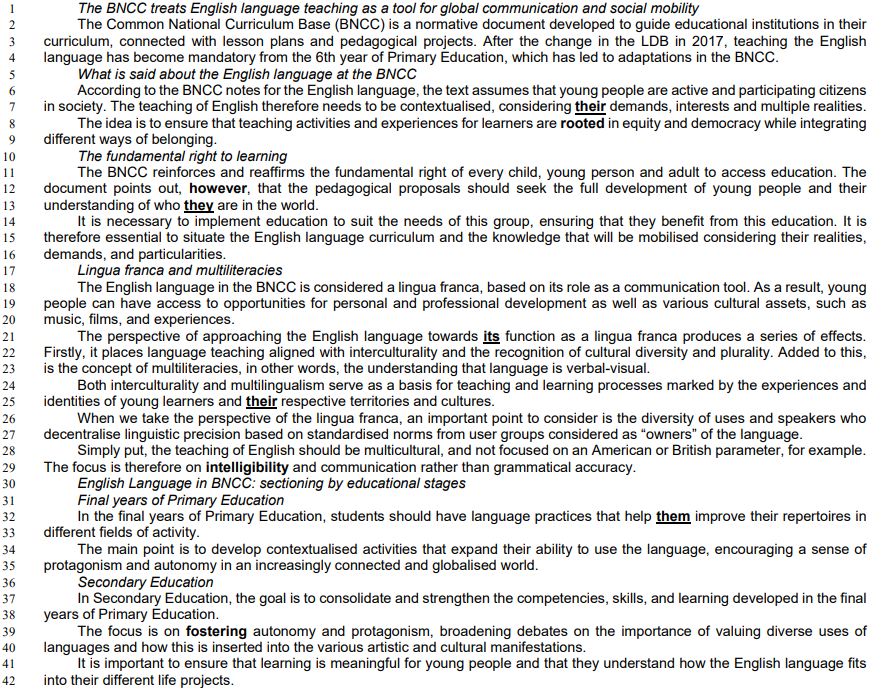
Disponível em: https://www.inglesnasescolas.org/en/headline/english-language-in-bncc/. Adaptado.
Mark the alternative that presents the comparative form of the adjectives below:
busy – cold – difficult – fat
1. Our high turnover rate has been a growing _______ for us. 2. A rose in full bloom had been allowed to grow _______ one of the walls. 3. The company is growing _______ all the time. 4. Opposition to the latest proposals is growing _______ . 5. The Catholic community in Edinburgh began to grow _______ in the mid-19th Century.
( ) considerably ( ) steadily ( ) concern ( ) bigger ( ) unchecked up
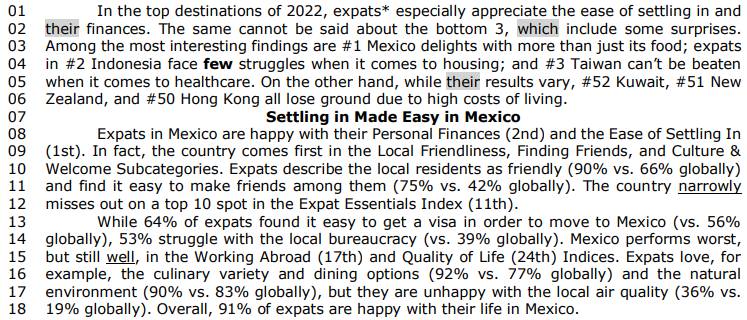
I. The excerpt contains both a comparative and a superlative structure. II. To convey the opposite meaning, it would be grammatically correct to replace the superlative structure with “the less interesting” or “the more boring”. III. The word “its” is a possessive adjective. IV. There would be no significative changes in meaning if the word “among” were replaced by “between” because they are always interchangeable.
Which statements are correct?
Julgue o item subsequente.
Julgue o item subsequente.
Julgue o item subsequente.
Julgue o item subsequente.
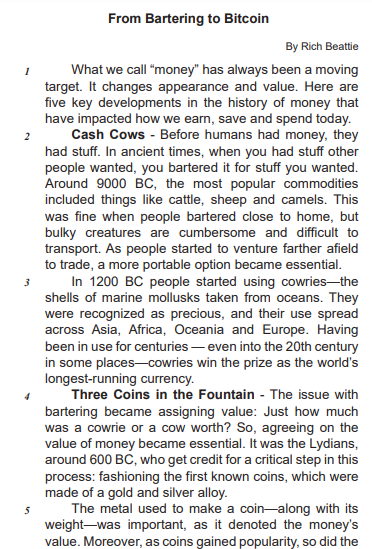
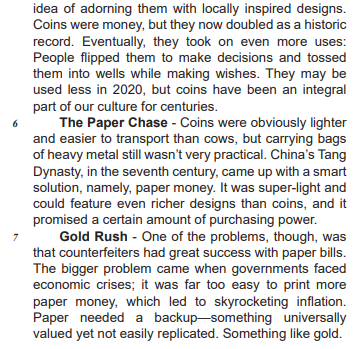
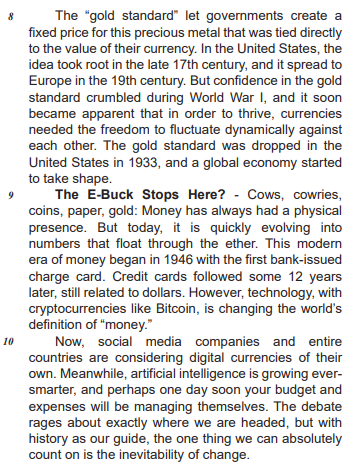
Available at: https://www.synchronybank.com/blog/brief-history-of-money/. Retrieved on: Sept 10, 2022. Adapted.
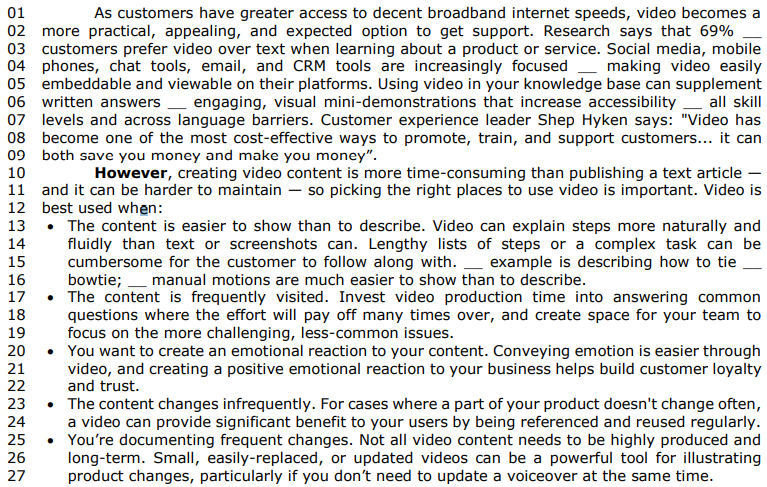
“As customers have greater access to decent broadband internet speeds, video becomes a more practical, appealing, and expected option to get support” (l. 01-02).
The underlined words represent comparative structures. Mark the option below that shows the correct superlative forms of these adjectives, in the order they are presented in the text:
“One of these is the world’s largest land predator, the polar bear.”
Study the affirmatives below:
1. ‘these’ is a relative pronoun. 2. ‘largest’ is the comparative of superiority form of the adjective ‘ large’. 3. ‘world’s’ means ‘world is’. 4. ‘largest’ is the superlative of superiority form of the adjective ‘ large’. 5. ‘these’ is a demonstrative pronoun.
Choose the alternative which contains all the correct affirmatives.
1. The underlined words in the sentence “This long, pointed stick was first used as a weapon…” is an example of active voice in the past tense.
2. The words in bold “they” and “their”, in the text, are being used as a personal pronoun and a possessive adjective, respectively.
3. The negative form of the following sentence: “Do exercises for your arms, legs, back, and neck…” is “Don’t exercise your arms, legs, back, and neck…”.
4. The word ‘properly’ in “it’s important to warm up properly before practicing the javelin.” is an adverb that means correctly or satisfactorily.
Choose the alternative which contains the correct sentences.

 Conheça nossos planos