Questões de Vestibular
Comentadas
Foram encontradas 36.667 questões
Resolva questões gratuitamente!
Junte-se a mais de 4 milhões de concurseiros!


Texto 3
The lessons Italy has learned about its COVID-19 outbreak could help the rest of the world
Only carefully conducted epidemiological studies will bring to light exactly how and why COVID-19 took off in northern Italy with such speed. But in the midst of the emergency, experts say there are already lessons to be gleaned from Italy's fatal errors — and urgent messages for other parts of the world.
"The biggest mistake we made was to admit patients infected with COVID-19 into hospitals throughout the region," said Carlo Borghetti, the vice- premier of Lombardy, an economically crucial region with a population of 10 million.
"We should have immediately set up separate structures exclusively for people sick with coronavirus. I recommend the rest of the world do this, to not send COVID patients into health-care facilities that are still uninfected."
Already, Italian cities in other regions are doing this, as well as field hospitals in Milan and Bergamo, Lombardy, which are almost complete.
However, the virus was not only spread to "clean" — i.e. infection-free — hospitals by admitting positive patients. In early March, as the number of infected was doubling every few days, authorities allowed overwhelmed hospitals to transfer those who tested positive but weren't gravely ill into assistedliving facilities for the elderly.
"It was like throwing a lit match onto a haystack," said Borghetti, who spoke out against the directive at the time. "Some facilities refused to take in the positive patients. For those that did [take them in], it was devastating."
Along with the tragic misstep of putting infected people under the same roof as clusters of the most physically vulnerable, Borghetti and others point to a deeper structural factor that accelerated the outbreak in northern Italy: a highly centralized health-care system with large hospitals as its focus.
From: shorturl.at/cMRTW. Accesses on 04/09/2020
Texto 3
The lessons Italy has learned about its COVID-19 outbreak could help the rest of the world
Only carefully conducted epidemiological studies will bring to light exactly how and why COVID-19 took off in northern Italy with such speed. But in the midst of the emergency, experts say there are already lessons to be gleaned from Italy's fatal errors — and urgent messages for other parts of the world.
"The biggest mistake we made was to admit patients infected with COVID-19 into hospitals throughout the region," said Carlo Borghetti, the vice- premier of Lombardy, an economically crucial region with a population of 10 million.
"We should have immediately set up separate structures exclusively for people sick with coronavirus. I recommend the rest of the world do this, to not send COVID patients into health-care facilities that are still uninfected."
Already, Italian cities in other regions are doing this, as well as field hospitals in Milan and Bergamo, Lombardy, which are almost complete.
However, the virus was not only spread to "clean" — i.e. infection-free — hospitals by admitting positive patients. In early March, as the number of infected was doubling every few days, authorities allowed overwhelmed hospitals to transfer those who tested positive but weren't gravely ill into assistedliving facilities for the elderly.
"It was like throwing a lit match onto a haystack," said Borghetti, who spoke out against the directive at the time. "Some facilities refused to take in the positive patients. For those that did [take them in], it was devastating."
Along with the tragic misstep of putting infected people under the same roof as clusters of the most physically vulnerable, Borghetti and others point to a deeper structural factor that accelerated the outbreak in northern Italy: a highly centralized health-care system with large hospitals as its focus.
From: shorturl.at/cMRTW. Accesses on 04/09/2020
Texto 3
The lessons Italy has learned about its COVID-19 outbreak could help the rest of the world
Only carefully conducted epidemiological studies will bring to light exactly how and why COVID-19 took off in northern Italy with such speed. But in the midst of the emergency, experts say there are already lessons to be gleaned from Italy's fatal errors — and urgent messages for other parts of the world.
"The biggest mistake we made was to admit patients infected with COVID-19 into hospitals throughout the region," said Carlo Borghetti, the vice- premier of Lombardy, an economically crucial region with a population of 10 million.
"We should have immediately set up separate structures exclusively for people sick with coronavirus. I recommend the rest of the world do this, to not send COVID patients into health-care facilities that are still uninfected."
Already, Italian cities in other regions are doing this, as well as field hospitals in Milan and Bergamo, Lombardy, which are almost complete.
However, the virus was not only spread to "clean" — i.e. infection-free — hospitals by admitting positive patients. In early March, as the number of infected was doubling every few days, authorities allowed overwhelmed hospitals to transfer those who tested positive but weren't gravely ill into assistedliving facilities for the elderly.
"It was like throwing a lit match onto a haystack," said Borghetti, who spoke out against the directive at the time. "Some facilities refused to take in the positive patients. For those that did [take them in], it was devastating."
Along with the tragic misstep of putting infected people under the same roof as clusters of the most physically vulnerable, Borghetti and others point to a deeper structural factor that accelerated the outbreak in northern Italy: a highly centralized health-care system with large hospitals as its focus.
From: shorturl.at/cMRTW. Accesses on 04/09/2020
Texto 2
Boris Johnson should have taken his own medicine - The British prime minister tested positive for Covid-19 and went into isolation, but not before doing untold damage and setting a bad example.

Boris Johnson, the prime minister of Britain, on Friday announced that he had tested positive for the coronavirus. In a brief video released on Twitter, he shared the basics: Having developed “mild symptoms — that’s to say, a temperature and a persistent cough” — he underwent testing and received the bad news. He will now be “selfisolating” until the illness has run its course.
Looking mostly healthy, if typically disheveled, Mr. Johnson stressed that he would continue to “lead the national fightback” from his home via teleconferencing. He urged the British public to abide by the three-week lockdown put into place on Monday.
The more effectively people stick with social distancing, the faster the nation and its National Health Service (N.H.S.) will “bounce back,” he said, before closing with the plea, “Stay at home, protect the N.H.S and save lives.” It was a responsible, no- drama message. If only the prime minister had displayed such leadership sooner, he — and who knows how many others — might have been spared this illness.
From: shorturl.at/dKV23. Accessed on 03/27/2020
Texto 2
Boris Johnson should have taken his own medicine - The British prime minister tested positive for Covid-19 and went into isolation, but not before doing untold damage and setting a bad example.
Boris Johnson, the prime minister of Britain, on Friday announced that he had tested positive for the coronavirus. In a brief video released on Twitter, he shared the basics: Having developed “mild symptoms — that’s to say, a temperature and a persistent cough” — he underwent testing and received the bad news. He will now be “selfisolating” until the illness has run its course.
Looking mostly healthy, if typically disheveled, Mr. Johnson stressed that he would continue to “lead the national fightback” from his home via teleconferencing. He urged the British public to abide by the three-week lockdown put into place on Monday.
The more effectively people stick with social distancing, the faster the nation and its National Health Service (N.H.S.) will “bounce back,” he said, before closing with the plea, “Stay at home, protect the N.H.S and save lives.” It was a responsible, no- drama message. If only the prime minister had displayed such leadership sooner, he — and who knows how many others — might have been spared this illness.
From: shorturl.at/dKV23. Accessed on 03/27/2020
Texto 2
Boris Johnson should have taken his own medicine - The British prime minister tested positive for Covid-19 and went into isolation, but not before doing untold damage and setting a bad example.
Boris Johnson, the prime minister of Britain, on Friday announced that he had tested positive for the coronavirus. In a brief video released on Twitter, he shared the basics: Having developed “mild symptoms — that’s to say, a temperature and a persistent cough” — he underwent testing and received the bad news. He will now be “selfisolating” until the illness has run its course.
Looking mostly healthy, if typically disheveled, Mr. Johnson stressed that he would continue to “lead the national fightback” from his home via teleconferencing. He urged the British public to abide by the three-week lockdown put into place on Monday.
The more effectively people stick with social distancing, the faster the nation and its National Health Service (N.H.S.) will “bounce back,” he said, before closing with the plea, “Stay at home, protect the N.H.S and save lives.” It was a responsible, no- drama message. If only the prime minister had displayed such leadership sooner, he — and who knows how many others — might have been spared this illness.
From: shorturl.at/dKV23. Accessed on 03/27/2020
Texto 2
Boris Johnson should have taken his own medicine - The British prime minister tested positive for Covid-19 and went into isolation, but not before doing untold damage and setting a bad example.
Boris Johnson, the prime minister of Britain, on Friday announced that he had tested positive for the coronavirus. In a brief video released on Twitter, he shared the basics: Having developed “mild symptoms — that’s to say, a temperature and a persistent cough” — he underwent testing and received the bad news. He will now be “selfisolating” until the illness has run its course.
Looking mostly healthy, if typically disheveled, Mr. Johnson stressed that he would continue to “lead the national fightback” from his home via teleconferencing. He urged the British public to abide by the three-week lockdown put into place on Monday.
The more effectively people stick with social distancing, the faster the nation and its National Health Service (N.H.S.) will “bounce back,” he said, before closing with the plea, “Stay at home, protect the N.H.S and save lives.” It was a responsible, no- drama message. If only the prime minister had displayed such leadership sooner, he — and who knows how many others — might have been spared this illness.
From: shorturl.at/dKV23. Accessed on 03/27/2020
Texto 1
Part of President Obama’s Speech at Rutgers Commencement 2016
Facts, evidence, reason, logic, an understanding of science — these are good things. These are qualities you want in people making policy. These are qualities you want to continue to cultivate in yourselves as citizens. That might seem obvious. That’s why we honor Bill Moyers or Dr. Burnell. We traditionally have valued those things. But if you were listening to today’s political debate, you might wonder where this strain of anti-intellectualism came from.
So, Class of 2016, let me be as clear as I can be. In politics and in life, ignorance is not a virtue. It’s not cool to not know what you’re talking about. That’s not keeping it real, or telling it like it is. That’s not challenging political correctness. That’s just not knowing what you’re talking about.
You know, it’s interesting that if we get sick, we actually want to make sure the doctors have gone to medical school, they know what they’re talking about. If we get on a plane, we say we really want a pilot to be able to pilot the plane. The rejection of facts, the rejection of reason and science — that is the path to decline.
From: shorturl.at/deAIX. Accessed on 04/01/2020
Texto 1
Part of President Obama’s Speech at Rutgers Commencement 2016
Facts, evidence, reason, logic, an understanding of science — these are good things. These are qualities you want in people making policy. These are qualities you want to continue to cultivate in yourselves as citizens. That might seem obvious. That’s why we honor Bill Moyers or Dr. Burnell. We traditionally have valued those things. But if you were listening to today’s political debate, you might wonder where this strain of anti-intellectualism came from.
So, Class of 2016, let me be as clear as I can be. In politics and in life, ignorance is not a virtue. It’s not cool to not know what you’re talking about. That’s not keeping it real, or telling it like it is. That’s not challenging political correctness. That’s just not knowing what you’re talking about.
You know, it’s interesting that if we get sick, we actually want to make sure the doctors have gone to medical school, they know what they’re talking about. If we get on a plane, we say we really want a pilot to be able to pilot the plane. The rejection of facts, the rejection of reason and science — that is the path to decline.
From: shorturl.at/deAIX. Accessed on 04/01/2020
Texto 1
Part of President Obama’s Speech at Rutgers Commencement 2016
Facts, evidence, reason, logic, an understanding of science — these are good things. These are qualities you want in people making policy. These are qualities you want to continue to cultivate in yourselves as citizens. That might seem obvious. That’s why we honor Bill Moyers or Dr. Burnell. We traditionally have valued those things. But if you were listening to today’s political debate, you might wonder where this strain of anti-intellectualism came from.
So, Class of 2016, let me be as clear as I can be. In politics and in life, ignorance is not a virtue. It’s not cool to not know what you’re talking about. That’s not keeping it real, or telling it like it is. That’s not challenging political correctness. That’s just not knowing what you’re talking about.
You know, it’s interesting that if we get sick, we actually want to make sure the doctors have gone to medical school, they know what they’re talking about. If we get on a plane, we say we really want a pilot to be able to pilot the plane. The rejection of facts, the rejection of reason and science — that is the path to decline.
From: shorturl.at/deAIX. Accessed on 04/01/2020
Somos todos juntos uma miscigenação E não podemos fugir da nossa etnia Índios, brancos, negros e mestiços Nada de errado em seus princípios O seu e o meu são iguais Corre nas veias sem parar
(SCIENCE, Chico. Etnia. Disponível em <https://www.letras.mus.br/chico-science/83236/>)

HIDALGO, Emilio Sanchéz. Barbie e Ken, chacota dos opositores aos antipetistas ricos. Disponível em <https://brasil.elpais.com/brasil/2018/10/23/politica/1540287712_846177.html>
Considere as afirmações a seguir e assinale a alternativa CORRETA:
1. O Romantismo Brasileiro, tendo como traço reconhecido o esforço de buscar uma fisionomia nacional que se distanciasse da literatura europeia, investiu no aportuguesamento da língua.
2. Nossos escritores românticos eram unânimes quanto ao reconhecimento da importância da contribuição de africanos e índios, como marca que nos diferenciava da literatura europeia.
3. Álvares de Azevedo negava a importância do
elemento indígena para a consolidação da
literatura nacional brasileira.
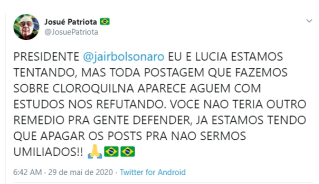
(@JosuePatriota, Instagram)
Leia o trecho a seguir e responda o que se pede:
“Negrinha abriu a boca, como o cuco, e fechou os olhos. A patroa então, com uma colher, tirou da água “pulando” o ovo e zás! na boca da pequena. E antes que o urro de dor saísse, prática que era D. Inácia nesse castigo, suas mãos amordaçaram-na até que o ovo arrefecesse. Negrinha urrou surdamente, pelo nariz. Esperneou. Mas só. Nem os vizinhos chegaram a perceber aquilo. Depois:
— Diga nomes feios aos mais velhos outra vez!! Ouviu, peste??”
(LOBATO, Monteiro. Negrinha. Disponível em <https://cs.ufgd.edu.br/download/Negrinha-de-Monteiro- Lobato.pdf>)
Assinale a alternativa que indica a classe
gramatical e o processo de formação da palavra
destacada:
Observe o quadrinho e assinale a alternativa CORRETA:

(@leandro_assis_ilustra, Instagram)
As terras sentidas de África nos ais chorosos do antigo e do novo escravo no suor aviltante do batuque impuro de outros mares sentidas As terras sentidas de África na sensação infame do perfume estonteante da flor esmagada na floresta pela imoralidade do ferro e do fogo as terras sentidas
(NETO, Agostinho. [Trecho de] As terras sentidas. Poemas. Disponível em < https://www.uccla.pt/sites/default/files/colectania_poemas_ag_neto.pdf>
Sobre o trecho do poeta e herói nacional angolano Agostinho Neto é CORRETO afirmar:
Leia o fragmento abaixo e assinale a resposta CORRETA:
“Existe um povo que a bandeira empresta
P'ra cobrir tanta infâmia e cobardia!...
E deixa-a transformar-se nessa festa
Em manto impuro de bacante fria!...
Meu Deus! meu Deus! mas que bandeira é esta,
Que impudente na gávea tripudia?
Silêncio. Musa... chora, e chora tanto
Que o pavilhão se lave no teu pranto! ...
Auriverde pendão de minha terra,
Que a brisa do Brasil beija e balança,
Estandarte que a luz do sol encerra
E as promessas divinas da esperança...
Tu que, da liberdade após a guerra,
Foste hasteado dos heróis na lança
Antes te houvessem roto na batalha,
Que servires a um povo de mortalha!...
(ALVES, Castro.[Trecho de] O navio negreiro.
Disponível em <http://www.dominiopublico.gov.br/download/texto/bv 000068.pdf>.)
“Os outros dois, que o Capitão teve nas naus, a que deu o que já disse, nunca mais aqui apareceram – do que tiro ser gente bestial, de pouco saber e por isso tão esquiva. Porém e com tudo isso andam muito bem curados e muito limpos. E naquilo me parece ainda mais que são como aves ou alimárias monteses, às quais faz o ar melhor pena e melhor cabelo que às mansas, porque os corpos seus são tão limpos, tão gordos e tão formosos, que não pode mais ser.
Isto me faz presumir que não têm casas nem moradas a que se acolham, e o ar, a que se criam, os faz tais. Nem nós ainda até agora vimos nenhuma casa ou maneira delas.” CAMINHA, Pero Vaz de. A Carta de Pero Vaz de Caminha. Disponível em <http://objdigital.bn.br/Acervo_Digital/livros_eletronic os/carta.pdf>)
No trecho citado, a atitude de Caminha revela PRINCIPALMENTE:
 Conheça nossos planos